

ProductPRODUCT
Featured products


Contact Us
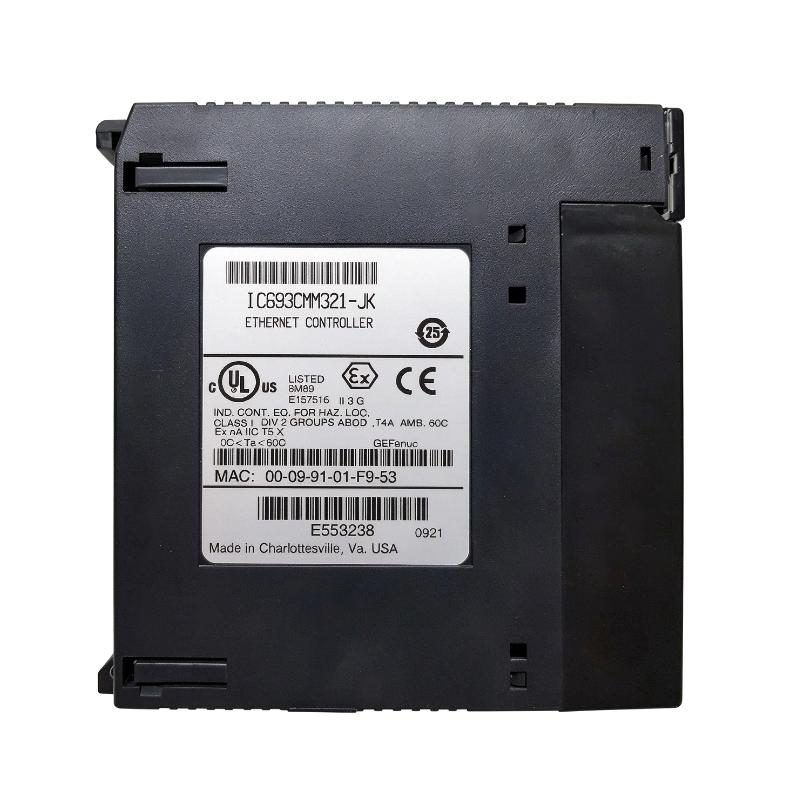
- GE
- IC693CMM321-JK
- Ethernet Interface Module
- USA
- 150 × 38 × 140 mm
- 0.45 kg
- Xiamen, China
- New & In Stock
- T/T, PayPal, Western Union
- 1 Year
- 1-3 Working Days
- DHL, UPS, TNT, FedEx and EMS.
- 24-Hour Service
- COO
- 6
Our advantage

Global Logistics
We have a 10-year logistics and express cooperation agreement, so our products can be shipped to any place in the world.

Brand new and original
Our products are imported in bulk from the place of origin. Because of the cooperative relationship, our products are all original and 100% new.

24-hour service
We provide 7*24 hours service to our customers. We will be there whenever you need us.

Price advantage
All our products are priced very favorably because we have our own warehouse and supply.
| Company Information | |||
| [email protected] | |||
| Mobile | +8615980777398 | ||
| +8615980777398 | |||
| 15980777398 |
Product Overview
The GE Fanuc IC693CMM321-JK Ethernet Interface Module is an industrial communication module designed for compatible GE Fanuc Series 90-30 programmable logic controller (PLC) systems. It enables a PLC to exchange data with computers, supervisory systems, and other compatible industrial control devices over an Ethernet network.
In industrial automation, communication between controllers and supervisory equipment is essential for monitoring production, collecting operating data, coordinating processes, and diagnosing equipment conditions. An Ethernet interface allows PLC data to be accessed by other devices without relying exclusively on local programming connections or hardwired signals.
The IC693CMM321-JK belongs to the IC693CMM321 family of TCP/IP Ethernet interface modules. Depending on the hardware and firmware revision, the module supports network communication functions used in Series 90-30 automation systems. Its capabilities include client and server communications, enabling compatible devices to exchange data through supported protocols and configured connections.
The module is installed in a compatible Series 90-30 PLC baseplate. Once configured, it can provide a communication path between the PLC and a host computer, another compatible controller, or a supervisory application. This makes it useful in existing manufacturing and process-control installations where maintaining established PLC communication infrastructure is important.
Because the IC693CMM321-JK is a revision-specific product, users should verify the complete catalog number and firmware version before purchasing or replacing the module. Network interfaces, supported features, and CPU compatibility can vary across hardware and software revisions.
Technical Specifications
| Parameter | Specification |
|---|---|
| Brand | GE Fanuc |
| Manufacturer / Product Family | GE Fanuc / Series 90-30 |
| Model | IC693CMM321-JK |
| Product Type | Ethernet Interface Module |
| Main Function | PLC Ethernet communication |
| Network Technology | Ethernet |
| Communication Stack | TCP/IP |
| PLC Platform | GE Fanuc Series 90-30 |
| Communication Role | Client and server, subject to firmware and configuration |
| Data Exchange | PLC, host computer, and compatible control devices |
| Installation | Compatible Series 90-30 baseplate |
| Configuration | Hardware and firmware revision dependent |
| Dimensions Provided | 150 × 38 × 140 mm |
| Weight Provided | 0.45 kg |
| Typical Applications | Factory automation, PLC networking, supervisory monitoring, and data acquisition |
Note: The dimensions and weight above are supplied listing values. Confirm the physical module and packaging details before using them for shipping or cabinet-design calculations. Port availability and supported communication functions should be verified against the exact hardware and firmware revision.
Function and Working Principle
The IC693CMM321-JK provides the communication interface required to connect a compatible Series 90-30 PLC to an Ethernet-based control network. It transfers data between the PLC and other devices according to the protocols, connection settings, and access methods supported by the installed version.
1. Ethernet Network Connectivity
The module allows a compatible PLC to communicate over an Ethernet network. This connection can provide access to controller data for monitoring, supervisory control, and data collection.
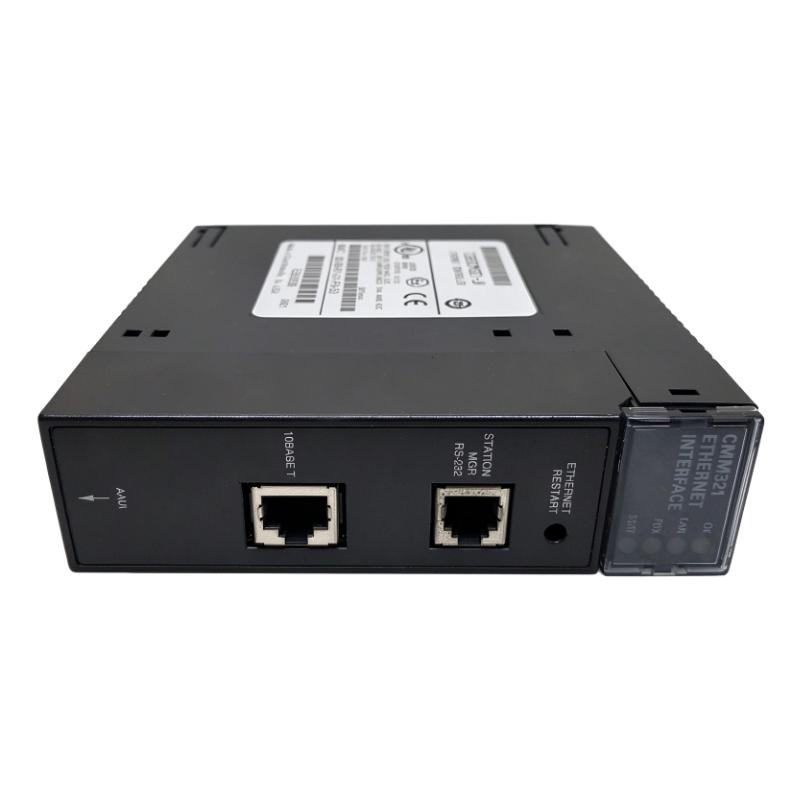
Depending on the hardware revision, the interface may use a direct Ethernet connection or a legacy transceiver-based connection. The physical ports and accessories must be checked before installation because not every IC693CMM321 revision has identical network-interface hardware.
2. TCP/IP Communication
TCP/IP provides the network communication foundation used by the module. Correct configuration of the IP address, network parameters, and supported services is necessary for devices to exchange data successfully.
Network settings should be coordinated with the site’s addressing plan. Duplicate IP addresses, incorrect subnet settings, or incompatible software configurations can prevent communication even when the module is physically installed correctly.
3. Client and Server Operations
The IC693CMM321 family supports client and server communication functions, subject to the firmware and system configuration.
In a client role, the PLC can initiate communication requests to compatible devices. In a server role, it can respond to supported requests from other devices. These functions allow PLC data to be exchanged with host applications and other controllers without requiring every communication task to be implemented through discrete wiring.
The exact available functions and connection limits depend on the installed firmware and the communication protocol being used.
4. PLC Data Exchange
The module can provide a path for exchanging controller information with supervisory computers and compatible automation equipment. Depending on the configured application, this information may include process values, equipment status, operating states, and diagnostic data.
Data access must be configured in the PLC program and the connected software. The Ethernet interface provides connectivity; it does not independently define the machine’s control logic or guarantee that every data point is accessible to every connected device.
5. Diagnostic and Maintenance Access
The IC693CMM321 family includes diagnostic indicators and a restart function. These features can assist maintenance personnel in checking module status and investigating communication problems.
Diagnostic procedures should follow the applicable hardware and firmware documentation. A restart should not be used as a substitute for identifying the underlying cause of repeated communication failures.
Role in Industrial Control Systems
The IC693CMM321-JK serves as a communication component within a PLC-based automation architecture. It connects compatible Series 90-30 controller equipment to an Ethernet network, allowing control data to be shared with other parts of the system.
PLC and Supervisory Computer Integration
A supervisory computer can collect information from the PLC for production monitoring, alarm handling, historical data collection, and operational reporting. The Ethernet interface provides the communication path, while the PLC program and supervisory software determine which information is exchanged.
This arrangement can help operators observe equipment status without connecting directly to every machine.
Integration with SCADA Systems
Supervisory Control and Data Acquisition (SCADA) systems commonly collect operating data from PLCs and present it through graphical interfaces. A compatible SCADA application may communicate with the Series 90-30 system through supported protocols and configured services.
Before implementation, engineers should verify the SCADA driver’s protocol support, the module firmware, and the CPU’s communication capabilities. A physical Ethernet connection alone does not establish application-level compatibility.
Communication Between Controllers
Industrial plants may use several PLCs to control separate production cells or machine sections. A supported network communication arrangement can enable controllers to exchange selected data for coordination.
The communication architecture should account for data-update requirements, network traffic, timeout handling, and the effect of communication loss on machine operation.
Maintenance and Troubleshooting
The Ethernet interface can assist maintenance teams by providing a network path for supported diagnostic and data-access functions. When communication fails, technicians can inspect module indicators, network cabling, addressing, firmware compatibility, and the configuration of the connected software.
Maintaining records of the installed catalog number, firmware version, IP configuration, and PLC program can reduce troubleshooting time.
Industrial Applications
1. Manufacturing Automation
In manufacturing facilities, Series 90-30 PLC systems may control conveyors, assembly stations, packaging equipment, and production machinery. The IC693CMM321-JK can provide network connectivity for compatible systems that need to share operational information with supervisory equipment.
2. Process Monitoring
Process-control applications often require operating values and equipment states to be collected from PLCs. With a compatible network configuration, the Ethernet interface can support data transfer to monitoring applications.
The actual information available depends on the PLC program and communication configuration.
3. Production Data Collection
Industrial computers may collect equipment status, production counts, and process information for reporting or analysis. The module can provide a communication path for this data when the connected software supports the applicable protocol.
Data integrity, update intervals, and communication-loss handling should be considered when designing the collection system.
4. Distributed Machine Control
A production line may contain multiple machines controlled by separate PLCs. Network communication can support the exchange of selected status information and production signals between compatible systems.
Engineers should avoid making critical machine-safety functions dependent solely on ordinary Ethernet communication. Safety-related functions must use appropriately designed and validated safety systems.
5. Legacy Automation System Maintenance
The IC693CMM321-JK may be relevant to maintenance projects involving existing GE Fanuc Series 90-30 installations. Retaining the established communication architecture can reduce the scope of changes required when replacing a failed module.
However, compatibility should be checked carefully because legacy network hardware, firmware restrictions, and connected software can affect replacement decisions.
Installation and System Integration
Correct installation and configuration are essential for stable communication between the PLC and the industrial network.
1. Verify Baseplate Compatibility
Confirm that the IC693CMM321-JK is compatible with the installed Series 90-30 baseplate and controller configuration. Check the CPU model, firmware version, module revision, and any applicable system restrictions before installation.
Do not assume that every Series 90-30 CPU supports every feature of every IC693CMM321 revision.
2. Inspect the Network Interface
Identify the actual network connector on the module before preparing cables or ordering accessories. Depending on the hardware revision, the connection may use an Ethernet port or a legacy transceiver interface.
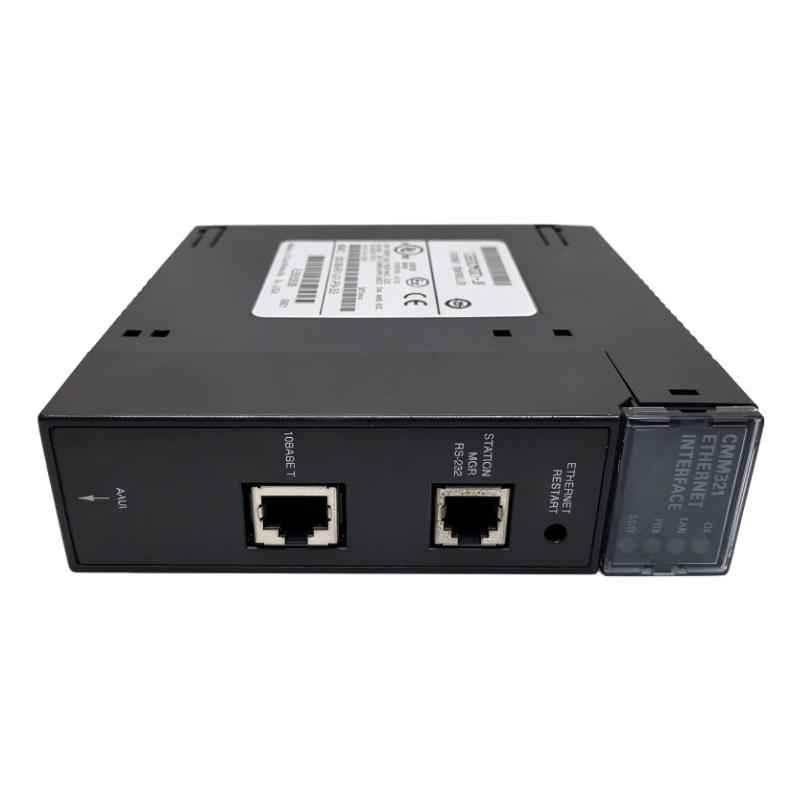
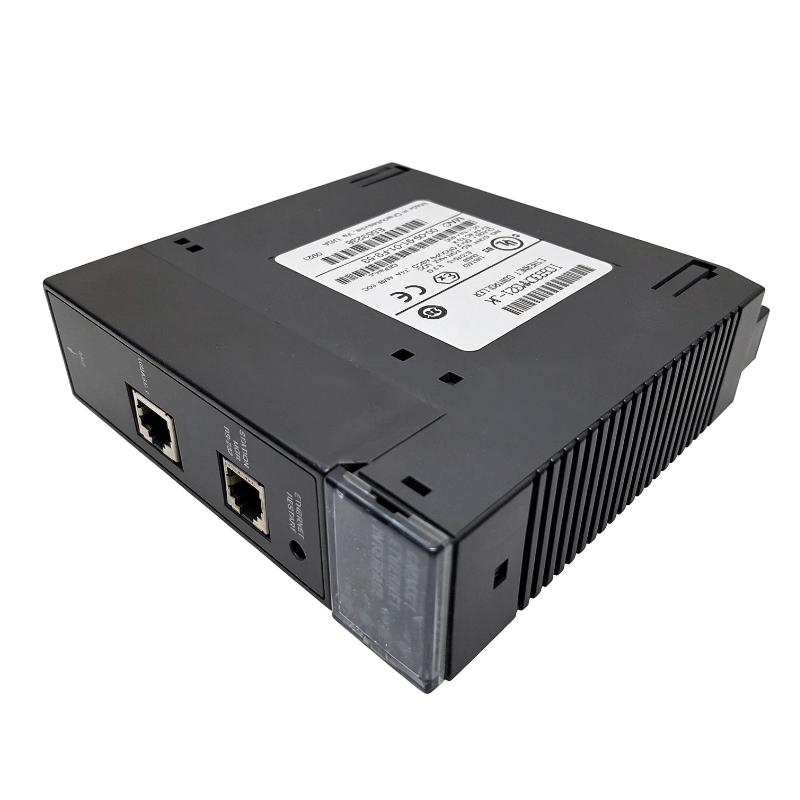
Some versions support a direct 10BASE-T connection, while older versions may require an external transceiver and compatible cable. Confirm the hardware revision rather than relying on the family name alone.
3. Configure Network Parameters
Assign the appropriate IP address and other required network settings according to the site’s network plan. Verify the subnet configuration and ensure that the address does not conflict with another device.
Where the system uses legacy configuration tools or firmware, confirm that the available engineering software supports the installed module.
4. Configure Communication Services
Configure the PLC and the connected application to use a supported communication method. Confirm the protocol, addressing, connection parameters, and data-access configuration.
If a host computer or SCADA application cannot communicate with the PLC, verify the software driver and firmware compatibility before replacing hardware.
5. Test Network Communication
After installation, inspect the module’s status indicators and verify the physical network connection. Confirm that the PLC and the intended host device can establish communication and exchange the required data.
Test normal operation, communication recovery, and behavior following a network interruption. Document the final configuration for future maintenance.
6. Follow Electrical and ESD Precautions
Before removing or installing the module, follow the PLC system’s approved procedures for isolation, module handling, and electrostatic-discharge protection. Confirm whether the installation procedure permits insertion or removal under power; do not assume that the module is hot-swappable.
Use suitable grounding and handling practices to protect the module’s electronic components.
Compatible System Components
The IC693CMM321-JK is intended to operate within a compatible GE Fanuc Series 90-30 control system. The following components may be involved in a typical installation.
| Component | Function | Compatibility Considerations |
|---|---|---|
| GE Fanuc Series 90-30 CPU | Executes PLC logic | Confirm CPU model, firmware version, and supported communication functions |
| Series 90-30 baseplate | Houses the controller and modules | Verify the required mounting and system configuration |
| Ethernet switch | Connects compatible network devices | Check network speed, cabling, and infrastructure requirements |
| Ethernet cable | Provides the physical network connection | Match the cable and connector to the actual module interface |
| External Ethernet transceiver | Provides connectivity for applicable legacy interfaces | Required only for hardware revisions that use a transceiver-based connection |
| Engineering computer | Supports configuration and maintenance | Verify software version and module support |
| SCADA or HMI software | Displays process values and equipment status | Confirm protocol and driver compatibility |
| Industrial computer or data gateway | Collects or transfers controller data | Verify supported protocols and communication settings |
| PLC programming software | Configures the controller and associated communication functions | Check compatibility with the CPU and module firmware |
The components listed above are examples of a possible system arrangement and are not necessarily included with the Ethernet interface module.
Alternative Models and Replacement Considerations
When replacing an IC693CMM321-JK, selection should be based on the complete hardware and firmware requirements rather than the model family alone.
| Alternative or Related Option | Replacement Considerations |
|---|---|
| Another IC693CMM321 revision | Verify the exact hardware revision, firmware, port type, and supported features |
| GE Fanuc IC693CMM321 with a different suffix | Confirm whether the revision supports the same communication functions and connected CPU |
| GE Fanuc Series 90-30 CPU with an integrated Ethernet interface | May offer an alternative architecture, but requires a full system compatibility assessment |
| Compatible industrial Ethernet gateway | May support integration with legacy equipment, subject to protocol and data-mapping requirements |
| Modern PLC platform with Ethernet communications | May be appropriate for a larger upgrade, but generally requires engineering, programming, and commissioning work |
Before selecting a replacement, compare the following:
- Complete catalog number and hardware revision.
- Firmware version and supported communication functions.
- Compatible CPU models and firmware requirements.
- Network connector type and required accessories.
- Supported protocols and software drivers.
- IP configuration and network architecture.
- PLC program and data-access requirements.
- Mounting and installation requirements.
- Availability of technical documentation and replacement support.
A newer communication module may use a different protocol, connector, configuration method, or system architecture. Confirm these differences before planning a migration.
Key Advantages
Ethernet-Based PLC Connectivity
The module provides a network communication path for compatible Series 90-30 PLC systems, supporting data exchange with supervisory and industrial computing equipment.
Support for TCP/IP Communication
Its TCP/IP interface allows compatible applications to exchange information using supported network services and communication configurations.
Client and Server Communication
Depending on firmware and configuration, the IC693CMM321 family supports client and server operations for communication with compatible devices.
Integration with Existing Automation Systems
The module can help maintain network connectivity in legacy installations where the Series 90-30 PLC platform remains in service.
Diagnostic Support
Status indicators and the restart function provide useful information and controls for troubleshooting module operation.
Flexible Industrial Data Access
When configured with compatible software, the module can support data collection and supervisory monitoring without requiring every data point to be transmitted through separate hardwired signals.
Technical FAQs
1. What is the GE Fanuc IC693CMM321-JK?
It is an Ethernet interface module for compatible GE Fanuc Series 90-30 PLC systems. It provides network communication capabilities for exchanging data with host computers and other supported devices.
2. What is the main function of this module?
Its primary function is to provide Ethernet-based communication between a Series 90-30 PLC and compatible network devices. The specific services depend on the hardware and firmware revision.
3. Does the IC693CMM321-JK support TCP/IP?
The IC693CMM321 family is a TCP/IP Ethernet interface family. Verify the installed firmware and configuration to establish which communication functions are available on the specific unit.
4. Can it communicate with a SCADA system?
It can be used in a compatible SCADA architecture when the SCADA software supports the required communication protocol and the PLC interface is configured correctly.
5. Does every IC693CMM321 version have an RJ45 Ethernet port?
No. Hardware revisions differ. Some versions provide a direct 10BASE-T interface, while older versions may require an external transceiver through a legacy interface. Inspect the actual unit and verify its revision before ordering cables or accessories.
6. Which PLC systems are compatible?
The module is designed for the GE Fanuc Series 90-30 platform. The supported CPU models and available functions depend on CPU firmware and the interface module’s revision.
7. What should be checked if communication fails?
Inspect the physical connection, module status indicators, network addressing, cable and connector type, firmware compatibility, and host software configuration. Check the network settings for address conflicts and confirm that the connected software supports the configured protocol.
8. Is the IC693CMM321-JK suitable for a new automation project?
It may be useful when maintaining or extending a compatible legacy installation. For a new system, evaluate current PLC and network-interface options alongside lifecycle support, cybersecurity requirements, and long-term maintenance needs.
9. What should buyers verify before purchasing?
Confirm the complete model number, suffix, hardware revision, firmware details where available, physical condition, connector type, and included accessories. For used or surplus units, request clear photographs and relevant functional-test information.
10. Why can the weight differ between listings?
Listings may report the module’s net weight, an estimated weight, or a packaged shipping weight. The supplied value of 0.45 kg should be treated as the listing parameter and verified against the actual item and packaging before shipment.
Procurement and Maintenance Recommendations
When sourcing the GE Fanuc IC693CMM321-JK, verify the full catalog number and ensure that the hardware revision matches the installed system. Because this is a legacy communication product, the physical interface and firmware compatibility are particularly important.
For used, refurbished, or surplus modules, inspect the connector, housing, terminal areas, and status indicators. Ask for photographs of the nameplate and front panel, and request functional testing where the module is intended for a critical production system.
Before installation, confirm the CPU model, firmware requirements, network configuration, and software compatibility. Keep a record of the IP address, communication settings, connected devices, and configuration changes. These records can help restore communication after a module replacement.
For long-term maintenance planning, assess whether retaining the existing interface is appropriate or whether a gateway or controller migration would provide better lifecycle support. Any migration should account for protocol compatibility, PLC logic, supervisory software, network security, and commissioning requirements.
Conclusion
The GE Fanuc IC693CMM321-JK Ethernet Interface Module provides Ethernet communication capabilities for compatible Series 90-30 PLC systems. It can support data exchange with supervisory computers and other industrial control devices through supported TCP/IP communication functions.
Its value is particularly relevant in legacy automation systems where maintaining established network connectivity is important. Before purchasing or replacing the module, verify the hardware revision, firmware compatibility, CPU requirements, physical network interface, and connected software. These checks help ensure that the selected module meets the communication requirements of the existing industrial control system.