

ProductPRODUCT
Featured products
Contact Us
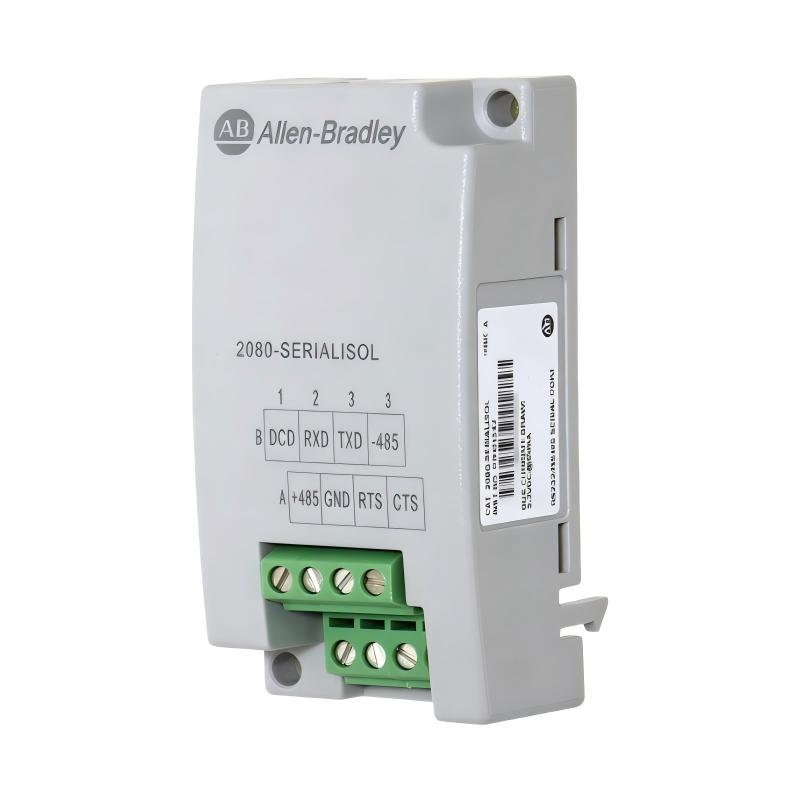
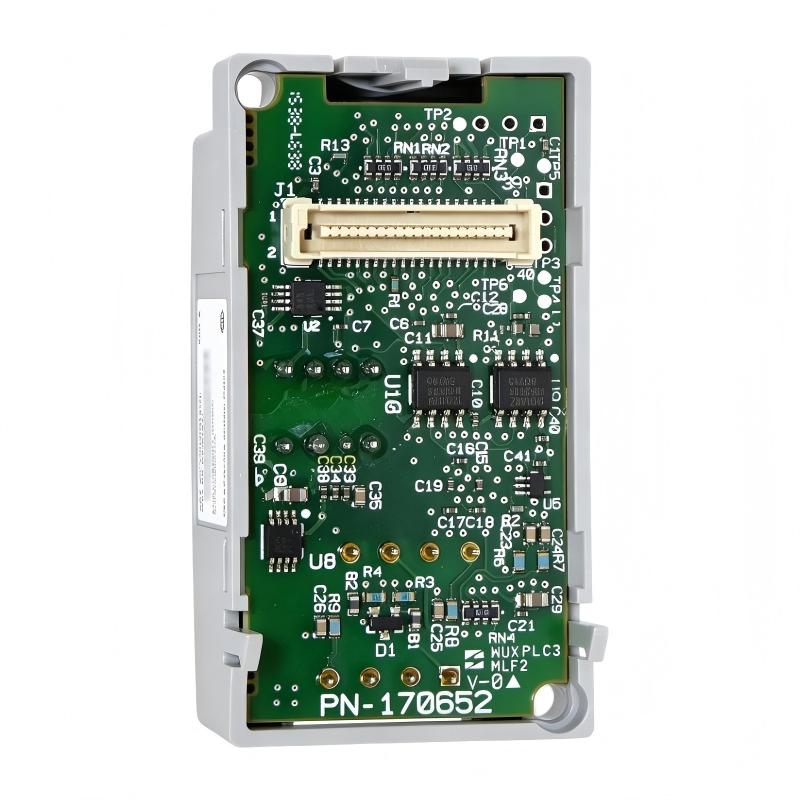
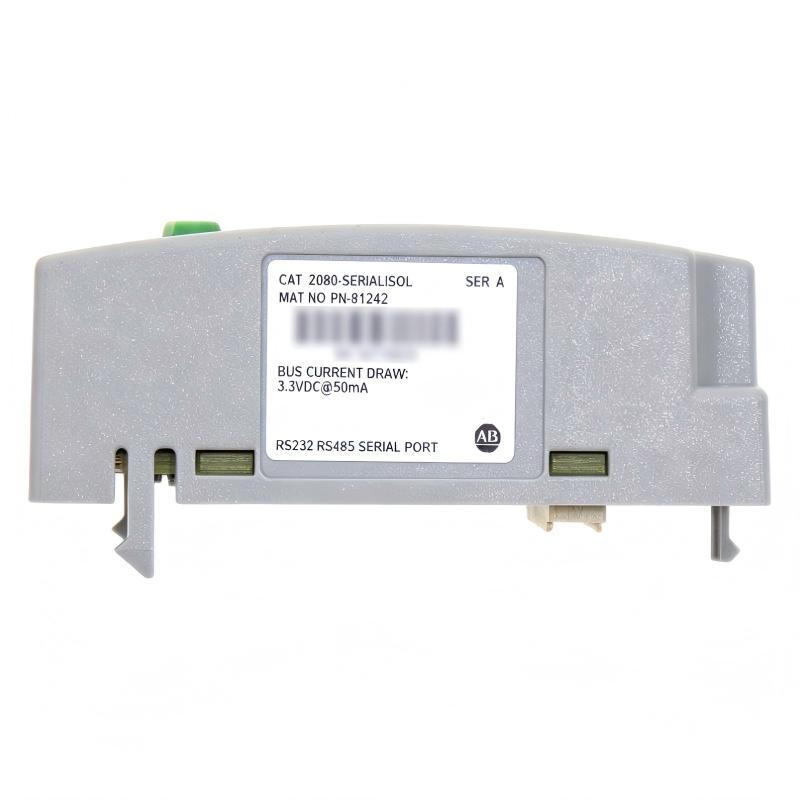
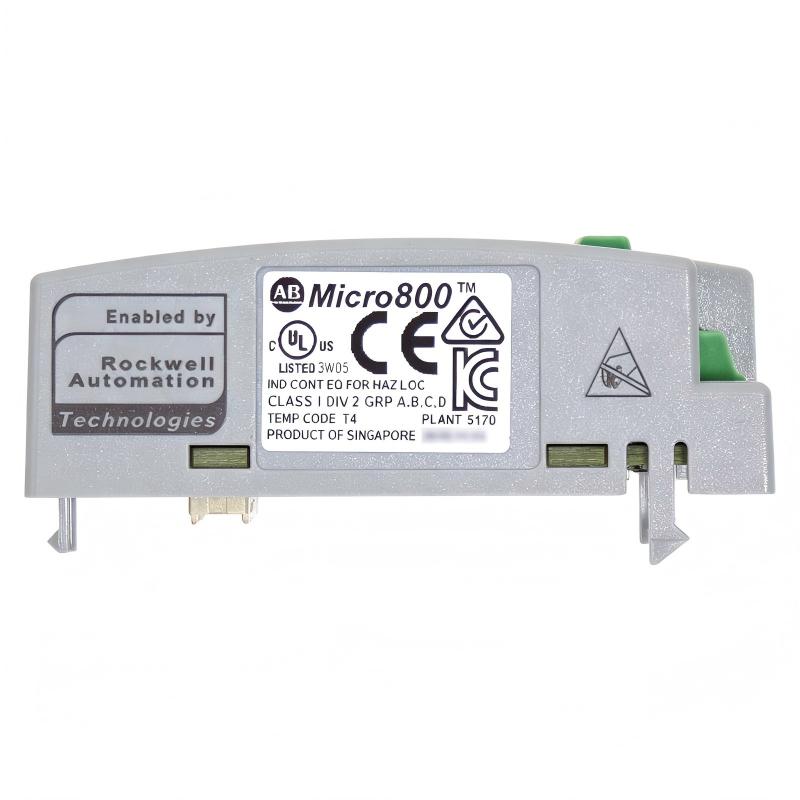
- Allen Bradley
- 2080-SERIALISOL
- Micro800 Isolated Serial Port Plug-in
- USA
- 73 x 22 x 57 mm
- 0.02 kg
- Xiamen, China
- New & In Stock
- T/T, PayPal, Western Union
- 1 Year
- 1-3 Working Days
- DHL, UPS, TNT, FedEx and EMS.
- 24-Hour Service
- COO
- 7
Our advantage

Global Logistics
We have a 10-year logistics and express cooperation agreement, so our products can be shipped to any place in the world.

Brand new and original
Our products are imported in bulk from the place of origin. Because of the cooperative relationship, our products are all original and 100% new.

24-hour service
We provide 7*24 hours service to our customers. We will be there whenever you need us.

Price advantage
All our products are priced very favorably because we have our own warehouse and supply.
| Company Information | |||
| [email protected] | |||
| Mobile | +8615980777398 | ||
| +8615980777398 | |||
| 15980777398 |
1. Product Overview
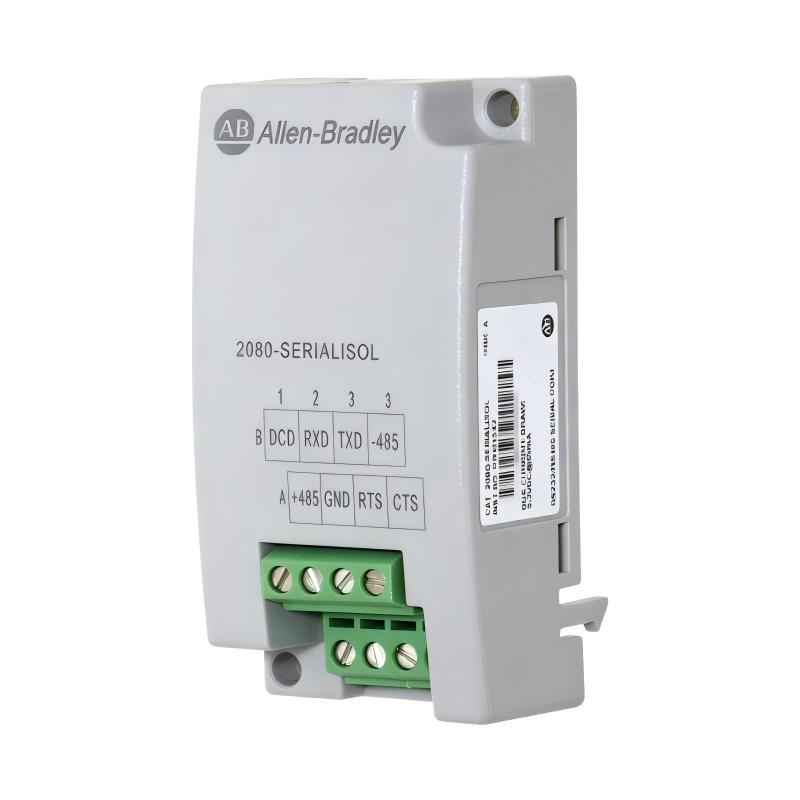
The Allen-Bradley 2080-SERIALISOL Micro800 Isolated Serial Port Plug-In Module is a compact industrial communication accessory designed to expand the serial communication capabilities of compatible Micro800 programmable logic controllers (PLCs). It provides isolated RS-232 and RS-485 interfaces, allowing Micro800 controllers to exchange data with compatible industrial devices, instrumentation, drives, and other serial communication equipment.
In industrial automation environments, dependable communication between controllers and field devices is essential for effective process monitoring, equipment coordination, and production management. The 2080-SERIALISOL supports this requirement by providing an electrically isolated serial interface that can help reduce the impact of electrical noise and ground potential differences on communication reliability.
The module supports Modbus RTU and ASCII communication over RS-232 and RS-485. CIP Serial is also supported over RS-232. These capabilities make it suitable for applications involving legacy serial equipment, variable frequency drives, servo drives, meters, and other devices that use compatible serial protocols.
Designed as a Micro800 plug-in module, the 2080-SERIALISOL integrates into a compatible controller without requiring a separate, full-size communication module. This compact design is valuable in machine control panels and equipment enclosures where installation space is limited.
For industrial automation distributors, system integrators, maintenance teams, and spare-parts purchasers, the 2080-SERIALISOL is a useful component to consider when adding an isolated serial interface or maintaining an existing Micro800 control system.
2. Technical Specifications
| Parameter | Specification |
|---|---|
| Brand | Allen-Bradley |
| Manufacturer | Rockwell Automation |
| Model | 2080-SERIALISOL |
| Product Type | Micro800 Isolated Serial Port Plug-In Module |
| Product Series | Bulletin 2080 Micro800 |
| Communication Interfaces | RS-232 and RS-485 |
| Supported Protocols | Modbus RTU, ASCII, CIP Serial |
| CIP Serial Support | RS-232 |
| Modbus RTU Support | RS-232 and RS-485 |
| ASCII Support | RS-232 and RS-485 |
| Electrical Isolation | 500 V AC |
| Maximum RS-485 Communication Distance | Up to 1000 m under specified conditions |
| Maximum RS-485 Baud Rate for the Stated Distance | 19.2 kbps |
| Operating Temperature | -20 to +65°C |
| Mounting Torque | 0.2 N·m |
| Terminal Screw Torque | 0.22–0.25 N·m |
| User-Provided Dimensions | 73 × 22 × 57 mm |
| User-Provided Weight | 0.02 kg |
| Manufacturer Reference Dimensions | Approximately 62 × 31.5 × 20 mm |
| Manufacturer Reference Weight | Approximately 21 g |
| Installation Type | Compatible Micro800 controller plug-in slot |
Note: Physical specifications above distinguish the supplied listing data from manufacturer reference figures. Confirm the exact product version, measurement orientation, and packaging weight before purchasing or designing a replacement.
3. Function and Working Principle
3.1 RS-232 Serial Communication
RS-232 is commonly used for point-to-point communication between industrial controllers and individual devices. It remains useful in applications involving configuration interfaces, serial instruments, legacy equipment, and certain drive or operator-interface connections.
The 2080-SERIALISOL provides an additional RS-232 communication interface for compatible Micro800 controllers. Depending on the connected device and the application configuration, the controller can transmit commands, receive operating data, and exchange status information.
Typical applications include reading measurement values, transmitting operating parameters, and communicating with equipment that relies on established serial protocols.
When using RS-232, the communication settings at both ends must match. Important parameters include baud rate, data bits, parity, stop bits, and the applicable protocol. Cable pin assignments must also match the connected equipment.
3.2 RS-485 Communication
RS-485 is widely used in industrial environments because it supports differential signaling and is suitable for communication over longer cable runs than conventional RS-232 connections.
The 2080-SERIALISOL supports RS-485 communication for compatible Modbus RTU and ASCII applications. This makes it useful when a Micro800 controller must communicate with equipment installed at a distance from the control panel.
Under the manufacturer’s stated conditions, the RS-485 interface can support communication distances of up to 1000 m at baud rates of up to 19.2 kbps. Actual performance depends on cable characteristics, installation quality, electrical noise, network topology, and device configuration.
For longer cable runs, shielded twisted-pair cable is recommended. Appropriate termination at both ends of the RS-485 network and correct polarity are important for reliable signal transmission.
3.3 Electrical Isolation
Electrical isolation is one of the defining features of the 2080-SERIALISOL.
Industrial environments frequently contain electrical noise generated by motors, contactors, switching power supplies, variable frequency drives, and other high-power equipment. Differences in ground potential between connected devices may also affect communication reliability.
The module provides a specified isolation voltage of 500 V AC between the relevant isolated interface and circuitry. This helps reduce the transfer of unwanted electrical disturbances through the communication connection.
Isolation does not eliminate every source of communication failure. Correct grounding, shielding, cable routing, and compliance with installation requirements remain essential.
3.4 Protocol Support
The module supports several serial communication options for different industrial applications.
- Modbus RTU: Used for exchanging registers, measurements, status information, and control data with compatible devices over RS-232 or RS-485.
- ASCII: Supports applications that use compatible ASCII-based serial message formats over RS-232 or RS-485.
- CIP Serial: Supports the specified CIP Serial communication functionality over RS-232.
RS-485 support requires Connected Components Workbench software version 6 or later, according to the manufacturer’s documentation. Users should confirm controller firmware, software version, protocol implementation, and target-device compatibility before commissioning.
4. Role in Micro800 Industrial Control Systems
4.1 Expanding Communication Capabilities
The 2080-SERIALISOL adds a serial communication option to a compatible Micro800 controller. This can be valuable when the controller’s built-in communication interfaces are already assigned to other tasks or when an application requires an electrically isolated connection.
Instead of replacing the controller or redesigning the entire control architecture, an appropriate plug-in module can provide an additional communication path within the existing system.
The number of available plug-in slots varies by controller model. Before ordering, verify that the target Micro800 controller supports the module and has an available compatible slot.
4.2 Connecting Legacy Equipment
Many industrial installations contain equipment that continues to operate reliably through RS-232 or RS-485 communication. Replacing these devices solely to obtain a newer communication interface can be expensive and may require additional engineering work.
The 2080-SERIALISOL can help maintain communication between a compatible Micro800 PLC and legacy devices that support the same serial protocol.
This approach may reduce retrofit costs while allowing existing equipment to remain part of a modernized control system.
4.3 Supporting Drive and Instrument Communication
Variable frequency drives, servo drives, power meters, temperature instruments, and other industrial devices may provide serial communication interfaces.
Where the target equipment supports a compatible protocol, the 2080-SERIALISOL can be used to exchange operating data and status information with the controller.
The exact functions available depend on the target device, its communication configuration, and the controller program.
4.4 Improving Communication Robustness
The isolated interface is particularly relevant where communication cables pass through electrically noisy areas or connect equipment with different grounding conditions.
Isolation can help limit the effect of certain electrical disturbances, while RS-485 provides a suitable physical interface for many longer-distance industrial connections.
The benefits depend on the complete installation, including cable selection, grounding, termination, and separation from high-power wiring.
5. Industrial Applications
5.1 Factory Automation
In automated production lines, a Micro800 controller may need to communicate with auxiliary machinery, serial instruments, or compatible drive systems.
The 2080-SERIALISOL can provide an additional communication channel for these devices, helping the controller exchange data required for sequencing, monitoring, and machine coordination.
5.2 Variable Frequency Drive Integration
Variable frequency drives are commonly used to control motor speed and operating conditions. When a drive supports a compatible Modbus RTU or ASCII implementation, the serial interface can provide a communication path for reading status values and transmitting supported commands.
Before integration, confirm the drive’s supported protocol, register map, baud rate, parity, and electrical interface.
5.3 Water and Wastewater Equipment
Pumps, meters, dosing equipment, and auxiliary instruments may use serial communication in water-treatment and wastewater installations.
An isolated serial port can help a compatible Micro800 controller exchange measurements and operating information with these devices. RS-485 may be useful where equipment is distributed across a larger installation.
5.4 Building and Utility Equipment
Certain utility instruments, energy meters, and environmental monitoring devices use Modbus RTU over RS-485.
The 2080-SERIALISOL may be appropriate for connecting compatible equipment to a Micro800 controller where serial communication meets the project’s monitoring and control requirements.
5.5 Packaging and Material Handling
Packaging machines, conveyors, and material-handling systems often combine controllers with drives, sensors, and auxiliary devices from different manufacturers.
Where compatible serial communication is available, the module can help connect selected equipment without adding a separate full-size communication adapter.
5.6 Equipment Modernization
During control-system upgrades, existing instruments and drives may remain in service even when the primary controller is replaced or updated.
The 2080-SERIALISOL can support a modernization strategy that retains compatible serial devices while the control system is upgraded. Engineering teams should still verify the required protocol functions, timing, and device compatibility.
6. Installation and System Integration
6.1 Confirm Controller Compatibility
Before installation, verify the exact Micro800 controller model, its supported plug-in modules, available slots, firmware requirements, and applicable software version.
The 2080-SERIALISOL is not a universal serial adapter for every PLC platform. It is designed for compatible Micro800 controllers.
6.2 Install the Module Correctly
Before handling or installing the module, follow the manufacturer’s electrical safety and installation procedures. Isolate power as required and take appropriate electrostatic discharge precautions.
Install the module in the designated plug-in position according to the controller and module instructions. Ensure that the connector is properly aligned and fully seated.
Do not force the module into position. Mechanical misalignment can damage the connector or the controller.
6.3 Configure the Serial Interface
Configure the communication parameters according to the requirements of the connected equipment.
Key settings may include:
- Communication protocol
- Baud rate
- Data bits
- Parity
- Stop bits
- Device address, where applicable
- RS-232 or RS-485 operating mode
- Message timing and response timeout
For Modbus RTU, the controller and target device must use compatible serial settings and device addressing. For ASCII communication, message formatting and termination rules must also match.
6.4 Use Appropriate Cable and Termination
For RS-485 networks, use suitable shielded twisted-pair cable and follow the manufacturer’s wiring guidance.
Where required by the network design, install 120-ohm termination resistors at both ends of the RS-485 transmission line. Avoid unnecessary termination at intermediate devices.
Keep communication cables away from high-current power cables, motor leads, and other major sources of electromagnetic interference. Follow the project’s grounding and shielding practices.
For RS-232 connections, confirm transmit, receive, and signal-ground assignments as well as any required handshake signals. Incorrect pin connections may prevent communication or damage the interface.
6.5 Test Communication Before Commissioning
After installation, verify that the controller recognizes the configured interface and that the target device responds correctly.
A systematic commissioning process should include:
- Confirming the physical wiring and connector pinout.
- Verifying serial settings at both ends.
- Testing basic communication.
- Checking device addressing and message format.
- Monitoring communication errors and response timeouts.
- Testing the intended application functions under normal operating conditions.
For systems using long RS-485 cable runs, test the actual installed network rather than assuming that the maximum documented distance will be achievable under every condition.
7. Compatible System Components
The following table identifies related equipment categories and examples that may be relevant to a Micro800 installation. Compatibility must be verified for the specific controller and application.
| Component or Model | Product Type | Potential Role |
|---|---|---|
| Micro820 Controller | Compact PLC | Main controller for small automation systems |
| Micro830 Controller | Compact PLC | Machine and equipment control |
| Micro850 Controller | Compact PLC | Expanded control and communication applications |
| Micro870 Controller | Compact PLC | Larger Micro800 control applications |
| 2080-SERIALISOLK | Conformally Coated Serial Plug-In | Alternative version for applicable environments |
| 2080-MODTCP | Communication Plug-In | Different communication functionality; not a direct serial replacement |
| Compatible Modbus RTU Drive | Variable Frequency Drive | Serial drive communication |
| Compatible RS-485 Meter | Power or Process Instrument | Measurement and status data exchange |
| Compatible Serial Instrument | Industrial Instrumentation | Data acquisition or device monitoring |
A listed component should not be interpreted as automatically compatible with every Micro800 controller. Confirm slot availability, controller support, protocol requirements, and firmware/software compatibility before selecting hardware.
8. Alternative Models and Replacement Considerations
The correct replacement depends on the required communication interface, isolation, protocol, controller compatibility, and environmental conditions.
| Model or Option | Description | Replacement Considerations |
|---|---|---|
| 2080-SERIALISOL | Isolated RS-232/RS-485 serial plug-in | Original model for compatible Micro800 applications |
| 2080-SERIALISOLK | Conformally coated isolated serial plug-in | Consider when the coated version is required by the application |
| 2080-MODTCP | Micro800 communication plug-in | Different communication function; not a direct RS-232/RS-485 substitute |
| External Serial Gateway | Third-party communication device | Requires protocol, wiring, power, and integration checks |
| Replacement Micro800 Controller | Programmable controller | Consider only after evaluating compatibility and system redesign requirements |
The 2080-SERIALISOL and 2080-SERIALISOLK are closely related, but the conformally coated version should be selected based on environmental requirements and exact application specifications.
An external gateway may provide another route for serial communication, but it introduces additional hardware, configuration, and maintenance considerations. It should not be treated as a direct plug-in replacement without engineering review.
Before purchasing a replacement, compare the complete catalog number, physical condition, terminal arrangement, communication protocol support, controller compatibility, and environmental requirements.
9. Key Advantages of the Allen-Bradley 2080-SERIALISOL
Isolated Serial Communication
The module’s 500 V AC specified isolation helps separate the communication interface from relevant controller circuitry, which can be beneficial in electrically noisy installations.
Support for RS-232 and RS-485
Having both serial interface options provides flexibility for point-to-point connections and suitable longer-distance serial networks.
Multiple Serial Protocol Options
Support for Modbus RTU, ASCII, and CIP Serial on the specified interfaces helps integrate compatible devices used in different industrial applications.
Compact Plug-In Design
The module fits into a compatible Micro800 controller’s plug-in architecture, allowing communication functionality to be expanded without adding a separate full-size module.
Suitability for Equipment Modernization
It can help preserve communication with compatible serial devices during upgrades, reducing the need to replace every field device at the same time.
Practical Maintenance and Spare-Parts Value
For installed Micro800 systems, holding a verified spare communication module can help maintenance teams restore serial communication when a module fails.
10. Technical FAQs
Q1: What is the Allen-Bradley 2080-SERIALISOL?
The 2080-SERIALISOL is an isolated RS-232/RS-485 serial communication plug-in module for compatible Allen-Bradley Micro800 controllers.
Q2: Which communication protocols does it support?
It supports Modbus RTU over RS-232 and RS-485, ASCII over RS-232 and RS-485, and CIP Serial over RS-232. Confirm the applicable controller software and firmware requirements before commissioning.
Q3: What is the purpose of electrical isolation?
Electrical isolation helps reduce the transfer of certain electrical disturbances between the serial interface and the relevant controller circuitry. It is useful in installations where electrical noise or differences in ground potential may affect communications.
Q4: Can the 2080-SERIALISOL communicate over long distances?
Yes. The manufacturer’s documentation specifies distances up to 1000 m for RS-485 under defined conditions, including a baud rate of up to 19.2 kbps. Actual achievable distance depends on cable properties, network topology, termination, interference, and installation quality.
Q5: Can it connect to a variable frequency drive?
It can communicate with a drive that supports a compatible serial interface and protocol. Verify the drive’s protocol implementation, register map, wiring, and serial configuration before use.
Q6: Is the 2080-SERIALISOL compatible with every Micro800 controller?
Compatibility depends on the controller model, supported plug-in slots, and applicable firmware/software requirements. Always check the controller’s technical documentation before ordering.
Q7: What is the difference between 2080-SERIALISOL and 2080-SERIALISOLK?
The 2080-SERIALISOLK is the conformally coated version. The correct choice depends on the environmental requirements of the installation and the applicable product documentation.
Q8: What dimensions and weight should be used for procurement?
The supplied product listing gives dimensions of 73 × 22 × 57 mm and a weight of 0.02 kg. Manufacturer reference documentation lists approximately 62 × 31.5 × 20 mm and 21 g. Because these figures differ, verify the exact module and the measurement convention before finalizing mechanical design or shipping calculations.
Q9: What should be checked before replacing an existing module?
Confirm the complete model number, controller compatibility, RS-232/RS-485 requirements, protocol support, terminal configuration, environmental conditions, and the condition of the communication cabling.
Q10: How can communication reliability be improved?
Use the correct cable type, verify the wiring and serial settings, apply appropriate RS-485 termination, separate signal cables from power wiring, and check grounding and shielding. Test the system at the actual operating distance.
11. Procurement and Maintenance Recommendations
When purchasing an Allen-Bradley 2080-SERIALISOL, verify the catalog number and ensure that the module matches the requirements of the installed Micro800 controller.
For replacement or spare-parts procurement, review the following points:
- Confirm the exact model number and whether the conformally coated version is required.
- Check the physical condition of the module, connectors, and terminals.
- Verify communication protocols and controller compatibility.
- Confirm that the available documentation matches the product revision.
- Inspect serial wiring and termination before concluding that a failed module is the cause of communication problems.
- Keep a record of communication settings and connected device configurations to simplify future maintenance.
For international purchases, request clear product photographs, identification-label details, packaging information, and a confirmation of the supplied model. The physical dimensions and weight should also be verified if the component must fit into a predefined enclosure or if freight calculations depend on exact measurements.
A suitable spare module can help reduce downtime in installations that rely on serial communication for drive control, instrumentation, or equipment monitoring.
12. Conclusion
The Allen-Bradley 2080-SERIALISOL Micro800 Isolated Serial Port Plug-In Module provides RS-232 and RS-485 connectivity for compatible Micro800 PLC systems. With support for Modbus RTU, ASCII, and CIP Serial on the specified interfaces, it can help integrate industrial drives, instruments, and other compatible serial devices into automated control applications.
Its electrical isolation, compact plug-in architecture, and support for suitable longer-distance RS-485 communication make it a practical option for machine automation, equipment modernization, and industrial maintenance.
When selecting or replacing this module, verify controller compatibility, protocol requirements, wiring details, and the exact physical specifications. These checks help ensure that the 2080-SERIALISOL is suitable for the intended application and supports reliable operation over the service life of the control system.