

ProductPRODUCT
Featured products
Contact Us
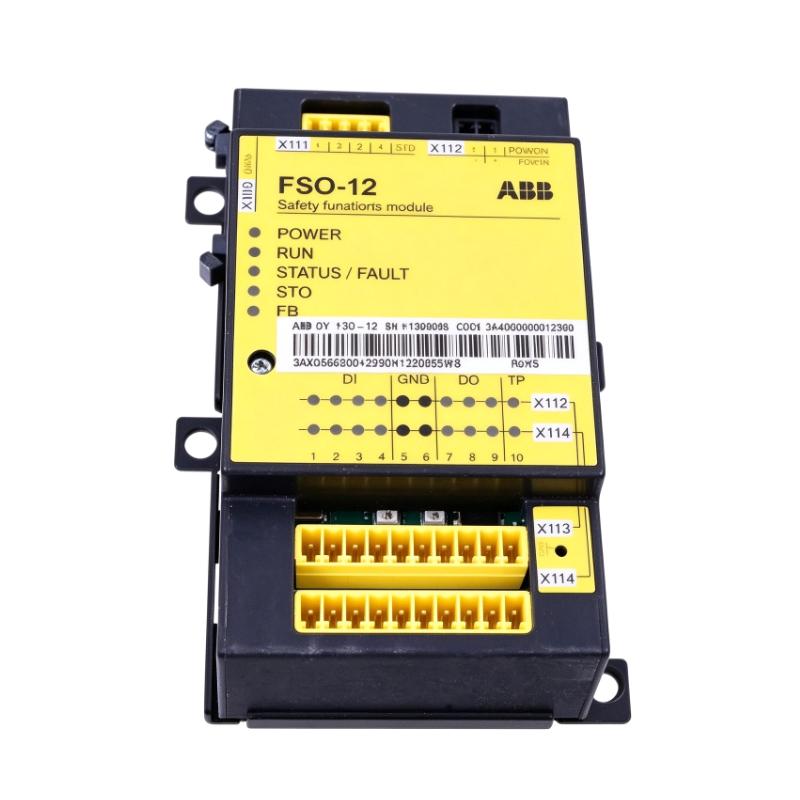
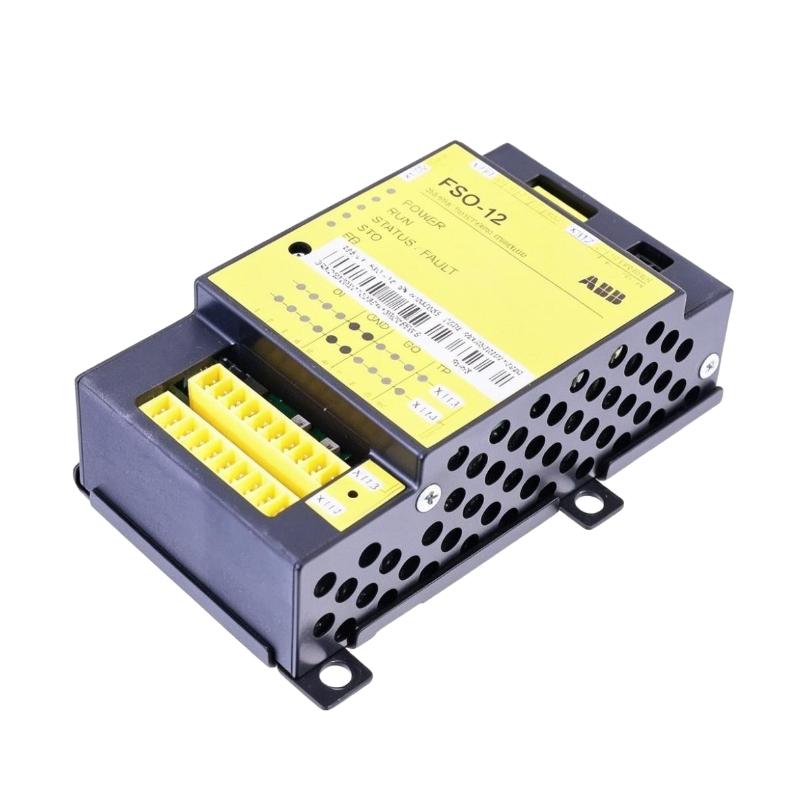
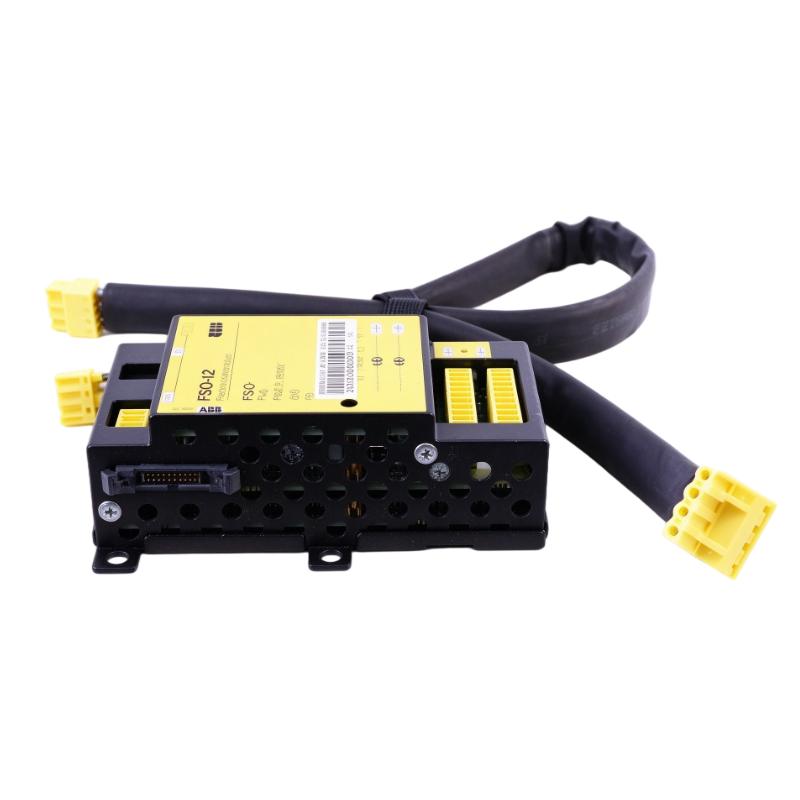
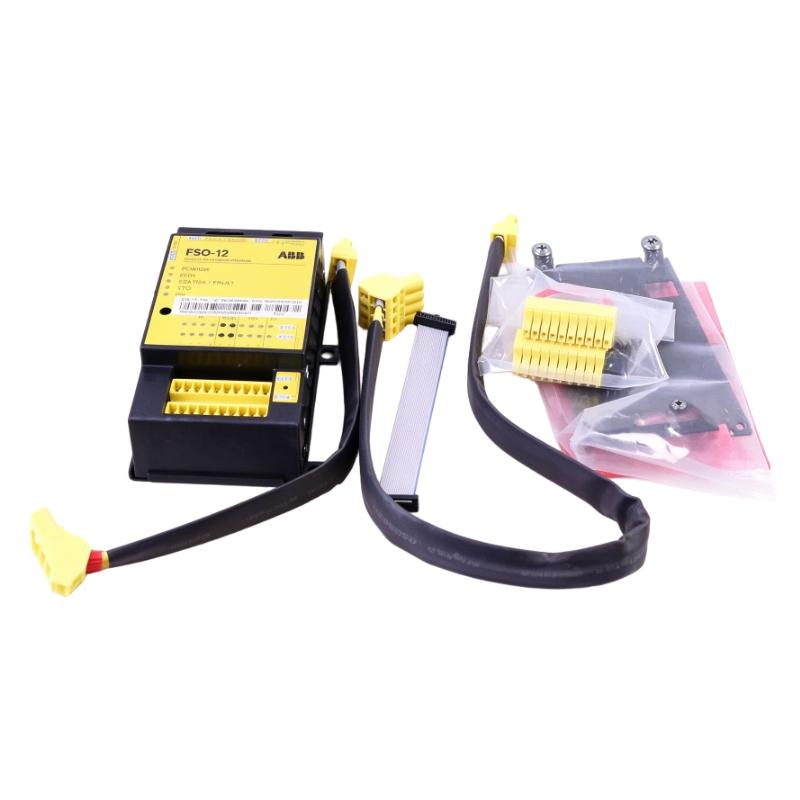
- ABB
- FSO-21 3AXD50000016771
- Extended Security Module
- Sweden (SE)
- 111 × 38 × 76 mm
- 0.339 kg
- Xiamen, China
- New & In Stock
- T/T, PayPal, Western Union
- 1 Year
- 1-3 Working Days
- DHL, UPS, TNT, FedEx and EMS.
- 24-Hour Service
- COO
- 7
Our advantage

Global Logistics
We have a 10-year logistics and express cooperation agreement, so our products can be shipped to any place in the world.

Brand new and original
Our products are imported in bulk from the place of origin. Because of the cooperative relationship, our products are all original and 100% new.

24-hour service
We provide 7*24 hours service to our customers. We will be there whenever you need us.

Price advantage
All our products are priced very favorably because we have our own warehouse and supply.
| Company Information | |||
| [email protected] | |||
| Mobile | +8615980777398 | ||
| +8615980777398 | |||
| 15980777398 |
Product Overview
The ABB FSO-21 Extended Safety Functions Module is an optional functional safety module designed for compatible ABB industrial drives. It extends the drive’s safety capabilities by providing configurable safety functions that help reduce risks associated with motor movement, unexpected startup, excessive speed, and other hazardous operating conditions.
In automated manufacturing, motors and drives frequently operate machinery with moving parts, rotating equipment, conveyors, and mechanical braking systems. Functional safety features allow engineers to implement defined responses to hazardous conditions while coordinating drive operation with machine safety devices and safety controllers.
The FSO-21 is designed for integration inside compatible drive systems. It supports safety functions and diagnostics that can be configured for the requirements of a particular machine. Compared with the FSO-12, the FSO-21 provides additional safety functions, including Safe Direction (SDI) and Safe Speed Monitor (SSM). The SDI function requires a compatible FSE-31 pulse encoder interface where specified by the system configuration.
The module can be used in appropriately designed safety architectures involving emergency-stop devices, safety interlocks, safety PLCs, and other machine safety equipment. Depending on the selected functions and complete system design, it can support safety-related control strategies for industrial drives.
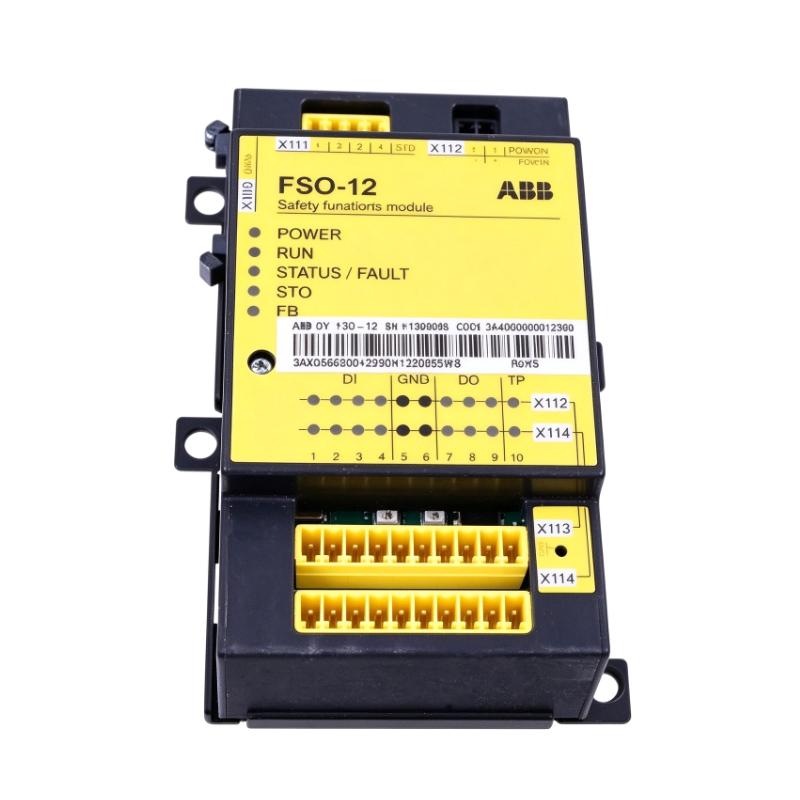
Part-number verification is essential for this listing. ABB identifies ordering code 3AXD50000016771 as the FSO-12 Safety Functions Module. The FSO-21 is associated with ordering code 3AXD50000023987 in ABB drive selection documentation. Buyers should verify the module label and exact ordering code before purchasing or installing the product.
Technical Specifications
| Parameter | Specification |
|---|---|
| Brand | ABB |
| Product Model | FSO-21 |
| Product Type | Extended Safety Functions Module |
| Product Family | ABB Functional Safety Modules |
| Intended Application | Functional safety for compatible drive systems |
| Compatible Drive Family | Selected ABB ACS880 drives and other specifically supported configurations |
| Safety Functions | Eight functions, subject to configuration and system compatibility |
| Safe Stop 1 | Supported |
| Safe Stop Emergency | Supported |
| Safe Brake Control | Supported |
| Safely-Limited Speed | Supported |
| Safe Maximum Speed | Supported |
| Prevention of Unexpected Startup | Supported |
| Safe Direction | Supported; requires compatible encoder-interface configuration |
| Safe Speed Monitor | Supported |
| Safety Capability | SIL 3 / PL e capability under applicable certified conditions |
| Configuration Software | Drive Composer Pro |
| Encoder Interface | FSE-31 required for applicable encoder-dependent functions |
| Safety Communication | PROFIsafe integration possible with compatible fieldbus and safety-controller configuration |
| Dimensions Provided | 111 × 38 × 76 mm |
| Weight Provided | 0.339 kg |
| Ordering Code to Verify | 3AXD50000023987 is associated with FSO-21 in ABB selection documentation |
| Related Model | FSO-12, ordering code 3AXD50000016771 |
The dimensions and weight above are supplied listing values and should be checked against the actual unit. Safety ratings apply to the specified certified configuration and do not automatically certify the complete machine or installation.
Function and Working Principle
The FSO-21 extends the functional safety capabilities of a compatible drive by processing safety-related inputs and coordinating the required safety response. It operates as part of a designed safety system rather than as a standalone replacement for all machine safety equipment.
1. Safe Stop Functions
Safe Stop 1 (SS1) supports a controlled stopping sequence followed by the applicable safe torque-off response, according to the configured implementation. This can be useful where machinery must decelerate in a controlled manner before torque is removed.
Safe Stop Emergency (SSE) supports a safety-related emergency stopping response. The required stopping behavior depends on the selected configuration and the overall machine risk assessment.
Engineers must distinguish between an operational stop command and a safety-rated stop function. Ordinary PLC logic or a standard drive stop command should not be treated as a substitute for a properly designed safety function.
2. Safely-Limited Speed
Safely-Limited Speed (SLS) monitors whether a drive remains within a defined safe speed limit. If the configured safety conditions are violated, the system initiates the prescribed response.
SLS can be useful during setup, inspection, cleaning, or maintenance operations where movement may be permitted only at a reduced speed. The permitted speed, response behavior, and operating procedure must be established through the machine risk assessment.
3. Safe Maximum Speed
Safe Maximum Speed (SMS) provides a safety function for monitoring a defined maximum speed. It can help prevent a motor or driven mechanism from operating above the configured safety limit.
The speed limit must be selected according to the mechanical design, equipment capabilities, and potential hazards. Correct commissioning and verification are necessary before the function is relied upon for risk reduction.
4. Safe Brake Control
Safe Brake Control (SBC) supports safety-related control of a mechanical brake in a compatible drive system.
This function can be important for applications in which a mechanical brake is required to help prevent unintended movement, such as certain lifting or vertical-axis systems. The brake, wiring, drive configuration, and safety architecture must all be suitable for the intended function.
The module does not eliminate the need to select and maintain an appropriately rated mechanical brake.
5. Prevention of Unexpected Startup
Prevention of Unexpected Startup (POUS) supports safety measures intended to prevent a drive from starting unexpectedly under defined conditions.
Unexpected movement can expose operators and maintenance personnel to mechanical hazards. This function can form part of a broader machine safety strategy, but it does not replace electrical isolation, lockout/tagout, or other required maintenance procedures.
6. Safe Direction and Safe Speed Monitoring
The FSO-21 provides Safe Direction (SDI) and Safe Speed Monitor (SSM) functions in addition to the functions shared with the FSO-12.
SDI can be used where movement in an unintended direction creates a hazard. Its use requires the applicable compatible encoder-interface arrangement, including the FSE-31 where specified.
SSM provides a safety-related indication that a configured speed condition has been reached or maintained, according to the implemented function. These capabilities must be configured and validated for the particular drive and machine.
Role in Industrial Control Systems
The FSO-21 is intended to form part of a functional safety architecture for compatible industrial drives. It helps coordinate safety-related drive behavior with other elements of a machine-control system.
Integration with ABB Drives
The module is designed for supported ABB drive configurations, particularly compatible ACS880 systems. Compatibility depends on the drive hardware, control unit, firmware, and the applicable FSO module revision.
Before installation, verify that the drive supports the module and that the control program and hardware versions meet ABB’s requirements. A physical connector or similar module appearance is not sufficient evidence of compatibility.
Safety PLC Integration
A safety programmable logic controller can coordinate safety functions across multiple drives and machine zones. Depending on the system architecture, a safety PLC may receive signals from emergency-stop devices, guard interlocks, and other safety sensors before coordinating the required response.
Where PROFIsafe over PROFINET is required, compatible fieldbus hardware and a suitable safety PLC configuration are necessary. The FSO-21 alone does not automatically provide every communication interface.
Safety Sensors and Interlocks
External safety devices may include emergency-stop buttons, guard switches, interlocking doors, and other appropriately rated safety equipment.
The safety system must be designed so that the required response occurs when a relevant safety condition is detected. Signal wiring, diagnostic behavior, reset logic, and fault handling must follow the applicable safety design.
Drive Configuration and Diagnostics
Drive Composer Pro is used for configuring supported FSO safety functions. The commissioning engineer must select the appropriate functions, set their parameters, and validate the resulting behavior.
Safety-related parameters should be documented and protected against unauthorized changes. Any modification to safety settings, drive hardware, or control software may require renewed verification.
Industrial Applications
The FSO-21 can be considered for compatible drive applications where safety-related monitoring and controlled responses to hazardous motor movement are required.
1. Conveyor Systems
Industrial conveyors can contain pinch points, rotating rollers, transfer mechanisms, and moving products. Safe stopping and speed-monitoring functions can form part of a safety strategy for these machines.
For maintenance and adjustment operations, an appropriately engineered SLS function may allow selected activities at a restricted speed when the overall machine design permits it.
2. Packaging and Processing Machinery
Packaging equipment often combines fast-moving conveyors, cutters, feeders, and mechanical actuators. Safety functions can help coordinate drive responses with guard interlocks and emergency-stop systems.
The selected functions must reflect the machine’s hazards, stopping distance, operator access, and required production modes.
3. Material-Handling Equipment
Material-handling machines may require monitoring of speed and direction to reduce risks caused by unintended movement. Depending on the drive and machine configuration, FSO-21 functions can contribute to the required safety response.
The module must be combined with suitable sensors, mechanical protection, and safety-related control logic.
4. Industrial Processing Lines
Processing lines may contain motors, rollers, pumps, and other driven equipment operating in coordinated sequences. Safety functions can help bring selected equipment into a defined safe condition when a hazardous event occurs.
Each drive must be configured according to its role in the process. Stopping one motor may not be sufficient if other connected equipment can continue to create a hazard.
5. Machinery Requiring Controlled Maintenance Modes
Some machines require setup, adjustment, inspection, or troubleshooting while controlled movement remains necessary. Safely-limited speed and other suitable safety functions can support these modes when the risk assessment and machine design permit them.
The safety system must clearly define the permitted operating state, required operator actions, and response to faults.
Installation and System Integration
Functional safety modules require careful installation and commissioning. The process must follow the applicable ABB instructions and the safety requirements for the complete machine.
1. Confirm the Exact Product Code
Before installation, check the module’s label and ordering code.
The code 3AXD50000016771 identifies the FSO-12, not the FSO-21, in ABB’s published product information. If the intended item is an FSO-21, verify the correct code and hardware revision before proceeding.
This check is particularly important for replacement projects where an incorrect module may not provide the required safety functions.
2. Verify Drive Compatibility
Confirm that the target drive supports the FSO-21. Review the drive model, control unit, firmware version, module revision, and any required additional hardware.
Do not assume that every ABB drive can accept the module. Compatibility must be confirmed for the specific installation.
3. Install According to Manufacturer Instructions
The FSO-21 is installed inside a compatible drive and must be connected according to the manufacturer’s installation documentation.
Isolate power and follow the required electrical safety procedures before opening equipment or handling internal components. Do not open or modify the safety module itself, as unauthorized changes can invalidate its safety classification and warranty.
4. Configure the Required Safety Functions
Use the supported configuration software to select and configure the safety functions required by the application.
Parameters should reflect the machine’s risk assessment, motor characteristics, stopping behavior, and permitted operating modes. Where encoder-dependent functions are used, verify the required encoder interface and associated configuration.
5. Validate the Safety Response
After installation and configuration, carry out the prescribed validation and commissioning procedures.
Tests should verify the response to relevant safety inputs, safe-stop behavior, speed limits, direction monitoring where applicable, brake-control behavior, fault conditions, and reset sequences. Record the results in the machine’s safety documentation.
6. Maintain Configuration Records
Keep records of the module model, ordering code, hardware revision, drive firmware, configured functions, safety parameters, and validation results.
Changes to the drive, module, encoder interface, safety PLC, or machine mechanics may affect the safety design. Reassess and revalidate the system whenever required by the applicable procedures.
Compatible System Components
The FSO-21 is used with compatible ABB drive and safety-system components. The required combination depends on the selected safety functions and communication architecture.
| Component | Function | Compatibility Considerations |
|---|---|---|
| ABB ACS880 drive | Provides motor control and hosts the safety module | Confirm supported drive type, control unit, and firmware |
| ABB FSE-31 pulse encoder interface | Supports applicable encoder-dependent safety functions | Required for SDI in the specified configuration; verify revision and compatibility |
| ABB FPNO-21 fieldbus adapter | Supports PROFINET communication in applicable configurations | Confirm hardware and firmware compatibility |
| ABB FENA-21 Ethernet adapter | Supports applicable Ethernet-based drive communication arrangements | Verify that the selected safety architecture supports the required configuration |
| Safety PLC | Coordinates safety logic across equipment | Must support the selected safety communication and application requirements |
| Emergency-stop devices | Provide safety-related operator stop inputs | Select and wire according to the machine safety design |
| Guard interlocks | Detect access to hazardous machine areas | Ensure suitable safety ratings and correct integration |
| Mechanical brake | Holds or stops mechanical movement where required | Verify brake rating, control method, and SBC configuration |
| Drive Composer Pro | Configures supported drive and safety parameters | Use a compatible software version and follow commissioning instructions |
These components are not necessarily included with the FSO-21. The exact bill of materials must be determined from the drive configuration and safety requirements.
Alternative Models and Replacement Considerations
The correct alternative depends on whether the application requires the extended safety functions of the FSO-21 or can use a different safety architecture.
| Alternative | Description | Considerations |
|---|---|---|
| ABB FSO-12 | Safety functions module with a more limited function set | May suit applications that do not require the two additional FSO-21 functions |
| ABB FSO-21 | Extended safety functions module | Suitable when the required drive configuration supports its functions |
| ABB FSPS-21 | PROFIsafe safety functions module for compatible drive systems | Consider when the required safety architecture and drive compatibility call for this module |
| ABB FSCS-21 | CIP Safety functions module for compatible drives | Consider for systems designed around supported CIP Safety communication |
| Drive-integrated safety functions | Safety capabilities available within selected drive platforms | Verify the available functions and certified implementation before changing hardware |
The modules are not automatically interchangeable. Before choosing a replacement, compare:
- Required safety functions and safety performance.
- Drive model, control unit, and firmware compatibility.
- Module ordering code and hardware revision.
- Encoder requirements and interface compatibility.
- Safety PLC and fieldbus architecture.
- Parameter configuration and validation requirements.
- Applicable certifications and machine safety documentation.
A substitute should not be selected solely because it fits the same drive or has a similar product description.
Key Advantages
Expanded Functional Safety
The FSO-21 provides eight safety functions, including Safe Direction and Safe Speed Monitor, for compatible drive configurations.
Integration Inside Compatible Drives
Its plug-in design allows it to be installed inside supported drives, helping integrate safety functionality into the drive system.
Support for Safety-Related Motion Control
The available functions can support safety strategies involving speed limits, direction monitoring, controlled stopping, and brake control.
Safety-System Integration
The module can form part of a broader architecture involving safety PLCs, emergency-stop devices, guard interlocks, and compatible communication hardware.
Configurable Functions and Diagnostics
Supported software tools allow engineers to configure and verify safety functions according to the application requirements.
Certified Safety Capability
ABB specifies SIL 3 / PL e capability for the FSO-12 and FSO-21 under the applicable certified conditions. The final safety performance depends on correct component selection, configuration, installation, and validation of the complete system.
Technical FAQs
1. What is the ABB FSO-21?
The ABB FSO-21 is an optional safety functions module designed for compatible ABB industrial drives. It adds configurable safety functions for applications involving motor speed, direction, stopping, and brake control.
2. What is the difference between FSO-12 and FSO-21?
The FSO-21 provides the functions available in the FSO-12 plus Safe Direction and Safe Speed Monitor. Safe Direction requires the appropriate compatible encoder-interface arrangement.
3. Is 3AXD50000016771 the correct order code for FSO-21?
No. ABB identifies 3AXD50000016771 as the FSO-12. ABB selection documentation associates 3AXD50000023987 with FSO-21. Always confirm the module label and ordering code before purchase.
4. Which drives support the FSO-21?
The FSO-21 is designed for compatible ABB drive configurations, including supported ACS880 systems. Compatibility depends on the exact drive, control unit, firmware, and module revision.
5. Does the FSO-21 provide SIL 3 and PL e capability?
ABB specifies SIL 3 / PL e capability for the FSO-21 under applicable certified conditions. This does not mean that any machine containing the module automatically achieves those safety levels. The complete safety function must be designed, implemented, and validated correctly.
6. Does the module need an encoder?
Not every FSO-21 function requires encoder feedback. However, the Safe Direction function requires a compatible encoder-interface configuration, including the FSE-31 where specified.
7. Can the FSO-21 communicate with a safety PLC?
It can be integrated into supported safety architectures. PROFIsafe communication requires compatible fieldbus hardware and a suitable safety PLC configuration. Verify the exact required components and software versions before implementation.
8. Can the FSO-21 be installed in any ABB drive?
No. It must be used only with supported drive configurations. Confirm hardware, firmware, control-unit, and module-revision compatibility before installation.
9. What should be checked before buying a replacement module?
Check the full model name, ABB ordering code, module revision, drive compatibility, required safety functions, and included accessories. For this listing, distinguishing FSO-12 from FSO-21 is particularly important.
10. Can the FSO-21 replace the FSO-12 directly?
Not without reviewing the system configuration. Although the FSO-21 offers additional functions, replacement may require configuration changes, compatible hardware, and renewed safety validation.
Procurement and Maintenance Recommendations
When purchasing the ABB FSO-21, begin by confirming the exact model and ordering code. The distinction between FSO-12 and FSO-21 must be resolved before the product is listed or used as a replacement part.
Request a clear photograph of the product label and confirm the drive model and module revision for the intended application. If the part is used or refurbished, review its condition and provenance and confirm the supplier’s testing and warranty terms.
Before installation, check the applicable ABB manuals for drive compatibility, wiring, configuration, and commissioning requirements. Verify that any required encoder interface, fieldbus adapter, safety PLC, and external safety devices are included in the project design.
After commissioning, maintain records of the configured safety functions, parameters, validation results, and hardware revisions. Any changes to safety-related components or software should be assessed for their effect on the machine’s safety functions.
The supplied dimensions of 111 × 38 × 76 mm and weight of 0.339 kg should be verified against the actual unit before finalizing shipping information or cabinet-layout details.
Conclusion
The ABB FSO-21 Extended Safety Functions Module extends the functional safety capabilities of compatible ABB drives with functions such as Safe Stop 1, Safe Brake Control, Safely-Limited Speed, Safe Maximum Speed, Safe Direction, and Safe Speed Monitor. It can support machine safety architectures used in industrial automation, material handling, and processing equipment when correctly selected and commissioned.
For procurement accuracy, the ordering code must be checked carefully: 3AXD50000016771 identifies FSO-12, while ABB documentation associates 3AXD50000023987 with FSO-21. Verifying the actual module label, drive compatibility, required safety functions, and system configuration is essential before purchasing or installing the component.