

ProductPRODUCT
Featured products
Contact Us
- ABB
- TC513 3BSE006385R1
- AF100 Twisted Pair Coaxial Modem
- Sweden (SE)
- 175 × 40 × 130 mm
- 0.73 kg
- Xiamen, China
- New & In Stock
- T/T, PayPal, Western Union
- 1 Year
- 1-3 Working Days
- DHL, UPS, TNT, FedEx and EMS.
- 24-Hour Service
- COO
- 6
Our advantage

Global Logistics
We have a 10-year logistics and express cooperation agreement, so our products can be shipped to any place in the world.

Brand new and original
Our products are imported in bulk from the place of origin. Because of the cooperative relationship, our products are all original and 100% new.

24-hour service
We provide 7*24 hours service to our customers. We will be there whenever you need us.

Price advantage
All our products are priced very favorably because we have our own warehouse and supply.
| Company Information | |||
| [email protected] | |||
| Mobile | +8615980777398 | ||
| +8615980777398 | |||
| 15980777398 |
Product Overview
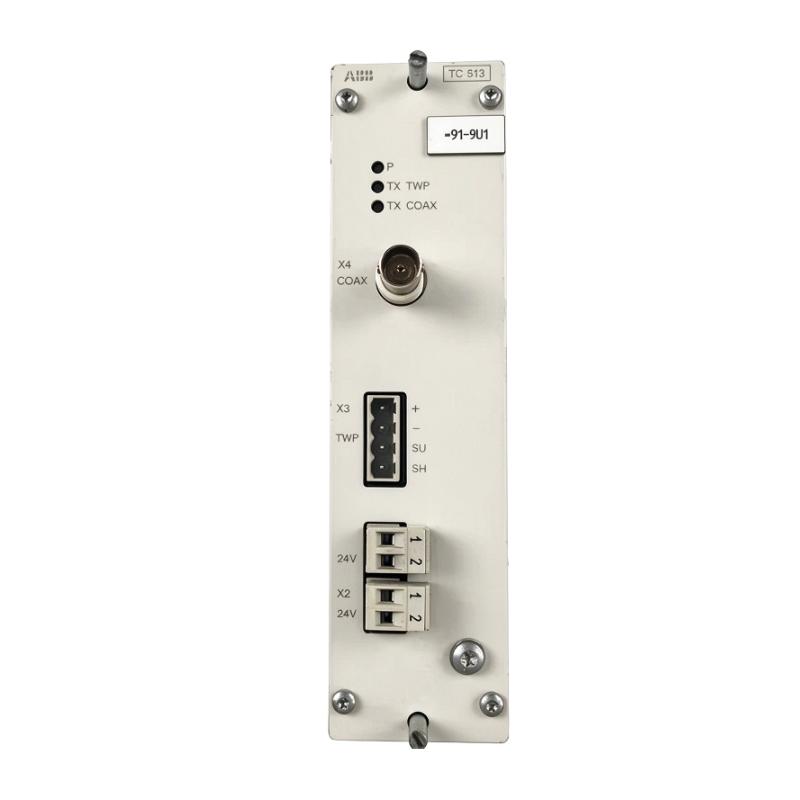
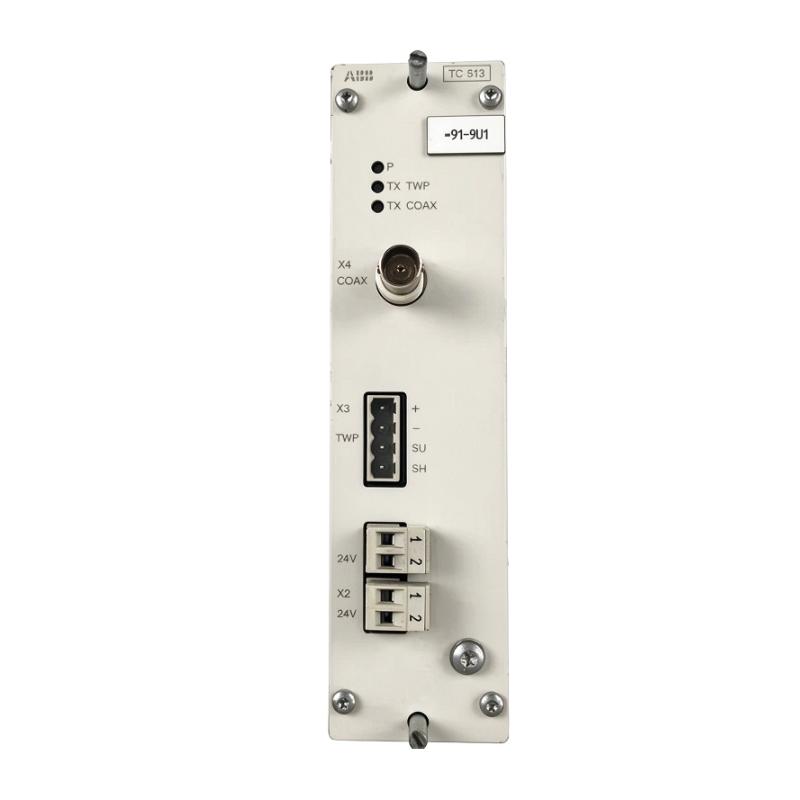
The ABB TC513 3BSE006385R1 AF100 Twisted Pair Coaxial Modem is an industrial communication device designed for use with compatible ABB Advant Fieldbus 100 (AF100) networks. Its primary function is to provide a physical communication interface between twisted-pair and coaxial cable segments, allowing different transmission media to coexist within a supported industrial automation network.
In industrial control systems, reliable communication between controllers and other network components is essential for monitoring, process coordination, and data exchange. Legacy automation installations may use different cable types because of their original design, physical layout, or historical expansion requirements. A dedicated media-conversion modem helps connect these cable segments without requiring the entire network to use a single transmission medium.
The TC513 is designed to operate transparently within the AF100 bus architecture. It converts between twisted-pair and coaxial media while preserving the logical communication carried by the network. This makes it relevant to maintenance, network expansion, and replacement projects involving compatible ABB Advant control systems.
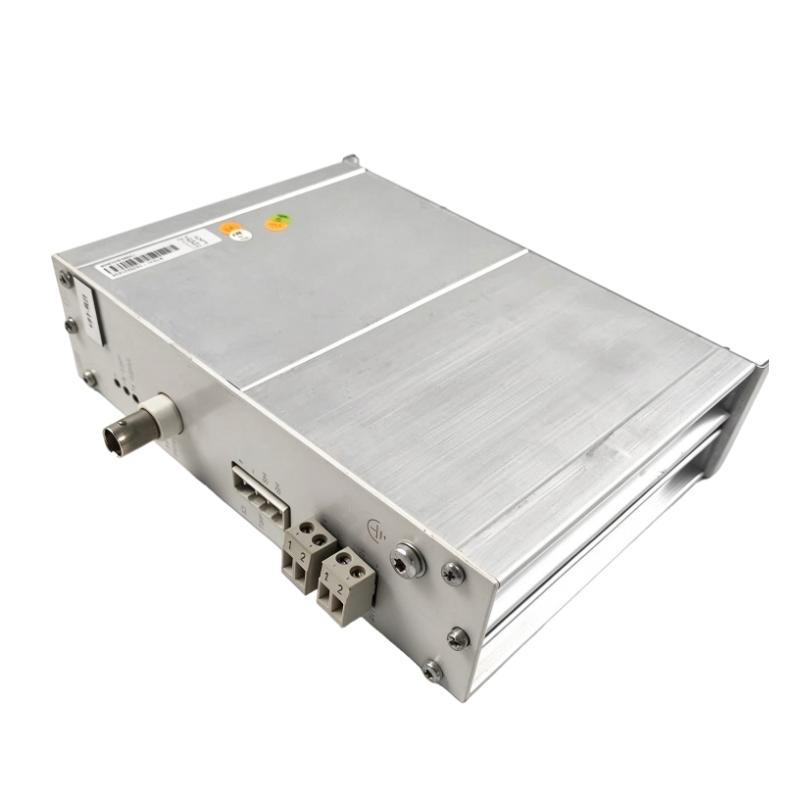
The module uses a 24 V DC power supply. Its connectors support the relevant AF100 cable interfaces, including a coaxial BNC connection and a terminal connection for twisted-pair wiring. Correct cable termination, network topology, grounding, and power-supply arrangements are important for reliable operation.
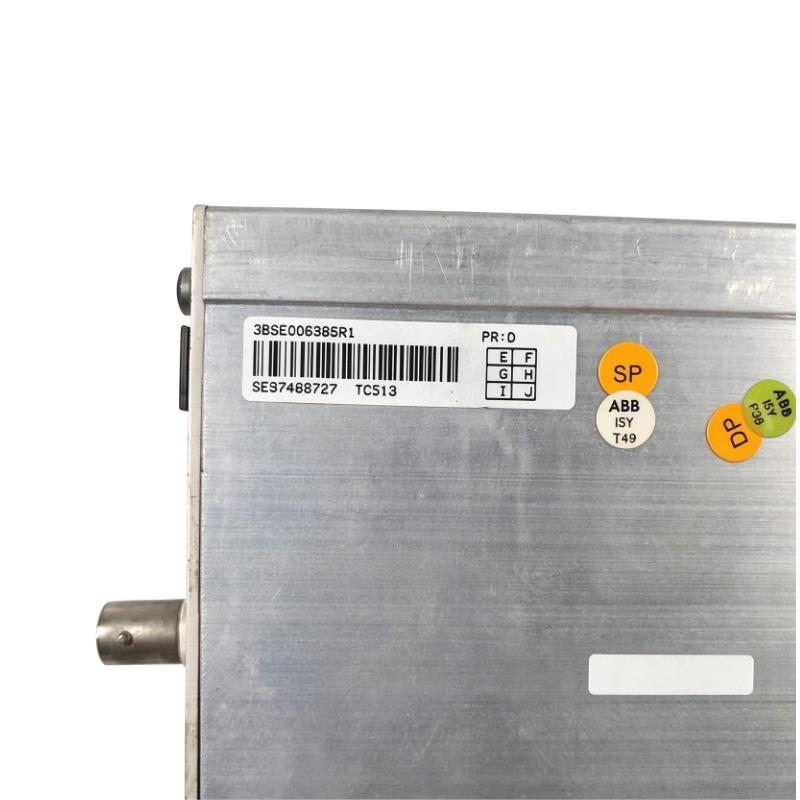
The model number TC513 and product number 3BSE006385R1 should be used together when identifying the component. ABB has introduced the later TC513V1 version, catalog number 3BSE018405R1. Although the newer version serves a similar purpose, engineers should verify the system documentation and installation requirements before selecting it as a replacement.
Technical Specifications
| Parameter | Specification |
|---|---|
| Brand | ABB |
| Manufacturer | ABB |
| Model | TC513 |
| Product Number | 3BSE006385R1 |
| Product Type | AF100 Twisted Pair/Coaxial Modem |
| Communication Network | Advant Fieldbus 100 (AF100) |
| Primary Function | Conversion between twisted-pair and coaxial cable media |
| Power Supply | 24 V DC |
| Twisted-Pair Interface | AF100 twisted-pair terminal connection |
| Coaxial Interface | BNC connector |
| Network Operation | Transparent media conversion |
| Electrical Isolation | Twisted-pair and coaxial interfaces are electrically isolated |
| Dimensions Provided | 175 × 40 × 130 mm |
| Weight Provided | 0.73 kg |
| Related Updated Model | TC513V1, 3BSE018405R1 |
| Typical Applications | ABB Advant control systems and compatible AF100 networks |
Note: Dimensions and weight are the supplied listing values. Physical dimensions can differ between model revisions and published measurement conventions. Verify the exact hardware and its technical documentation before finalizing installation or shipping specifications.
Function and Working Principle
The TC513 functions as a communication media-conversion device within an AF100 network. It allows a network segment using twisted-pair cable to connect with a segment using coaxial cable, provided the installation follows the supported network architecture.
1. Twisted-Pair to Coaxial Conversion
Industrial networks may use different transmission media depending on installation requirements and the configuration of existing equipment. Twisted-pair cabling uses paired conductors to carry communication signals, while coaxial cable uses a central conductor and surrounding shielding structure.
The TC513 provides an interface between these two media. This is particularly useful when an existing AF100 installation contains cable segments of different types and replacing all the cabling would be impractical.
The modem handles the physical media transition while maintaining the network’s logical communication. It should not be treated as a general-purpose Ethernet converter or a universal modem for unrelated industrial protocols.
2. Transparent AF100 Communication
The TC513 is designed for transparent operation within the AF100 bus. Its purpose is to bridge the supported physical cable media rather than perform application-level data processing.
This distinction is important when planning a control-system network. The modem supports the communication infrastructure, while the controllers and other connected devices continue to perform their assigned control, monitoring, and process functions.
3. Electrical Isolation
The twisted-pair and coaxial interfaces are electrically isolated from each other. This separation helps prevent a direct electrical connection between the two cable interfaces and is an important characteristic of the device’s media-conversion design.
Electrical isolation does not eliminate the need for proper grounding, cable shielding, or compliance with the network’s installation requirements.
4. Network Distance Considerations
The TC513 contributes to the overall AF100 bus design and must be included in network-length calculations. ABB’s AF100 documentation specifies that one TC513 is equivalent to approximately 150 metres of cable for the relevant bus-length calculation.
This is an engineering allowance, not a statement that the modem itself extends the cable by 150 metres. When adding or replacing a modem, engineers should review the complete bus topology, cable types, segment lengths, and any redundancy requirements.
5. Status Indication
The documented TC513V1 design includes LED indicators for power and transmission activity on the twisted-pair and coaxial sides. These indicators can assist maintenance personnel when checking power and communication activity.
Indicator details and physical layouts should be confirmed against the exact installed version. The presence of an activity indicator alone does not prove that the entire network is communicating correctly.
Role in Industrial Control Systems
The TC513 supports the communication layer of compatible ABB industrial control installations. It does not replace the controller, I/O modules, or supervisory system; instead, it provides the physical network interface needed to connect supported cable segments.
ABB Advant Control Systems
ABB Advant control architectures use dedicated communication arrangements to connect controllers and other system components. In installations using AF100, the TC513 may be required where twisted-pair and coaxial cable segments meet.
The exact system compatibility depends on the installed controller generation, network configuration, and system documentation. Engineers should verify the location of the modem in the network before replacing it.
Distributed Control Systems
In a distributed control system, communication infrastructure supports the exchange of process and status information between system components. A functioning media-conversion device helps maintain the physical communication path where different cable types are used.
The TC513’s role is limited to the supported AF100 media conversion. It does not independently perform process control, signal conditioning, or data acquisition.
Legacy Network Maintenance
Industrial automation installations can remain in service for many years. Replacing a failed communication modem may be more practical than redesigning an entire network, particularly when the existing system remains compatible with the original equipment.
For such projects, accurate identification of the model and revision is essential. A replacement must match the required cable interfaces, power supply, network configuration, and mounting arrangement.
Industrial Applications
The TC513 is primarily relevant to industrial installations using ABB AF100 communication networks. Its applications are determined by the network design rather than by a particular type of production machine.
1. Process Automation
Process plants may use ABB control systems to coordinate equipment and monitor operating conditions. Where an AF100 installation contains both twisted-pair and coaxial segments, the TC513 can provide the required media interface.
Potential environments include process facilities where the original control-system communication infrastructure remains in service.
2. Power and Utility Facilities
Power-generation and utility installations may contain legacy control and monitoring equipment that depends on established communication networks. A compatible TC513 can support maintenance of the AF100 communication path when different cable media are used.
Its suitability must be confirmed against the actual network design and the requirements of the facility.
3. Industrial Manufacturing
Manufacturing facilities often contain distributed control equipment connected through existing communication infrastructure. Where an ABB Advant system uses AF100, the TC513 may support network continuity between compatible twisted-pair and coaxial segments.
The modem is a network component rather than a direct motor-control or production-control device.
4. Legacy DCS Replacement Projects
When maintaining an older distributed control system, engineers may need to replace an individual communication component while retaining the remaining infrastructure.
The TC513 can be considered where the failed device is confirmed to be the same model and the network requires its specific media-conversion function. Replacing it with a generic network converter is not an appropriate assumption because AF100 is a dedicated industrial bus architecture.
5. Industrial Network Expansion
Some legacy installations require network modifications to accommodate equipment relocation or additional compatible components. The TC513 may be used where the documented AF100 topology requires a transition between twisted-pair and coaxial cable.
Before expanding a network, calculate the total cable-length budget, account for modem-related allowances, and verify whether redundant cabling is required.
Installation and System Integration
Correct installation helps maintain communication reliability and prevents avoidable network faults.
1. Verify the Model and Network Position
Before installing a TC513, confirm the complete product number, 3BSE006385R1, and check the network diagram to identify the cable segment connected to each interface.
The twisted-pair and coaxial connections serve different physical interfaces. Reversing or incorrectly terminating cables may prevent communication or cause intermittent faults.
2. Confirm the Power Supply
The TC513 requires a 24 V DC supply. Verify the supply voltage, polarity, wiring, and available current capacity against the applicable documentation.
Do not assume that the modem can be connected directly to a nearby supply without checking the system’s power distribution and grounding arrangement.
3. Connect the Coaxial Interface
The coaxial side uses a BNC connector. Inspect the connector and cable for mechanical damage, contamination, or poor termination before installation.
Use the cable type and connector arrangement specified for the AF100 network. Do not substitute unrelated coaxial cable types solely because they use a similar connector.
4. Connect the Twisted-Pair Interface
The twisted-pair connection uses a dedicated terminal interface. Follow the terminal markings and the network wiring instructions to ensure correct conductor assignment and shield handling.
Cable routing, shielding, and termination should follow the documented AF100 installation practices. Improper shield connections or unsuitable cable can contribute to communication instability.
5. Check Network Length and Topology
Include the TC513 in the bus-length calculation using the applicable AF100 documentation. The documented allowance of approximately 150 metres per TC513 must be considered when assessing the overall network budget.
For redundant network arrangements, verify the required number of modems and the intended cable paths. ABB documentation indicates that redundant cable arrangements require two TC513 units in the relevant configuration.
6. Commission and Verify Communication
After installation, verify that the power supply is stable, connectors are secure, and the cable layout matches the network design.
Check the available status indicators and confirm communication at the system level. If the network remains faulty, inspect cable termination, segment lengths, grounding, power supply, and the configuration of adjacent devices rather than assuming the modem is the only possible cause.
Compatible System Components
The TC513 operates as part of a supported AF100 communication arrangement. The following components and infrastructure may be relevant to an installation, depending on the specific system design.
| Component | Function | Compatibility Considerations |
|---|---|---|
| ABB Advant controllers | Execute control and monitoring functions | Confirm the controller supports the installed AF100 architecture |
| AF100 twisted-pair cable | Carries bus communication over paired conductors | Verify cable type, wiring, shield handling, and segment length |
| AF100 coaxial cable | Carries bus communication over coaxial media | Confirm cable specification, connectors, and termination |
| 24 V DC power supply | Powers the modem | Verify voltage, polarity, and supply capacity |
| AF100 network connectors | Provide the physical cable interfaces | Match the correct connector and terminal arrangement |
| AF100 network termination components | Support correct bus electrical characteristics | Follow the system’s specified termination design |
| TC513V1 modem | Later version of the TC513 media-conversion modem | Verify hardware and system compatibility before substitution |
| Control-system engineering documentation | Defines topology and installation requirements | Use the documentation applicable to the actual system revision |
This list identifies relevant system components and does not imply that any of them are included with the TC513.
Alternative Models and Replacement Considerations
The most directly related alternative is ABB’s later TC513V1, product number 3BSE018405R1. However, replacement selection should be based on documented compatibility rather than the similarity of product names.
| Model or Option | Description | Replacement Considerations |
|---|---|---|
| ABB TC513, 3BSE006385R1 | Original AF100 twisted-pair/coaxial modem | Match the installed unit and original network design |
| ABB TC513V1, 3BSE018405R1 | Later AF100 twisted-pair/coaxial modem version | Check system compatibility, wiring, dimensions, and documentation |
| Existing compatible AF100 media-conversion arrangement | Retaining the installed network architecture | Inspect the complete topology and confirm the replacement serves the same function |
| Network redesign | Alternative for major modernization projects | Requires engineering assessment of controllers, interfaces, cable types, and migration requirements |
Before selecting a replacement, verify:
- The full ABB product number and hardware revision.
- The supported AF100 communication architecture.
- Twisted-pair and coaxial connector arrangements.
- The 24 V DC power-supply requirements.
- Electrical isolation and grounding requirements.
- Total bus-length calculations and modem allowances.
- Redundancy requirements and the number of units needed.
- Mounting, terminal access, and available installation space.
A generic Ethernet converter or an unrelated modem should not be treated as a direct substitute. The TC513 is designed for a specific industrial bus application.
Key Advantages
AF100 Media Conversion
The TC513 supports communication between twisted-pair and coaxial segments in compatible AF100 installations, helping maintain existing network infrastructure.
Transparent Network Operation
Its function is to provide a physical media transition while preserving the logical AF100 communication carried by the bus.
Electrical Isolation Between Interfaces
The documented isolation between the twisted-pair and coaxial sides helps separate the electrical interfaces while maintaining the intended communication path.
Support for Legacy Automation Systems
The modem is relevant to maintenance and replacement work involving installed ABB Advant control systems that depend on AF100 communication.
Dedicated Industrial Interface
The device is designed for a defined industrial network architecture rather than general-purpose office networking, making exact model identification and correct installation particularly important.
Clear Replacement Identification
The catalog number 3BSE006385R1 provides a specific reference for procurement and maintenance. The related TC513V1 model can also be evaluated when planning a supported replacement.
Technical FAQs
1. What is the ABB TC513 3BSE006385R1?
It is an AF100 twisted-pair/coaxial modem designed for compatible ABB Advant Fieldbus 100 networks. Its primary function is to connect supported network segments that use different physical cable media.
2. What is the main function of the TC513?
The TC513 converts between twisted-pair and coaxial cable media while operating transparently within the supported AF100 bus architecture.
3. What power supply does the TC513 require?
The documented power supply is 24 V DC. Verify the polarity, wiring, and power-distribution requirements before installation.
4. Can the TC513 be used as a standard Ethernet converter?
No. It is designed for the ABB AF100 industrial communication architecture. It should not be treated as a universal Ethernet media converter.
5. What is the difference between TC513 and TC513V1?
TC513V1, product number 3BSE018405R1, is a later version of the AF100 twisted-pair/coaxial modem. Although the two serve similar purposes, engineers should verify the system’s requirements and the manufacturer’s documentation before substituting one for the other.
6. Does the TC513 affect AF100 network length calculations?
Yes. ABB’s AF100 documentation specifies that one TC513 is equivalent to approximately 150 metres of cable for the relevant bus-length calculation. This allowance must be included when verifying the total network configuration.
7. How many TC513 units are needed for redundant cabling?
ABB documentation states that redundant cable arrangements require two TC513 units in the relevant configuration. Confirm the exact redundancy design and system documentation before installation.
8. What should be checked when replacing a faulty TC513?
Verify the product number, power supply, twisted-pair wiring, coaxial connection, network topology, cable lengths, and redundancy requirements. After installation, check power and confirm communication at the system level.
9. Is the TC513 suitable for a new automation project?
It may be appropriate when a project specifically requires the compatible AF100 network architecture. For a new system design, engineers should also evaluate the long-term availability, support, and migration strategy for the installed control platform.
10. What should be confirmed before purchasing?
Confirm the exact product number, hardware condition, connector condition, included accessories, and any applicable warranty. For replacement projects, verify compatibility with the installed AF100 network and determine whether the original TC513 or the later TC513V1 is appropriate.
Procurement and Maintenance Recommendations
When sourcing the ABB TC513 3BSE006385R1, begin by checking the product number and confirming that the installed system requires an AF100 twisted-pair/coaxial modem. Product descriptions alone may not identify the correct hardware revision or connector arrangement.
For used, refurbished, or surplus units, request clear photographs of the label, connectors, terminal block, and enclosure. Confirm the unit’s operating condition and whether it has been tested in a compatible communication arrangement.
Before installing a replacement, review the AF100 network diagram and confirm that the power supply, cable types, connector assignments, termination, and cable-length calculations are correct. Where redundancy is required, check the complete arrangement rather than replacing a single component without reviewing the system design.
During maintenance, inspect the BNC connector, twisted-pair terminals, wiring, grounding, and 24 V DC supply. Monitor communication faults and investigate the complete cable segment if intermittent problems occur.
For modernization projects, assess whether the existing AF100 infrastructure should be retained or replaced as part of a wider control-system upgrade. Any transition to a different communication architecture requires a planned engineering approach, including controller compatibility, interface selection, cable redesign, and commissioning.
Conclusion
The ABB TC513 3BSE006385R1 AF100 Twisted Pair Coaxial Modem is a dedicated industrial communication device used to connect compatible twisted-pair and coaxial cable segments within ABB Advant Fieldbus 100 networks. It operates from a 24 V DC supply and provides transparent media conversion with electrical isolation between its two communication interfaces.
For maintenance and replacement applications, correct product identification, cable compatibility, network-length calculations, and verification of the installed AF100 topology are essential. The later TC513V1 may be an option for some replacement projects, but its suitability should be confirmed against the actual system documentation before installation.