

ProductPRODUCT
Featured products
Contact Us
- Schneider
- TM3DI16K
- Discrete Input Module
- France
- 90 × 81.3 × 33.5 mm
- 0.1 kg
- Xiamen, China
- New & In Stock
- T/T, PayPal, Western Union
- 1 Year
- 1-3 Working Days
- DHL, UPS, TNT, FedEx and EMS.
- 24-Hour Service
- COO
- 4
Our advantage

Global Logistics
We have a 10-year logistics and express cooperation agreement, so our products can be shipped to any place in the world.

Brand new and original
Our products are imported in bulk from the place of origin. Because of the cooperative relationship, our products are all original and 100% new.

24-hour service
We provide 7*24 hours service to our customers. We will be there whenever you need us.

Price advantage
All our products are priced very favorably because we have our own warehouse and supply.
| Company Information | |||
| [email protected] | |||
| Mobile | +8615980777398 | ||
| +8615980777398 | |||
| 15980777398 |
Product Overview
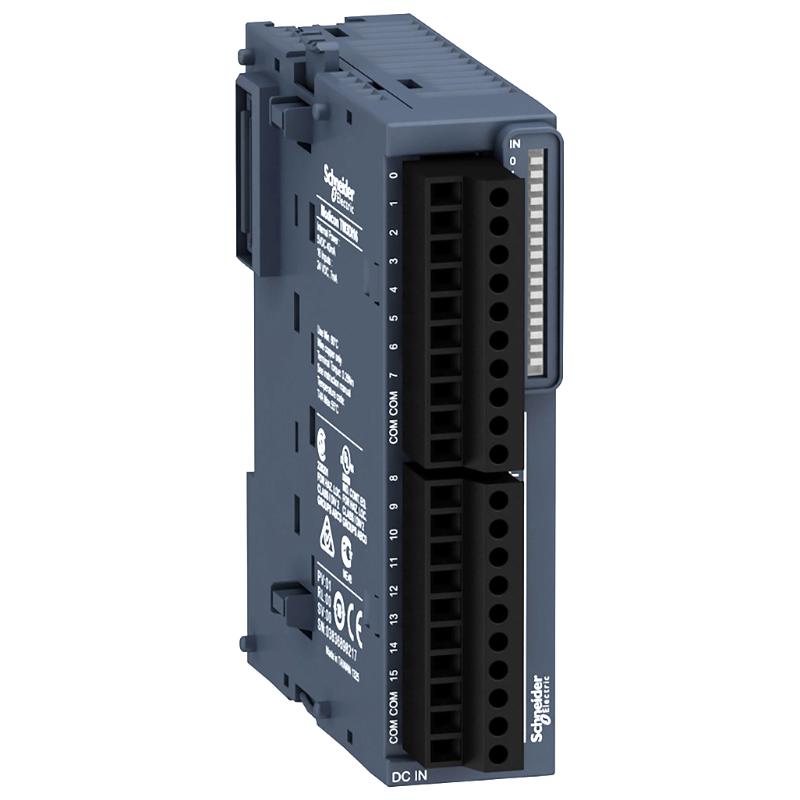
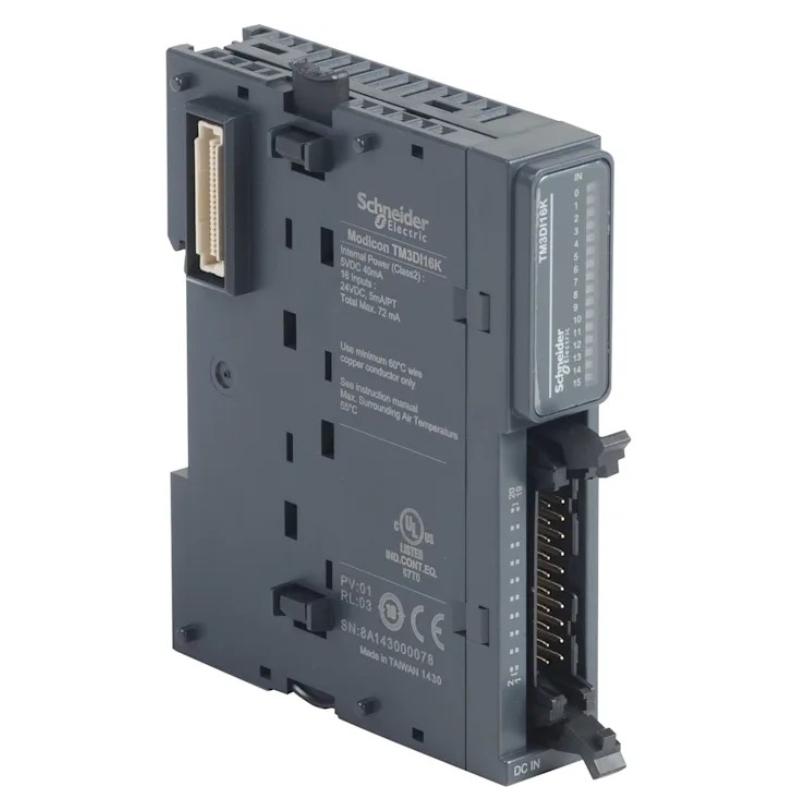
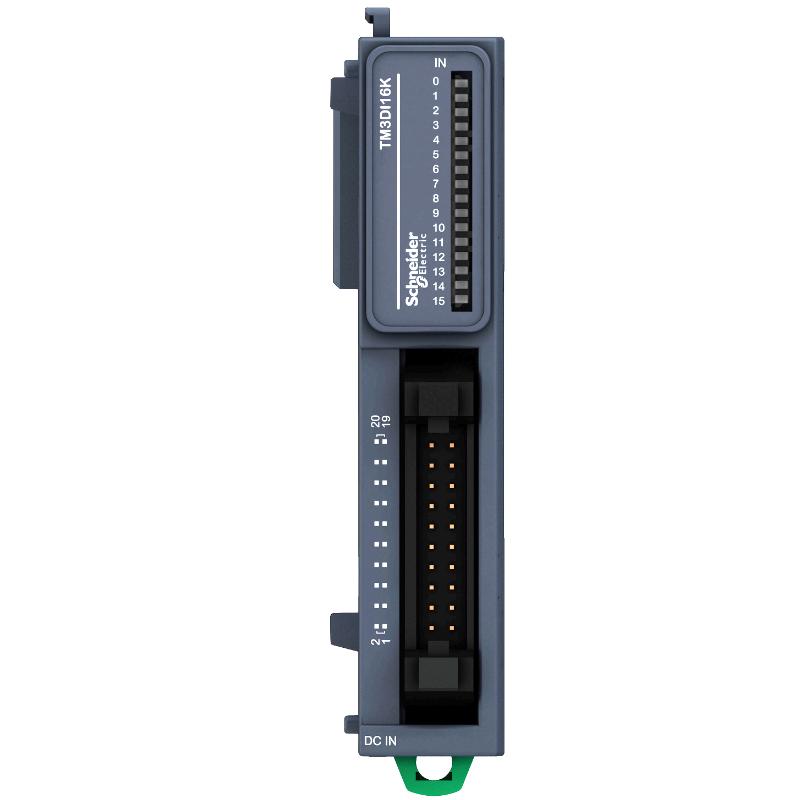
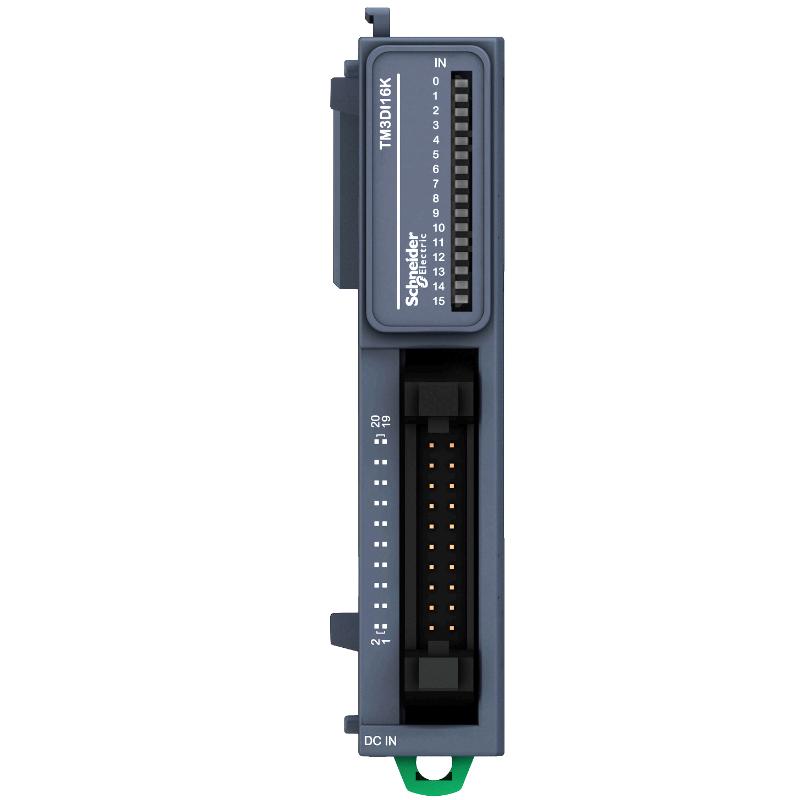
The Schneider TM3DI16K is a Modicon TM3 Discrete Input Module used to add digital input capacity to compatible Modicon controllers. It provides 16 discrete input channels for receiving ON/OFF signals from field devices such as switches, push buttons, limit switches, proximity sensors, and auxiliary contacts.
Within a machine control system, the module acts as the interface between field devices and the controller. Each input channel captures the electrical state of its connected device and makes that information available to the controller program for sequencing, interlocking, machine status monitoring, alarms, and operator commands.
The TM3DI16K is suited to modular I/O configurations where additional discrete signal points are required. It can be combined with other Modicon TM3 expansion modules to match the I/O requirements of a machine or process.
Technical Specifications
| Parameter | Specification |
|---|---|
| Manufacturer | Schneider Electric |
| Model | TM3DI16K |
| Product Family | Modicon TM3 |
| Product Type | Discrete Input Module |
| Number of Inputs | 16 |
| Input Type | Discrete |
| Signal Function | ON/OFF field signal acquisition |
| Application | PLC digital input expansion |
| Dimensions | 90 × 81.3 × 33.5 mm |
| Weight | 0.1 kg |
Product Features
- Provides 16 discrete input channels for compatible Modicon control systems.
- Expands the controller’s available digital input capacity.
- Accepts ON/OFF signals from common industrial field devices.
- Suitable for switches, push buttons, limit switches, proximity sensors, and auxiliary contacts.
- Supports machine sequence, status, alarm, and interlock signals.
- Integrates into a modular Modicon TM3 I/O architecture.
- Can be used with other TM3 modules to build a mixed I/O configuration.
Working Principle
The TM3DI16K monitors the electrical state of each connected discrete input channel. Field devices generate ON/OFF signals, and the module detects these states before making the input information available to the connected Modicon controller.
The basic signal path is:
Field Device → TM3DI16K Discrete Input → Modicon Controller → Control Logic
A change in the state of a switch, sensor, or auxiliary contact is detected by the corresponding input channel. The controller then uses the input state according to the application program. For example, a limit switch can confirm that a mechanism has reached its position, while a push button can initiate a machine command.
Multiple input channels can operate independently, allowing the controller to process several field conditions at the same time.
Role in a Modicon TM3 Control Architecture
The TM3DI16K provides the discrete input interface between field devices and the controller.
| System Element | Function |
|---|---|
| Push Buttons / Selector Switches | Provide operator commands |
| Proximity / Limit Sensors | Detect machine position or object presence |
| TM3DI16K | Collects 16 discrete input signals |
| Modicon Controller | Processes input states through the control program |
| TM3 Expansion Architecture | Provides additional modular I/O capacity |
| Digital Output Modules | Send control signals to external devices |
| HMI | Displays machine status and operator information |
| Actuators | Execute physical machine actions |
The module handles field signal acquisition, while the controller determines how those signals affect the machine sequence and output commands.
Industrial Applications
- Automated machine control
- Packaging equipment
- Conveyor systems
- Material handling machinery
- Assembly machines
- Pump and motor control panels
- Machine position detection
- Operator command interfaces
- Industrial equipment status monitoring
- PLC digital input expansion
Installation and Maintenance
- Verify controller compatibility — Confirm that the TM3DI16K is supported by the intended Modicon controller and TM3 expansion configuration.
- Define channel assignments — Identify the field device connected to each input channel before wiring the module.
- Check field signal requirements — Verify that connected devices provide the appropriate discrete electrical signals for the input circuit.
- Install the module securely — Ensure that the module is properly mounted and correctly connected to the TM3 expansion system.
- Verify terminal wiring — Check each input connection and its associated reference connection against the electrical drawings.
- Organize field wiring — Route discrete signal cables neatly and keep them away from potential sources of electrical interference where necessary.
- Label the channels — Mark each input according to its connected sensor, switch, command, or machine status function.
- Test every input — Operate each field device during commissioning and verify the corresponding input state at the controller.
- Confirm I/O addressing — Make sure the control program references the correct input addresses for the installed module.
- Inspect connections periodically — Check terminals and wiring for looseness, corrosion, or mechanical damage during scheduled maintenance.
- Troubleshoot individual channels — Check the field device, wiring, reference connection, and input status systematically when an input remains in an unexpected state.
- Maintain I/O documentation — Keep channel assignments, wiring drawings, and controller configuration information synchronized with the installed system.
Related Components
- Schneider Modicon TM3 controller systems
- Modicon TM3 digital input modules
- Modicon TM3 digital output modules
- Modicon TM3 analog I/O modules
- Modicon M221 controllers
- Modicon M241 controllers
- Modicon M251 controllers
- Proximity sensors
- Limit switches
- Push buttons and selector switches
- Machine control HMIs
Recommended Related Models
- Schneider Modicon TM3 Digital Input Modules
- Schneider Modicon TM3 Digital Output Modules
- Schneider Modicon TM3 Mixed I/O Modules
- Schneider Modicon M221 Controllers
- Schneider Modicon M241 Controllers
- Schneider Modicon M251 Controllers
Key Advantages
- Provides 16 discrete input channels for Modicon controller expansion.
- Simplifies connection of additional digital field signals.
- Suitable for machine commands, status signals, and position detection.
- Fits into modular TM3 I/O configurations.
- Supports common industrial switches and discrete sensors.
- Provides a direct interface between field devices and controller logic.
Technical FAQs
What is the TM3DI16K used for?
The TM3DI16K is used to expand the discrete input capacity of compatible Modicon control systems. It collects ON/OFF signals from field devices and makes their states available to the controller.
What devices can be connected to its input channels?
Typical applications include push buttons, selector switches, limit switches, proximity sensors, and auxiliary contacts. The electrical characteristics of each field device should be checked before connection.
How does the TM3DI16K fit into a PLC system?
The module sits on the input side of the control architecture. It receives field signals and passes their states to the Modicon controller, where the application program uses them for sequencing, interlocking, alarms, and machine status functions.
What should be checked when an input remains ON or OFF?
Check the connected field device first, followed by the wiring, reference connection, terminal condition, and controller input status. If the expected electrical signal is present but the input state remains incorrect, inspect the module connection and controller I/O configuration.