

ProductPRODUCT
Featured products
Contact Us
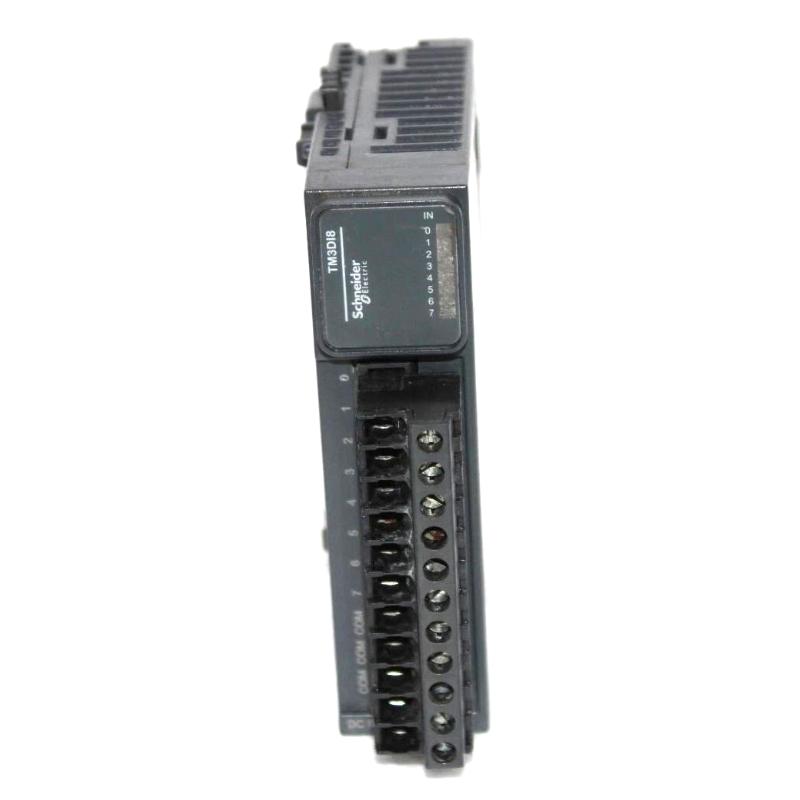
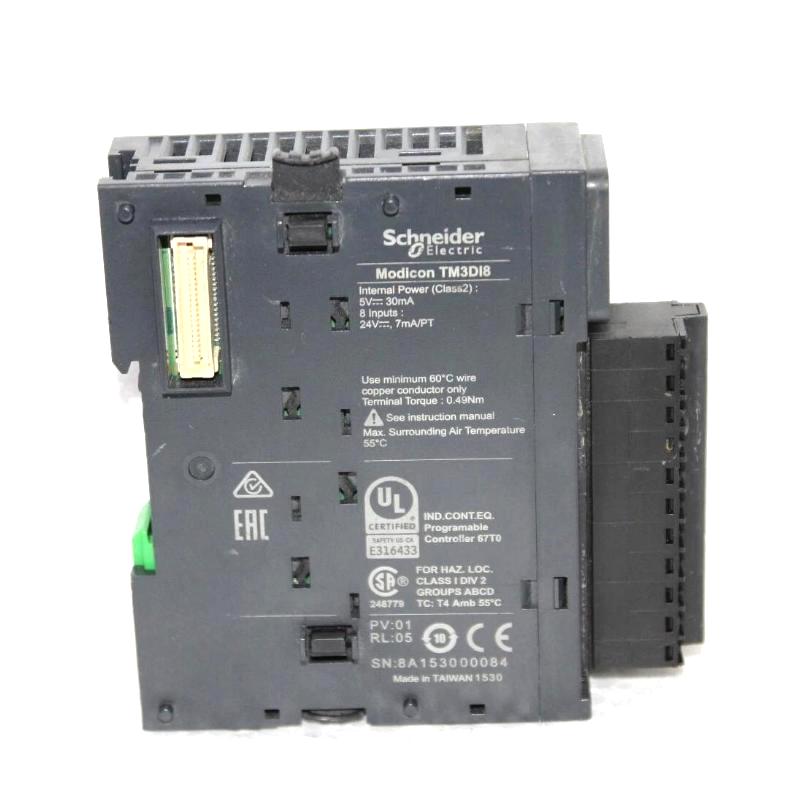
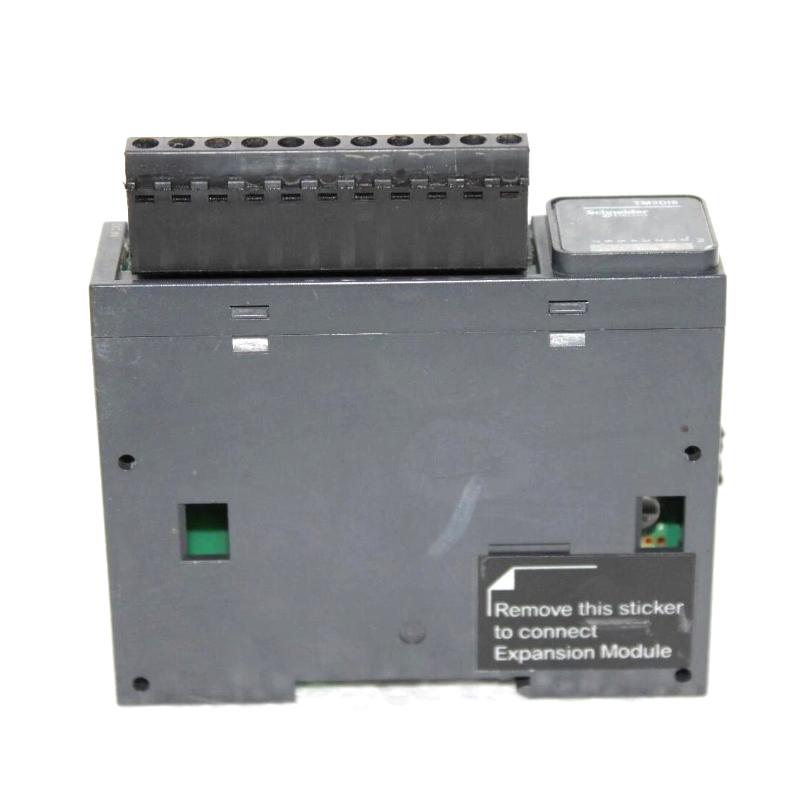
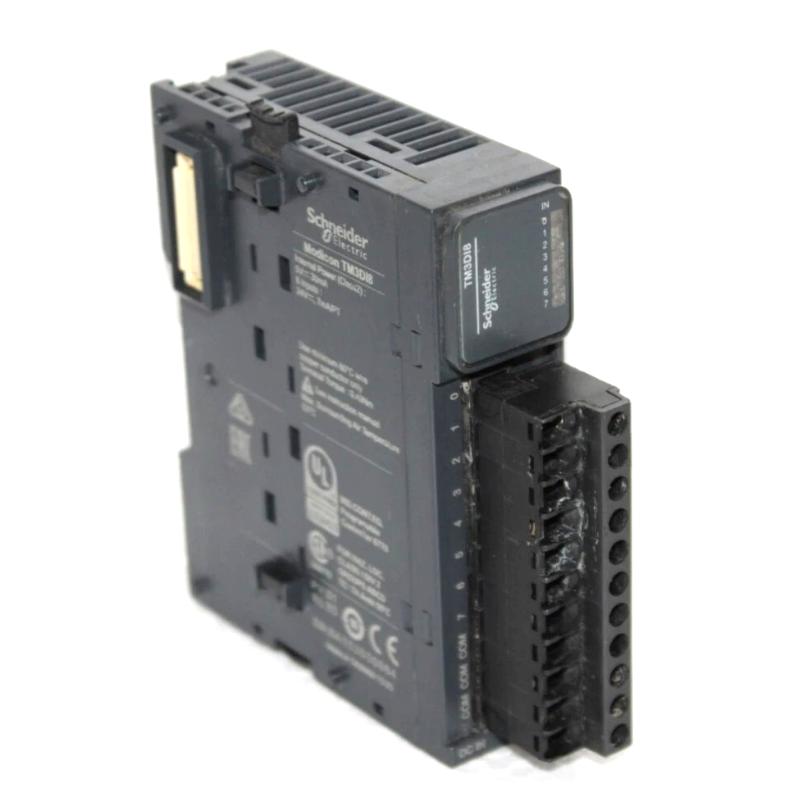
- Schneider
- TM3DI8
- Discrete Input Module
- France
- 90 × 27.4 × 84.6 mm
- 0.085 kg
- Xiamen, China
- New & In Stock
- T/T, PayPal, Western Union
- 1 Year
- 1-3 Working Days
- DHL, UPS, TNT, FedEx and EMS.
- 24-Hour Service
- COO
- 5
Our advantage

Global Logistics
We have a 10-year logistics and express cooperation agreement, so our products can be shipped to any place in the world.

Brand new and original
Our products are imported in bulk from the place of origin. Because of the cooperative relationship, our products are all original and 100% new.

24-hour service
We provide 7*24 hours service to our customers. We will be there whenever you need us.

Price advantage
All our products are priced very favorably because we have our own warehouse and supply.
| Company Information | |||
| [email protected] | |||
| Mobile | +8615980777398 | ||
| +8615980777398 | |||
| 15980777398 |
Product Overview
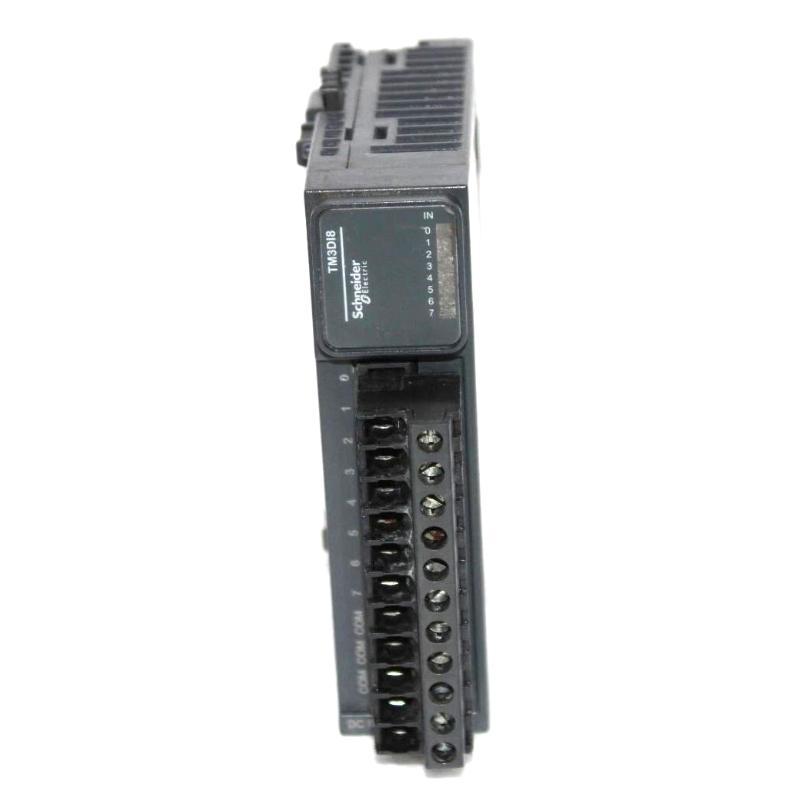
The Schneider TM3DI8 is a Modicon TM3 Discrete Input Module used to add eight discrete input channels to compatible Modicon controller systems. It provides a practical interface for collecting ON/OFF signals from field devices such as push buttons, selector switches, limit switches, proximity sensors, and auxiliary contacts.
In a machine control application, the TM3DI8 receives field-level status information and passes the input states to the controller. The controller can then use these signals for sequence logic, position confirmation, machine status, alarms, and interlocking functions.
The eight-channel configuration is suitable for smaller machines or applications where only a limited number of additional digital inputs are required. It can also be combined with other TM3 expansion modules when a control system requires different types of I/O.
Technical Specifications
| Parameter | Specification |
|---|---|
| Manufacturer | Schneider Electric |
| Model | TM3DI8 |
| Product Family | Modicon TM3 |
| Product Type | Discrete Input Module |
| Number of Inputs | 8 |
| Input Type | Discrete |
| Signal Function | ON/OFF field signal acquisition |
| Application | PLC digital input expansion |
| Dimensions | 90 × 27.4 × 84.6 mm |
| Weight | 0.085 kg |
Product Features
- Provides eight discrete input channels for compatible Modicon control systems.
- Adds digital input capacity without changing the main controller.
- Accepts ON/OFF signals from common industrial field devices.
- Suitable for switches, push buttons, proximity sensors, limit switches, and auxiliary contacts.
- Supports machine position, status, command, and interlock signals.
- Integrates into a modular Modicon TM3 I/O architecture.
- Suitable for applications requiring a relatively small number of additional discrete inputs.
Working Principle
The TM3DI8 detects the electrical state of each of its eight discrete input channels and communicates those states to the connected Modicon controller.
The basic signal path is:
Field Device → TM3DI8 Discrete Input → Modicon Controller → Control Logic
When a connected sensor or switch changes state, the corresponding input channel detects the change. The controller receives the input status and applies the programmed logic.
For example, a proximity sensor can indicate that a workpiece has reached a defined position, while a limit switch can confirm the end position of a mechanical movement. Push buttons and selector switches can provide operator commands that are also processed through the same input interface.
Role in a Modicon TM3 Control Architecture
The TM3DI8 provides the discrete input interface between field devices and the controller.
| System Element | Function |
|---|---|
| Push Buttons / Selector Switches | Provide operator commands |
| Proximity / Limit Sensors | Detect machine position or object presence |
| Auxiliary Contacts | Provide equipment status |
| TM3DI8 | Collects 8 discrete input signals |
| Modicon Controller | Processes input states through the control program |
| TM3 Expansion Architecture | Provides modular I/O expansion |
| Digital Output Modules | Send control commands to external devices |
| HMI | Displays machine status and operator information |
| Actuators | Execute physical machine actions |
The TM3DI8 handles field signal acquisition while the controller determines how each input affects the machine’s operation.
Industrial Applications
- Small automated machines
- Packaging equipment
- Conveyor systems
- Assembly machinery
- Material handling equipment
- Pump and motor control panels
- Machine position detection
- Operator push-button interfaces
- Equipment status monitoring
- PLC digital input expansion
Installation and Maintenance
- Verify controller compatibility — Confirm that the TM3DI8 is supported by the intended Modicon controller and TM3 expansion configuration.
- Assign the input channels — Define the field device associated with each of the eight input channels before wiring.
- Check field signal characteristics — Verify that connected sensors, switches, and contacts provide suitable discrete electrical signals.
- Install the module securely — Ensure that the module is correctly mounted and properly connected to the TM3 expansion system.
- Check terminal wiring — Confirm that each field signal and its reference connection are connected to the correct terminals.
- Route signal wiring carefully — Keep input wiring organized and separated from potential sources of electrical interference where necessary.
- Label each channel — Identify the connected field device and machine function for every input channel.
- Test each input during commissioning — Operate the connected field device and verify that the corresponding input state changes correctly in the controller.
- Confirm I/O addressing — Check that the control program references the correct input addresses for the installed module.
- Inspect connections periodically — Check terminals and field wiring for looseness, corrosion, or mechanical damage.
- Troubleshoot abnormal input states — Check the field device, wiring, reference connection, and controller status before replacing the module.
- Maintain I/O documentation — Keep the input channel assignment and electrical documentation updated after wiring changes or maintenance.
Related Components
- Schneider Modicon TM3 controller systems
- Modicon TM3 digital input modules
- Modicon TM3 digital output modules
- Modicon TM3 analog I/O modules
- Modicon M221 controllers
- Modicon M241 controllers
- Modicon M251 controllers
- Proximity sensors
- Limit switches
- Push buttons and selector switches
- Machine control HMIs
Recommended Related Models
- Schneider Modicon TM3 Digital Input Modules
- Schneider Modicon TM3 Digital Output Modules
- Schneider Modicon TM3 Mixed I/O Modules
- Schneider Modicon M221 Controllers
- Schneider Modicon M241 Controllers
- Schneider Modicon M251 Controllers
Key Advantages
- Provides eight discrete input channels for controller expansion.
- Suitable for machines requiring a smaller number of additional digital inputs.
- Supports common industrial sensors, switches, and operator devices.
- Handles machine status, position, command, and interlock signals.
- Integrates into the modular Modicon TM3 architecture.
- Provides a direct interface between field devices and controller logic.
Technical FAQs
What is the TM3DI8 used for?
The TM3DI8 is used to expand the discrete input capacity of compatible Modicon control systems. It collects ON/OFF signals from field devices and makes their states available to the controller.
What types of field devices can be connected?
Typical applications include proximity sensors, limit switches, push buttons, selector switches, and auxiliary contacts. The electrical requirements of the connected devices should be verified before installation.
When is an eight-channel input module useful?
An eight-channel module is suitable when the machine requires only a limited number of additional discrete input points. It can also be used as part of a larger TM3 configuration alongside other I/O modules.
What should be checked if an input channel does not respond?
Check the connected field device first, then verify the wiring, reference connection, terminal condition, and controller input status. If the expected field signal is present but the controller still shows an incorrect state, inspect the module connection and I/O configuration.