

ProductPRODUCT
Featured products



Contact Us
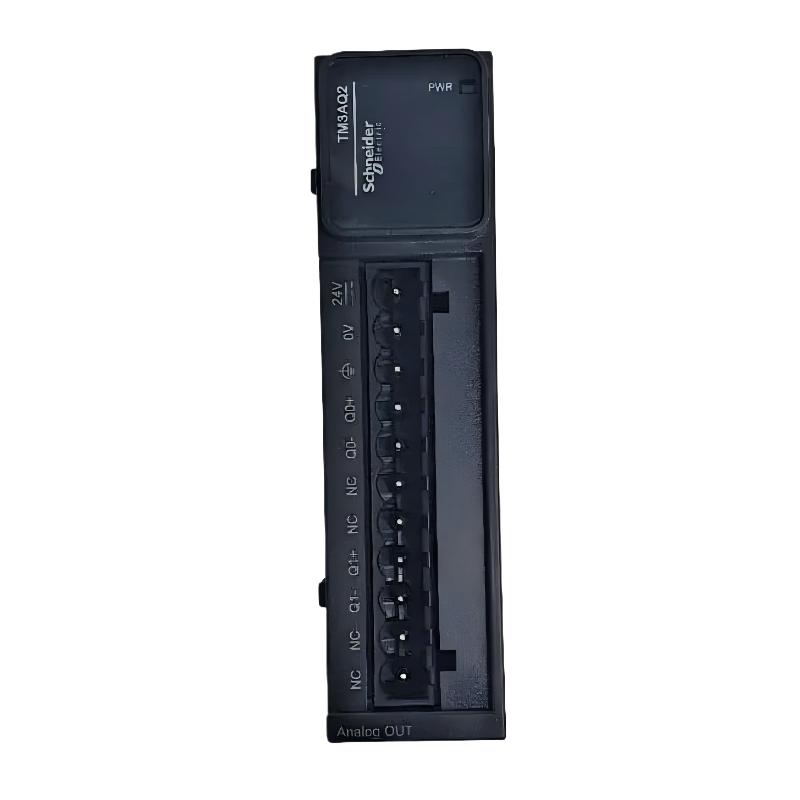
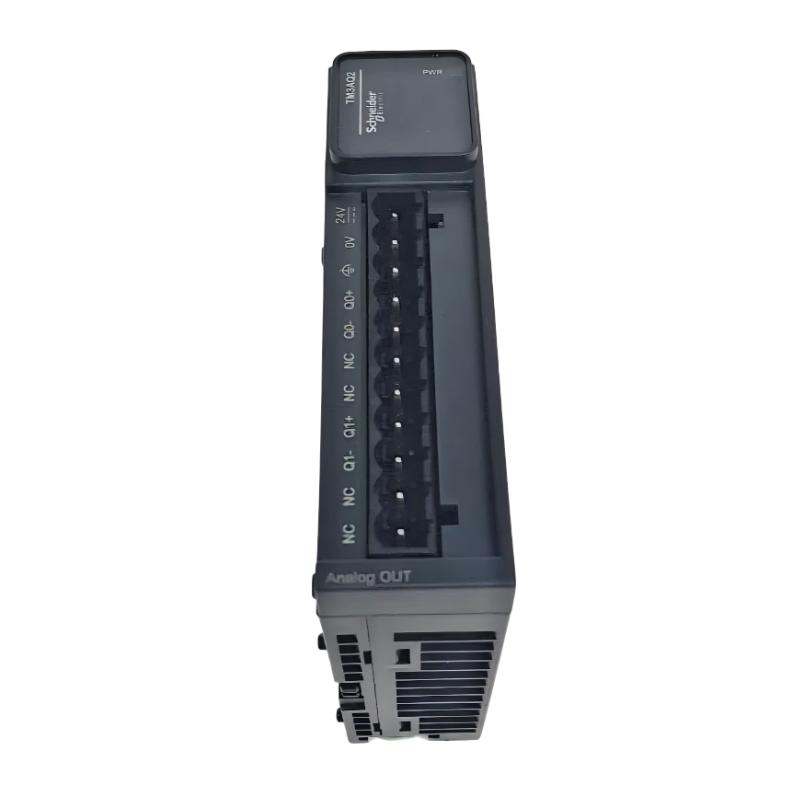
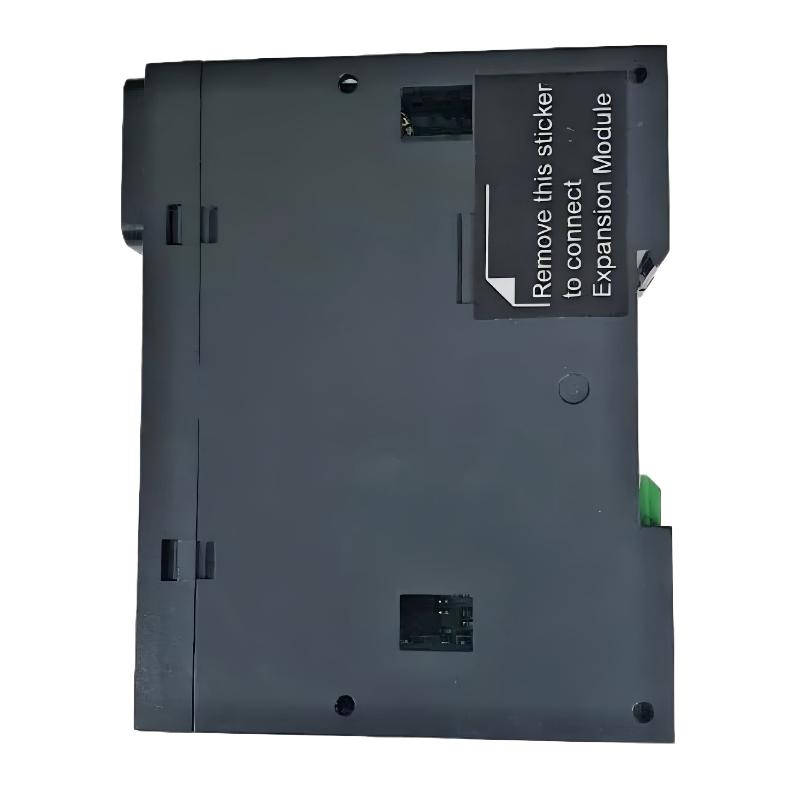
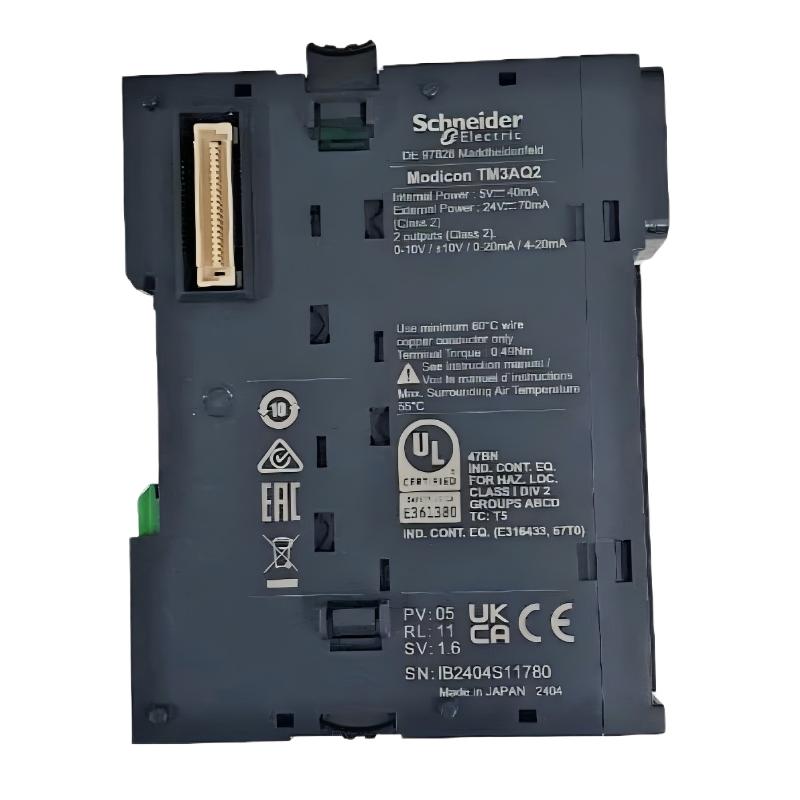
- Schneider
- TM3AQ2
- Analog Output Module
- France
- 90 x 23.6 x 70 mm
- 0.115 kg
- Xiamen, China
- New & In Stock
- T/T, PayPal, Western Union
- 1 Year
- 1-3 Working Days
- DHL, UPS, TNT, FedEx and EMS.
- 24-Hour Service
- COO
- 2
Our advantage

Global Logistics
We have a 10-year logistics and express cooperation agreement, so our products can be shipped to any place in the world.

Brand new and original
Our products are imported in bulk from the place of origin. Because of the cooperative relationship, our products are all original and 100% new.

24-hour service
We provide 7*24 hours service to our customers. We will be there whenever you need us.

Price advantage
All our products are priced very favorably because we have our own warehouse and supply.
| Company Information | |||
| [email protected] | |||
| Mobile | +8615980777398 | ||
| +8615980777398 | |||
| 15980777398 |
1. Product Overview
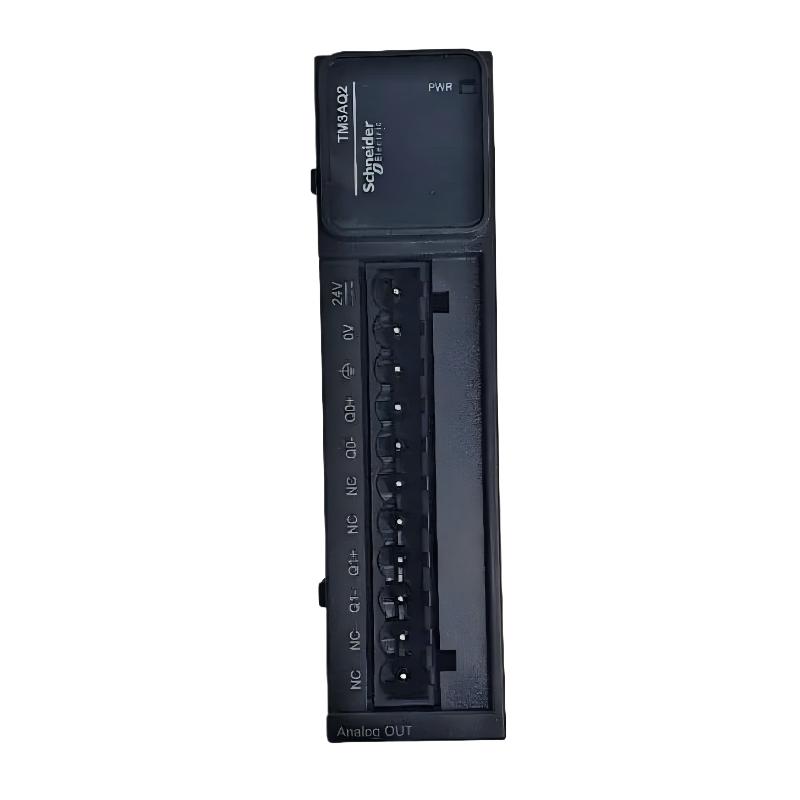
The Schneider Electric TM3AQ2 is a two-channel analog output expansion module designed for the Modicon TM3 I/O system. It enables compatible Modicon logic controllers to send analog control signals to external devices such as variable speed drives, control valves, actuators, and other equipment that accepts voltage or current references.
As part of Schneider Electric’s Modicon TM3 expansion range, the TM3AQ2 supports flexible PLC system configuration for industrial automation applications. It provides selectable voltage and current output modes, allowing engineers to match the module to the requirements of connected field devices.
The TM3AQ2 supports 12-bit resolution or 11-bit resolution plus sign, depending on the configured signal mode. Its two output channels can be configured for standard analog signals, including 0–10 V, -10–+10 V, 0–20 mA, and 4–20 mA. This makes the module suitable for applications that require PLC-based control of speed, position references, flow, pressure, or other process variables.
The module uses a removable screw terminal block for field wiring and is designed for integration with compatible Modicon M221, M241, M251, and M262 logic controllers. Its compact form supports DIN-rail or panel installation within industrial control cabinets.
2. Technical Specifications
| Parameter | Specification |
|---|---|
| Brand | Schneider Electric |
| Model | TM3AQ2 |
| Product Series | Modicon TM3 |
| Product Type | Analog Output Module |
| Number of Output Channels | 2 |
| Output Signal Types | Voltage and current |
| Voltage Output Ranges | 0–10 V DC, -10–+10 V DC |
| Current Output Ranges | 0–20 mA, 4–20 mA |
| Output Resolution | 12 bits or 11 bits + sign |
| Rated Supply Voltage | 24 V DC |
| Supply Voltage Limits | 20.4–28.8 V DC |
| Terminal Type | Removable screw terminal block |
| Terminal Pitch | 5.08 mm |
| Load Type | Resistive |
| Minimum Voltage Load Impedance | 1 kΩ |
| Maximum Current Load Impedance | 300 Ω |
| Stabilization Time | 1 ms |
| Conversion Time | 1 ms + 1 ms per channel + one controller cycle |
| Output Cable | Twisted, shielded pair |
| Maximum Recommended Output Cable Length | 30 m |
| Protection Rating | IP20 |
| Compatible Controller Families | Modicon M221, M241, M251, M262 |
| Mounting Options | Compatible DIN rail or panel mounting kit |
| Dimensions (H × W × D) | 90 × 23.6 × 70 mm |
| Weight | 0.115 kg |
| Status Indicator | Green PWR LED |
Specifications are provided for product identification and engineering reference. Confirm the required output mode, load characteristics, wiring arrangement, and controller compatibility before installation.
3. Function and Working Principle
The primary function of the TM3AQ2 is to convert digital control values from a PLC into analog electrical output signals. These signals allow a controller to regulate external equipment whose operating level is determined by voltage or current.
3.1 Digital-to-Analog Conversion
The PLC program calculates a desired control value and transfers the corresponding output command to the analog output module through the TM3 expansion bus. The TM3AQ2 converts this digital value into the selected voltage or current signal.
For example, a PLC may calculate a desired motor speed reference based on a process setpoint. The TM3AQ2 can then provide a corresponding analog signal to a compatible variable speed drive. The drive interprets that signal according to its own configuration and adjusts motor operation accordingly.
3.2 Voltage Output
The module supports 0–10 V DC and -10–+10 V DC output ranges. Voltage output can be used when the connected equipment accepts a voltage reference.
Typical applications include speed references for drives, position commands for compatible controllers, and analog setpoints for process instruments. The selected range must match the receiving device’s input configuration.
3.3 Current Output
The TM3AQ2 also supports 0–20 mA and 4–20 mA current output ranges. Current signals are widely used in industrial environments for process control because they can be suitable for transmitting reference values over appropriately designed wiring.
A 4–20 mA output can represent a process setpoint across a defined operating range. For example, a PLC may command a valve position by varying the output current, provided that the valve positioner is designed for that input type.
3.4 Output Resolution and Response
The module offers 12-bit resolution or 11-bit resolution plus sign, depending on the selected mode. Resolution determines the number of digital steps available across the configured signal range. The practical control accuracy also depends on module accuracy, wiring, electrical noise, the receiving device, and system configuration.
The documented stabilization time is 1 ms. The conversion time includes a 1 ms base interval, an additional 1 ms per channel, and one controller cycle. The actual response of the complete control system therefore depends on the PLC task cycle and the connected equipment.
3.5 Output Configuration
Each channel must be configured for its intended signal type in the engineering software. The physical wiring must correspond to the selected software configuration. Voltage and current modes must not be treated as interchangeable without checking the terminal assignment and the applicable wiring instructions.
Incorrect mode selection or wiring can cause inaccurate output behavior and may damage the analog circuit.
4. Role in Industrial Control Systems
The TM3AQ2 serves as the output interface between a programmable logic controller and external devices requiring analog commands.
4.1 PLC Output Expansion
A controller may have a limited number of onboard analog outputs. Adding a TM3AQ2 can provide two additional analog output channels, subject to the supported expansion configuration and controller limits.
This allows a machine builder to add analog control functions without replacing the main controller solely to obtain additional outputs.
4.2 Equipment Setpoint Control
Many industrial devices require an external reference signal rather than a simple digital ON/OFF command. The TM3AQ2 can provide that reference to compatible drives, valve positioners, and other analog-controlled equipment.
The PLC program remains responsible for calculating the required command and determining when it should change.
4.3 Process Automation
In a process-control application, the controller may calculate an output command from a measured value, operating mode, or recipe. The TM3AQ2 translates that command into a voltage or current signal for the final control element.
The module supplies the analog output interface; it does not independently perform the complete process-control strategy. Feedback acquisition, interlocks, alarms, and control algorithms must be implemented through the appropriate system components and PLC program.
4.4 Machine Control Integration
The TM3AQ2 can be used in automated production equipment where analog commands are required alongside digital input and output functions. It can be incorporated into a broader TM3 expansion arrangement when the controller, module count, power budget, and physical layout meet the applicable requirements.
5. Industrial Applications
5.1 Variable Speed Drive Control
The TM3AQ2 can provide an analog speed reference to a compatible variable speed drive. A PLC may adjust the reference according to production demand, process conditions, or operator commands.
Before commissioning, verify that the drive’s selected analog input range matches the module output range.
5.2 Valve and Actuator Positioning
Some control valves and actuators accept a 0–10 V or 4–20 mA command. The TM3AQ2 can provide the required signal when the field device’s electrical interface and load requirements are compatible.
The output module itself does not verify actual valve position. Position feedback, where required, must be provided by an appropriate sensor or feedback device.
5.3 Flow and Pressure Control
In industrial fluid systems, the PLC may calculate a command for a pump drive, valve positioner, or other regulating device. The TM3AQ2 can transmit the command as a configured analog output.
The module is particularly useful when the controlled device requires a continuously adjustable reference instead of a simple digital command.
5.4 Temperature Control Systems
The module can send an analog reference to compatible temperature-control equipment, such as a controller or power-regulation device that accepts the selected signal type.
The temperature measurement and control logic must be provided by suitable input devices and PLC programming. The TM3AQ2 is an output module, not a temperature sensor.
5.5 Packaging and Material Handling
Packaging machinery and material-handling systems may use analog references for drive speed, tension control, or other adjustable process parameters. The TM3AQ2 can support these functions when the receiving equipment is designed for its output signals.
5.6 Water Treatment and Utility Systems
Pumping, dosing, and flow-regulation systems can use analog commands to control compatible drives or actuators. The module can form part of a PLC-based control architecture, provided that environmental, electrical, and process-safety requirements are addressed by the overall system design.
6. Installation and System Integration
Correct installation and configuration are essential for reliable operation of the TM3AQ2.
6.1 Controller Compatibility
The TM3AQ2 belongs to the Modicon TM3 expansion range and is designed for use with compatible Modicon M221, M241, M251, and M262 logic controllers. Confirm the controller’s hardware and firmware requirements, expansion limits, and engineering-software version before assembly.
6.2 Mounting
Install the module in an appropriate control cabinet using a supported DIN rail or the specified panel-mounting arrangement. Allow adequate clearance for wiring, heat dissipation, servicing, and access to terminal blocks.
The module has an IP20 rating. It should be installed in an enclosure that provides the protection required by the surrounding industrial environment.
6.3 Power Supply
The rated supply voltage is 24 V DC, with a documented supply range of 20.4–28.8 V DC. Confirm the applicable supply and bus-power requirements from the installation documentation.
The cabinet power supply must be sized for the complete installed system, including the controller, expansion modules, sensors, actuators, and other connected loads. Do not determine the total power requirement from the TM3AQ2 rating alone.
6.4 Output Wiring
Use suitable twisted, shielded pair cable for analog output wiring, with a recommended maximum output cable length of 30 m. Route analog signal cables away from high-current conductors, motor cables, and sources of electromagnetic interference where practical.
Follow the specified grounding and shield-termination practices for the complete installation. Incorrect grounding can introduce noise or create unwanted current paths.
6.5 Output Load Verification
Before connecting a field device, verify its input type and electrical load. The specified minimum voltage-load impedance is 1 kΩ, while the maximum current-load impedance is 300 Ω.
Ensure the selected output range and the receiving device’s input configuration are compatible. An unsuitable load can prevent the module from producing the intended signal.
6.6 Software Configuration
Use the applicable Schneider Electric engineering software to identify the expansion module and configure each output channel. Select the correct voltage or current mode and set the intended operating range in accordance with the PLC application.
After configuration, test each channel using a controlled commissioning procedure. Confirm the command value, measured output, receiving-device response, and any relevant alarms.
6.7 Commissioning and Troubleshooting
During commissioning, check the following:
- The module is correctly installed and recognized by the controller.
- The green PWR indicator shows the expected power status.
- The field wiring matches the configured output type.
- The receiving device uses the same voltage or current range.
- The output load is within the specified limits.
- Analog cables and shield connections follow the installation requirements.
- The PLC program scales engineering values correctly to the configured output range.
If the output is incorrect, check the software configuration, terminal wiring, load impedance, external power, controller status, and the receiving device’s input settings before replacing hardware.
7. Compatible System Components
The TM3AQ2 is intended to operate as part of a compatible Modicon control system. Typical associated components include:
| Component | Role in the System |
|---|---|
| Modicon M221 Logic Controller | Executes PLC logic and exchanges data with supported TM3 expansion modules |
| Modicon M241 Logic Controller | Provides machine-control functions and supported I/O expansion |
| Modicon M251 Logic Controller | Supports compatible controller and expansion configurations |
| Modicon M262 Logic Controller | Provides control and communication functions in supported configurations |
| TM3 Digital Input Modules | Acquire discrete signals from switches, sensors, and other devices |
| TM3 Digital Output Modules | Control compatible discrete field loads through the appropriate interface |
| TM3 Analog Input Modules | Acquire compatible voltage or current signals from field instruments |
| Variable Speed Drive | Receives an analog reference when its input configuration supports the selected signal |
| Valve Positioner or Actuator Controller | Uses a compatible analog command to regulate position or operation |
| 24 V DC Power Supply | Supplies the control system according to the applicable power requirements |
| Shielded Twisted-Pair Cable | Connects analog outputs to compatible field devices |
Actual compatibility depends on the controller model, expansion arrangement, software configuration, power budget, and field-device requirements. Check the relevant system documentation before selecting or combining components.
8. Recommended Alternative Models
The following models may be considered when selecting an analog output module or planning a different I/O configuration. They are not automatically interchangeable with the TM3AQ2.
| Model | Description | Key Difference |
|---|---|---|
| Schneider TM3AQ2 | Two-channel analog output module with screw terminals | Reference model |
| Schneider TM3AQ2G | Two-channel analog output module with spring terminals | Different terminal connection style |
| Schneider TM3AQ4 | Four-channel analog output module with screw terminals | Provides four output channels |
| Schneider TM3AQ4G | Four-channel analog output module with spring terminals | Four outputs with spring terminals |
| Schneider TM3AI2 | Two-channel analog input module | Receives analog signals rather than generating outputs |
| Schneider TM3AI4 | Four-channel analog input module | Provides analog input expansion rather than analog output |
When selecting an alternative, compare channel count, signal types, terminal style, electrical ratings, controller compatibility, and engineering-software configuration. Analog input and output modules perform different functions and should not be substituted for one another without redesigning the system.
9. Key Advantages
Two Analog Output Channels
The TM3AQ2 provides two configurable output channels, enabling a compatible PLC to control two analog-command devices or functions within the supported system design.
Multiple Signal Ranges
Support for 0–10 V, -10–+10 V, 0–20 mA, and 4–20 mA allows the module to interface with a range of industrial devices that accept these standard signals.
Compact Form Factor
With dimensions of 90 × 23.6 × 70 mm and a weight of approximately 0.115 kg, the module can be incorporated into suitably designed industrial control cabinets where installation space matters.
Removable Screw Terminals
The removable screw terminal block supports field wiring and can simplify wiring preparation and maintenance when used in accordance with the product’s installation instructions.
Modicon TM3 Expansion Integration
The module is designed for compatible Modicon M221, M241, M251, and M262 controller families, providing an option for expanding analog output capacity within the supported TM3 architecture.
PLC-Based Control Flexibility
Because output values are managed by the PLC program, the module can support different machine and process-control strategies without requiring a separate analog output device for each supported signal function.
10. Technical FAQs
Q1: What is the Schneider TM3AQ2?
The Schneider Electric TM3AQ2 is a two-channel analog output expansion module in the Modicon TM3 series. It converts PLC output commands into configurable voltage or current signals for compatible external equipment.
Q2: How many analog outputs does the TM3AQ2 provide?
The TM3AQ2 provides two analog output channels.
Q3: Which output signal ranges are supported?
The module supports 0–10 V DC, -10–+10 V DC, 0–20 mA, and 4–20 mA. The selected mode must match the field-device input and physical wiring.
Q4: What is the output resolution?
The module supports 12-bit resolution or 11-bit resolution plus sign, depending on the selected output mode.
Q5: Which PLC controllers are compatible with the TM3AQ2?
The module is designed for compatible Modicon M221, M241, M251, and M262 logic controllers. The precise system configuration should be checked against the controller and expansion documentation.
Q6: What is the rated power supply?
The documented rated supply voltage is 24 V DC, with supply limits of 20.4–28.8 V DC.
Q7: What are the dimensions and weight of the module?
The module measures approximately 90 mm high, 23.6 mm wide, and 70 mm deep. Its specified weight is 0.115 kg.
Q8: Can the TM3AQ2 control a variable speed drive?
Yes, when the drive accepts a supported analog reference and is configured for the same signal type and range. The PLC program and drive configuration determine how the reference affects operation.
Q9: What cable should be used for analog output wiring?
Twisted, shielded pair cable is specified for the output circuit, with a maximum recommended cable length of 30 m. Follow the product instructions and site grounding practices.
Q10: Is the TM3AQ2 interchangeable with the TM3AQ2G?
Not directly in every installation. Both models provide two analog output channels, but the TM3AQ2 uses removable screw terminals while the TM3AQ2G uses removable spring terminals. Check the exact wiring and installation requirements before substituting one for the other.
Q11: What should be checked if the analog output is incorrect?
Check the selected output mode, terminal wiring, power supply, output load, PLC scaling, receiving-device input configuration, and controller status. Verify these conditions before concluding that the module is defective.
Q12: Does the TM3AQ2 measure analog process values?
No. It is an analog output module. Analog measurement requires a compatible analog input module or another suitable measurement device.
11. Conclusion
The Schneider Electric TM3AQ2 is a compact, two-channel analog output module for compatible Modicon TM3 control systems. Its support for common voltage and current signal ranges makes it suitable for PLC-based command generation in machine automation and industrial process applications.
With 12-bit or 11-bit-plus-sign resolution, removable screw terminals, and compatibility with supported Modicon M221, M241, M251, and M262 controllers, the TM3AQ2 provides an option for extending analog control capability without changing the overall PLC architecture.
For successful implementation, engineers should verify controller compatibility, output configuration, wiring, load impedance, power requirements, and the input specifications of connected field devices. These checks help ensure that the module is correctly integrated into the wider automation system.