
NewsNEWCENTER
Featured products
Contact Us
Allen Bradley 1606-XLP100E Power Supply Troubleshooting Guide
2026-09-15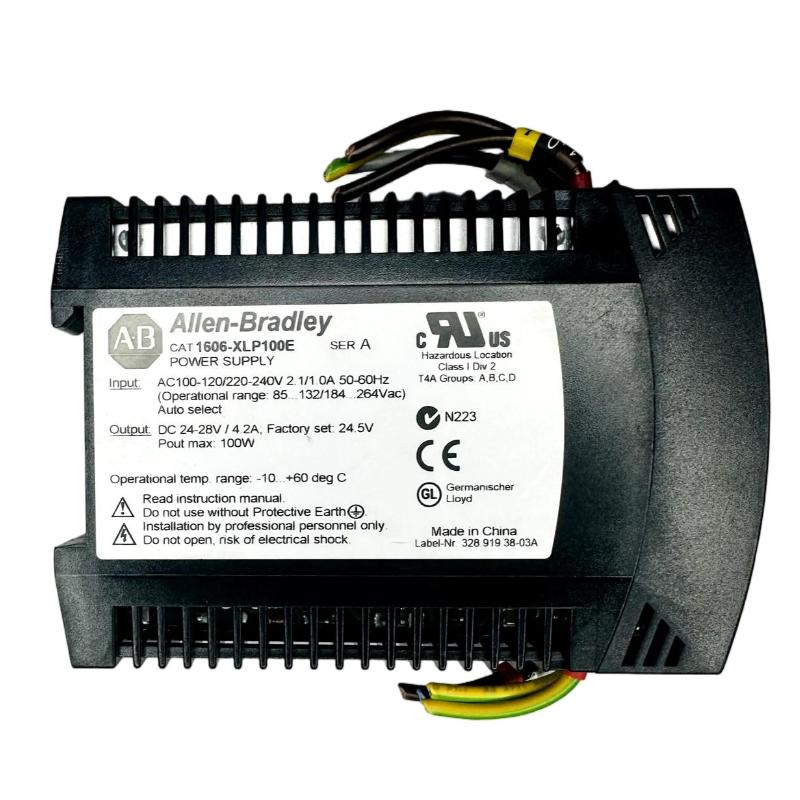
Table of Contents
- Allen Bradley 1606-XLP100E Power Supply Fault Diagnosis Overview
- Allen Bradley 1606-XLP100E Common Fault Symptoms
- Common Causes of Allen Bradley 1606-XLP100E Faults
- Allen Bradley 1606-XLP100E Troubleshooting Diagnostic Logic
- Allen Bradley 1606-XLP100E Voltage Measurement and Fault Analysis
- Allen Bradley 1606-XLP100E Repair and Replacement Procedure
- Allen Bradley 1606-XLP100E Field Troubleshooting Case
- Allen Bradley 1606-XLP100E Troubleshooting FAQ
- Allen Bradley 1606-XLP100E Technical Summary
Allen Bradley 1606-XLP100E Power Supply Fault Diagnosis Overview
Allen Bradley 1606-XLP100E Power Supply Troubleshooting should begin by separating a genuine power supply fault from a downstream DC distribution problem. A PLC Controller restart, remote I/O dropout, HMI reset or unstable Sensor signal may be related to the DC power system, but the power supply itself should not be condemned until its input and output behavior has been measured under the conditions that produce the fault.
The most useful Fault Diagnosis question is simple: does the abnormal voltage already exist at the 1606-XLP100E output, or does it appear somewhere between the power supply and the affected device?
Allen Bradley 1606-XLP100E Common Fault Symptoms
- PLC Controller unexpectedly restarts.
- Remote I/O Modules intermittently lose communication.
- HMI equipment resets.
- Network equipment becomes unavailable.
- Control relays drop out.
- Sensor signals become intermittent.
- Automation equipment fails when several loads operate together.
- DC voltage decreases at remote equipment.
The operating condition associated with the fault is often more useful than the alarm message itself. A failure that appears only during peak load should be investigated differently from a failure that occurs immediately after energization.
Common Causes of Allen Bradley 1606-XLP100E Faults
- Unstable incoming AC power
- Incorrect input wiring
- Overloaded DC distribution
- Loose terminals
- Corroded connections
- Undersized DC conductors
- Excessive cable length
- Poor grounding or EMC practices
- Excessive cabinet temperature
- Internal power supply failure
Several external conditions can create symptoms that resemble an internal power supply failure. A disciplined Troubleshooting procedure should therefore eliminate external causes before replacement.
Allen Bradley 1606-XLP100E Troubleshooting Diagnostic Logic
Use a source-to-load diagnostic approach. Start at the incoming power and progressively move toward the device reporting the fault.
Reported Fault
      |
      v
Check Incoming AC
      |
      v
Check 1606-XLP100E Output
      |
 +----+----------------+
 |                     |
Stable                Unstable
 |                     |
 v                     v
Check DC               Investigate
Distribution            Input / Supply
 |
 v
Measure Remote Load
 |
 v
Check Connected Loads
 |
 v
Identify Root Cause
This approach is particularly effective when multiple devices fail simultaneously. A single bad distribution connection can affect an entire group of PLCs, I/O Modules or communication devices.
Allen Bradley 1606-XLP100E Voltage Measurement and Fault Analysis
Take measurements during both normal and fault-producing conditions. Testing only while the machine is idle can hide problems that appear when current demand increases.
- Incoming AC voltage
- Power supply DC output
- Main DC distribution voltage
- Remote cabinet voltage
- PLC Controller supply voltage
- I/O Module supply voltage
- Voltage during simultaneous load activation
An example maintenance record can be structured as follows:
Machine idle:
Power supply output = approximately 24.1 VDC
Remote cabinet = approximately 24.0 VDC

High-load condition:
Power supply output = approximately 24.0 VDC
Remote cabinet = approximately 22.3 VDC

Diagnostic direction:
Investigate downstream distribution and load behavior.
The numerical values above are illustrative field-diagnostic examples, not universal specifications for the Allen Bradley 1606-XLP100E.
Allen Bradley 1606-XLP100E Repair and Replacement Procedure
Once the measurements have been collected, use the evidence to determine whether repair or replacement is justified.
- Confirm the exact failure symptom.
- Inspect the cabinet and power supply visually.
- Verify incoming AC voltage.
- Measure the power supply output.
- Repeat the measurement under load.
- Measure voltage at the affected equipment.
- Inspect terminals, cables and distribution blocks.
- Check the total connected DC load.
- Compare results with commissioning records.
- Replace the power supply only when the evidence indicates an internal failure.
After any repair, reproduce the original operating condition and verify that the fault no longer occurs. A replacement that merely makes the system operate temporarily should not be considered a complete repair until the root cause has been confirmed.
Allen Bradley 1606-XLP100E Field Troubleshooting Case
In one maintenance case, an automated assembly machine experienced intermittent PLC Controller resets during simultaneous operation of several actuators. The machine ran normally when only a small number of devices were active.
Because the PLC and field equipment were powered through the same DC system, maintenance personnel suspected the Allen Bradley 1606-XLP100E.
Engineers measured approximately 24.2 VDC at the power supply under normal conditions. During the fault condition, the power supply output remained close to 24 VDC, but voltage at the remote PLC cabinet briefly decreased to approximately 22.0 VDC.
The team traced the DC distribution path and found a partially loosened terminal. The connection showed little obvious abnormality during visual inspection but produced significant voltage loss when the current increased.
After servicing the terminal and checking the complete distribution circuit, the remote cabinet voltage remained stable during repeated high-load cycles. The 1606-XLP100E itself remained in service.
This case demonstrates a key Fault Diagnosis principle: when source voltage is stable but load voltage collapses, investigate the electrical path between the source and the load before replacing the source.
Allen Bradley 1606-XLP100E Troubleshooting FAQ
How can I determine whether the 1606-XLP100E is actually defective?
Measure its output under idle and loaded conditions and compare those values with voltage at the affected equipment. A stable source with unstable downstream voltage generally points toward a distribution problem.
Why does the fault occur only when several devices operate simultaneously?
Higher current demand can expose undersized conductors, overloaded branches or high-resistance connections that are not obvious during light-load operation.
Can a loose terminal cause PLC resets?
Yes. A loose connection can create a significant voltage drop when current increases, potentially causing PLC Controllers or other sensitive devices to reset.
Should the power supply be replaced when multiple devices fail together?
Not automatically. First determine whether the abnormal condition exists at the power supply output or only within the downstream DC distribution system.
Allen Bradley 1606-XLP100E Technical Summary
The Allen Bradley 1606-XLP100E Power Supply Troubleshooting Guide uses a source-to-load approach to Fault Diagnosis and Repair. By checking incoming power, DC output, distribution voltage and connected loads under actual operating conditions, maintenance engineers can distinguish an internal power supply failure from wiring and distribution problems. This method reduces unnecessary replacement, improves troubleshooting efficiency and supports reliable operation of PLC Controllers, I/O Modules and other industrial automation equipment.