

ProductPRODUCT
Featured products
Contact Us
- Schneider
- STBACI8320
- Standard Analog Input Module
- France
- 70 x 18.4 x 128.3 mm
- 0.07 kg
- Xiamen, China
- New & In Stock
- T/T, PayPal, Western Union
- 1 Year
- 1-3 Working Days
- DHL, UPS, TNT, FedEx and EMS.
- 24-Hour Service
- COO
- 7
Our advantage

Global Logistics
We have a 10-year logistics and express cooperation agreement, so our products can be shipped to any place in the world.

Brand new and original
Our products are imported in bulk from the place of origin. Because of the cooperative relationship, our products are all original and 100% new.

24-hour service
We provide 7*24 hours service to our customers. We will be there whenever you need us.

Price advantage
All our products are priced very favorably because we have our own warehouse and supply.
| Company Information | |||
| [email protected] | |||
| Mobile | +8615980777398 | ||
| +8615980777398 | |||
| 15980777398 |
Product Overview
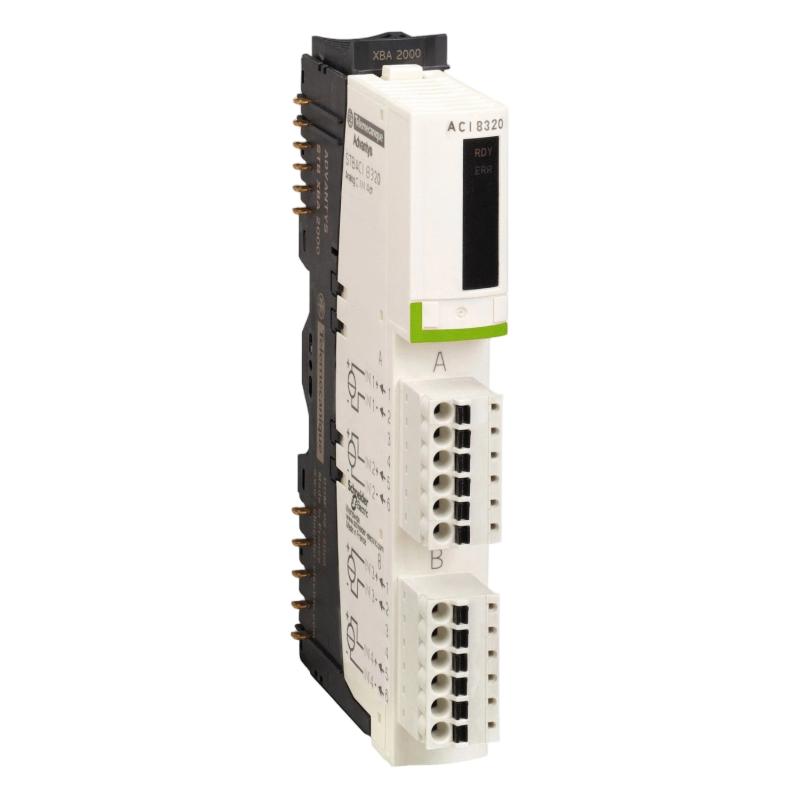
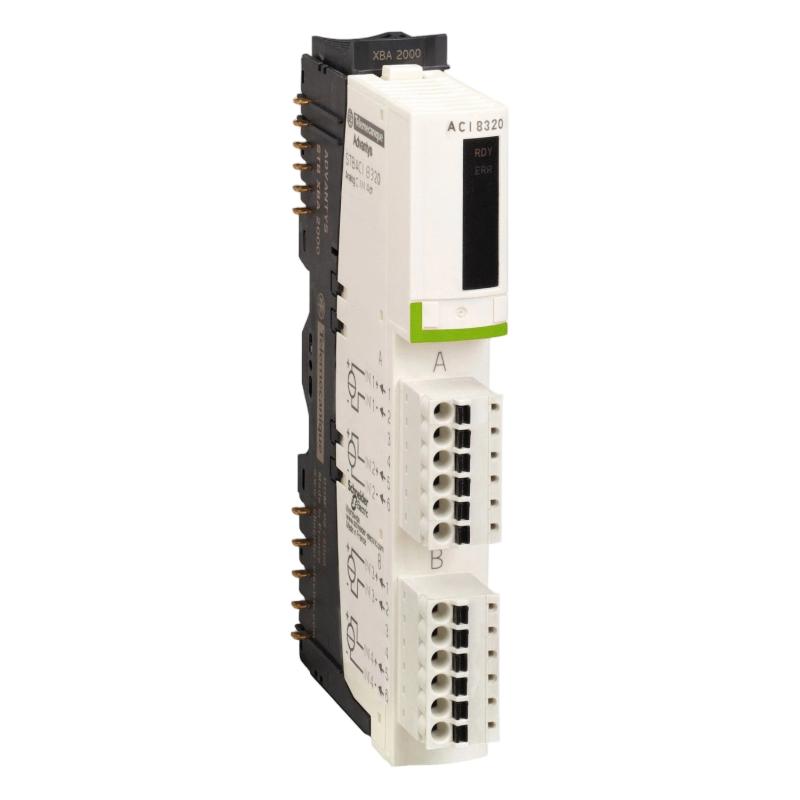
The Schneider Electric STBACI8320 Standard Analog Input Module is an industrial automation component designed to acquire analog current signals from field instruments and make measurement data available to a programmable logic controller (PLC) or distributed control system. It belongs to the Modicon Advantys STB distributed I/O platform, which allows industrial control systems to collect process data from multiple field devices through modular I/O assemblies.
In industrial environments, many instruments measure continuously changing process variables, including pressure, flow, temperature, liquid level, and other operating conditions. These instruments commonly transmit their measurements as standardized current signals. An analog input module receives these electrical signals, converts them into digital values, and makes the resulting data available to the automation system for monitoring, calculation, alarm processing, and control.
The STBACI8320 provides four differential analog current input channels. It supports 4–20 mA signals as its default range and can also be configured for 0–20 mA operation. Its resolution is specified as 15 bits plus a sign bit in the default configuration, allowing the controller to distinguish changes in the measured input signal.
The module is designed for installation on a compatible Modicon STB I/O base. It operates as part of an Advantys STB island, where a network interface module and associated power-distribution components provide the connection between the local I/O assembly and the wider control system.
The STBACI8320 is particularly relevant to maintenance teams working with existing Modicon STB installations. It can support the continued operation of legacy automation equipment when the original configuration, wiring, and system compatibility are maintained.
This product is discontinued, so procurement and replacement planning require particular attention to the exact model number, mounting base, field wiring connectors, and network interface configuration.
Technical Specifications
| Parameter | Specification |
|---|---|
| Brand | Schneider Electric |
| Product Model | STBACI8320 |
| Product Series | Modicon Advantys STB |
| Product Type | Standard Analog Input Module |
| Input Signal Type | Analog current |
| Number of Input Channels | 4 |
| Default Input Range | 4–20 mA |
| Configurable Input Range | 0–20 mA |
| Resolution | 15 bits + sign in the default configuration |
| Nominal System Supply | 24 V DC |
| Mounting Base | STBXBA2000 |
| Field Wiring | Two six-terminal connectors |
| Input Configuration | Differential current inputs |
| Typical Data Update Time | 80 ms |
| Integral Linearity | ±0.05% of full scale |
| Maximum Absolute Accuracy Error | ±0.4% of full scale at 25°C |
| Input Impedance | Approximately 250 Ω |
| Channel-to-Channel Isolation | 200 V DC |
| Protection | Short-circuit protection |
| Dimensions Provided | 70 × 18.4 × 128.3 mm |
| Weight Provided | 0.07 kg |
| Product Lifecycle | Discontinued |
| Typical Application | Industrial process measurement and PLC-based monitoring |
Specifications are based on the STBACI8320 module documentation. Confirm the required input configuration, mounting base, connector accessories, and installation conditions against the technical documentation for the actual unit.
Function and Working Principle
The main function of the STBACI8320 is to acquire analog current signals and convert them into digital measurement values for an industrial automation system.
1. Analog Current Signal Acquisition
Industrial transmitters frequently use 4–20 mA current loops to communicate measured process values. For example, a pressure transmitter may output 4 mA at the lower end of its configured measurement range and 20 mA at the upper end.
The STBACI8320 receives compatible current signals through its field wiring terminals. Each of its four input channels can be used to monitor an individual measurement point, provided that the transmitter wiring and electrical requirements are correctly configured.
This allows several instruments to share a single I/O module, reducing the number of separate input modules needed for suitable applications.
2. Signal Conversion
The module processes the incoming analog signals and makes digital values available through the Advantys STB I/O system.
The controller can then use the values in control logic, process calculations, alarm conditions, and operator displays. The digital representation allows a PLC to compare actual process values with configured limits or target values.
Accurate conversion depends on correct wiring, a suitable signal source, proper configuration, and operation within the module’s specified electrical limits.
3. Four-Channel Measurement
The four input channels allow the module to acquire measurements from several field instruments simultaneously. A typical installation could monitor pressure at different points in a production line, measure flow in several process branches, or collect current signals from different equipment sensors.
The controller assigns meaning to each channel through its I/O configuration and application program. Proper channel identification is important to prevent measurement values from being associated with the wrong instrument.
4. Signal Resolution and Accuracy
The STBACI8320 has a specified resolution of 15 bits plus a sign bit in its default configuration. Resolution describes how finely the module represents changes in the input signal.
The module’s documented integral linearity is ±0.05% of full scale, while the maximum absolute accuracy error is specified as ±0.4% of full scale at 25°C.
Resolution and accuracy are different characteristics. A high-resolution digital value does not eliminate errors caused by the field transmitter, wiring, temperature, calibration, or the module’s own measurement circuitry.
5. Input Filtering and Update Time
Analog measurement systems may be affected by electrical noise, fluctuating sensor outputs, or changes in the surrounding industrial environment. Input filtering helps manage signal variations, while the update time determines how quickly new measurement information becomes available to the control system.
The STBACI8320 documentation specifies a typical update time of approximately 80 ms for all channels. The effective response of the complete control loop also depends on the network interface, PLC scan, application logic, and any additional filtering configured in the system.
Role in Industrial Control Systems
The STBACI8320 functions as a field-level measurement interface within a distributed automation architecture. It connects current-output instruments to the Modicon STB I/O platform, which communicates the acquired data to the controller.
PLC Integration
A PLC uses the module’s digital measurement values to make control decisions. For example, a controller can compare a pressure measurement with a configured limit and activate an alarm or adjust a control output.
The module does not independently perform the entire control strategy. Its role is to collect and convert measurement signals, while the PLC or other compatible controller interprets the data and executes the application logic.
Distributed I/O Architecture
The Advantys STB platform uses a modular island structure. The STBACI8320 mounts on a compatible base and operates alongside other appropriate I/O and power-distribution components.
A network interface module provides the communication connection between the island and the wider automation system. The exact network protocol and controller compatibility depend on the installed network interface and system configuration.
This architecture allows field instruments to be grouped near the equipment they monitor, potentially reducing long individual signal runs back to a central control cabinet.
HMI and Process Visualization
A human-machine interface can display the values collected by the module after they have been transferred to the controller. Operators may use these values to monitor pressure, flow, level, or other process conditions.
The HMI is normally integrated through the PLC or supervisory control system. The STBACI8320 itself is an I/O component rather than an operator display or standalone controller.
Alarm and Interlock Processing
Measurement values from the module can be used by the PLC to detect abnormal conditions. For example, a low-flow measurement may trigger an alarm, while a high-pressure condition may initiate a predefined response.
Such functions depend on application programming, sensor selection, and the complete control and safety design. The analog input module alone does not provide a complete safety function.
Industrial Applications
The STBACI8320 is suitable for industrial installations that require the acquisition of compatible analog current signals. Its four channels make it useful where several measurement points must be connected to a distributed I/O island.
1. Process Pressure Monitoring
Pressure transmitters are widely used in manufacturing, water treatment, chemical processing, and industrial utilities. A transmitter can convert pressure into a standardized current signal, which the STBACI8320 acquires for PLC monitoring.
The controller can display the pressure value, compare it with operating limits, and initiate alarms when the measurement falls outside the configured range.
2. Flow Measurement
Flow transmitters often provide 4–20 mA signals to represent liquid or gas flow rates. The module can collect these signals for process monitoring and control calculations.
In a suitable installation, the PLC may use the flow measurement to regulate a pump, coordinate a valve, or track production consumption. Correct scaling is necessary to convert the digital input value into engineering units such as liters per minute or cubic meters per hour.
3. Tank Level Monitoring
Level transmitters can provide current signals corresponding to the liquid level inside a tank or vessel. The STBACI8320 can acquire compatible signals from multiple tanks or measurement locations.
The PLC can use the data to monitor inventory, control filling sequences, or generate high- and low-level alarms. The measurement range and scaling must match the transmitter’s configured range.
4. Water and Wastewater Treatment
Water and wastewater treatment facilities use analog instruments to monitor pressure, flow, and other process variables. A distributed I/O module can collect signals from field devices installed near pumps, filtration equipment, and treatment units.
The controller can then coordinate the associated equipment based on the acquired measurements. Instrument compatibility, electrical isolation, grounding, and environmental protection must be evaluated for the installation.
5. Manufacturing and Production Lines
Industrial production lines may use analog current signals to monitor equipment conditions and process variables. Four input channels can collect data from several instruments within a local section of a machine or production system.
This information can support process supervision, trend recording, alarm generation, and coordination with other I/O modules.
6. Building and Utility Systems
Some industrial utility installations use current-output transmitters for monitoring ventilation, fluid distribution, and equipment operating conditions. The STBACI8320 can serve as an interface for compatible transmitters when installed within an appropriately designed control system.
The module should be selected according to the signal type, required measurement performance, and environmental requirements rather than the application name alone.
Installation and System Integration
Correct installation is essential for reliable measurement, stable communication, and long-term operation.
1. Verify the Mounting Base
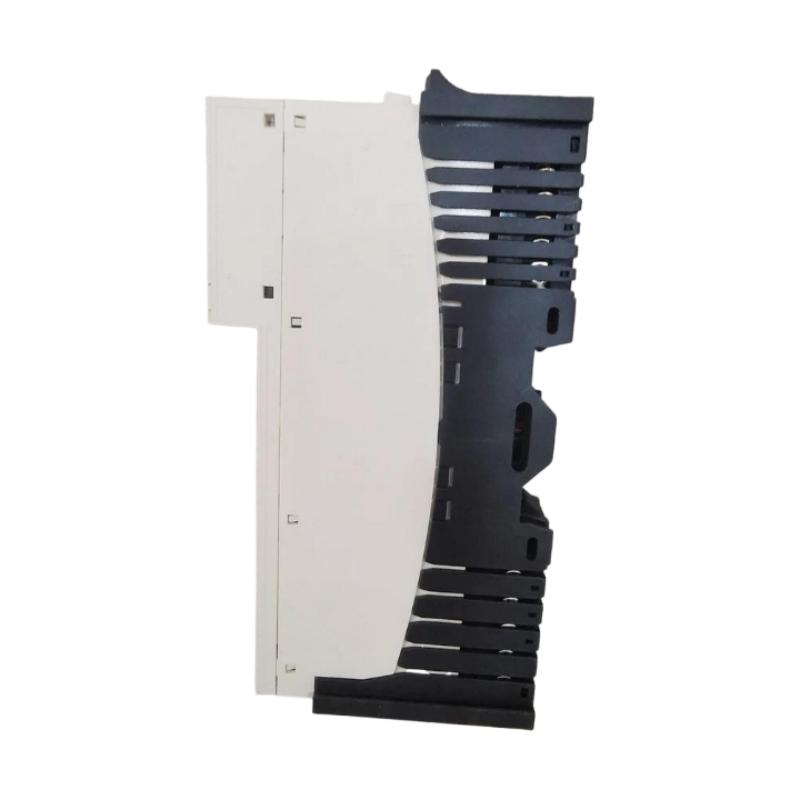
The STBACI8320 is designed for use with the compatible Modicon STB mounting base, identified in product documentation as STBXBA2000.
Confirm that the existing base, island configuration, and adjacent components match the module requirements. The module should not be assumed to be compatible with unrelated Schneider Electric I/O platforms simply because they share the same manufacturer.
2. Confirm the Field Wiring Connectors
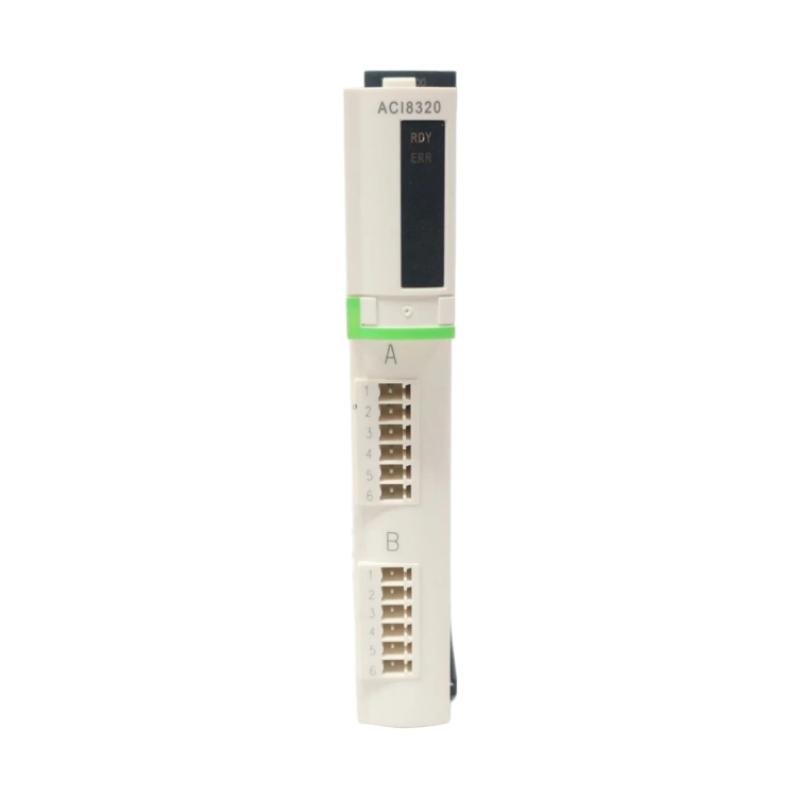
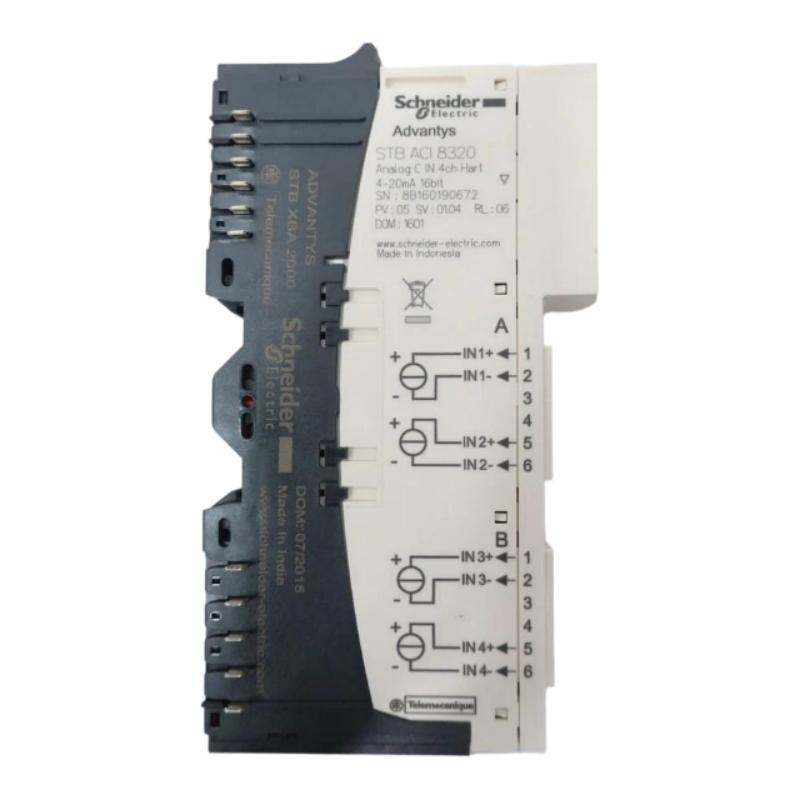
The module uses two six-terminal field wiring connectors. The top connector supports the first two input channels, while the bottom connector supports the third and fourth channels.
Depending on the installation, compatible screw-type or spring-clamp connectors may be used. Confirm the exact connector types and quantities required for the replacement or installation project.
3. Check the Current Signal Range
The default input range is 4–20 mA, with 0–20 mA operation also supported. Confirm the output range of each connected transmitter and configure the channel accordingly.
Incorrect range selection can result in incorrect displayed values, misleading alarms, or improper control actions. The PLC’s engineering-unit scaling must also match the transmitter’s measurement range.
4. Wire Differential Inputs Correctly
The STBACI8320 uses differential current inputs. Connect the positive and negative current signal terminals according to the module’s terminal diagram and the transmitter’s wiring instructions.
Do not assume that all field instruments use the same wiring arrangement. Verify whether the transmitter is loop-powered or requires an external supply, and ensure that the signal loop is designed for the module’s input requirements.
5. Manage Grounding and Electrical Noise
Analog current signals can be affected by poor wiring practices, grounding problems, and electromagnetic interference. Use suitable field wiring, maintain separation from high-noise power conductors where required, and follow the system’s grounding and shielding recommendations.
Shielded twisted-pair wiring is recommended for installations requiring the applicable electromagnetic compatibility practices. The shield termination should follow the system’s installation guidance.
6. Confirm the Island Configuration
Check that the installed network interface module, power-distribution components, mounting base, and system configuration support the STBACI8320.
The module’s documentation identifies compatibility with the STBPDT3100 and STBPDT3105 power-distribution modules. The complete island configuration should be checked before installing or replacing any component.
7. Test the Measurement Channels
After installation, verify each input channel using a known signal or a suitable calibrated current source. Confirm that the PLC displays the expected value at representative points within the configured range.
For a 4–20 mA transmitter, check the configured lower and upper range values and confirm that the PLC’s scaling converts them to the intended engineering units. Investigate discrepancies before returning the equipment to normal service.
Compatible System Components
The STBACI8320 operates as part of a compatible Modicon STB distributed I/O assembly. The following components may be relevant when designing, maintaining, or replacing an installation.
| Component | Function | Integration Considerations |
|---|---|---|
| STBXBA2000 mounting base | Supports the analog input module | Verify the base model and physical condition |
| STBPDT3100 power-distribution module | Supports the island’s power distribution | Confirm the installed island configuration |
| STBPDT3105 power-distribution module | Alternative documented power-distribution component | Verify system compatibility before use |
| Compatible STB network interface module | Connects the I/O island to the automation network | Network protocol and controller compatibility depend on the specific NIM |
| 4–20 mA transmitter | Supplies a standardized process measurement signal | Verify range, loop power, and wiring |
| 0–20 mA transmitter | Supplies a configurable current signal | Configure the input channel and PLC scaling correctly |
| PLC or compatible controller | Processes measurement data and executes logic | Confirm the supported island configuration and network interface |
| HMI or supervisory system | Displays process values and alarms | Configure data mapping through the controller |
| Six-terminal field connector | Connects field signals to the module | Verify screw or spring-clamp connector requirements |
| 24 V DC power supply | Supplies the applicable control or field circuits | Verify current capacity and the power-distribution design |
These components are not necessarily included with the STBACI8320. Confirm the actual bill of materials and installed hardware before ordering accessories.
Alternative Models and Replacement Considerations
The STBACI8320 has been discontinued. Schneider Electric lists a newer Modicon Edge I/O option, NTSAHI0412XHK, as a recommended replacement in its product information. This recommendation should not be interpreted as confirmation that the newer product is a direct plug-in replacement for the original Advantys STB module.
| Alternative or Related Option | Considerations |
|---|---|
| Schneider Electric NTSAHI0412XHK | A manufacturer-listed replacement option; verify system architecture, base, wiring, and migration requirements |
| Schneider Electric STBACI8320K | A kit based on the STBACI8320 module with a mounting base and field connectors; confirm whether the complete kit or module alone is required |
| Schneider Electric STBACI0320K | A related Modicon STB analog input kit with different catalog identification; verify the exact input configuration before substitution |
| Another compatible Advantys STB analog input module | May suit an existing island if the signal range, channel count, and system requirements match |
| A newer distributed I/O platform | May be suitable for an upgrade, but may require changes to the mounting arrangement, network interface, wiring, and controller configuration |
Before choosing a replacement, compare:
- Number of analog input channels.
- Supported current signal ranges.
- Input resolution and accuracy.
- Electrical isolation and input impedance.
- Required mounting base and field connectors.
- Network interface and controller compatibility.
- Power-distribution requirements.
- PLC addressing, scaling, and application logic.
- Physical dimensions and installation clearances.
- Commissioning, migration, and maintenance requirements.
For an existing installation, the safest replacement strategy is to identify the complete hardware configuration and confirm compatibility before removing the original module.
Key Advantages
Four Analog Current Inputs
The four-channel design allows several compatible transmitters to be connected through one module, supporting compact distributed I/O installations.
Support for Standard Current Signals
The module supports 4–20 mA and configurable 0–20 mA signals, covering common measurement interfaces used in industrial instrumentation.
Defined Measurement Performance
Published resolution, linearity, accuracy, and update-time specifications provide useful criteria for engineering selection and troubleshooting.
Differential Input Design
Differential inputs support the intended connection of current signals while providing a defined measurement interface for compatible field instruments.
Distributed I/O Integration
Installation within the Advantys STB platform allows the module to exchange measurement data with a compatible controller through the configured network interface.
Modular System Architecture
The modular platform allows suitable I/O components to be arranged in an island configuration based on the requirements of the application.
Useful for Legacy System Maintenance
The STBACI8320 remains relevant to installations that use the original Advantys STB architecture. Correct identification can help maintenance teams assess spare-part requirements and plan upgrades.
Technical FAQs
1. What is the Schneider Electric STBACI8320?
The STBACI8320 is a standard analog current input module in the Modicon Advantys STB distributed I/O platform. It acquires current signals from compatible field instruments and makes the measurement data available to a connected automation controller.
2. How many analog inputs does it provide?
It provides four analog current input channels. Each channel can be used for a compatible measurement signal when the field wiring and configuration are correct.
3. Does the STBACI8320 support 4–20 mA signals?
Yes. Its default input range is 4–20 mA. It can also be configured for 0–20 mA operation.
4. What is the resolution of this module?
The default resolution is specified as 15 bits plus a sign bit. The exact representation and scaling of values should be checked in the module and controller documentation.
5. What is the typical update time?
The documented typical update time is approximately 80 ms for all channels. The response time of the complete automation system also depends on the network interface, controller scan, and application configuration.
6. Which mounting base does it use?
The STBACI8320 is designed for the STBXBA2000 mounting base. Verify the installed base and other island components before replacing the module.
7. Is the STBACI8320 discontinued?
Yes. Schneider Electric lists the STBACI8320 as discontinued. Availability may depend on remaining inventory and the industrial spare-parts market.
8. Can I replace it with STBACI8320K?
The STBACI8320K is a related kit that includes the STBACI8320 module, an STBXBA2000 base, and specified field connectors. It may be appropriate when the complete kit is required, but confirm the contents and compatibility with the existing installation.
9. Can the STBACI8320 be replaced by a newer Modicon Edge I/O module?
A newer module may be a suitable upgrade option, but it should not be treated as an automatic drop-in replacement. Verify the new module’s mounting arrangement, network architecture, electrical characteristics, connector requirements, and software configuration.
10. What should be checked when purchasing a used module?
Confirm the exact catalog number, physical condition, terminal condition, connector availability, and seller’s test information. For a critical application, request suitable functional testing and verify that the module is compatible with the existing Advantys STB island.
Procurement and Maintenance Recommendations
Because the STBACI8320 is discontinued, procurement should begin with confirmation of the complete model number and the requirements of the installed I/O system.
For a like-for-like replacement, check the original module label, mounting base, terminal connectors, network interface, and PLC configuration. Confirm that the replacement supports the required current range and that all four channels can be wired and scaled as intended.
When sourcing used or surplus modules, request clear product photographs and information about the item’s condition and test status. Verify whether field connectors or mounting accessories are included, because a module-only listing may not provide everything required for installation.
During maintenance, inspect field wiring, connector condition, shielding, and grounding. Check transmitter loop power and confirm that each input channel is configured for the correct signal range. If a measurement is inaccurate, verify the transmitter output and wiring before concluding that the input module is faulty.
For long-term support, retain a record of the I/O island configuration, controller mapping, channel assignments, and scaling parameters. If an upgrade to a newer I/O platform is planned, document the existing wiring and control logic before migration.
Conclusion
The Schneider Electric STBACI8320 Standard Analog Input Module is a four-channel current input component for the Modicon Advantys STB distributed I/O system. It supports 4–20 mA signals by default and can be configured for 0–20 mA operation, making it suitable for acquiring process measurements from compatible industrial transmitters.
Its role in the automation system is to convert field current signals into digital measurement data for controller-based monitoring and control. Correct installation requires a compatible mounting base, appropriate field connectors, accurate signal scaling, and a properly configured STB island.
Since the STBACI8320 has been discontinued, buyers should verify the exact catalog number and installed system requirements before purchasing a replacement. Careful compatibility checks and proper commissioning help maintain reliable measurement and reduce the risk of unnecessary downtime in legacy industrial automation systems.