

ProductPRODUCT
Featured products
Contact Us
- Schneider
- SXWASB36X10001
- Automated Server
- France
- 198 x 64 x 114 mm
- 5.04 kg
- Xiamen, China
- New & In Stock
- T/T, PayPal, Western Union
- 1 Year
- 1-3 Working Days
- DHL, UPS, TNT, FedEx and EMS.
- 24-Hour Service
- COO
- 7
Our advantage

Global Logistics
We have a 10-year logistics and express cooperation agreement, so our products can be shipped to any place in the world.

Brand new and original
Our products are imported in bulk from the place of origin. Because of the cooperative relationship, our products are all original and 100% new.

24-hour service
We provide 7*24 hours service to our customers. We will be there whenever you need us.

Price advantage
All our products are priced very favorably because we have our own warehouse and supply.
| Company Information | |||
| [email protected] | |||
| Mobile | +8615980777398 | ||
| +8615980777398 | |||
| 15980777398 |
Product Overview
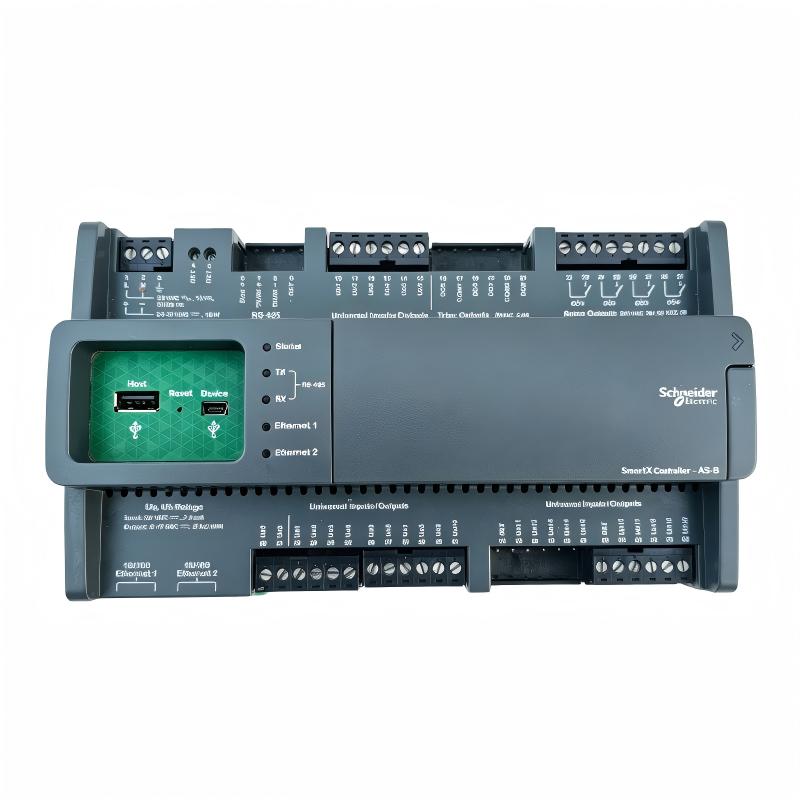
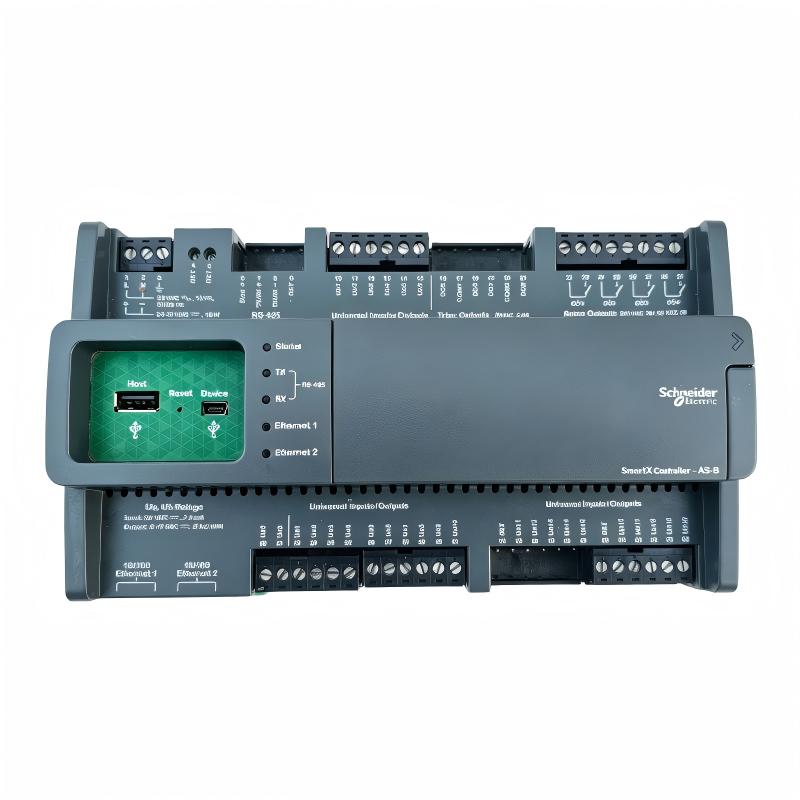
The Schneider Electric SXWASB36X10001 SpaceLogic AS-B-36 Automation Server is a building automation controller designed to integrate monitoring, control, and communication functions within modern building management systems. It belongs to Schneider Electric’s SpaceLogic automation platform and is intended for applications such as HVAC control, plant-room automation, and centralized supervision of building equipment.
Unlike a conventional IT server used for general computing or file storage, the SXWASB36X10001 is a dedicated automation device. It connects with building systems, processes control logic, communicates with field devices, and supports the collection of operating information required for building management.
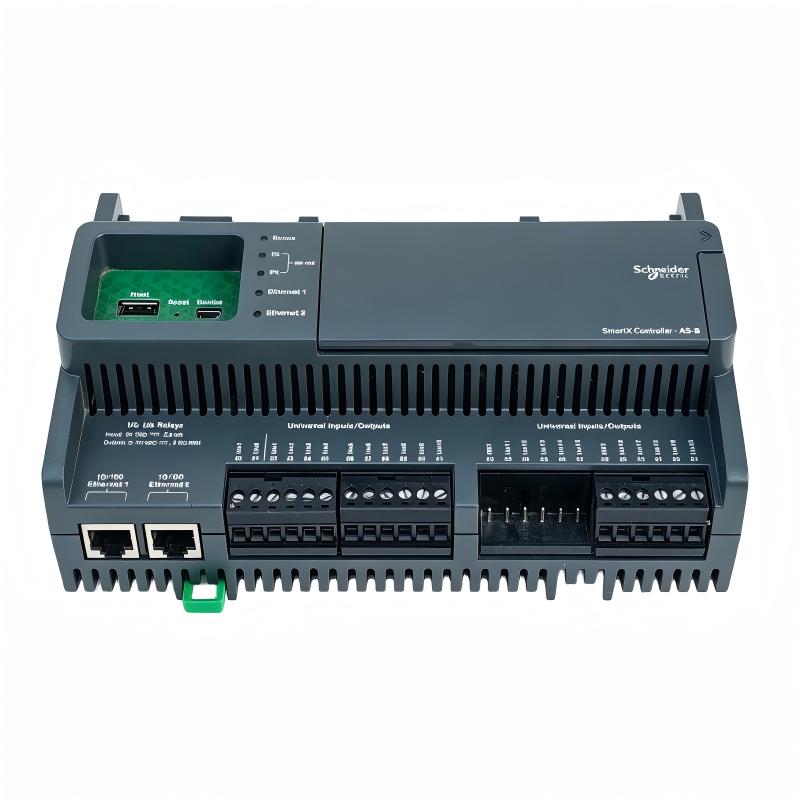
The AS-B-36 provides 36 I/O points through a combination of 28 universal I/O points, four relay outputs, and four Triac outputs. This integrated I/O capability allows the controller to interface with suitable sensors, actuators, and building equipment, depending on the electrical characteristics of each point and the application design.
The controller supports building automation communication technologies, including BACnet and Modbus. Its dual Ethernet ports support IP-based connectivity, while serial communication capabilities support integration with compatible field devices. These features allow it to participate in a broader building management network and exchange information with other automation controllers and supervisory software.
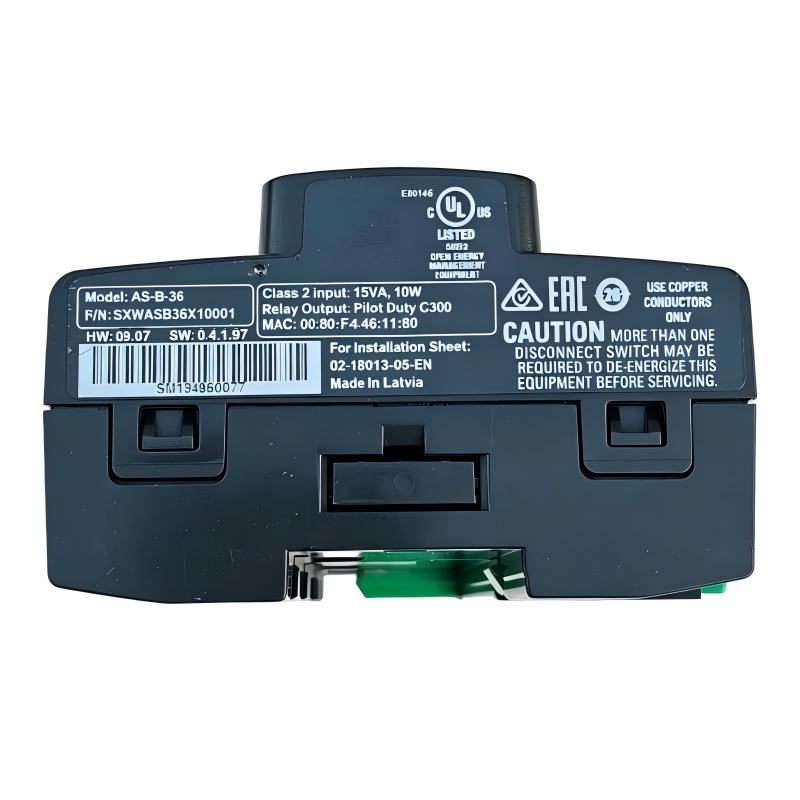
The SXWASB36X10001 operates from a 19–29 V AC or 21–33 V DC supply and has a nominal power consumption of approximately 10 W. It includes a local LCD display for device information and is designed for installation in an appropriate control cabinet or plant-room automation panel.
For facility managers, system integrators, and maintenance engineers, this model can serve as a controller for coordinating building services and collecting operational data. Successful deployment depends on correct I/O assignment, network configuration, application software, and compatibility with the existing EcoStruxure Building Operation environment.
Technical Specifications
| Parameter | Specification |
|---|---|
| Brand | Schneider Electric |
| Product Model | SXWASB36X10001 |
| Product Family | SpaceLogic |
| Device Name | AS-B-36 |
| Product Type | Automation Server / Building Automation Controller |
| Primary Application | Building Management Systems (BMS) |
| I/O Point Capacity | 36 points |
| Universal I/O | 28 points |
| Relay Outputs | 4 |
| Triac Outputs | 4 |
| Communication Protocols | BACnet, Modbus, and supported building automation services |
| Ethernet Ports | 2 |
| Rated AC Supply | 19–29 V AC |
| Rated DC Supply | 21–33 V DC |
| Power Consumption | Approximately 10 W |
| Apparent Power Consumption | Approximately 15 VA |
| Local Display | FSTN transflective LCD |
| Display Resolution | 128 × 64 pixels |
| Memory | 256 MB FRAM and 2 GB flash |
| Protection Rating | IP20 |
| Operating Temperature | 0–50°C |
| Storage Temperature | -20–70°C |
| Relative Humidity | 0–95%, non-condensing |
| Dimensions Provided | 198 × 64 × 114 mm |
| Weight Provided | 5.04 kg |
| Product Range | EcoStruxure Building Operation |
Note: Verify the exact hardware revision, terminal configuration, included accessories, and software licensing requirements before installation or replacement.
Function and Working Principle
The SXWASB36X10001 functions as a local automation controller within a building management system. It receives information from connected field devices, executes configured control logic, and operates compatible outputs according to programmed requirements.
1. Field Data Acquisition
The controller’s universal I/O points can be configured for supported input and output functions according to the hardware specifications. Depending on the selected configuration, inputs may be used to monitor sensors, switches, temperature signals, and other building-system measurements.
This information allows the controller to determine current operating conditions and respond to changes in the environment or equipment status.
For example, temperature measurements from a suitable sensor may be used by the building control application to determine whether a heating or cooling system needs adjustment. Exact sensor compatibility depends on the input type and electrical characteristics supported by the controller.
2. Control Logic Execution
After collecting field information, the controller processes configured control logic. The application may include schedules, equipment interlocks, operating limits, and control sequences for HVAC or plant-room equipment.
A typical sequence could compare a measured temperature with a target value and then adjust a compatible output or issue a command to another controller.
The actual control strategy depends on the application software and the engineering configuration. The controller’s hardware provides the platform for these functions, while the programmed application defines how the building system behaves.
3. Output Control
The AS-B-36 provides four relay outputs and four Triac outputs in addition to its universal I/O.
Relay outputs may be used for compatible switching applications, subject to their electrical ratings. Triac outputs are commonly used in appropriate AC control applications. Engineers must verify voltage, current, load type, and wiring requirements before connecting actuators or other equipment.
Output assignments should be documented during commissioning so that future maintenance personnel can identify which points control specific devices.
4. Network Communication
The controller supports building automation communication through BACnet and Modbus, along with supported IP-based communication services. Its two Ethernet ports provide network connectivity for appropriate building automation architectures.
Depending on the system design, the controller can exchange data with supervisory software, other automation servers, and compatible field controllers. Communication settings, network addressing, protocol configuration, and device naming should be standardized to simplify troubleshooting.
5. Monitoring and Operational Data
The controller supports building management functions such as trend logging, alarms, schedules, and supervisory integration when configured within the appropriate software environment.
Trend data can help engineers identify temperature variations, equipment cycling, and changes in operating conditions. Alarm functions can notify operators when monitored values or equipment states fall outside configured limits.
These functions support ongoing facility management, but their availability and behavior depend on the installed application, software version, licensing, and system configuration.
Role in Building Management Systems
The SXWASB36X10001 is designed to function as a controller within a broader building management architecture. It can connect field equipment, coordinate local control sequences, and communicate with supervisory systems.
HVAC Control
Heating, ventilation, and air-conditioning systems require coordinated monitoring and control of temperatures, equipment status, and operating schedules. The AS-B-36 can support suitable HVAC applications by collecting sensor information and operating compatible control outputs.
Possible applications include plant-room equipment, auxiliary HVAC controls, and selected heating or cooling sequences. The controller must be configured according to the system’s actual electrical and control requirements.
Plant-Room Automation
Plant rooms may contain pumps, fans, valves, heating equipment, and other mechanical services. A building automation controller can monitor equipment states and coordinate operations according to configured sequences.
For example, a controller may monitor a pump status signal and coordinate an alarm response when the expected operating condition is not detected. More complex sequences may require additional controllers or supervisory logic.
Integration with Supervisory Systems
The controller’s communication capabilities allow it to exchange information with compatible building management software. Supervisory systems can provide centralized visualization of equipment status, alarms, schedules, and trends.
This arrangement helps maintenance teams understand system performance and identify problems without relying exclusively on local inspection.
Distributed Control Architecture
In larger buildings, control functions are often distributed among multiple field controllers and automation servers. The AS-B-36 can form part of this architecture, handling assigned local control functions while exchanging information with the wider system.
The exact number of devices, network topology, and control responsibilities should be established during system design.
Industrial and Building Automation Applications
1. Commercial Office Buildings
Office buildings commonly require coordinated control of HVAC equipment, schedules, and indoor environmental conditions. The AS-B-36 can support appropriate local control tasks and communicate operational data to a building management system.
Scheduled operation can help align equipment use with occupancy patterns, while alarms and trends can assist facility teams with maintenance and performance reviews.
2. Hotels and Hospitality Facilities
Hotels operate HVAC and other building services across guest rooms, common areas, kitchens, and service spaces. Building automation can coordinate equipment operation and provide centralized monitoring for facility staff.
The AS-B-36 may be suitable for assigned control tasks where its I/O capacity, protocol support, and electrical ratings meet the project’s requirements.
3. Hospitals and Healthcare Buildings
Healthcare facilities rely on dependable building services, including HVAC and plant-room equipment. A properly engineered automation system can support monitoring, scheduled operation, and alarms for selected building services.
Applications involving critical environmental control must be designed and validated according to the facility’s operational, safety, and regulatory requirements. The controller should not be assumed to provide specialized safety functions unless those functions are explicitly supported by the complete system design.
4. Educational Institutions
Schools, colleges, and universities may use building automation to manage heating, ventilation, cooling, and equipment schedules across multiple areas.
The AS-B-36 can be integrated into an appropriate control network to coordinate local equipment and provide information to the building management platform.
5. Retail and Commercial Facilities
Retail stores, shopping centers, and commercial premises may use automation controllers to manage HVAC equipment and other building services. Centralized monitoring can help facility teams identify equipment faults and review operational trends.
The required number of I/O points and the types of connected devices should be assessed before choosing a controller.
6. Industrial Administration and Utility Buildings
Factories often contain offices, technical rooms, maintenance areas, and utility buildings in addition to production equipment. Building automation can coordinate HVAC and selected facility services in these areas.
The AS-B-36 may be used where the project requires local I/O, supported communication protocols, and integration with a compatible building management system.
Installation and System Integration
Correct installation is important for communication reliability, I/O accuracy, and long-term controller operation.
1. Verify the Power Supply
The controller supports 19–29 V AC or 21–33 V DC. Confirm that the selected supply is within the specified range and can provide sufficient capacity for the controller and connected circuits as designed.
Use suitable wiring and protective measures, and follow the manufacturer’s installation instructions. Incorrect supply voltage or poor connections may cause unstable operation or equipment damage.
2. Confirm Mounting and Cabinet Requirements
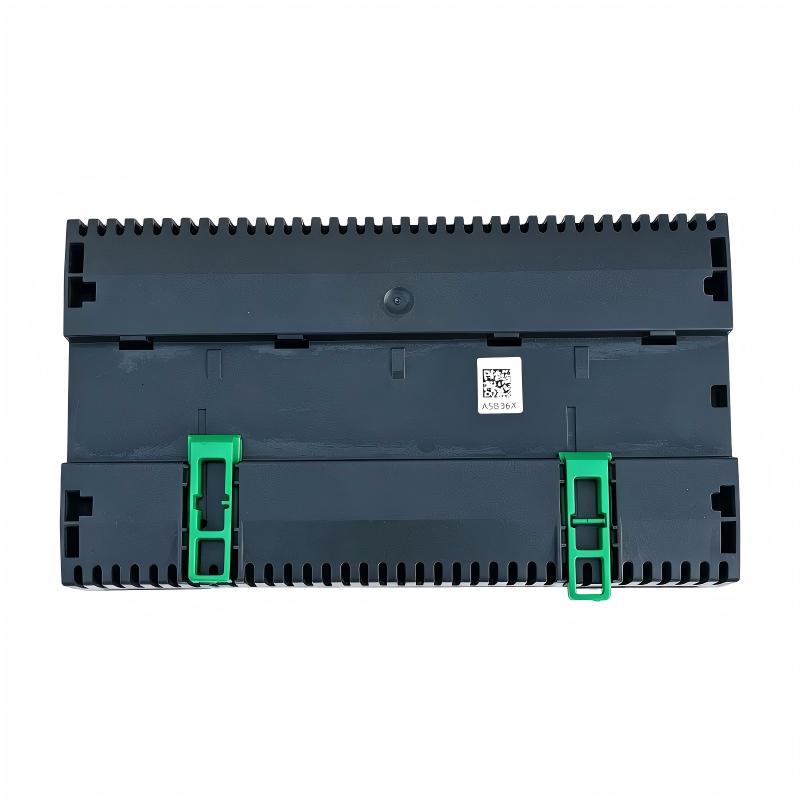
The supplied dimensions are 198 × 64 × 114 mm. Verify the orientation and clearances using the manufacturer’s installation documentation before preparing the control panel.
The controller has an IP20 rating and should be installed in a suitable environment. It is not designed for direct exposure to water or uncontrolled outdoor conditions. Protect it from conductive dust, excessive heat, condensation, and other contaminants that may affect electronic equipment.
3. Plan the I/O Connections
Before wiring, prepare an I/O schedule identifying each sensor, actuator, contact, and output load. Verify signal types, polarity, voltage levels, and current limits against the controller’s hardware documentation.
Do not assume that every universal I/O point supports every signal type. The selected point configuration and connected device must be compatible.
Relay and Triac outputs should be wired according to their respective electrical ratings and load requirements. Use appropriate external interfaces where required.
4. Configure Network Communication
Assign network addresses and communication parameters according to the building management system’s design. Confirm Ethernet connectivity, protocol settings, and any required serial bus parameters.
For BACnet or Modbus integration, consistent device naming and point mapping can simplify commissioning and future troubleshooting. Network termination, biasing, and cable requirements should be observed where serial communications are used.
5. Install and Configure the Software
The AS-B platform requires the appropriate building automation software configuration. Confirm the software version, license, and provisioning requirements for the exact product supplied.
Use the applicable Schneider Electric tools and documentation to install or configure the required application. Do not assume that the controller is ready to run a project simply because the hardware powers on.
6. Commission and Test
After installation, verify power, network connectivity, I/O status, and the behavior of each configured control sequence.
Test sensor readings, output operation, schedules, alarm conditions, and communication with the supervisory system. Document the final configuration, point assignments, and any special operating settings for future maintenance.
Compatible System Components
The SXWASB36X10001 can be integrated with compatible components used in a building automation installation. Actual compatibility depends on the device specifications, communication protocols, and project design.
| Component | Function | Integration Considerations |
|---|---|---|
| Temperature and humidity sensors | Provide environmental measurements | Verify supported input types and signal ranges |
| Pressure and flow sensors | Monitor HVAC and plant-room conditions | Match the signal format to the configured I/O |
| Valves and actuators | Regulate water, air, or other process flows | Verify output type, supply voltage, and actuator requirements |
| Fans and pump control systems | Support mechanical equipment operation | Use appropriate interfaces and equipment protection |
| BACnet-compatible controllers | Exchange building automation data | Confirm supported BACnet services and network configuration |
| Modbus-compatible devices | Provide data through supported Modbus communication | Verify protocol mode, addressing, and register mapping |
| Ethernet network infrastructure | Provides IP-based connectivity | Confirm addressing, network topology, and IT policies |
| EcoStruxure Building Operation software | Provides supervisory management and integration | Check software version, licensing, and controller provisioning |
| 24 V AC/DC power supply | Powers the automation server | Confirm voltage range, capacity, and installation requirements |
| Control cabinet and terminals | Provide mounting and field wiring organization | Ensure adequate space, environmental protection, and service access |
The listed components are examples of equipment used in compatible building automation systems. They are not necessarily included with the controller.
Alternative Models and Replacement Considerations
When replacing an AS-B-36 controller, selecting a device with a similar name or I/O count is not sufficient. The replacement must meet the system’s communication, electrical, software, and control requirements.
| Alternative or Related Model | Considerations |
|---|---|
| Schneider Electric SXWASB24X10001 | AS-B-24 model with a different I/O capacity; assess whether the available points meet the application requirements |
| Schneider Electric SXWASB36H10001 | Related AS-B-36 variant with an override display; verify functional and hardware differences before substitution |
| Schneider Electric SXWASB36PX10001 | Related AS-B-36 hardware variant; verify software and licensing requirements carefully |
| Schneider Electric SXWASB36X10002 | Related AS-B-36L variant; verify protocol and functional limitations before considering it as a replacement |
| Other SpaceLogic automation controllers | May suit an upgrade or redesign, depending on I/O, communication, and software requirements |
Before replacing the controller, compare:
- Number and type of I/O points.
- Input signal compatibility and output ratings.
- Supported BACnet and Modbus functions.
- Ethernet and serial communication requirements.
- Power supply range and wiring arrangements.
- Mounting dimensions and terminal layout.
- Software version, licensing, and application migration requirements.
- Existing device addressing, point mapping, and supervisory integration.
A replacement may require application changes, network reconfiguration, point remapping, and recommissioning. Always confirm compatibility with the actual installed system.
Key Advantages
Integrated I/O Capacity
The AS-B-36 combines universal I/O with relay and Triac outputs, allowing a range of compatible building devices to connect to a single controller.
Multiple Communication Options
Support for BACnet and Modbus enables integration with compatible building automation equipment and supervisory systems.
Dual Ethernet Ports
Two Ethernet ports provide flexibility for network connection and supported system architectures.
Local Display
The integrated LCD supports local access to device information and can assist with installation and maintenance tasks.
Compact Automation Hardware
The controller combines control and communication functions in a compact enclosure suitable for an appropriately designed control panel.
Building Management Integration
When configured with the appropriate software, the controller can support schedules, alarms, trends, and centralized monitoring for building services.
Flexible Power Input
Support for specified AC and DC supply ranges gives system designers options when planning suitable control power arrangements.
Technical FAQs
1. What is the Schneider Electric SXWASB36X10001?
It is a SpaceLogic AS-B-36 automation server designed for building management and control applications. It provides integrated I/O and communication capabilities for compatible HVAC and other building systems.
2. Is it a conventional computer server?
No. It is a dedicated building automation controller, not a general-purpose IT server. Its primary functions are automation control, field-device integration, and building management communication.
3. How many I/O points does the AS-B-36 provide?
The controller provides 36 I/O points, comprising 28 universal I/O points, four relay outputs, and four Triac outputs. Check the hardware documentation for the supported configurations and electrical ratings of each point.
4. Which communication protocols does it support?
The AS-B-36 supports building automation communication including BACnet and Modbus, along with supported IP-based services. Confirm the exact protocol modes and services needed by the project before commissioning.
5. What power supply does the controller require?
Its rated supply range is 19–29 V AC or 21–33 V DC. Use a supply within the specified range and follow the manufacturer’s wiring instructions.
6. Does it support HVAC control?
Yes. It is designed for building automation applications and can support suitable HVAC control sequences when configured with compatible sensors, actuators, and application software.
7. Does it include software?
The required software and licensing arrangement should be verified for the exact product supplied. Confirm whether the unit has been provisioned and whether the project requires additional software installation or licensing.
8. Can it communicate with other building controllers?
Yes, it can communicate with compatible devices using supported protocols. Successful integration depends on matching protocol modes, network configuration, point mapping, and device capabilities.
9. What should be checked before purchasing a replacement?
Confirm the full model number, hardware condition, I/O requirements, communication protocols, supply voltage, software licensing, and compatibility with the installed building management system.
10. What is the operating temperature range?
The specified operating ambient temperature range is 0–50°C. The controller should be installed in a suitable environment with adequate ventilation and protection from condensation and contamination.
Procurement and Maintenance Recommendations
When sourcing the Schneider Electric SXWASB36X10001, verify the full model number and confirm that the device matches the intended SpaceLogic AS-B-36 application. Check whether the product is new, surplus, refurbished, or used, and establish what accessories and documentation are included.
For replacement projects, confirm the required I/O capacity and communication functions before purchasing. A controller with a similar appearance may have different I/O arrangements, protocol support, display features, or software requirements.
During maintenance, inspect terminal connections, power supply stability, network cabling, and the condition of the installation environment. Review alarms and trend data where available, and maintain an up-to-date record of device addressing, point mapping, and application settings.
Before modifying or replacing the controller, back up the existing application and configuration where supported. Coordinate any change with the building management system administrator, because changes to point assignments or communication settings can affect other connected equipment.
Conclusion
The Schneider Electric SXWASB36X10001 SpaceLogic AS-B-36 Automation Server is a building automation controller designed for HVAC, plant-room, and broader building management applications. It provides 36 I/O points, supports BACnet and Modbus communication, and offers dual Ethernet connectivity within a compact automation platform.
With a specified supply range of 19–29 V AC or 21–33 V DC, an LCD display, and support for integration with EcoStruxure Building Operation, the AS-B-36 can serve as a local control component in a properly engineered building automation system.
For procurement, installation, and replacement, verify the exact model, I/O configuration, software requirements, communication compatibility, and environmental conditions. These checks help ensure reliable integration and simplify future maintenance.