

ProductPRODUCT
Featured products
Contact Us
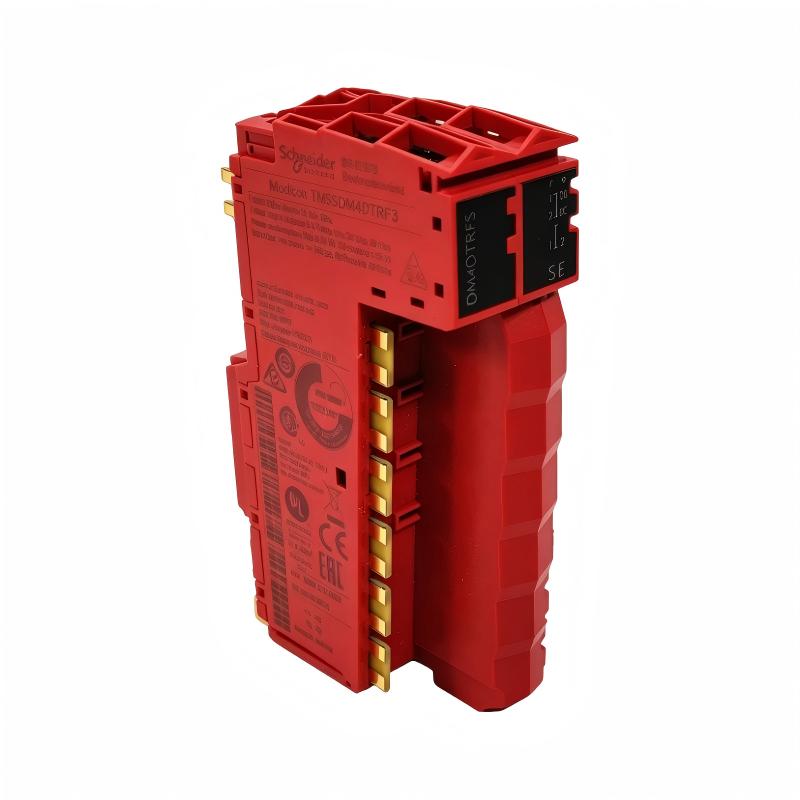
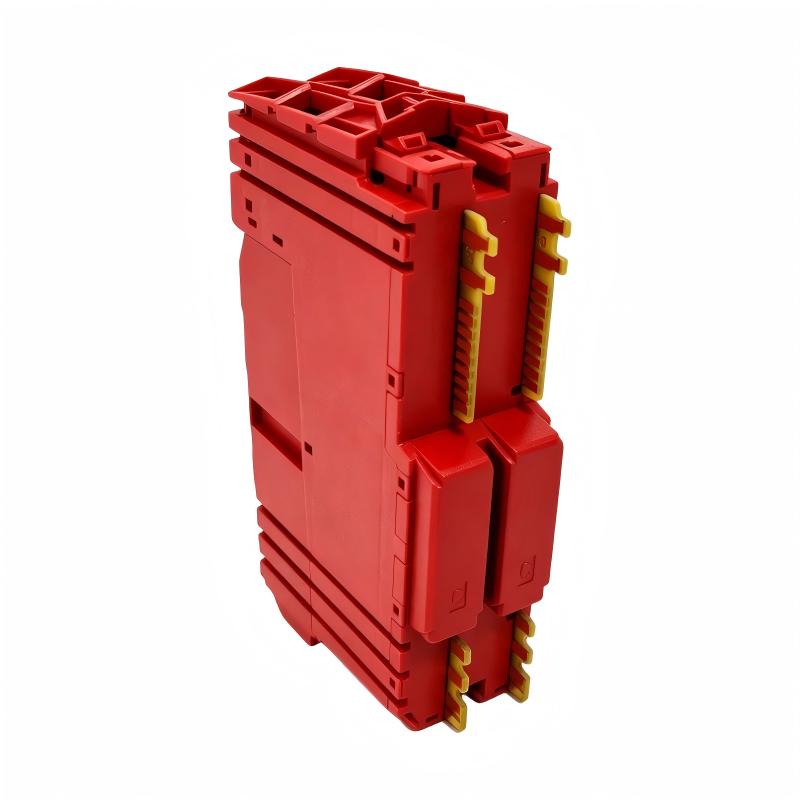
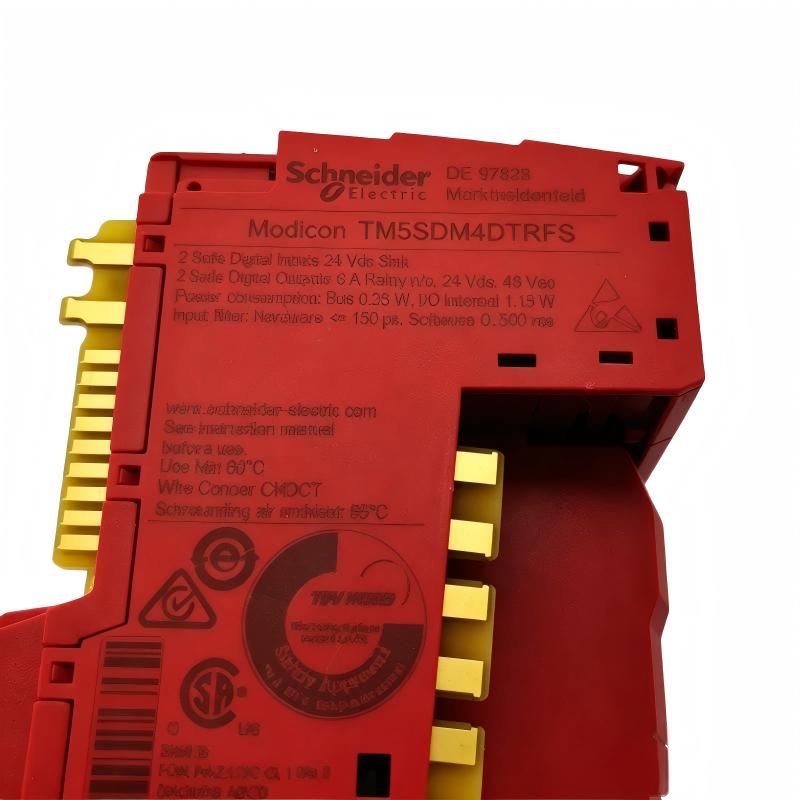
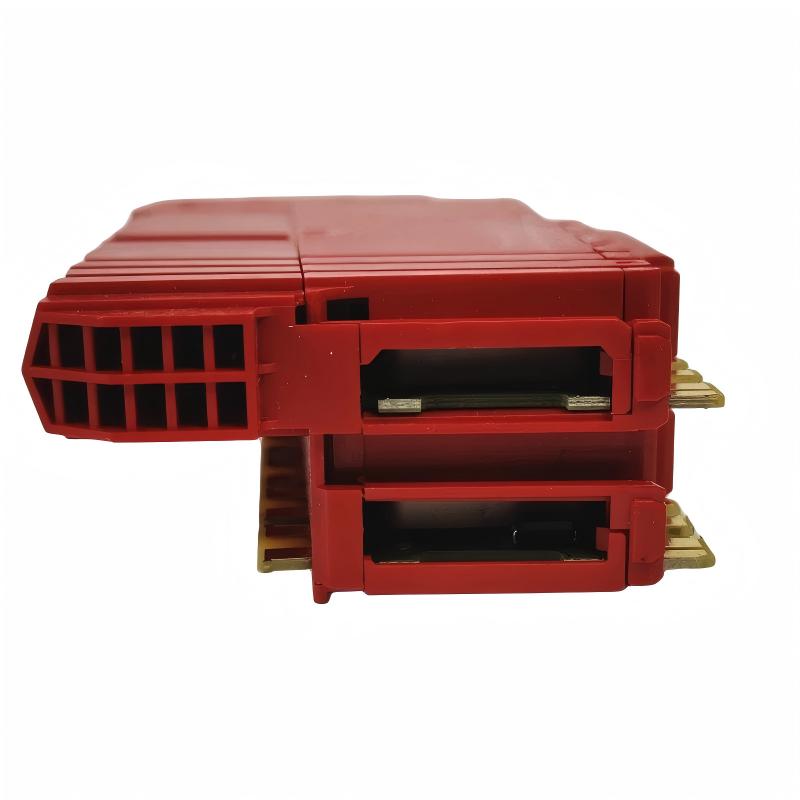
- Schneider
- TM5SDM4DTRFS
- Safety-Proof Discrete I/O Module
- France
- 99 × 25 × 75 mm
- 0.025 kg
- Xiamen, China
- New & In Stock
- T/T, PayPal, Western Union
- 1 Year
- 1-3 Working Days
- DHL, UPS, TNT, FedEx and EMS.
- 24-Hour Service
- COO
- 7
Our advantage

Global Logistics
We have a 10-year logistics and express cooperation agreement, so our products can be shipped to any place in the world.

Brand new and original
Our products are imported in bulk from the place of origin. Because of the cooperative relationship, our products are all original and 100% new.

24-hour service
We provide 7*24 hours service to our customers. We will be there whenever you need us.

Price advantage
All our products are priced very favorably because we have our own warehouse and supply.
| Company Information | |||
| [email protected] | |||
| Mobile | +8615980777398 | ||
| +8615980777398 | |||
| 15980777398 |
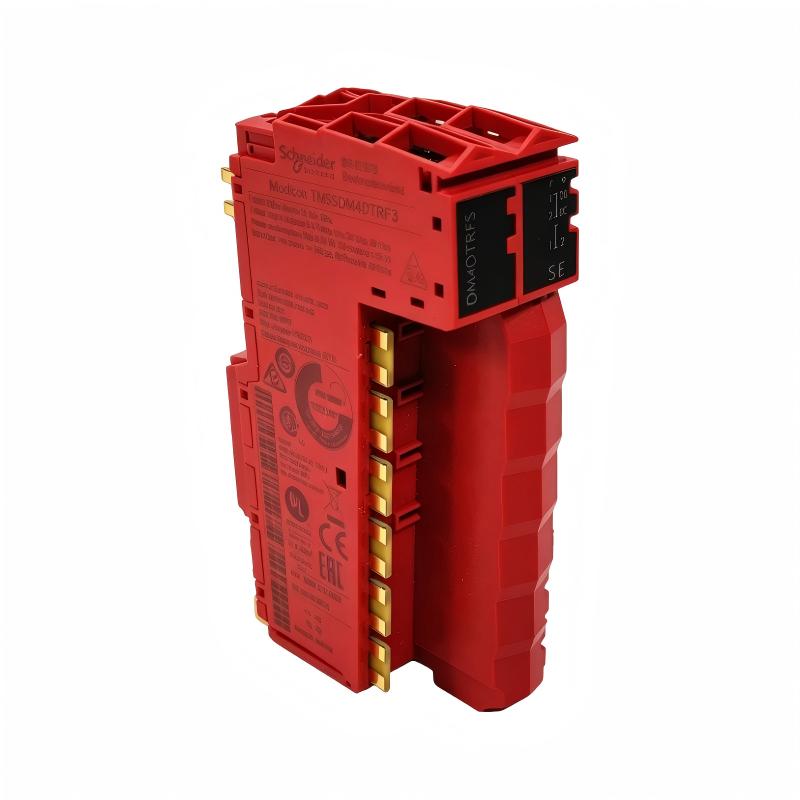
Product Overview
The Schneider Electric TM5SDM4DTRFS Safety Discrete I/O Module is a safety-oriented digital input/output module in the Modicon TM5 automation platform. It is designed to exchange safety-related digital signals with compatible machine-control systems, helping industrial equipment monitor safety devices and control selected actuators through a properly engineered safety architecture.
Unlike a conventional digital I/O module intended only for standard machine sequencing, the TM5SDM4DTRFS is designed for safety-related applications. It combines two safety-related digital inputs with two safety-related relay outputs, allowing a compatible safety controller to monitor input conditions and manage output states according to the configured safety logic.
The module operates with a nominal 24 V DC supply for its safety I/O functions. Its input channels can receive signals from compatible devices such as safety switches and other appropriately designed safety circuits. Its relay outputs can switch compatible loads within the specified voltage and current limits.
The TM5SDM4DTRFS is part of the Modicon TM5 modular I/O system and is associated with Schneider Electric PacDrive LMC motion-control platforms. It is intended for use in applications where standard automation functions must work alongside defined machine-safety functions, including packaging machinery, assembly systems, and material-handling equipment.
The module supports safety-related system designs that can achieve SIL 3 and Performance Level e when all applicable requirements are satisfied. These ratings do not automatically apply to an entire machine simply because this module is installed. The controller, safety logic, wiring, external devices, configuration, validation, and overall risk assessment must all meet the relevant requirements.
With compact dimensions of 99 × 25 × 75 mm and a specified weight of 0.025 kg, the TM5SDM4DTRFS can be incorporated into a modular control cabinet where installation space is limited. Its compact format is useful for machine builders who need to integrate safety-related I/O without dedicating a large amount of cabinet space to an individual module.
Technical Specifications
| Parameter | Specification |
|---|---|
| Brand | Schneider Electric |
| Product Model | TM5SDM4DTRFS |
| Product Family | Modicon TM5 |
| Product Type | Safety Discrete Mixed I/O Module |
| Input Channels | 2 safety-related digital inputs |
| Input Voltage | 24 V DC nominal |
| Input Logic | Sink |
| Output Channels | 2 safety-related relay outputs |
| Relay Contact Type | Normally open (NO) |
| Relay Switching Voltage | 5–24 V DC; 5–48 V AC |
| Relay Switching Current | 5 mA–6 A, subject to load conditions |
| Test Outputs | Digital pulse outputs |
| Rated Control Supply | 24 V DC |
| Protection | Reverse-polarity protection and specified output protection |
| Module Diagnostics | Status LEDs and software diagnostics |
| Protection Rating | IP20 |
| Safety Capability | Up to SIL 3 and PL e in a compliant safety system |
| Mounting | Modicon TM5 safety bus base and compatible system mounting |
| Dimensions | 99 × 25 × 75 mm |
| Weight | 0.025 kg |
| Typical Applications | Machine safety, packaging, assembly, material handling |
Important: The module’s electrical ratings, safety capabilities, and permissible operating conditions must be verified against the manufacturer’s documentation for the specific application. The 6 A relay rating is not a universal rating for every load type.
Function and Working Principle
The TM5SDM4DTRFS combines safety-related digital input monitoring and relay output switching in a single compact module. Its primary role is to provide a defined interface between field devices and a compatible safety-control system.
1. Safety-Related Digital Inputs
The module provides two safety-related digital input channels designed for nominal 24 V DC signals. These inputs can be used in appropriately designed safety circuits involving devices such as safety switches, monitored contacts, and other compatible field devices.
The module evaluates input conditions and makes the relevant status information available to the configured safety-control system. The safety logic then determines the appropriate response based on the machine’s operating state and risk-reduction requirements.
Input filtering and fault-detection behavior are important considerations during configuration. Incorrect filtering settings or unsuitable wiring can affect response time and system behavior, so the configured parameters must comply with the application’s safety requirements.
2. Safety-Related Relay Outputs
The module provides two safety-related relay outputs with normally open contacts. These outputs can switch compatible loads within the specified voltage and current limits.
Possible applications include controlling suitable interposing relays, contactor circuits, or other approved devices used in a machine’s safety-related control architecture. The exact circuit must be designed around the load characteristics, switching frequency, required fault response, and applicable safety requirements.
The outputs should not be treated as general-purpose power outputs for arbitrary loads. External protection is required, and inductive loads may require appropriate suppression components to limit switching transients.
3. Digital Test Pulse Function
The TM5SDM4DTRFS includes digital test pulse outputs. These outputs are intended for their specified diagnostic and safety-related applications, including compatible input circuits.
The test pulses can support fault-detection strategies when the wiring and connected devices are configured correctly. They must be used for their intended purpose rather than treated as ordinary digital output signals.
4. Diagnostic and Status Monitoring
Status indicators provide information about the module’s operating state, input channels, output channels, and detected errors. Software diagnostics can provide additional information to the compatible controller or engineering environment.
These features help maintenance personnel distinguish between a missing field signal, a channel-related fault, and a module or communication issue. Diagnostic information supports troubleshooting but does not replace the required safety validation or inspection procedures.
5. Safety-System Coordination
The module is intended to work as part of a complete safety-control architecture. Its inputs, outputs, controller logic, and external safety devices must work together to achieve the intended safety function.
For example, a safety-related input may indicate that a protective device has changed state. The safety controller processes that information and, where required, commands a safety-related output to transition to its configured state.
The actual response depends on the complete safety application. The module should never be assumed to provide a complete emergency-stop or guard-monitoring function independently of the controller, circuit design, and validated system.
Role in Industrial Control Systems
The TM5SDM4DTRFS is a component of the machine-control architecture rather than a standalone safety controller. It provides field-level I/O functions that a compatible safety controller can use when implementing machine safety logic.
Integration with PacDrive Controllers
The module is designed for use with compatible Schneider Electric PacDrive LMC controllers and associated safety-control architectures. The exact controller, firmware, engineering software, and system configuration must be checked before installation.
Compatibility should not be inferred from the Modicon TM5 product family name alone. The safety module must be supported by the target controller and configured according to the applicable system documentation.
Integration with Standard PLC Functions
Standard PLC logic often handles normal production sequencing, motion commands, alarms, and process data. Safety-related logic has separate requirements for detecting hazardous conditions and initiating defined responses.
The TM5SDM4DTRFS belongs to the safety-related I/O layer. Its use must preserve the required separation and coordination between standard automation functions and safety functions. Ordinary PLC logic should not be treated as a substitute for a validated safety-control system.
Interaction with Field Devices
The module connects to compatible field devices through the required safety terminal arrangement. Input signals may represent the state of safety-related contacts, while relay outputs may control selected devices in the safety circuit.
Correct signal assignment, electrical ratings, wiring, and fault-detection arrangements are essential. Engineers should verify the full circuit diagram before connecting sensors or actuators.
Support for Machine Diagnostics
The module’s status indicators and software diagnostics help engineers monitor channel states and identify faults during commissioning or maintenance.
When combined with suitable controller diagnostics and a documented maintenance procedure, these features can reduce troubleshooting time and help maintenance teams identify the part of a safety-control circuit requiring inspection.
Industrial Applications
The TM5SDM4DTRFS is intended for safety-related digital I/O applications in industrial machinery. Its suitability depends on the risk assessment, required safety function, electrical load, controller compatibility, and validated system design.
1. Packaging Machinery
Packaging equipment frequently combines high-speed production movements with access doors, protective guards, and operator loading stations. A safety-related I/O module can provide an interface for compatible safety devices and selected output circuits.
For example, the module may form part of a system that monitors a protective-device state and coordinates a defined response through a compatible safety controller. The complete circuit must be designed and validated for the machine’s hazards.
2. Assembly and Manufacturing Equipment
Automated assembly machines use sensors, actuators, and motion-control systems to coordinate production operations. Safety-related I/O can help monitor selected protective devices and control designated safety-related outputs.
The TM5SDM4DTRFS may be considered where its two input channels and two relay output channels meet the application’s requirements. Applications requiring more channels or different output technologies may need additional compatible safety modules.
3. Material-Handling Systems
Material-handling equipment such as conveyors, transfer units, and automated workstations may require safety-related monitoring around operator access points and moving mechanisms.
The module can support suitable input and relay-output functions within a compatible safety architecture. The required response time, stopping behavior, and actuator interface must be established by the safety design rather than assumed from the I/O module alone.
4. Machine Guarding
Protective guards and access doors are commonly monitored as part of machine safety systems. Compatible safety devices can provide signals to the safety controller through the appropriate input architecture.
The TM5SDM4DTRFS may be suitable for selected guarding-related circuits, provided the sensor arrangement, diagnostics, input configuration, and controller logic satisfy the required safety performance.
5. Automated Production Cells
Automated production cells may include robots, conveyors, fixtures, and operator work areas. Safety-related I/O helps coordinate protective-device monitoring with the safety controller’s response logic.
The module can be one component of a broader safety system, but the suitability of the complete design must be verified against the cell’s hazards, operating modes, and access requirements.
Installation and System Integration
Correct installation is essential for signal integrity, reliable diagnostics, and safety-system performance.
1. Verify Controller Compatibility
Before installation, confirm that the target PacDrive LMC or other supported safety-control configuration is compatible with the TM5SDM4DTRFS. Check the controller model, firmware, engineering software, and applicable safety-system documentation.
Do not assume that a standard TM5 bus base or an unrelated I/O terminal arrangement is suitable for this safety module.
2. Install the Required Safety Bus Base and Terminal Block
The module requires the appropriate safety bus base and safety terminal block. The documented associated components are:
- TM5ACBM3FS — safety bus base.
- TM5ACTB52FS — 12-pin safety terminal block.
These components should be confirmed separately when ordering the module. Inspect the mechanical fit, safety coding, terminal arrangement, and system assembly instructions before installation.
3. Confirm the 24 V DC Supply
Verify the required 24 V DC supply and the applicable I/O power-segment requirements. Check polarity, current capacity, grounding, and the wiring arrangement specified for the TM5 system.
The module includes reverse-polarity protection, but this does not make incorrect wiring acceptable. Supply voltage and all electrical parameters must remain within the manufacturer’s specified limits.
4. Wire the Input Channels Correctly
Connect safety-related input devices according to the approved wiring diagrams. Confirm the input logic, signal voltage, common connections, and required diagnostic arrangements.
Use only the specified test pulse outputs for their intended purpose. Do not connect unused terminals or terminals marked as not connected. Any changes to input filtering or safety parameters must be assessed against the application’s response-time and safety requirements.
5. Protect Relay Output Circuits
Relay outputs must be connected only to loads that fall within the specified switching ratings. Select external fuses and other protective devices according to the manufacturer’s wiring instructions and the characteristics of the connected load.
Inductive loads may require suitable suppression components. The relay contact rating, load inrush current, switching frequency, and expected service life should be considered before the output circuit is finalized.
6. Observe Environmental Requirements
The module has an IP20 protection rating and should be installed in an appropriate control cabinet. Keep the installation within the specified temperature and humidity limits, and prevent condensation, conductive dust, and other contaminants from affecting the equipment.
The manufacturer specifies different operating-temperature limits depending on whether the module is mounted horizontally or vertically. Check the relevant derating requirements when designing the cabinet layout.
7. Commission and Validate the Safety Function
After wiring, verify module status, controller communication, input behavior, relay output behavior, and fault diagnostics. Conduct the tests required by the complete safety-system design.
Validation must confirm that the intended safety functions operate correctly under normal and relevant fault conditions. Record the configuration, test results, and maintenance requirements before returning the machine to production.
Compatible System Components
The TM5SDM4DTRFS works as part of a compatible Modicon TM5 safety-control arrangement. The following components are examples of equipment that may be required or considered, depending on the application.
| Component | Function | Integration Considerations |
|---|---|---|
| TM5ACBM3FS safety bus base | Provides the required safety bus-base interface | Required compatible component; verify system assembly requirements |
| TM5ACTB52FS safety terminal block | Provides field wiring connections | Confirm terminal assignments and wiring requirements |
| Compatible PacDrive LMC controller | Executes supported motion and control functions | Verify model, firmware, safety support, and configuration |
| Compatible safety-control system | Executes the validated safety logic | Must support the intended safety function and required performance |
| Safety switches and sensors | Provide safety-related field signals | Confirm electrical compatibility and diagnostic requirements |
| Contactors or interposing relays | Switch suitable external circuits | Verify coil requirements, contact ratings, and circuit protection |
| 24 V DC power supply | Supplies the required control power | Confirm voltage, current capacity, and grounding |
| External fuses | Protect relay output circuits | Select according to load characteristics and manufacturer guidance |
| Inductive-load suppression components | Limit switching transients | Apply where required by the load and circuit design |
| DIN rail and cabinet | Support mechanical installation and enclosure protection | Follow the system’s mounting and clearance requirements |
Component compatibility must be confirmed for the actual controller and safety-system design. The bus base and terminal block are not included automatically with every module listing.
Alternative Models and Replacement Considerations
Selecting a replacement for the TM5SDM4DTRFS requires more than matching the number of I/O channels. It is a safety-related module, so replacement decisions must account for electrical specifications, supported controllers, diagnostics, safety certification, and system validation.
| Alternative or Related Option | Considerations |
|---|---|
| Another TM5SDM4DTRFS module | The most direct option when the original catalog number and hardware configuration match |
| Schneider Electric TM5 safety input module | May be suitable when the application requires input-only safety monitoring |
| Schneider Electric TM5 safety output module | May be appropriate when the application requires additional safety-related output channels |
| Another compatible TM5 mixed I/O module | Must match the required signal types, channel count, and safety functions |
| A supported current-generation safety I/O solution | May be considered for a system upgrade, subject to engineering and validation |
Before approving a replacement, compare:
- Complete catalog number and hardware revision.
- Controller and firmware compatibility.
- Input voltage and input logic.
- Relay output contact type and switching ratings.
- Test pulse and diagnostic functions.
- Required safety performance and certification.
- Bus base and terminal block compatibility.
- Physical dimensions and mounting requirements.
- Configuration software and parameter settings.
- Required safety validation and documentation.
A conventional digital I/O module must not be substituted for a safety-related module solely because it has similar input and output counts. Any substitution must preserve the intended safety functions and satisfy the applicable safety engineering requirements.
Key Advantages
Compact Modular Design
The 99 × 25 × 75 mm form factor supports integration into modular control cabinets where space is limited.
Combined Digital Inputs and Relay Outputs
Two safety-related digital inputs and two safety-related relay outputs provide a compact arrangement for selected safety-related I/O tasks.
24 V DC Control Interface
The nominal 24 V DC I/O arrangement supports common industrial control architectures when the connected devices and wiring meet the module’s requirements.
Integrated Diagnostics
Status LEDs and software diagnostics help maintenance teams monitor channel conditions and investigate detected errors.
Safety-System Capability
The module supports system designs that can achieve SIL 3 and PL e when the controller, wiring, configuration, external devices, and complete safety application meet the applicable requirements.
Modular System Integration
The TM5 platform allows compatible I/O components to be assembled into a modular automation architecture, helping machine builders organize field connections and control functions.
Support for Industrial Machinery
Its combination of safety-related inputs and relay outputs makes it relevant to selected packaging, assembly, and material-handling applications.
Technical FAQs
1. What is the Schneider Electric TM5SDM4DTRFS?
It is a Modicon TM5 safety discrete mixed I/O module featuring two safety-related digital inputs and two safety-related relay outputs.
2. What is the rated input voltage?
The module uses a nominal 24 V DC I/O supply. The input voltage range and electrical limits must be checked against the manufacturer’s technical documentation.
3. How many input and output channels does it have?
It has two safety-related digital inputs and two safety-related relay outputs. It also provides digital test pulse outputs for their specified applications.
4. What is the maximum relay output current?
The specified relay switching-current range extends up to 6 A, depending on the load type and operating conditions. The correct external fuse and protective arrangement must be selected according to the manufacturer’s instructions.
5. Does the module support SIL 3 and PL e?
It supports safety-system designs capable of achieving SIL 3 and PL e when all applicable requirements are met. These ratings do not independently certify the complete machine or guarantee that every wiring arrangement achieves those levels.
6. Which controller can be used with the TM5SDM4DTRFS?
The module is associated with compatible Schneider Electric PacDrive LMC control platforms. The exact controller, firmware, engineering software, and safety configuration must be verified before installation.
7. Does it require a separate bus base and terminal block?
Yes. The documented associated components are the TM5ACBM3FS safety bus base and TM5ACTB52FS safety terminal block. Confirm that both are included or ordered separately.
8. What is the IP rating?
The module is rated IP20. It should be installed in an appropriate control cabinet and protected from conditions outside its specified environmental limits.
9. What are the dimensions and weight?
The supplied dimensions are 99 × 25 × 75 mm, and the weight is 0.025 kg. These values match the product specifications found for the module.
10. Can a standard digital I/O module replace it?
Not as a direct substitution based only on channel count. A replacement must support the intended safety function, compatible controller architecture, required diagnostics, and applicable safety performance.
Procurement and Maintenance Recommendations
When purchasing the Schneider Electric TM5SDM4DTRFS, verify the complete catalog number and inspect the module label. Confirm that the module is the safety-related mixed I/O version rather than a standard TM5 digital I/O module with a similar appearance.
Check the condition of the housing, terminals, connector interfaces, and status indicators. For used or surplus equipment, request clear product photographs and available functional-test information. Confirm the supplier’s warranty and return terms, especially when the module will be used in a safety-critical machine.
Verify whether the TM5ACBM3FS safety bus base and TM5ACTB52FS safety terminal block are included. Their availability and compatibility can affect installation planning and the total procurement cost.
During maintenance, inspect the control cabinet, power supply, wiring, terminal connections, and module status. Investigate diagnostic indications according to the applicable system documentation. Any module showing an inoperable safety status should be handled in accordance with the manufacturer’s safety instructions before the machine is returned to service.
Keep configuration records, safety validation results, and replacement history up to date. After replacing a safety-related module, perform all required functional checks and safety validation steps rather than assuming that the new module will operate correctly with the existing configuration.
Conclusion
The Schneider Electric TM5SDM4DTRFS Safety Discrete I/O Module is a compact Modicon TM5 component that combines two 24 V DC safety-related digital inputs with two safety-related relay outputs. Its diagnostic functions and compatibility with supported PacDrive safety-control architectures make it suitable for selected industrial machine-safety applications.
With dimensions of 99 × 25 × 75 mm and a weight of 0.025 kg, it fits compact modular control installations. However, correct controller compatibility, safety bus-base and terminal-block selection, circuit protection, and system validation remain essential.
For procurement and replacement projects, verify the complete model number, required accessories, electrical ratings, and safety-system requirements. Proper installation and validation help ensure that the module performs its intended role within a compliant industrial safety architecture.