

ProductPRODUCT
Featured products
Contact Us
- Siemens
- 6AG1138-6CG00-2BA0
- Timer Module
- Germany
- 15 × 73 × 58 mm
- 0.045 kg
- Xiamen, China
- New & In Stock
- T/T, PayPal, Western Union
- 1 Year
- 1-3 Working Days
- DHL, UPS, TNT, FedEx and EMS.
- 24-Hour Service
- COO
- 6
Our advantage

Global Logistics
We have a 10-year logistics and express cooperation agreement, so our products can be shipped to any place in the world.

Brand new and original
Our products are imported in bulk from the place of origin. Because of the cooperative relationship, our products are all original and 100% new.

24-hour service
We provide 7*24 hours service to our customers. We will be there whenever you need us.

Price advantage
All our products are priced very favorably because we have our own warehouse and supply.
| Company Information | |||
| [email protected] | |||
| Mobile | +8615980777398 | ||
| +8615980777398 | |||
| 15980777398 |
Product Overview
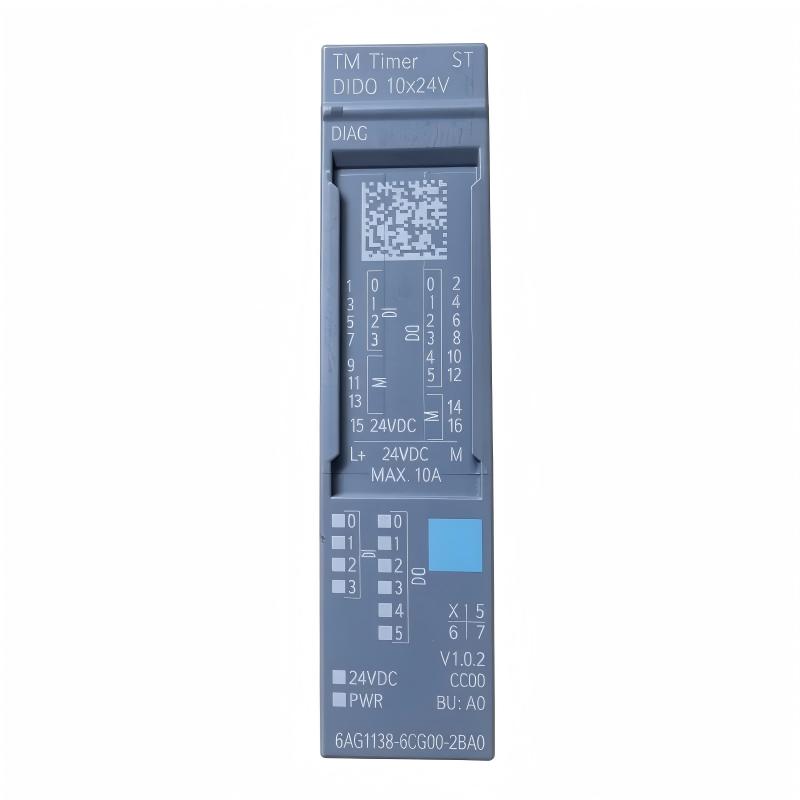
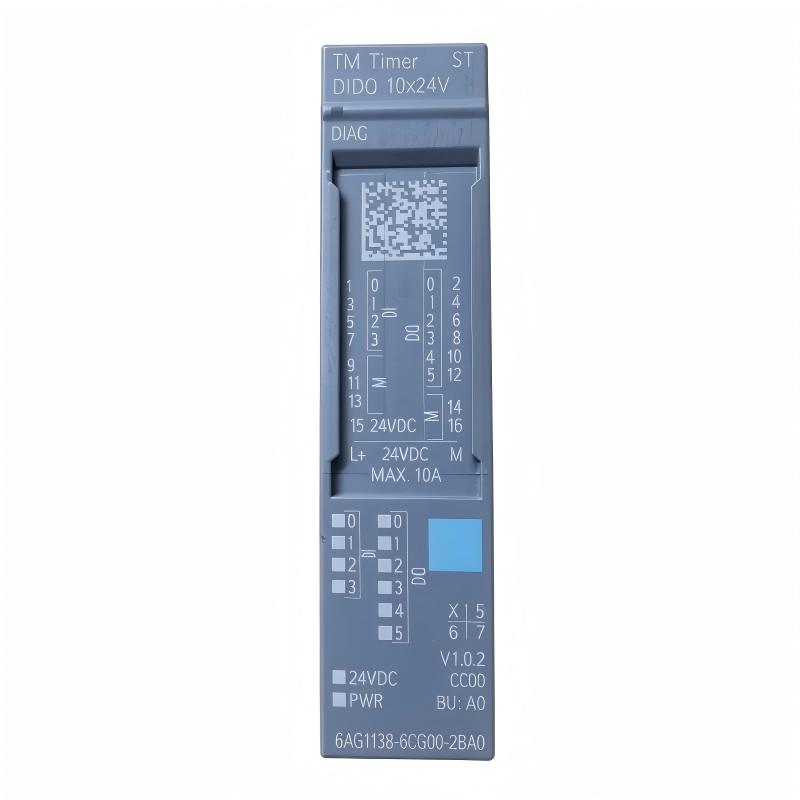
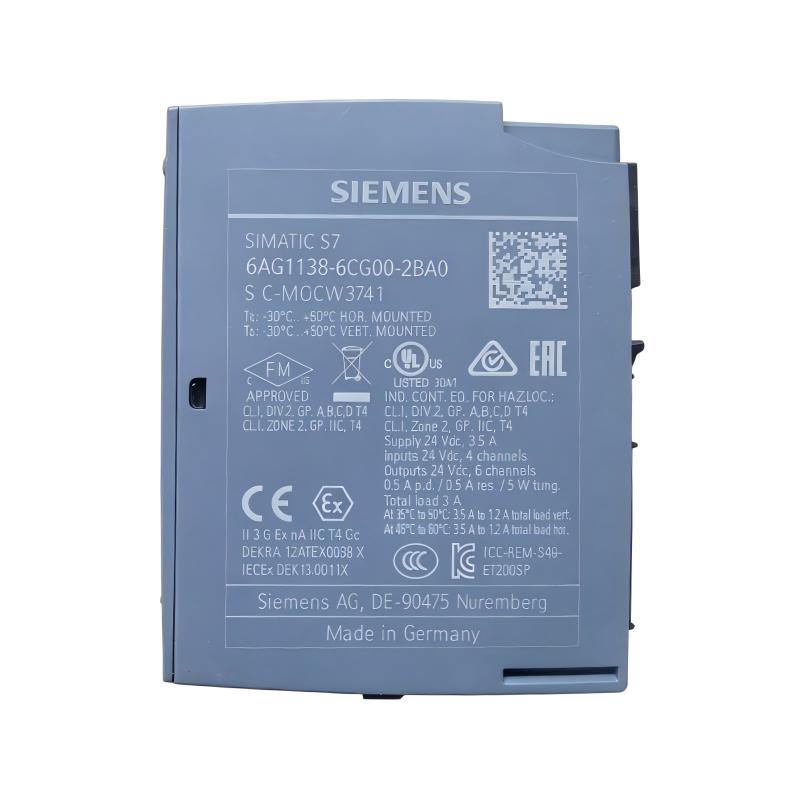
The Siemens 6AG1138-6CG00-2BA0 is a SIPLUS ET 200SP TM Timer DIDQ 10x24V technology module designed for time-controlled digital signal processing in industrial automation systems. It belongs to the Siemens SIPLUS range and is based on the standard SIMATIC ET 200SP module 6ES7138-6CG00-0BA0.
Unlike a conventional digital input or output module, this technology module provides functions for handling digital signals with precise timing requirements. Its capabilities include time-stamp acquisition, time-controlled switching, counting, pulse-width modulation (PWM), and oversampling. These functions make it suitable for automation applications where signal timing and event detection are important.
The module provides four time-controlled digital inputs and six time-controlled digital outputs. The input channels can detect signal transitions with microsecond-level timing accuracy, while the output channels support controlled switching operations. This makes the module useful for applications involving sensors, incremental encoders, timed actuators, and synchronized machine operations.
As part of the SIPLUS product family, the 6AG1138-6CG00-2BA0 includes conformal coating and an extended operating temperature range of -40°C to +60°C. These characteristics make it suitable for industrial environments where temperature conditions or exposure to environmental substances require additional consideration.
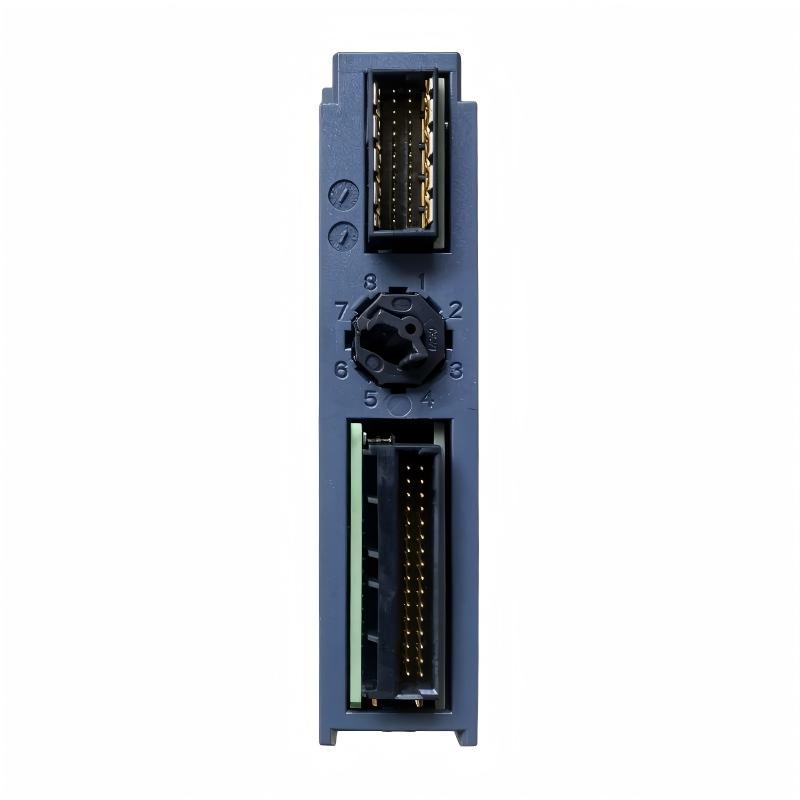
The module is designed for integration into the SIMATIC ET 200SP distributed I/O system. It communicates with the higher-level automation controller through the ET 200SP station architecture and requires a compatible A0-type BaseUnit.
Its compact construction allows it to be installed in control cabinets alongside other ET 200SP modules. The module is particularly useful when ordinary digital I/O cannot provide the timing functionality required by a machine or process.
Technical Specifications
| Parameter | Specification |
|---|---|
| Brand | Siemens |
| Product Model | 6AG1138-6CG00-2BA0 |
| Product Family | SIPLUS ET 200SP |
| Product Type | TM Timer DIDQ 10x24V Technology Module |
| Standard Base Model | 6ES7138-6CG00-0BA0 |
| Module Function | Time-Controlled Digital Input and Output |
| Digital Inputs | 4 time-controlled inputs |
| Digital Outputs | 6 time-controlled outputs |
| Rated Supply Voltage | 24 V DC |
| Permitted Supply Voltage Range | 19.2–28.8 V DC |
| Maximum Current Consumption | 50 mA without load |
| Input Function | Time-stamp detection and signal-edge acquisition |
| Output Function | Time-controlled switching |
| Additional Functions | Counting, PWM, oversampling |
| Encoder Support | Compatible 24 V incremental encoder signals |
| Maximum Counting Frequency | Up to 200 kHz, subject to operating configuration |
| Protective Design | Conformal coating |
| Operating Temperature | -40°C to +60°C |
| Installation System | SIMATIC ET 200SP |
| Compatible BaseUnit | BU Type A0 |
| Protection Rating | IP20 |
| Dimensions | 15 × 73 × 58 mm |
| Weight | 0.045 kg |
Note: Channel operating modes, output-current limits, timing performance, and encoder compatibility depend on the configured function and the applicable Siemens technical documentation. Verify the exact application requirements before commissioning.
Function and Working Principle
The 6AG1138-6CG00-2BA0 is designed to process digital signals when the timing of an input event or output transition is important. It combines digital I/O hardware with dedicated technology functions, reducing the need to perform every timing operation through ordinary PLC program scanning.
1. Time-Controlled Digital Inputs
The module provides four time-controlled digital input channels. These inputs can detect signal transitions and associate them with timing information.
In conventional digital input processing, the controller reads signal states during its configured processing cycle. Very short events or precise transition times may require specialized hardware support.
The timer module helps address this requirement by capturing input events with high timing resolution. This is useful when a controller needs to determine when a sensor changes state, measure intervals between events, or coordinate several signals.
Possible applications include:
- Detecting the arrival of products at a defined machine position.
- Recording the timing of sensor transitions.
- Monitoring pulse sequences from compatible sensors.
- Measuring intervals between digital events.
- Supporting synchronized production operations.
The exact time resolution and supported input behavior should be confirmed for the selected operating mode.
2. Time-Controlled Digital Outputs
The module also provides six time-controlled digital outputs. These channels are designed to generate switching signals according to configured timing requirements.
For example, a machine may need to activate an actuator at a specific time after a sensor event. A time-controlled output function can support this operation without requiring the PLC to manage every switching transition through ordinary cyclic logic.
The outputs can be used in suitable applications involving:
- Timed actuator commands.
- Synchronized digital switching.
- Pulse generation.
- Machine sequence control.
- Time-dependent process signals.
Output load characteristics and switching modes must be checked before connecting external devices.
3. Time-Stamp Acquisition
Time-stamp acquisition allows input events to be associated with timing information. This helps the automation system understand not only which event occurred, but also when it occurred.
In a production line, several sensors may detect products or machine movements at different points. Time-stamped events can help the controller analyze event order, calculate intervals, and coordinate downstream operations.
This capability is particularly valuable where event timing affects production quality, machine synchronization, or process monitoring.
4. Counting Function
The module supports counting functions for suitable digital pulse signals. It can process incoming transitions according to the configured counting mode.
Counting functions may be useful for:
- Monitoring the number of products passing a sensor.
- Counting machine cycles.
- Processing pulse signals from compatible encoders.
- Tracking repetitive movements.
- Measuring production quantities.
The maximum counting frequency depends on the selected operating configuration and signal conditions. Wiring quality, signal characteristics, and encoder compatibility should be considered when designing a high-speed counting application.
5. Pulse-Width Modulation
Pulse-width modulation controls the proportion of time that an output remains active during a defined cycle. By changing the pulse width, a control system can generate different average output levels or timed switching patterns.
In industrial automation, PWM can be useful for compatible control devices and applications that require repetitive pulse signals.
The module’s PWM capability can help reduce the amount of custom timing logic required in the PLC program. The connected device must still be compatible with the output voltage, current, frequency, and switching characteristics.
6. Oversampling
Oversampling allows signal values or states to be acquired or processed at a rate higher than the standard controller update cycle.
This can provide more detailed information about fast-changing signals and improve the timing relationship between input events and output operations.
Oversampling is useful in applications where ordinary cyclic I/O updates may not provide sufficient temporal detail. Its actual benefits depend on the configured system, controller capabilities, and application design.
Role in Industrial Control Systems
The Siemens 6AG1138-6CG00-2BA0 is designed to operate as a technology module within a SIMATIC ET 200SP distributed I/O station.
It performs specialized digital signal processing locally while the higher-level PLC manages the overall machine or process logic.
Integration with SIMATIC ET 200SP
The ET 200SP system provides a modular distributed I/O architecture. Technology modules, digital I/O modules, analog modules, and interface modules can be assembled within a common station.
The 6AG1138-6CG00-2BA0 occupies an appropriate module position and connects through a compatible A0-type BaseUnit.
The BaseUnit provides the electrical connection between the field wiring and the module. Selecting the correct BaseUnit is important because the mechanical and electrical interface must match the module requirements.
PLC Communication
The module operates within an ET 200SP station connected to a compatible controller through the station’s interface module.
The PLC can configure and coordinate the module’s technology functions, process the resulting signal information, and use it in the wider automation program.
Depending on the controller and system configuration, the application may use the module for time-controlled signal acquisition, output switching, counting, or PWM operations.
Machine Synchronization
In automated machinery, several operations may need to occur at defined intervals or in response to precise signal transitions.
The timer module can support these operations by handling selected timing functions locally. The PLC can then focus on sequence management, production coordination, alarm handling, and process decisions.
This separation of functions can simplify the control program in applications that involve frequent or time-sensitive digital events.
Industrial Applications
The 6AG1138-6CG00-2BA0 is suitable for industrial automation tasks that require time-controlled digital signal processing. Its combination of digital inputs, outputs, counting, PWM, and oversampling supports a range of specialized machine-control applications.
1. Packaging Machinery
Packaging equipment often depends on accurate timing between product detection, material feeding, cutting, sealing, and discharge operations.
The module can capture sensor transitions and support timed output switching in suitable machine configurations.
For example, a photoelectric sensor may detect a package at a defined position. The control system can use the captured event information to coordinate a downstream actuator or switching operation.
2. Conveyor and Material-Handling Systems
Conveyor systems use sensors and pulse signals to detect product movement, monitor machine cycles, and coordinate equipment.
The timer module’s input timing and counting functions can help process relevant signals. Its time-controlled outputs can support synchronized switching in suitable installations.
Typical applications include product counting, position-related event detection, and coordination between conveyor sections.
3. Encoder-Based Monitoring
Incremental encoders generate pulse signals representing movement or rotation. The module can support compatible 24 V encoder-related signal processing.
In an industrial machine, encoder pulses may be used to monitor shaft movement, calculate position changes, or coordinate process events.
Correct encoder wiring, signal type, operating frequency, and configuration are essential for reliable measurement.
4. Automated Assembly Equipment
Assembly machinery often uses sensors to detect components and determine when an operation should begin.
Time-stamped input events and controlled digital outputs can support the coordination of clamps, feeders, positioning mechanisms, and other devices.
The module can help handle timing-sensitive signal operations while the PLC manages the overall assembly sequence.
5. High-Speed Signal Processing
Some industrial processes involve short digital pulses or rapidly changing signal states. Ordinary PLC scan-cycle processing may not be sufficient for every timing requirement.
The module’s timing and oversampling functions can help capture and process signals in these applications, subject to the supported configuration and performance limits.
6. Production Counting and Monitoring
Manufacturing lines frequently need to count products, machine cycles, or repetitive movements.
The counting capability can process suitable pulse signals and provide information for production monitoring, batch control, and machine diagnostics.
The PLC can combine this information with other production data to support reporting and process coordination.
Installation and System Integration
Correct installation is essential for reliable signal acquisition, timing performance, and safe operation.
1. Select the Correct BaseUnit
The 6AG1138-6CG00-2BA0 is designed for use with a compatible ET 200SP A0-type BaseUnit.
Before installation, verify the BaseUnit order number and its electrical configuration. The BaseUnit must provide the correct mechanical interface and terminal arrangement for the module.
Do not assume that every ET 200SP BaseUnit is interchangeable.
2. Verify the 24 V DC Supply
The module uses a nominal 24 V DC supply with a permitted range of 19.2–28.8 V DC.
Check the power supply capacity, voltage stability, wiring polarity, and grounding arrangement. The connected field devices must also be compatible with the selected supply and signal levels.
3. Plan Input and Output Wiring
Separate field wiring according to signal type and installation requirements. Keep sensitive signal cables away from high-power conductors where necessary to reduce electrical interference.
For encoder and fast-switching signals, cable routing and signal quality are especially important. Use appropriate shielding and grounding practices where required.
Confirm the electrical characteristics of every sensor, actuator, and connected load before wiring.
4. Configure Technology Functions
The required functions should be configured in the Siemens engineering environment using the supported hardware configuration and technology parameters.
Typical configuration tasks may include:
- Selecting the required input and output operating modes.
- Setting up time-stamp acquisition.
- Configuring counting functions.
- Defining PWM parameters.
- Configuring oversampling where required.
- Assigning signals to the appropriate PLC program variables.
- Setting diagnostic and fault-handling behavior.
The selected configuration should be tested against the real signal conditions and machine timing requirements.
5. Observe Output Load Limits
The digital outputs must be operated within their specified electrical limits.
The module’s output behavior may vary between standard and high-speed operating modes. Confirm the permitted current per channel and total module load before connecting actuators or other devices.
Where the connected load exceeds the available output capacity, use an appropriately rated external switching device.
6. Consider Environmental Conditions
The SIPLUS version includes conformal coating and supports an extended operating temperature range of -40°C to +60°C under specified installation conditions.
However, the module is still an IP20 component intended for suitable control-cabinet installation. Conformal coating does not make it waterproof or suitable for unrestricted exposure to liquids, dust, or corrosive chemicals.
Follow the applicable installation orientation, temperature derating, and environmental requirements.
7. Commissioning and Functional Testing
After installation, inspect the module seating, BaseUnit connection, field wiring, and supply voltage.
Test each input channel with the corresponding sensor or signal source. Verify output switching with an appropriate test load and confirm the configured timing behavior.
Where counting, PWM, or oversampling functions are used, test the module under representative operating conditions before placing the machine into normal production.
Compatible System Components
The 6AG1138-6CG00-2BA0 is part of the Siemens ET 200SP automation platform. It requires compatible station hardware and correctly selected field devices.
| Component | Function | Integration Considerations |
|---|---|---|
| Siemens ET 200SP Interface Module | Connects the distributed I/O station to the controller network | Select according to the required communication architecture |
| Siemens A0-Type BaseUnit | Provides the module mounting and electrical connection | Verify the exact compatible BaseUnit |
| Siemens SIMATIC S7-1500 PLC | Executes machine and process-control logic | Confirm supported configuration and engineering software |
| Siemens SIMATIC S7-1200 PLC | Can be used in suitable distributed I/O architectures | Verify interface and system compatibility |
| 24 V DC Power Supply | Supplies module and field-device power | Maintain the permitted voltage range and sufficient capacity |
| 24 V Incremental Encoder | Provides pulse signals for movement or counting applications | Confirm signal type, voltage, and frequency |
| Digital Sensors | Detect product presence, position, or machine events | Match electrical signal characteristics to input requirements |
| Digital Actuators | Respond to controlled output signals | Check channel and total output-current limits |
| SIMATIC Engineering Software | Configures hardware and technology functions | Use compatible software and hardware support packages |
The listed components are examples of equipment that may be used in a complete ET 200SP installation. They are not necessarily included with the timer module.
Alternative Models and Replacement Considerations
When replacing or upgrading the 6AG1138-6CG00-2BA0, it is important to distinguish between the SIPLUS version and its standard SIMATIC counterpart.
| Model | Product Description | Replacement Considerations |
|---|---|---|
| 6AG1138-6CG00-2BA0 | SIPLUS ET 200SP TM Timer DIDQ 10x24V | Extended environmental specifications and conformal coating |
| 6ES7138-6CG00-0BA0 | SIMATIC ET 200SP TM Timer DIDQ 10x24V | Standard counterpart; compare environmental requirements |
| Other ET 200SP Technology Modules | Specialized digital signal and timing modules | Select according to the required function, channel count, and signal type |
| ET 200SP Standard Digital Input Modules | General-purpose digital signal acquisition | Not a direct substitute where time-stamp or specialized timing functions are required |
| ET 200SP Standard Digital Output Modules | General-purpose digital switching | May not provide equivalent time-controlled output behavior |
Before selecting a replacement, compare:
- Complete Siemens order number.
- SIPLUS or standard product designation.
- Number of digital input and output channels.
- Supported time-controlled functions.
- Time-stamp and counting requirements.
- PWM and oversampling capabilities.
- Input and output electrical characteristics.
- Compatible BaseUnit.
- Operating temperature range.
- Conformal coating and environmental requirements.
- Controller and engineering software compatibility.
The standard counterpart may provide similar functional capabilities, but its environmental specifications are not necessarily equivalent to those of the SIPLUS version.
Key Advantages
Specialized Timing Functions
The module combines digital I/O with technology functions for handling time-sensitive signal operations. This can reduce the need to implement every timing operation through ordinary PLC program logic.
Four Digital Inputs and Six Digital Outputs
The channel configuration supports applications requiring both event acquisition and controlled digital switching within one compact module.
Time-Stamp Acquisition
Time-stamped events help the controller determine when signal transitions occur, supporting event analysis and coordinated machine operations.
Counting and Encoder-Related Functions
The module supports counting applications and compatible 24 V encoder signals, making it useful for production monitoring and movement-related tasks.
PWM and Oversampling
PWM and oversampling provide additional flexibility for specialized digital signal applications.
Extended Temperature Range
The SIPLUS design supports operation from -40°C to +60°C under specified installation conditions, making it suitable for applications requiring an extended operating temperature range.
Conformal Coating
The conformal coating provides additional protection for electronic assemblies against certain environmental influences. This feature is useful when selecting equipment for more demanding industrial environments.
Compact ET 200SP Integration
Its 15 mm width allows it to be installed within the modular ET 200SP architecture, helping conserve control-cabinet space.
Technical FAQs
1. What is the Siemens 6AG1138-6CG00-2BA0?
It is a SIPLUS ET 200SP TM Timer DIDQ 10x24V technology module. It provides time-controlled digital input and output functions for industrial automation applications.
2. What is the standard Siemens model corresponding to this module?
The 6AG1138-6CG00-2BA0 is based on the standard SIMATIC module 6ES7138-6CG00-0BA0. The SIPLUS version includes conformal coating and an extended environmental specification.
3. How many input and output channels does it provide?
The module provides four time-controlled digital inputs and six time-controlled digital outputs.
4. What supply voltage does it require?
Its rated supply voltage is 24 V DC, with a permitted range of 19.2–28.8 V DC.
5. What is the operating temperature range?
The specified operating temperature range is -40°C to +60°C, subject to the applicable installation orientation and derating conditions.
6. Does the module support encoder signals?
Yes. It supports compatible 24 V incremental encoder-related applications. Verify the encoder signal characteristics and the selected module configuration before commissioning.
7. What is the purpose of time-stamp acquisition?
Time-stamp acquisition associates digital input events with timing information. This helps a controller analyze event order and intervals and coordinate machine operations.
8. Does the module support PWM?
Yes. PWM is one of its supported technology functions. The required output mode and electrical load limits must be configured according to the application.
9. Which BaseUnit is compatible with this module?
The module uses an ET 200SP A0-type BaseUnit. The exact BaseUnit order number should be confirmed using Siemens compatibility documentation before installation.
10. Can it replace a standard digital input or output module?
Not as a direct functional substitute in every application. This module provides specialized timing, counting, PWM, and oversampling functions that may not be available on ordinary digital I/O modules.
Procurement and Maintenance Recommendations
When purchasing the Siemens 6AG1138-6CG00-2BA0, verify the complete order number and confirm that the supplied module is the SIPLUS version rather than the standard 6ES7138-6CG00-0BA0 model.
For replacement projects, check the number of input and output channels, timing requirements, compatible BaseUnit, supply voltage, environmental specifications, and controller configuration. A standard ET 200SP module may have similar basic functions but may not provide the same environmental protection.
Before installation, inspect the housing, connector interface, module contacts, and identification label. Confirm that the correct BaseUnit is available and that the module is suitable for the intended station configuration.
During operation, monitor the module’s diagnostic indicators and investigate supply-voltage faults, output overloads, encoder-signal problems, or temperature-related warnings. Keep the control cabinet within the specified environmental limits and maintain suitable wiring and grounding practices.
For maintenance planning, document the hardware configuration and technology parameters. Retaining configuration records can simplify replacement, troubleshooting, and recommissioning.
Conclusion
The Siemens 6AG1138-6CG00-2BA0 SIPLUS ET 200SP TM Timer DIDQ 10x24V is a specialized technology module designed for time-controlled digital signal processing in industrial automation systems. It combines four digital inputs and six digital outputs with time-stamp acquisition, counting, PWM, and oversampling functions.
Its conformal coating and extended operating temperature range distinguish it from the standard 6ES7138-6CG00-0BA0 counterpart. Designed for integration into the SIMATIC ET 200SP platform with a compatible A0-type BaseUnit, the module is suitable for packaging machinery, conveyor systems, encoder-related monitoring, automated assembly, and other applications where precise digital signal timing is important.
For reliable operation, engineers should verify the BaseUnit, signal characteristics, output load limits, controller compatibility, and environmental conditions before installation.