

ProductPRODUCT
Featured products
Contact Us
- Schneider
- TSXSCP114
- Communication Processing Module
- France
- 155 × 35 × 170 mm
- 0.105 kg
- Xiamen, China
- New & In Stock
- T/T, PayPal, Western Union
- 1 Year
- 1-3 Working Days
- DHL, UPS, TNT, FedEx and EMS.
- 24-Hour Service
- COO
- 11
Our advantage

Global Logistics
We have a 10-year logistics and express cooperation agreement, so our products can be shipped to any place in the world.

Brand new and original
Our products are imported in bulk from the place of origin. Because of the cooperative relationship, our products are all original and 100% new.

24-hour service
We provide 7*24 hours service to our customers. We will be there whenever you need us.

Price advantage
All our products are priced very favorably because we have our own warehouse and supply.
| Company Information | |||
| [email protected] | |||
| Mobile | +8615980777398 | ||
| +8615980777398 | |||
| 15980777398 |
Product Overview
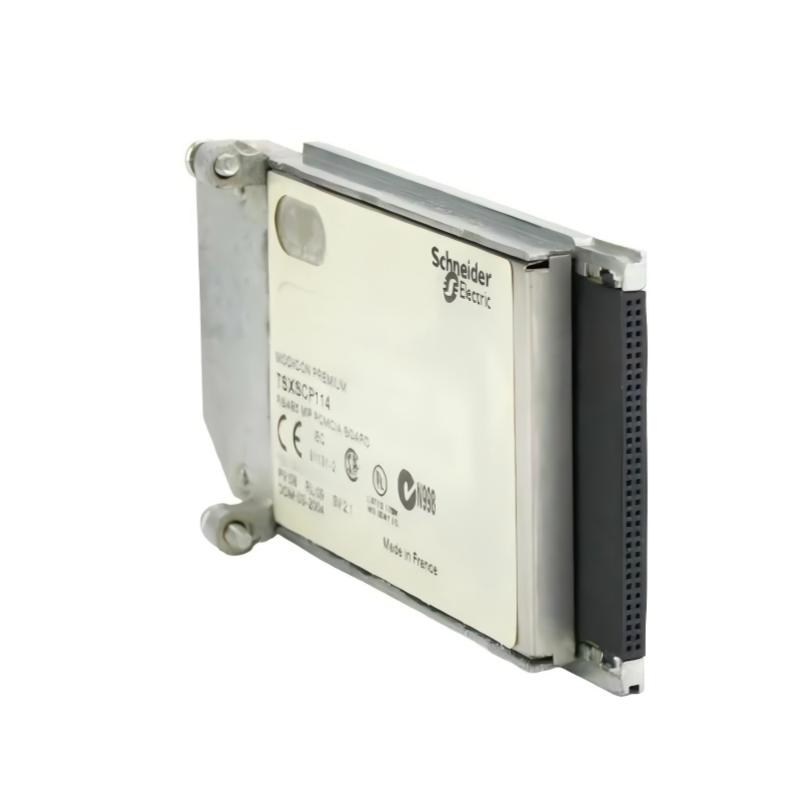
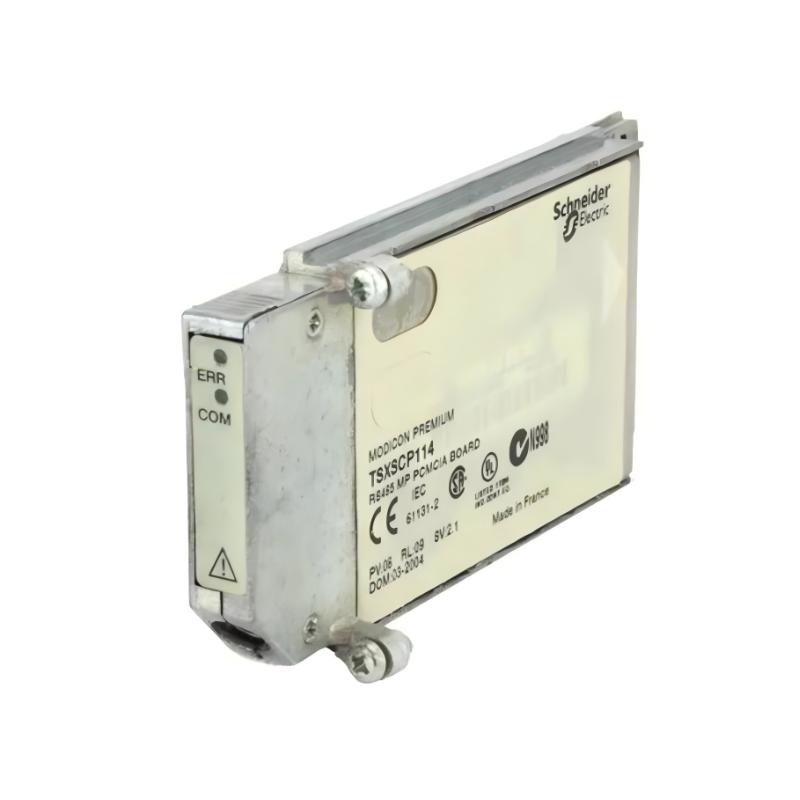
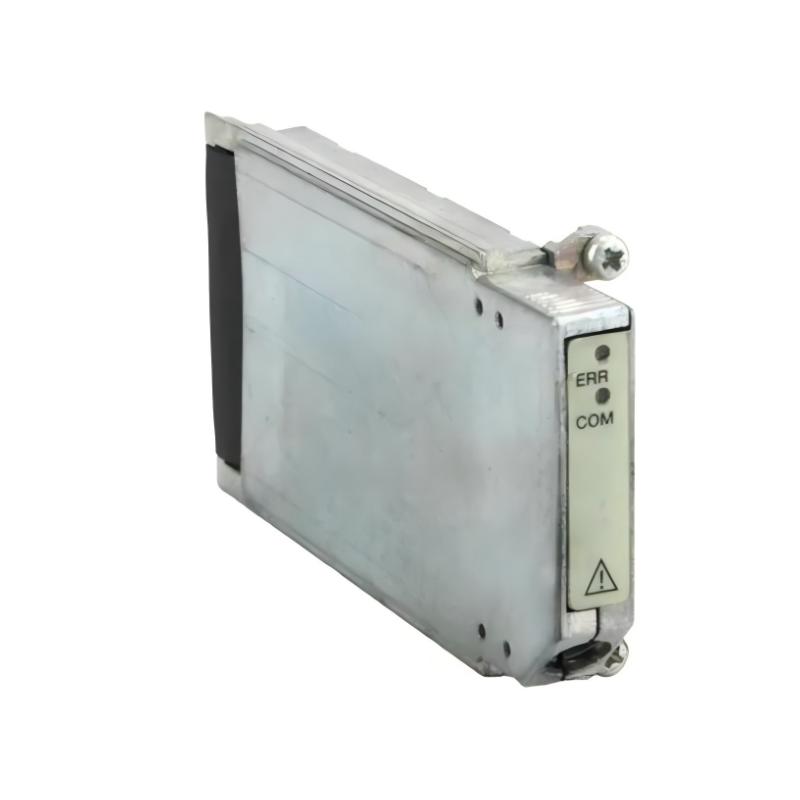
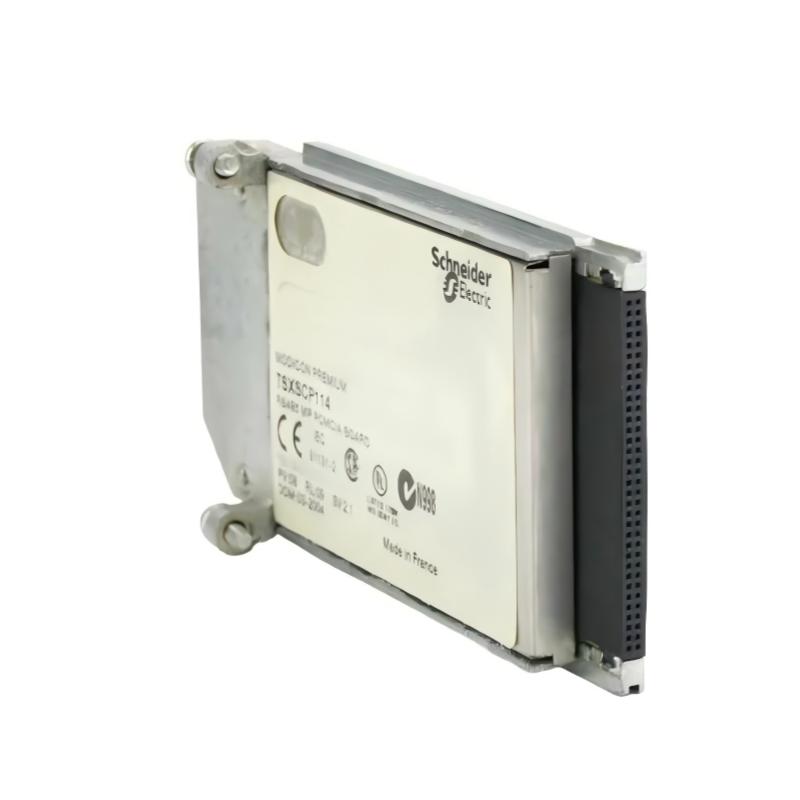
The Schneider Electric TSXSCP114 Communication Card is a PCMCIA Type III communication accessory designed for the Modicon Premium automation platform. It provides an RS485 physical interface and supports several industrial communication modes, including Modbus, Uni-Telway, and character mode.
Rather than functioning as a standalone PLC processor, the TSXSCP114 serves as a communication interface for compatible Premium processors and Atrium coprocessor configurations. It allows supported automation equipment to exchange data with external devices and communication networks through serial communication connections.
In industrial automation systems, communication interfaces are essential for coordinating controllers, exchanging process information, and connecting equipment from different parts of a production line. The TSXSCP114 supports these requirements in legacy Modicon installations where existing communication architecture and controller compatibility must be maintained.
The card uses PCMCIA Type III hardware and operates with a 5 V DC supply. Its documented current consumption is 150 mA, while its net weight is approximately 0.105 kg. Its compact construction makes it suitable for installations where the controller or coprocessor provides the appropriate PCMCIA interface.
The TSXSCP114 is associated with the Modicon Premium platform and is compatible with specified TSX37-21/22 controllers and TSXSCY21601 equipment. It is intended for use with supported Premium processors and Atrium coprocessors.
This model has been discontinued, so it is particularly relevant to industrial maintenance, legacy-system support, and replacement-part procurement. Before ordering, engineers should verify the complete reference number, hardware compatibility, communication requirements, and physical condition of the card.
Technical Specifications
| Parameter | Specification |
|---|---|
| Brand | Schneider Electric |
| Product Reference | TSXSCP114 |
| Product Family | Modicon Premium |
| Product Type | PCMCIA Communication Card |
| Card Format | PCMCIA Type III |
| Physical Interface | RS485 |
| Supported Protocols | Modbus, Uni-Telway |
| Communication Mode | Character Mode |
| Supply Voltage | 5 V DC |
| Current Consumption | 150 mA |
| Product Compatibility | TSX37-21/22, TSXSCY21601 |
| Intended Destination | Premium Processor, Atrium Coprocessor |
| Net Weight | 0.105 kg |
| Supplied Dimensions | 155 × 35 × 170 mm |
| Package Dimensions Reference | 155 × 170 × 35 mm |
| Product Lifecycle | Discontinued |
| Typical Application | Serial communication in legacy PLC systems |
Note: The supplied dimensions correspond to the manufacturer’s listed package dimensions when the measurement order is rearranged. They should not be treated as verified card-body dimensions. Net product weight is 0.105 kg; packaged weight may be different.
Function and Working Principle
The TSXSCP114 provides a serial communication interface for compatible industrial automation controllers. Its main purpose is to support data exchange between the controller environment and external devices through RS485-based communication.
1. RS485 Serial Communication
RS485 is a differential serial communication standard widely used in industrial environments. It is suitable for communication over longer cable distances than many basic single-ended serial interfaces and can support multi-device network arrangements when the wiring and network topology are correctly designed.
The TSXSCP114 uses this physical interface to connect compatible automation equipment to supported serial communication networks.
The actual network performance depends on cable quality, termination, wiring topology, baud rate, grounding, and the characteristics of the connected devices.
2. Modbus Communication
The card supports Modbus communication, a widely used industrial protocol for exchanging data between controllers, instruments, and other automation devices.
In a suitable system, Modbus can be used to exchange values such as operating status, process measurements, control commands, and equipment information.
The communicating devices must use compatible communication parameters, including addressing, baud rate, parity, and other protocol settings.
3. Uni-Telway Communication
Uni-Telway is a Schneider Electric communication protocol used in compatible Modicon automation systems.
The TSXSCP114 supports Uni-Telway communication, allowing suitable legacy equipment to exchange information within an established Schneider Electric control architecture.
This capability is important when maintaining existing installations where replacing the communication protocol or redesigning the controller network could require substantial engineering work.
4. Character Mode
The card also supports character-mode communication. This mode can be used for serial data exchange with compatible devices that communicate through character-based protocols.
Character-mode communication differs from protocol-specific communication because the application or connected equipment may determine how transmitted and received character data is interpreted.
Engineers should verify the required communication mode and connected-device configuration before commissioning.
5. Power Consumption
The TSXSCP114 operates at 5 V DC and has a documented current consumption of 150 mA.
This electrical requirement should be considered when evaluating the controller or coprocessor’s available power capacity and the compatibility of the PCMCIA interface.
Role in Industrial Control Systems
The TSXSCP114 is a communication accessory within a broader Modicon automation architecture. It supports data exchange rather than performing the main PLC control-processing function.
PLC Communication
A PLC executes control logic based on sensor inputs, programmed instructions, and operating conditions. Communication cards allow the controller to exchange information with other equipment.
The TSXSCP114 provides a serial communication interface for compatible Modicon systems. It can therefore support communication between the controller environment and external devices that use the supported communication methods.
Integration with Industrial Equipment
Industrial production systems often contain equipment from multiple manufacturers. Serial communication interfaces can help connect controllers to compatible instruments, devices, and other automation components.
The TSXSCP114 supports RS485-based communication arrangements where the external device and protocol configuration are compatible.
Support for Legacy Automation Systems
Many manufacturing facilities continue to operate established Modicon Premium and related automation equipment. Replacing an entire control system may require extensive engineering, validation, and production downtime.
A compatible replacement communication card can help maintain the original system architecture and preserve existing communication arrangements.
However, compatibility should be confirmed against the controller hardware, firmware, software configuration, and communication requirements.
Industrial Applications
The TSXSCP114 is intended for communication-related functions in compatible industrial automation systems.
1. Manufacturing Production Lines
Manufacturing lines use PLCs to coordinate conveyors, machines, sensors, and auxiliary equipment. Serial communication interfaces can support information exchange between controllers and compatible external devices.
The TSXSCP114 may be used in existing Modicon-based installations where Modbus or Uni-Telway communication is required.
2. Material Handling Systems
Material handling equipment often depends on communication between controllers, drives, and monitoring devices.
In compatible legacy systems, the TSXSCP114 can provide a serial interface for exchanging operating information and control-related data.
3. Process Automation
Process automation installations use controllers to monitor measurements and coordinate equipment operation. Communication cards can provide connections to compatible instruments and external devices.
The TSXSCP114 may support these functions when the connected equipment uses its supported communication methods.
4. Packaging Machinery
Packaging systems commonly combine PLCs, sensors, motor-control equipment, and operator interfaces. Communication between these components helps coordinate production sequences and equipment status.
The TSXSCP114 can be considered for maintaining compatible Modicon Premium installations that rely on serial communication.
5. Legacy Industrial Control Cabinets
The card is particularly relevant to maintenance projects involving older Schneider Electric automation systems.
When an original communication card becomes defective, a matching TSXSCP114 may help restore the existing communication configuration without requiring immediate replacement of the entire controller system.
Installation and System Integration
Correct installation is necessary to establish reliable communication and prevent hardware or configuration problems.
1. Verify Controller Compatibility
Before installation, confirm that the target equipment supports the TSXSCP114.
Documented compatibility includes TSX37-21/22 and TSXSCY21601, with the card intended for compatible Premium processors and Atrium coprocessors.
Do not assume that every Modicon controller with a PCMCIA slot supports this card. Check the hardware reference and applicable system documentation.
2. Check the PCMCIA Interface
The TSXSCP114 uses a PCMCIA Type III format. Confirm that the host equipment provides the correct slot and mechanical interface.
Inspect the card and slot for damaged contacts, contamination, bent components, or other physical problems before installation.
3. Confirm Power Requirements
The card operates at 5 V DC and consumes approximately 150 mA.
Verify that the host device can supply the required power through its PCMCIA interface. Do not apply an external power supply unless the manufacturer’s installation instructions specifically require it.
4. Configure Communication Parameters
The communication settings must match the connected equipment.
Depending on the selected protocol and application, relevant parameters may include:
- Communication protocol.
- Baud rate.
- Device address.
- Data bits.
- Parity.
- Stop bits.
- Communication mode.
- Network topology.
Incorrect communication settings can prevent devices from exchanging data even when the physical connection is correct.
5. Connect the RS485 Network
For RS485 communication, use suitable industrial communication cable and follow the recommended wiring arrangement.
Pay attention to signal polarity, cable shielding, grounding, network termination, and cable routing. Avoid unnecessary branches and follow the topology requirements of the selected network.
Schneider Electric documentation identifies the TSXSCPCX4030 cable, with a length of 3 meters, for specified RS485 or RS422 connections. Confirm the exact accessory and connection arrangement required for the installation.
6. Test Communication
After installation, verify that the controller recognizes the communication interface and that the connected equipment responds correctly.
Test the selected protocol, device addressing, data exchange, and communication stability. Check diagnostic indicators and controller messages if communication errors occur.
Record the final communication parameters to simplify future maintenance and troubleshooting.
Compatible System Components
The TSXSCP114 is designed to operate with specific Modicon automation equipment and compatible communication accessories.
| Component | Function | Integration Considerations |
|---|---|---|
| Modicon TSX37-21/22 | Compatible controller equipment | Confirm the exact controller reference and supported configuration |
| TSXSCY21601 | Compatible Modicon equipment | Verify the application and hardware documentation |
| Premium Processor | Executes PLC control logic | Must support the TSXSCP114 communication card |
| Atrium Coprocessor | Provides additional processing capabilities | Confirm the PCMCIA interface and system configuration |
| RS485 Network Cable | Connects serial communication devices | Check cable characteristics, polarity, shielding, and termination |
| TSXSCPCX4030 Cable | Specified communication cable accessory | Used for designated RS485 or RS422 connection arrangements |
| TSXSCA50 Junction Box | Supports specified Uni-Telway network connections | Verify the required network topology |
| TSXSCA62 Junction Box | Supports specified communication branching arrangements | Confirm the applicable wiring configuration |
| Modbus-Compatible Device | Exchanges serial data with the controller system | Match protocol parameters and device settings |
The listed components are examples of equipment associated with the communication architecture. They are not necessarily supplied with the TSXSCP114 card.
Alternative Models and Replacement Considerations
The TSXSCP114 has been discontinued and has no direct replacement designated by Schneider Electric. Replacement decisions should therefore be based on the existing system architecture and required communication functions.
| Replacement Approach | Considerations |
|---|---|
| Original TSXSCP114 | Preferred for maintaining the exact original hardware configuration when a suitable unit is available |
| Compatible Modicon communication accessory | Must be checked for controller compatibility, physical interface, and protocol support |
| External RS485 communication gateway | May provide an alternative connection method, but requires engineering and configuration work |
| Modern PLC communication module | May be suitable for a broader control-system upgrade rather than a direct replacement |
| Serial-to-Ethernet gateway | Can support protocol conversion in selected applications, subject to compatibility and network design |
Before choosing an alternative, evaluate:
- The exact controller and processor model.
- PCMCIA Type III hardware requirements.
- RS485 or RS422 interface requirements.
- Modbus and Uni-Telway protocol support.
- Character-mode communication requirements.
- Existing cable and junction-box arrangements.
- Software and firmware compatibility.
- Communication speed and network topology.
- Required testing and commissioning procedures.
A generic RS485 interface is not automatically equivalent to the TSXSCP114. The physical interface, communication protocol, host compatibility, and software configuration must all be considered.
Key Advantages
Multiple Communication Modes
The card supports Modbus, Uni-Telway, and character-mode communication, allowing it to serve different serial communication requirements within compatible installations.
RS485 Physical Interface
RS485 provides a widely used industrial serial communication interface suitable for appropriately designed networks.
Compact PCMCIA Type III Design
Its PCMCIA Type III format allows installation in compatible controller or coprocessor hardware without requiring a conventional rack-mounted communication module.
Low Power Consumption
The documented current consumption is 150 mA at 5 V DC, making its power requirement relatively modest.
Compatibility with Legacy Modicon Equipment
The TSXSCP114 is useful for maintaining compatible Modicon Premium and Atrium-based systems where existing communication architecture needs to be preserved.
Support for Existing Industrial Networks
Its communication functions can help maintenance teams retain established serial communication connections instead of immediately redesigning the control network.
Technical FAQs
1. What is the Schneider Electric TSXSCP114?
The TSXSCP114 is a PCMCIA Type III communication card designed for the Modicon Premium automation platform. It provides an RS485 physical interface for supported serial communication functions.
2. Which communication protocols does it support?
The card supports Modbus, Uni-Telway, and character-mode communication.
3. What is the physical interface of the TSXSCP114?
It uses an RS485 physical interface. The actual network connection depends on the selected communication mode and required accessories.
4. What is its power supply requirement?
The TSXSCP114 operates at 5 V DC and has a documented current consumption of 150 mA.
5. Which controllers are compatible with this card?
Documented compatibility includes TSX37-21/22 and TSXSCY21601 equipment. It is intended for compatible Premium processors and Atrium coprocessors. Always verify the exact host configuration.
6. Is the TSXSCP114 a PLC processor module?
No. It is a communication accessory in PCMCIA Type III format. It provides communication functionality and does not replace the main PLC processor.
7. Does it support Ethernet communication?
The TSXSCP114 provides an RS485 serial interface. It should not be treated as an Ethernet communication module.
8. Is the TSXSCP114 still available from the manufacturer?
The product has been discontinued. Schneider Electric lists December 2, 2020, as its discontinuation date in the US product information and December 31, 2027, as the end-of-service date. Availability through independent suppliers may vary.
9. What is the net weight of the card?
The documented net weight is approximately 0.105 kg. The packaged weight may be higher.
10. Can another RS485 communication card replace the TSXSCP114?
Not necessarily. A replacement must support the required host equipment, physical interface, protocols, and software configuration. A generic RS485 card may not provide equivalent Modbus or Uni-Telway functionality within the original Modicon system.
Procurement and Maintenance Recommendations
The TSXSCP114 is a discontinued communication accessory, so procurement should focus on accurate part identification and compatibility verification.
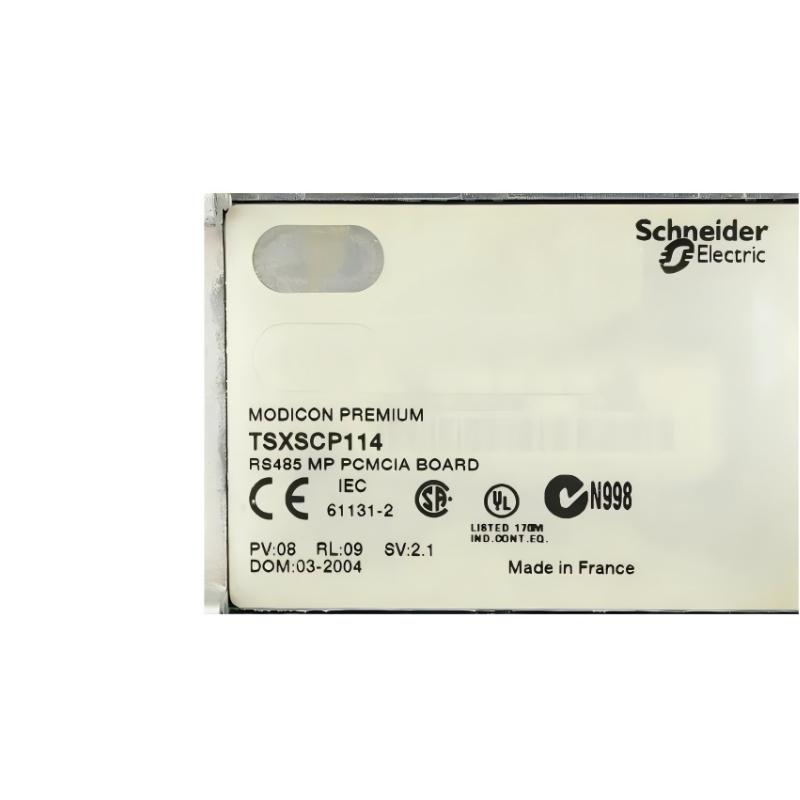
When purchasing a replacement, confirm the complete reference number and inspect the card’s PCMCIA connector, housing, and identification label. For used or refurbished units, request clear photographs and information about testing, storage conditions, and warranty coverage.
Check whether the card is supplied alone or with communication cables and accessories. The card’s net weight is approximately 0.105 kg, while its packaging may have different dimensions and weight. The supplied dimensions of 155 × 35 × 170 mm correspond to the manufacturer’s listed package measurements, not confirmed card-body measurements.
During maintenance, inspect the PCMCIA slot and connector contacts for contamination or damage. Check the RS485 wiring, shielding, grounding, and network termination if communication becomes intermittent.
If the communication card is replaced, verify all protocol parameters and connected-device settings. Test data exchange under normal operating conditions before returning the automation system to production.
For long-term system planning, consider the availability of spare communication cards and the lifecycle status of the associated controller platform. A future migration to a newer automation system may require communication gateways, protocol conversion, software changes, and a structured commissioning process.
Conclusion
The Schneider Electric TSXSCP114 Modicon Premium Communication Card is a PCMCIA Type III serial communication accessory featuring an RS485 interface and support for Modbus, Uni-Telway, and character-mode communication. It operates at 5 V DC with a current consumption of 150 mA and is intended for compatible Premium processors and Atrium coprocessors.
Its primary value is in maintaining communication functionality within existing Modicon automation installations. Because the product has been discontinued and has no designated direct replacement, accurate identification and host-system compatibility checks are essential when sourcing a replacement.