
NewsNEWCENTER
Featured products
Contact Us
Rockwell Automation Advances Intelligent Manufacturing as AI, Connected PLC Systems and Industrial Data Transform Factory Operations
2026-08-18Intelligent Manufacturing Is Changing the Role of Industrial Automation
The manufacturing industry is entering a new stage of digital transformation.
For decades, industrial automation focused primarily on controlling machines and production processes.
PLCs controlled equipment.
HMIs displayed operating conditions.
Drives controlled motors.
Sensors provided feedback.
Industrial networks connected control devices.
This architecture remains fundamental.
However, manufacturers now expect automation systems to do much more.
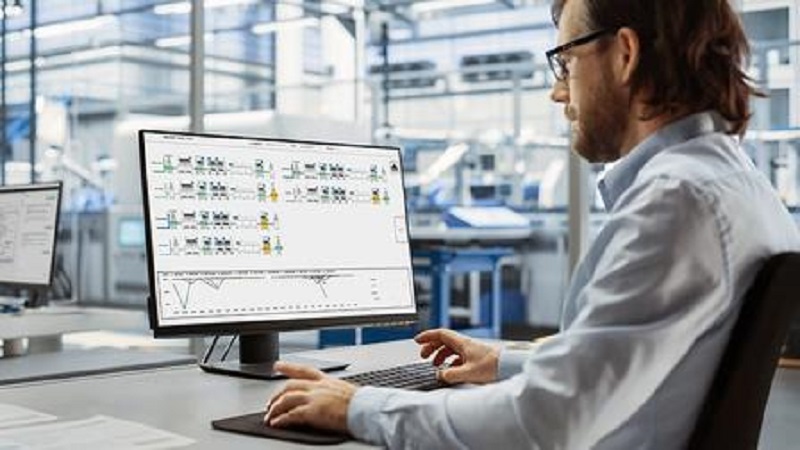
Modern production facilities need to:
- Collect large amounts of machine data
- Analyze equipment performance
- Predict maintenance requirements
- Improve production quality
- Optimize energy consumption
- Connect machines with enterprise software
- Support artificial intelligence
Rockwell Automation continues to develop technologies around this changing industrial environment, with connected automation, industrial information systems, edge computing and AI becoming increasingly important parts of modern manufacturing.
The transformation is not about replacing traditional PLC automation.
Instead, it is about extending the capabilities of the automation system.
PLC Control Remains the Foundation of Smart Manufacturing
Artificial intelligence may receive significant attention, but PLC technology remains essential to industrial production.
A PLC provides deterministic control for machines and processes.
Typical PLC functions include:
- Reading digital inputs
- Processing analog signals
- Controlling motors
- Operating valves
- Managing sequences
- Monitoring alarms
- Coordinating equipment
In a modern factory, these functions still need to operate reliably regardless of whether an AI system is available.
This makes PLCs the foundation upon which intelligent manufacturing technologies can be built.
The next generation of industrial architecture is therefore more accurately described as:
PLC control + industrial data + edge computing + AI + enterprise software
rather than AI replacing traditional automation.
Connected Automation Creates More Valuable Machine Data
A modern machine can generate thousands of data points.
These may include:
- Motor current
- Temperature
- Pressure
- Speed
- Position
- Production count
- Cycle time
- Alarm status
Historically, much of this information was used only for immediate machine control.
Today, manufacturers want to use the same information for broader analysis.
For example, production data can be used to calculate:
- Overall equipment effectiveness
- Machine utilization
- Downtime
- Production efficiency
- Energy consumption
This turns machine data into a valuable business resource.
Edge Computing Brings Analytics Closer to the Machine
One challenge of industrial digitalization is deciding where data should be processed.
Sending every signal to a remote cloud platform may not always be practical.
Industrial applications can require low latency.
Edge computing provides an alternative.
An industrial edge computer can process information close to the machine.
This allows manufacturers to perform:
- Data filtering
- Local analytics
- AI inference
- Machine monitoring
- Condition analysis
without sending every piece of information outside the production environment.
AI Can Help Identify Abnormal Machine Behavior
One of the most promising applications of industrial AI is anomaly detection.
Machines often behave differently before a failure.
For example, a motor may gradually develop:
- Higher current consumption
- Increased temperature
- Longer acceleration time
- Abnormal vibration
An AI system can compare current behavior with historical patterns.
If the operating condition becomes unusual, the system can alert engineers.
This provides an additional layer of protection beyond traditional alarm systems.
Predictive Maintenance Can Reduce Unexpected Downtime
Unexpected machine failure can be extremely expensive.
A single failed component can stop an entire production line.
Traditional preventive maintenance uses fixed schedules.
For example, a motor may be inspected every six months.
Predictive maintenance uses actual equipment conditions to determine when maintenance may be required.
This can potentially reduce unnecessary maintenance while identifying problems earlier.
Industrial AI can support this process by analyzing large quantities of equipment data.
Quality Control Is Becoming More Data-Driven
Quality control is another major area of digital transformation.
Traditional inspection methods often rely on:
- Human operators
- Fixed measurement thresholds
- Dedicated inspection equipment
Modern production systems increasingly use machine vision and AI.
Cameras can inspect products automatically.
AI algorithms can identify complex visual patterns.
The system can detect:
- Surface defects
- Incorrect assembly
- Missing components
- Dimensional abnormalities
- Packaging problems
This allows manufacturers to identify quality problems earlier in the production process.
Industrial Robots Are Becoming More Connected
Robots are increasingly integrated into broader automation architectures.
A robotic cell may include:
- PLC
- Robot controller
- Servo drives
- Sensors
- Safety systems
- Vision equipment
- HMI
The PLC can coordinate the overall process.
The robot performs motion operations.
Sensors provide feedback.
Vision systems identify objects.
The industrial network connects the entire cell.
This creates a coordinated automation environment rather than isolated robotic equipment.
Digital Engineering Reduces Automation Project Risk
Modern manufacturing projects are becoming more complex.
A production line may involve hundreds or thousands of control signals.
Testing everything after installation can create significant project risks.
Digital engineering and virtual commissioning allow engineers to test automation concepts earlier.
Engineers can simulate:
- PLC sequences
- Machine operation
- Robot movements
- Material handling
- Equipment interactions
Potential problems can be identified before physical commissioning.
This can reduce engineering rework and shorten startup time.
Industrial Cybersecurity Is Becoming Essential
Greater connectivity creates greater cybersecurity requirements.
Modern factories may connect automation systems with:
- Engineering computers
- MES platforms
- Production databases
- Remote service systems
- Cloud applications
This increases the importance of:
- Network segmentation
- Access control
- Authentication
- Secure communication
- System monitoring
Industrial cybersecurity must protect both operational technology and digital information.
Energy Efficiency Becomes Part of Automation
Manufacturers are also looking at automation as a tool for energy management.
Production equipment consumes electricity through:
- Motors
- Pumps
- Compressors
- Fans
- Heating systems
Automation systems can monitor equipment operation and energy consumption.
Engineers can then compare energy use with production output.
This helps identify inefficient operating conditions.
Energy optimization is increasingly becoming part of the overall industrial automation strategy.
What the Future Rockwell Automation Ecosystem Could Look Like
The future factory will likely combine multiple technological layers.
Control Layer
PLC systems, I/O modules, drives and safety controllers.
Machine Layer
Motors, sensors, robots and production equipment.
Edge Layer
Industrial computers and local analytics.
AI Layer
Predictive maintenance, quality analysis and optimization.
Enterprise Layer
Production management, planning and business applications.
The value comes from connecting these layers.
Automation Engineers Are Becoming Digital Engineers
The role of the automation engineer is changing.
Traditional skills remain critical:
- PLC programming
- Electrical engineering
- Industrial networking
- Instrumentation
- Motion control
But new skills are increasingly valuable:
- Data analysis
- Edge computing
- AI
- Cybersecurity
- Digital twins
The engineer who understands both machine control and industrial data will become increasingly important.
Conclusion
Rockwell Automation’s continued development of connected industrial automation reflects a broader transformation across manufacturing.
PLC control remains the foundation, but manufacturers are increasingly adding industrial data, edge computing, AI, machine vision and digital engineering.
The result is a more intelligent production architecture capable of monitoring equipment, analyzing performance and supporting better operational decisions.
For manufacturers, the goal is not simply to install more technology.
The goal is to create an automation environment in which machines, controllers, software and data work together.
That is the direction in which intelligent manufacturing is moving.