
NewsNEWCENTER
Featured products

Contact Us
Industrial Robot Orders Rise in 2026 as Automation Expands Across Electronics, Automotive, Food and Manufacturing Industries
2026-08-14Robot Demand Continues to Expand Across Global Manufacturing
Industrial robotics is becoming increasingly important as manufacturers search for higher productivity, consistent quality and more flexible production.
Recent industry data for the second quarter of 2026 showed growth in robot orders across several major manufacturing sectors.
Demand increased across areas including:
- Semiconductor and electronics
- Automotive components
- Food and consumer products
- Metals
- Life sciences
This diversification is significant.
Industrial robots were once strongly associated with automotive assembly plants.
Today, robots are increasingly used across a much wider range of industries.
Manufacturers are adopting robots for:
- Assembly
- Packaging
- Palletizing
- Material handling
- Machine tending
- Inspection
- Welding
The expansion demonstrates that industrial robotics is becoming a mainstream manufacturing technology rather than a specialized solution.
Why Manufacturers Are Increasing Robot Investment
Several factors are driving the growth of industrial robotics.
The first is productivity.
Robots can operate continuously and perform repetitive tasks with consistent motion.
The second is labor availability.
Many manufacturers have difficulty finding workers for repetitive or physically demanding jobs.
The third is quality.
Automated systems can perform standardized processes with high repeatability.
The fourth is flexibility.
Modern robots can be reprogrammed for different products and production processes.
Together, these factors are making robotic automation increasingly attractive.
Electronics Manufacturing Is a Major Robotics Market
Electronics manufacturing requires high precision.
Components are often small, delicate and produced in large quantities.
Robots can support:
- Component handling
- Assembly
- Inspection
- Packaging
- Material transfer
Vision systems can provide additional capabilities.
A robot equipped with machine vision can identify the position and orientation of components before performing an operation.
This is particularly useful in flexible production environments.
Automotive Manufacturing Continues to Drive Automation
The automotive sector remains one of the most important users of industrial robots.
Modern vehicle production involves highly automated processes.
Robots are widely used for:
- Welding
- Painting
- Assembly
- Material handling
- Inspection
The transition toward electric vehicles is also creating new manufacturing requirements.
Battery production requires specialized automation for:
- Cell handling
- Module assembly
- Pack production
- Inspection
This creates new opportunities for robotics suppliers.
Food Manufacturing Is Becoming More Automated
Food production presents different challenges.
Robots must often work in environments where:
- Hygiene is critical
- Products vary in shape
- Production speeds are high
- Cleaning requirements are strict
Robotic systems are increasingly used for:
- Packaging
- Picking
- Sorting
- Palletizing
Delta robots are particularly suitable for high-speed picking applications.
They can perform large numbers of repetitive movements quickly.
High-Speed Robotic Packaging
One recent manufacturing application demonstrates how robotics can address production bottlenecks.
A food manufacturer implemented a robotic pick-and-place system capable of handling approximately 240 picks per minute on a high-volume packaging line.
The system uses delta robots and industrial automation hardware to automate end-of-line handling.
The application illustrates an important principle.
Robotics does not necessarily mean replacing an entire production line.
Instead, robots can target one specific bottleneck.
By automating the slowest manual operation, manufacturers can increase the capacity of the entire production process.
Robots Can Improve Worker Roles
Industrial automation is sometimes described as a replacement for human labor.
In practice, many modern installations are designed differently.
Robots can take over:
- Repetitive tasks
- Heavy lifting
- High-speed repetitive movements
- Difficult ergonomic operations
Workers can then focus on:
- Machine supervision
- Quality control
- Maintenance
- Programming
- Process improvement
This can create higher-value technical roles.
Collaborative Robots Expand Automation Opportunities
Traditional industrial robots often operate inside guarded areas.
Collaborative robots provide another approach.
They are designed to work more closely with people under appropriate safety conditions.
Collaborative robots can support:
- Assembly
- Inspection
- Material handling
- Machine tending
They are particularly attractive for smaller manufacturers that may not have the resources for large fully automated production cells.
Machine Vision Is Becoming Essential
Robots become significantly more flexible when combined with machine vision.
Vision systems can identify:
- Object position
- Product orientation
- Surface defects
- Missing components
- Assembly errors
This allows robots to work with greater variation.
A conventional robot may require precisely positioned parts.
A vision-guided robot can identify where the part is located and adjust its movement accordingly.
AI Is Making Robots More Adaptive
Artificial intelligence is adding another layer of capability.
Traditional robotic systems typically follow predefined instructions.
AI-based systems can analyze visual and operational information to make more flexible decisions.
Potential applications include:
- Object recognition
- Quality inspection
- Dynamic picking
- Process optimization
- Anomaly detection
This is contributing to the development of more intelligent robotic systems.
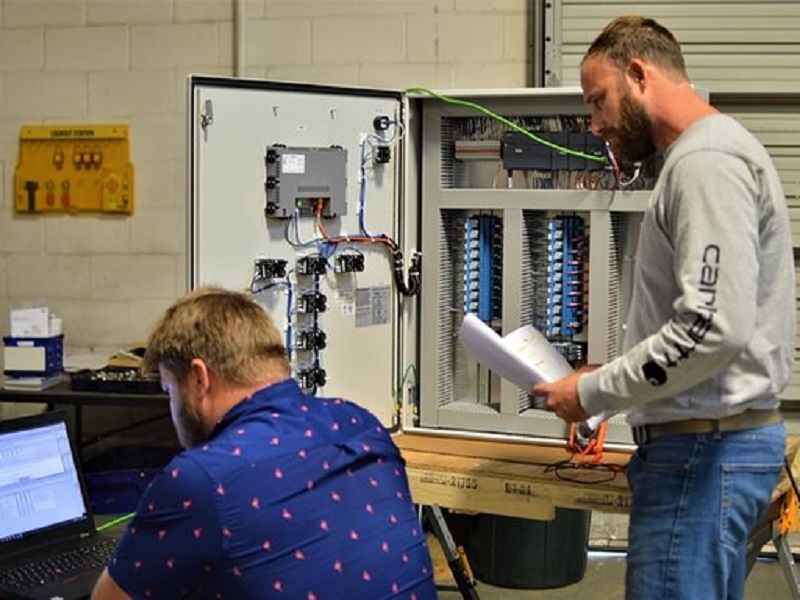
Industrial Robots Need Reliable Control Systems
Robots cannot operate independently.
A complete robotic cell may include:
- PLC
- Robot controller
- Servo drives
- Sensors
- Safety systems
- HMIs
- Industrial networks
The PLC coordinates the overall process.
The robot controller manages robotic motion.
Sensors provide information.
Safety systems protect workers.
Industrial networking connects the components.
This makes robotic automation a multidisciplinary engineering field.
Predictive Maintenance for Robot Cells
Robotic production systems also require maintenance.
Potential problems can develop in:
- Servo motors
- Gearboxes
- Bearings
- Grippers
- Sensors
Operational data can be used to monitor robot condition.
Changes in:
- Motor current
- Movement time
- Position accuracy
- Temperature
may provide indications of equipment degradation.
Predictive maintenance can therefore help prevent unexpected robotic-cell downtime.
Flexible Manufacturing Is Driving Robot Adoption
Manufacturers increasingly need to produce multiple products using the same equipment.
Robots are well suited to flexible production because their programs can be changed.
A robotic cell can potentially be configured for:
- Product A
- Product B
- Product C
without major hardware changes.
This flexibility is becoming more valuable as product lifecycles become shorter.
The Future of Industrial Robotics
The next generation of industrial robots will increasingly combine:
- Advanced motion control
- Machine vision
- AI
- Digital twins
- Industrial networking
Robotic cells will become more connected with factory management systems.
Production information can move from the machine to higher-level software.
This enables better:
- Production planning
- Maintenance
- Quality management
- Performance analysis
Conclusion
The continued increase in industrial robot orders demonstrates that automation demand is expanding beyond traditional automotive applications.
Electronics, food, consumer products, metals and other manufacturing sectors are increasingly adopting robotics to improve productivity and flexibility.
At the same time, AI and machine vision are making robotic systems more capable of handling variable production environments.
For manufacturers, the most successful automation strategy may not be to automate everything at once.
Instead, companies can identify repetitive or production-limiting tasks and use targeted robotic automation to improve the overall process.
As labor availability, product complexity and productivity requirements continue changing, industrial robots will become an increasingly important component of modern manufacturing.