
NewsNEWCENTER
Featured products




Contact Us
ABB Robotics Showcases Imitation Learning, AI Vision and Agentic AI at CIIF 2026
2026-10-14ABB Robotics Advances Physical AI at China International Industry Fair 2026
ABB Robotics is showcasing its latest developments in industrial robotics and physical artificial intelligence at the 26th China International Industry Fair (CIIF 2026) in Shanghai, China. The company’s exhibition highlights imitation learning, AI-powered machine vision, agentic AI, advanced simulation and a new generation of industrial robots designed to support more flexible and efficient manufacturing.
The demonstrations reflect a broader shift in industrial automation: moving beyond conventional robot programming toward systems that can learn from demonstrations, interpret their surroundings and adapt their actions to changing production requirements.
For manufacturers facing increasing demands for product variety, shorter production cycles and improved operational efficiency, these technologies could help simplify robot deployment and expand the range of tasks suitable for automation.
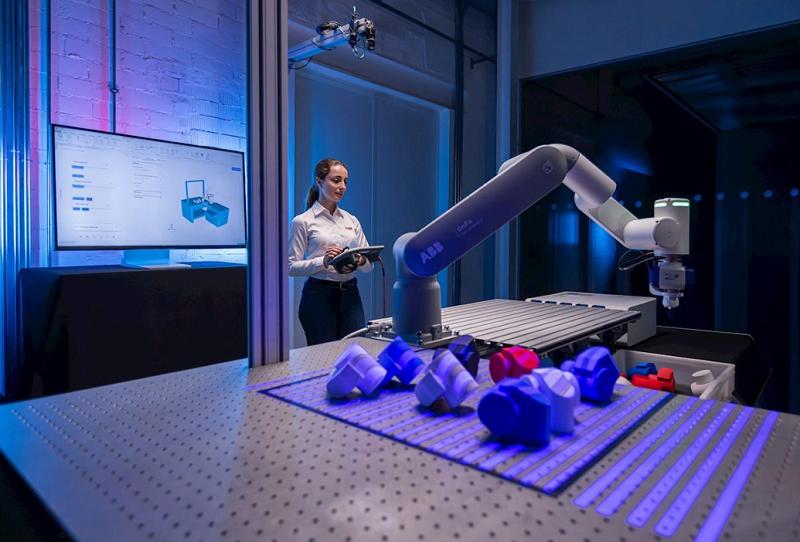
GoFa Collaborative Robots Demonstrate Imitation Learning
One of the key highlights is ABB’s GoFa™ collaborative robot demonstration, which shows how a robot can learn a task by observing a human demonstration.
At the exhibition’s coffee-making station, the robot learns the movements and timing involved in pouring water, including the sequence and rhythm required for the process. Rather than relying exclusively on predefined coordinates, the demonstration illustrates how imitation learning can help robots reproduce more complex, skill-based activities.
An agentic AI planner translates the task into executable actions, while ABB’s OmniCore™ EyeMotion vision system supports object recognition, localization and scene understanding. The demonstration also shows AI-assisted planning for operating a coffee grinder that the robot has not previously encountered.
This approach could be valuable for applications involving frequent product changes, variable workpieces and tasks that traditionally require extensive manual programming. However, industrial deployment still requires appropriate validation, risk assessment and safety measures for the specific application.
OmniCore EyeMotion and AI Robot Trainer Enhance Machine Vision
ABB is also highlighting the combination of OmniCore™ EyeMotion and AI Robot Trainer, which brings vision capabilities and AI model training into the robot deployment process.
The system is designed to help robots recognize objects, understand their working environment and respond to changing conditions. This can be particularly relevant to applications such as bin picking, component handling, inspection and flexible assembly, where object positions and surrounding conditions may vary.
According to ABB’s exhibition announcement, the combination of AI vision and automatic collision-free path planning can reduce on-site commissioning time by up to 90% and production cycle time by up to 50% in the relevant applications.
These figures are manufacturer-reported potential improvements rather than guaranteed results for every installation. Actual performance depends on factors such as the robot model, camera configuration, application complexity, workpiece characteristics and integration requirements.
For automation engineers and system integrators, the main benefit is the potential to reduce the amount of manual configuration needed when deploying robots in variable production environments.
RobotStudio HyperReality Supports Simulation-Based Development
Simulation is another important part of ABB’s physical AI strategy. Its RobotStudio® HyperReality technology uses high-fidelity synthetic data and simulation to help train and validate AI models before deployment on physical equipment.
By testing robot behavior in virtual production environments, manufacturers can investigate different operating conditions, identify potential problems and optimize workflows before commissioning a real production cell.
ABB states that its HyperReality technology can generate synthetic data with accuracy of up to 99%, potentially reduce product time to market by half and lower costs by up to 40%. These are ABB-reported figures associated with the technology, not universal performance guarantees.
ABB also plans to introduce Model Context Protocol (MCP) integration into RobotStudio, enabling external AI agents to interact with software tools through a standardized interface. The approach could help automate repetitive engineering tasks, including workstation model management and aspects of robot application development.
Together, simulation, synthetic data and AI-assisted engineering provide a foundation for connecting virtual development with physical manufacturing.
New Industrial Robots Target Precision Manufacturing
In addition to its software technologies, ABB is introducing new hardware at CIIF 2026.
The company has globally unveiled the IRB 1700 and IRB 1700ID medium-sized industrial robot models. The new range includes five variants with payload capacities from 6 kg to 12 kg, targeting demanding applications such as electronics assembly, AI server manufacturing, welding and surface finishing.
ABB reports that the new models can deliver cycle times up to 20% faster than comparable products, repeatability of path accuracy of 0.03 mm and joint speeds of up to 700 degrees per second, depending on the model and operating conditions.
The company is also presenting its E-Device programming tool, designed to allow users to program and operate compatible ABB industrial and collaborative robots using their own computers or tablets. This approach is intended to offer greater flexibility in engineering workflows and user interaction.
For manufacturers evaluating new robotic systems, the combination of hardware performance, simulation software and AI-assisted programming is increasingly important when comparing automation solutions.
China-Focused Robotics Products Expand ABB’s Portfolio
ABB’s exhibition also features products developed or adapted for the Chinese market, supporting its “In China, for China” strategy.
The IRB 6720 Lite+ large industrial robot is making its China debut, while the PoWa™ collaborative robot family is expanding with a new 7 kg payload model. ABB states that the PoWa family now covers six payload options ranging from 7 kg to 30 kg.
These additions address different automation requirements, from larger industrial handling operations to collaborative applications that need a balance of payload, speed and installation flexibility.
The expanded portfolio also highlights the importance of local market requirements in industrial automation, where manufacturers may need solutions tailored to production layouts, application demands and regional engineering support.
What the Latest ABB Robotics Developments Mean for Industrial Automation
ABB’s CIIF 2026 demonstrations illustrate several important directions in industrial robotics.
First, imitation learning and AI-assisted planning could reduce the programming effort associated with certain complex or frequently changing tasks. Second, integrated machine vision can help robots respond to variable object positions and dynamic work environments. Third, simulation-based development can improve the process of evaluating and validating robotic applications before commissioning.
These developments are particularly relevant to electronics manufacturing, automotive production, logistics, precision assembly and other industries seeking greater production flexibility.
Nevertheless, AI-enabled robotics does not eliminate the need for engineering expertise. Successful deployment still depends on application design, controller compatibility, validated robot programs, appropriate safety systems and effective integration with existing PLC, HMI, drive and manufacturing control systems.
For industrial equipment buyers and system integrators, the key consideration is not simply whether a robot incorporates AI, but whether the complete automation solution can deliver measurable improvements in productivity, reliability, flexibility and total operating cost.
Conclusion
ABB Robotics’ presence at China International Industry Fair 2026 highlights the growing role of physical AI in industrial automation. Through GoFa collaborative robots, OmniCore EyeMotion, AI Robot Trainer, RobotStudio HyperReality and new industrial robot models, ABB is demonstrating how learning, perception, simulation and motion control can work together to support more adaptable manufacturing systems.
As industrial companies continue to modernize production lines, the integration of AI-enabled robots with established automation infrastructure is likely to remain an important area of development. The practical value of these technologies will ultimately depend on their performance in real production environments and their ability to meet application-specific engineering and safety requirements.