
NewsNEWCENTER
Featured products
Contact Us
Siemens Expands Industrial AI Capabilities as Smart Manufacturing Enters a New Automation Era
2026-08-17Industrial AI Is Moving From Experimentation to Real Manufacturing
Artificial intelligence is becoming one of the most important technologies influencing the future of industrial automation.
For many years, manufacturers primarily used AI for research projects, data analysis and experimental applications.
That situation is changing.
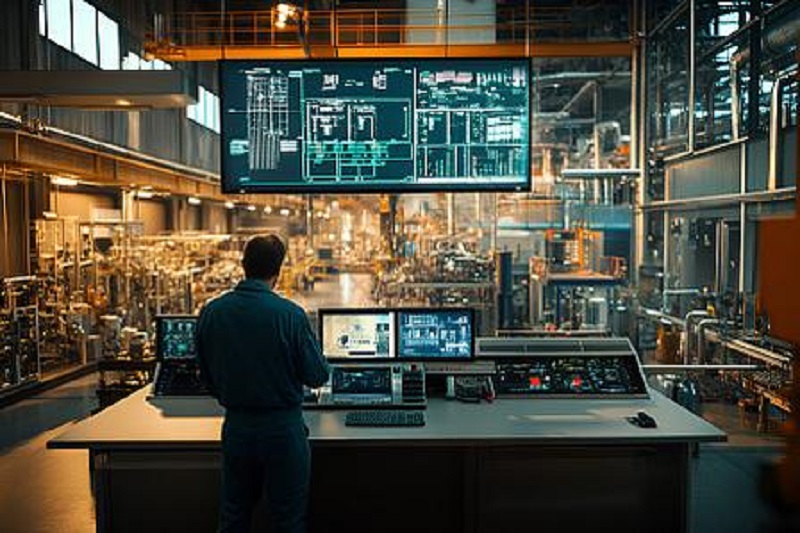
AI is now increasingly being integrated into:
- PLC engineering
- Machine vision
- Predictive maintenance
- Production optimization
- Industrial robotics
- Digital twins
- Energy management
Siemens is one of the major industrial automation companies investing heavily in this transition.
The company’s latest industrial AI developments demonstrate a broader change in the automation industry.
AI is no longer being treated simply as an external software technology.
It is increasingly becoming part of the industrial engineering environment itself.
Why Industrial AI Matters to Automation Engineers
Traditional automation depends heavily on deterministic control.
A PLC receives input signals and executes predefined logic.
For example:
A sensor detects a component.
The PLC processes the signal.
A motor starts.
A conveyor moves.
Another sensor detects the position.
The PLC stops the motor.
This approach remains extremely reliable.
However, traditional control logic is not designed to recognize complex patterns across huge amounts of historical information.
AI can provide another layer of intelligence.
It can analyze:
- Historical machine data
- Production trends
- Equipment behavior
- Visual information
- Process deviations
This allows AI to complement conventional automation.
Siemens Is Bringing AI Closer to Engineering
One of the most important developments in industrial AI is the use of AI during engineering.
PLC engineers traditionally spend significant amounts of time creating:
- Control programs
- Function blocks
- Hardware configurations
- Documentation
- Diagnostic routines
AI-assisted engineering can potentially reduce repetitive work.
An engineer may describe a machine function using natural language.
An AI engineering assistant can then help create an initial implementation.
The engineer still needs to verify:
- Logic
- Safety
- Timing
- I/O assignments
- Interlocks
The objective is not to remove engineering expertise.
The objective is to make engineers more productive.
AI-Assisted PLC Programming Could Change Project Development
Large automation projects often involve thousands of control functions.
For example, a production line may contain:
- Hundreds of sensors
- Hundreds of actuators
- Multiple drives
- Several robot systems
- Safety equipment
- Communication interfaces
Programming every function manually requires significant time.
AI-assisted tools could help engineers generate repetitive structures.
This could be particularly valuable for standardized machine functions.
Engineers could then focus on the more complex parts of the project.
Digital Twins Provide the Foundation for Intelligent Engineering
Digital twins are becoming increasingly important in industrial automation.
A digital twin represents a physical machine or production system in a virtual environment.
Engineers can use the virtual model to test:
- Machine sequences
- PLC logic
- Robot movements
- Production processes
- Equipment interactions
This can reduce commissioning risks.
AI can add another layer to this environment by analyzing simulated operating conditions.
The combination of digital twins and AI could eventually allow engineers to evaluate more possible operating scenarios before physical production begins.
Industrial AI and Predictive Maintenance
Predictive maintenance remains one of the most practical applications of AI.
Industrial equipment often produces warning signals before a failure.
These signals can include:
- Increasing vibration
- Higher motor current
- Rising temperature
- Longer cycle times
- Unusual pressure changes
Traditional maintenance may rely on fixed inspection schedules.
AI can analyze continuously changing equipment data.
This allows maintenance teams to identify unusual patterns earlier.
The objective is to move from:
Repair after failure
toward:
Detect → Predict → Plan → Maintain
AI Can Improve Production Quality
Quality inspection is another major application.
Traditional automated inspection systems often use fixed rules.
AI-based vision systems can recognize more complicated patterns.
For example, AI can potentially identify:
- Surface defects
- Incorrect assembly
- Missing components
- Product deformation
- Packaging problems
This is particularly valuable for high-volume manufacturing.
Detecting defects earlier can reduce:
- Scrap
- Rework
- Material waste
- Customer returns
Industrial Data Is Becoming a Strategic Asset
Modern factories generate enormous quantities of data.
The data comes from:
- PLCs
- Sensors
- Drives
- Robots
- CNC machines
- Vision systems
Historically, much of this information was used only for troubleshooting.
Today, manufacturers increasingly recognize its long-term value.
Historical machine data can help companies understand:
- Production efficiency
- Equipment reliability
- Process stability
- Energy consumption
AI can analyze this information at a scale that would be difficult for humans to achieve manually.
Cybersecurity Must Keep Pace With Industrial AI
AI increases the amount of information moving through industrial systems.
This can create additional cybersecurity requirements.
Manufacturers need to protect:
- PLC programs
- Engineering data
- Production information
- Machine configurations
- Industrial networks
AI systems also need controlled access to industrial data.
A successful industrial AI strategy therefore requires both intelligence and security.
AI Will Not Replace PLCs
There is sometimes a misconception that AI will eventually replace PLC technology.
This is unlikely in many industrial applications.
PLCs provide deterministic and highly reliable control.
AI provides prediction, classification and optimization.
The technologies solve different problems.
The future architecture is more likely to look like:
PLC + Industrial Network + Edge Computing + AI + Digital Software
rather than AI replacing the PLC.
The Automation Engineer of the Future
Automation engineering is becoming increasingly interdisciplinary.
Engineers will still need strong knowledge of:
- PLC programming
- Electrical systems
- Instrumentation
- Industrial networking
- Motion control
But they will increasingly work with:
- AI
- Data analytics
- Digital twins
- Edge computing
- Cybersecurity
This creates a new generation of automation professionals who understand both physical machines and digital intelligence.
Future Outlook
The industrial automation industry is moving toward increasingly intelligent engineering environments.
Machines will generate more data.
Controllers will become more connected.
AI will analyze operational information.
Digital twins will simulate production systems.
Engineering software will assist with development.
The result will be a more integrated manufacturing environment.
Conclusion
Siemens’ continued investment in industrial AI reflects one of the most important changes occurring in automation technology.
Artificial intelligence is moving beyond data analysis and becoming part of engineering, maintenance, quality control and production optimization.
The future factory will not depend on AI alone.
Instead, AI will work alongside PLCs, sensors, robots, drives and industrial networks.
For manufacturers, this combination can create more flexible, efficient and intelligent production systems.
For automation engineers, it represents a major evolution in the profession and an opportunity to work with a much broader range of technologies.