

ProductPRODUCT
Featured products

Contact Us
- Schneider
- TMCR2SL1
- Communication Expansion Module
- France
- 41 x 15 x 35 mm
- 0.012 kg
- Xiamen, China
- New & In Stock
- T/T, PayPal, Western Union
- 1 Year
- 1-3 Working Days
- DHL, UPS, TNT, FedEx and EMS.
- 24-Hour Service
- COO
- 3
Our advantage

Global Logistics
We have a 10-year logistics and express cooperation agreement, so our products can be shipped to any place in the world.

Brand new and original
Our products are imported in bulk from the place of origin. Because of the cooperative relationship, our products are all original and 100% new.

24-hour service
We provide 7*24 hours service to our customers. We will be there whenever you need us.

Price advantage
All our products are priced very favorably because we have our own warehouse and supply.
| Company Information | |||
| [email protected] | |||
| Mobile | +8615980777398 | ||
| +8615980777398 | |||
| 15980777398 |
1. Product Overview
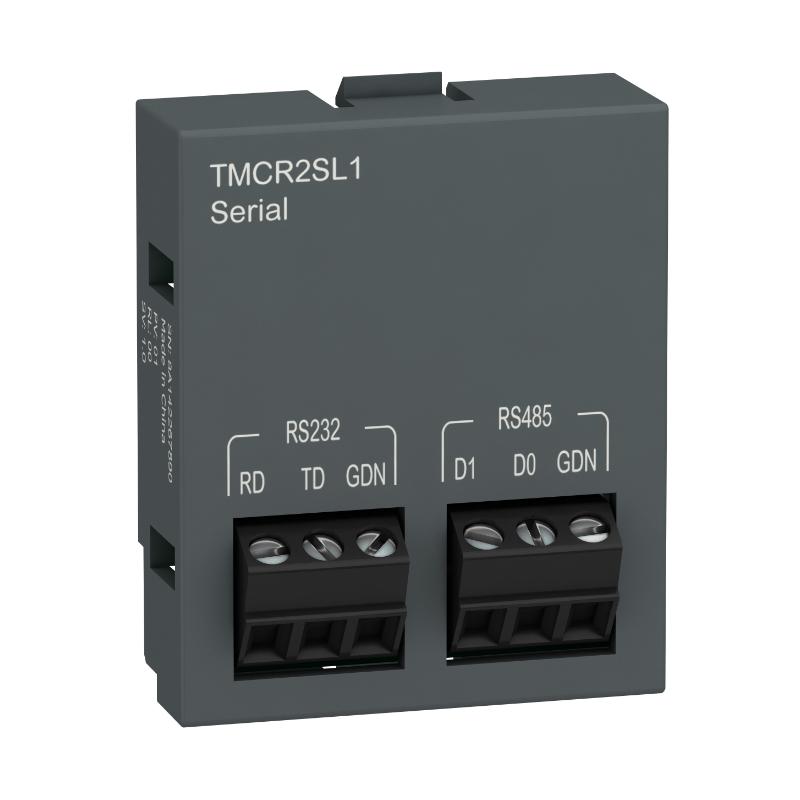
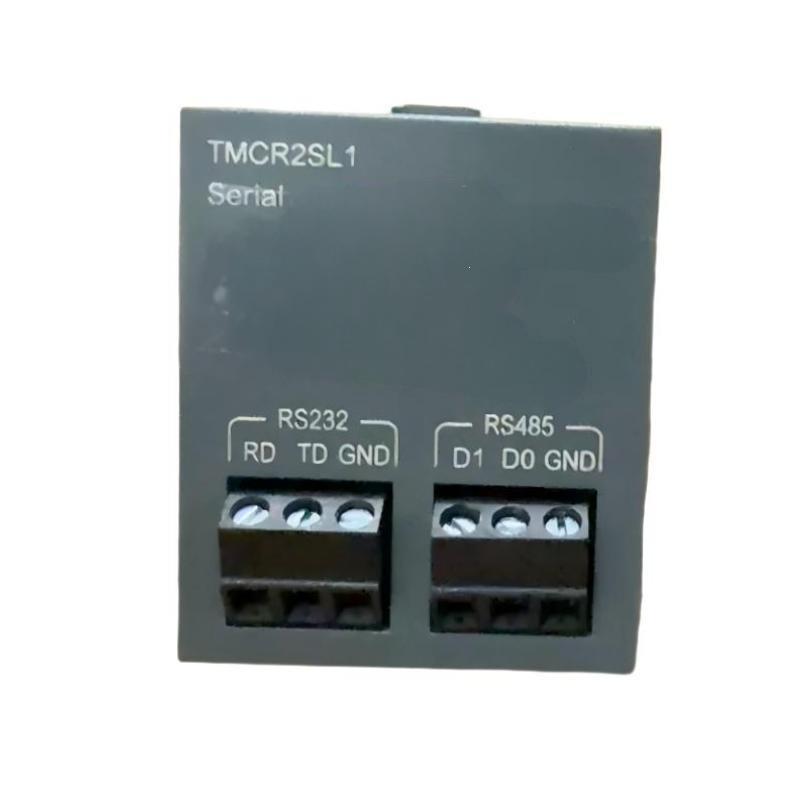
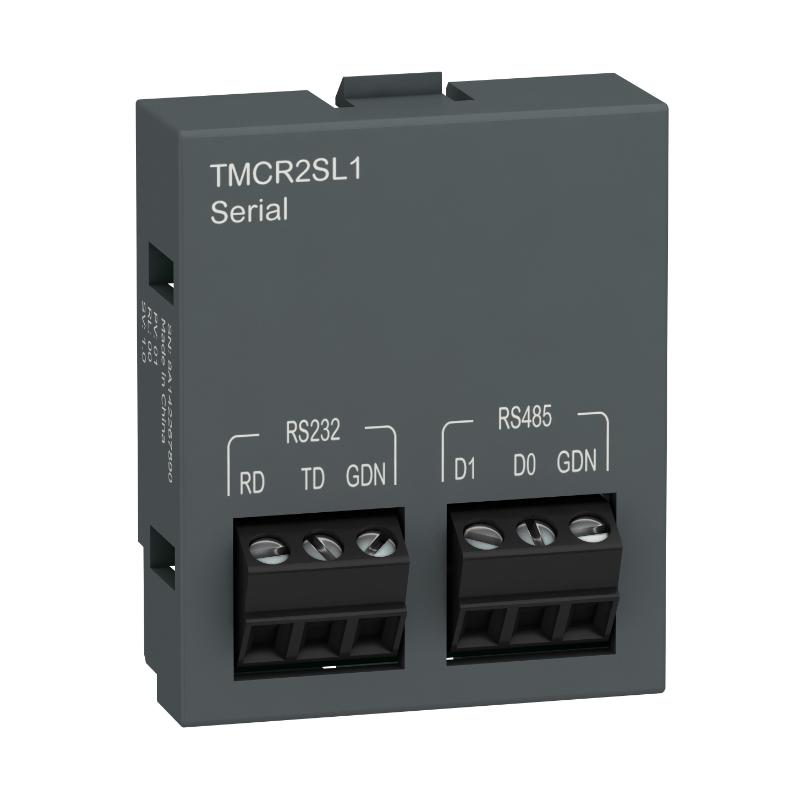
The Schneider Electric TMCR2SL1 Communication Expansion Module is a serial communication cartridge designed for the Easy Modicon M200 logic controller family. It adds a serial communication channel to a compatible controller, allowing the PLC to exchange data with supported industrial devices through RS232 or RS485 communication interfaces.
Serial communication remains important in industrial automation because many instruments, drives, operator interfaces, and legacy control devices use serial protocols to exchange process data and operating commands. By adding a serial interface, the TMCR2SL1 can help integrate compatible equipment into a PLC-based control system without requiring every device to communicate through Ethernet.
The TMCR2SL1 supports Modbus RTU and ASCII communication in master or slave configurations, as well as SoMachine-Network communication where supported by the applicable system configuration. Its transmission rate can be configured from 1.2 to 115.2 kbit/s, with 115.2 kbit/s as the default setting.
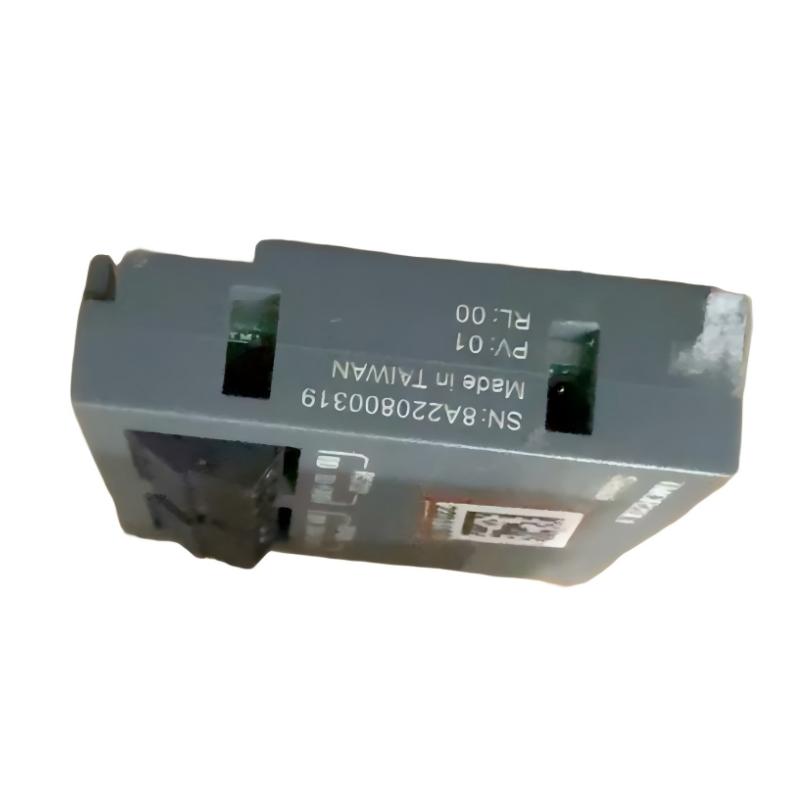
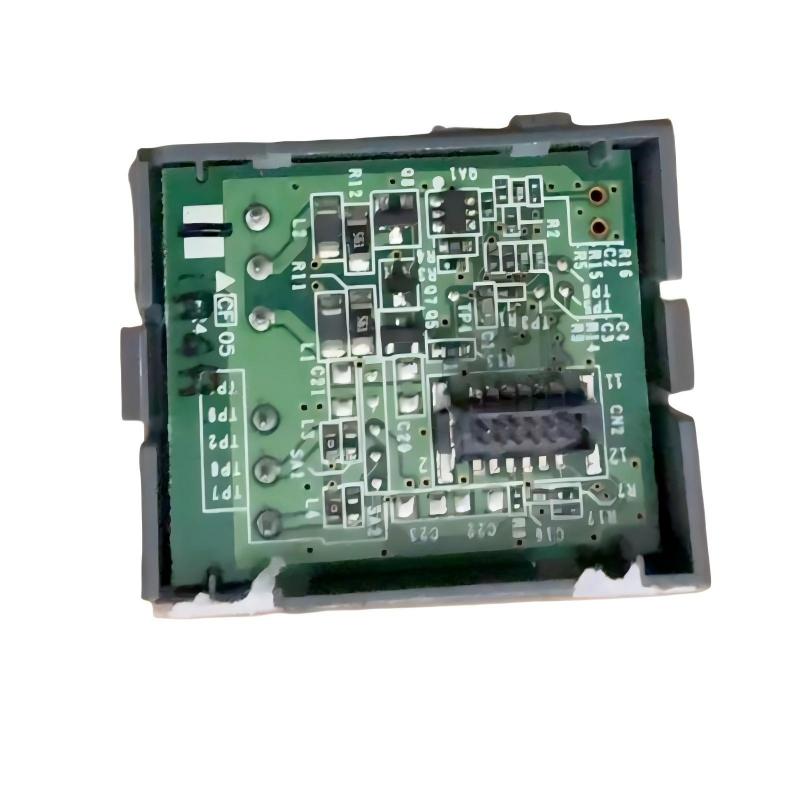
The module features screw-terminal connections for RS232 and RS485 serial links. Its compact dimensions of 41 × 15 × 35 mm and weight of 0.012 kg make it suitable for installations where controller expansion space is limited.
For automation engineers, system integrators, and industrial spare-parts purchasers, the TMCR2SL1 provides a compact way to extend serial communication capabilities in compatible Easy Modicon M200 applications.
2. Technical Specifications
| Parameter | Description |
|---|---|
| Brand | Schneider Electric |
| Model | TMCR2SL1 |
| Product Type | Communication Expansion Module / Serial Communication Cartridge |
| Product Range | Easy Modicon M200 |
| Compatible Controller Family | Easy Modicon M200 |
| Communication Channels | 1 additional serial communication channel |
| Serial Interfaces | RS232 and RS485 |
| Connection Type | Screw-terminal block |
| Communication Protocols | Modbus master/slave RTU and ASCII; SoMachine-Network where supported |
| Transmission Rate | 1.2–115.2 kbit/s |
| Default Transmission Rate | 115.2 kbit/s |
| Reference RS485 Cable Length | Up to 15 m under specified conditions |
| Reference RS232 Cable Length | Up to 3 m under specified conditions |
| Electrical Isolation | Non-isolated between communication lines and internal logic |
| Installation Type | Plug-in communication cartridge |
| Dimensions | 41 × 15 × 35 mm |
| Weight | 0.012 kg |
The communication settings, wiring arrangement, and permitted cable length should be confirmed against the applicable controller documentation and the requirements of the connected devices.
3. Function and Working Principle
The TMCR2SL1 extends the communication capabilities of a compatible PLC by providing an additional serial communication channel. Once installed and configured, it enables the controller to exchange information with devices that support the selected serial interface and protocol.
3.1 RS232 Serial Communication
RS232 is commonly used for point-to-point communication between a controller and a compatible external device. Typical applications include communication with certain operator terminals, configuration equipment, and serial instruments.
When using the RS232 interface, engineers must confirm the device’s pin assignments, signal requirements, baud rate, parity, stop bits, and cable configuration.
RS232 is generally intended for relatively short communication distances. The TMCR2SL1’s referenced RS232 cable length is up to 3 m under specified conditions.
3.2 RS485 Serial Communication
RS485 is widely used in industrial environments because it supports differential signaling and is suitable for multidrop communication networks when correctly designed.
With compatible devices and a properly configured network, the TMCR2SL1 can communicate with multiple field devices on an RS485 network. This is useful when several instruments or controllers need to exchange data over a shared serial link.
The referenced RS485 cable length is up to 15 m under specified conditions. Actual permissible cable length depends on the transmission rate, cable characteristics, network topology, electrical noise, and installation requirements.
3.3 Modbus Communication
Modbus RTU and Modbus ASCII allow compatible industrial devices to exchange structured data. Depending on the application, the PLC can act as a Modbus master or slave.
In a typical master configuration, the PLC requests data from connected devices, such as instrument measurements, drive status, or operating parameters. In a slave configuration, the PLC responds to requests from another compatible device.
The TMCR2SL1 provides the communication interface, while the controller program and device configuration determine how data is exchanged and processed.
4. Role in Industrial Automation Systems
Industrial automation systems frequently combine newer PLCs with devices that use serial communication. The TMCR2SL1 can help bridge this requirement by providing an additional serial interface to a compatible Easy Modicon M200 controller.
Its principal functions include:
- Serial communication expansion: Adds a communication channel to a supported controller.
- Device integration: Supports data exchange with compatible instruments, drives, and other serial devices.
- Modbus connectivity: Enables supported Modbus RTU and ASCII applications.
- Legacy equipment integration: Can help retain compatible serial devices when modernizing a control system.
- Compact controller expansion: Adds communication capability without requiring a separate full-size communication module.
The module does not automatically translate between every industrial protocol. Successful integration depends on protocol compatibility, communication settings, addressing, and correct application programming.
5. Industrial Applications
Manufacturing Machinery
Production machines may use serial communication to exchange status information, operating parameters, or commands with compatible instruments and controllers. The TMCR2SL1 can provide the additional interface required for such applications.
Packaging Equipment
Packaging machinery often integrates PLCs with drives, operator interfaces, and specialized equipment. Where the connected device supports the appropriate serial interface and protocol, the cartridge can support data exchange within the control system.
Process Instrumentation
Compatible meters, measurement devices, and instrumentation controllers may communicate using Modbus over RS232 or RS485. The PLC can read supported process values and use them for monitoring, alarms, and control logic.
HVAC and Building Equipment
Some HVAC controllers, meters, and equipment interfaces support serial Modbus communication. A compatible Modicon M200 controller with the TMCR2SL1 may communicate with these devices when the protocol and electrical requirements match.
Water and Pumping Systems
Pumps, meters, and auxiliary controllers may provide serial communication for status monitoring and parameter access. The TMCR2SL1 can help connect compatible devices to the PLC application.
Industrial System Modernization
During the replacement of older control hardware, serial communication may be needed to preserve connections to existing instruments or equipment. The cartridge can be considered when the legacy device’s interface and protocol are supported by the target system.
6. Installation and System Integration
Correct installation and configuration are essential for reliable serial communication.
Step 1: Verify Controller Compatibility
Confirm that the host controller belongs to the supported Easy Modicon M200 family. Check the exact controller model, available cartridge slot, and permitted cartridge arrangement.
The TMCR2SL1 should not be assumed compatible with every Schneider Electric PLC simply because the controller uses a similar modular design.
Step 2: Isolate the Equipment
Follow the machine’s electrical isolation procedure before installing the cartridge or modifying communication wiring. Confirm that the controller is in a safe maintenance state.
Remove the appropriate cartridge cover as specified by the controller’s installation instructions. Insert the module in the designated slot without forcing it into place.
Step 3: Select the Correct Serial Interface
Determine whether the application requires RS232 or RS485. Check the communication interface supported by the connected device and use the corresponding terminal connections.
Do not assume that RS232 and RS485 wiring are interchangeable. They use different electrical signaling methods and require different connection arrangements.
Step 4: Connect the Communication Cable
For RS232, follow the required signal and reference connections for the devices at both ends.
For RS485, verify the differential signal connections, network polarity, topology, and termination requirements. Keep the communication cable away from high-current conductors and other major sources of electrical interference.
Because the TMCR2SL1 is non-isolated between the communication lines and internal logic, grounding and potential differences should be considered carefully in the system design.
Step 5: Configure Communication Parameters
Configure the PLC and connected device with matching communication parameters, including:
- Baud rate.
- Data bits.
- Parity.
- Stop bits.
- Protocol selection.
- Device address, where applicable.
- Master/slave operating mode.
The default transmission rate is 115.2 kbit/s, but the correct setting depends on the connected equipment and the application.
Step 6: Configure the PLC Program
Set up the appropriate communication functions in the supported programming environment. Define the required read and write operations, device addresses, data registers, timeout behavior, and error-handling logic.
Ensure that the register mapping matches the connected device’s documentation. Incorrect register addresses or data types can cause misleading values even when the serial link is functioning correctly.
Step 7: Test Communication
After restoring power, check the controller diagnostics and perform a controlled communication test.
Verify that the PLC receives valid data, that responses arrive within the expected time, and that communication errors are handled appropriately. Test the system under normal operating conditions before returning the equipment to service.
7. Troubleshooting Common Problems
Problem 1: No Communication with the Connected Device
Possible causes:
- Incorrect RS232 or RS485 wiring.
- Mismatched baud rate or serial parameters.
- Incorrect Modbus address.
- Unsupported protocol or operating mode.
- Missing common reference or an unsuitable grounding arrangement.
- Incorrect PLC communication configuration.
Recommended checks:
- Confirm that the TMCR2SL1 is supported by the controller.
- Verify the selected interface and terminal assignments.
- Compare the communication parameters at both ends.
- Check the device address and Modbus register configuration.
- Review controller diagnostics and communication timeout messages.
Problem 2: Intermittent Communication
Intermittent communication may result from electrical noise, loose terminals, unsuitable cable routing, incorrect RS485 termination, or an unstable reference potential.
Inspect the wiring, tighten connections according to the applicable instructions, and separate communication cables from high-current power cables. For RS485 networks, verify the topology and termination arrangement against the network design.
Problem 3: Incorrect Data Values
A communication link may be operational even when the values received by the PLC are incorrect.
Possible causes include an incorrect register address, mismatched data type, word-order differences, scaling errors, or incorrect interpretation of signed and unsigned values.
Compare the PLC configuration with the connected device’s register map. Confirm how multi-register values are encoded and whether the program applies the correct engineering-unit conversion.
Problem 4: Modbus Timeout Errors
Timeouts can occur when the target device does not respond within the configured time or when requests are not delivered correctly.
Check the device address, physical wiring, communication parameters, response timing, and PLC request sequence. Ensure that the program does not issue requests faster than the connected device can process them.
Problem 5: RS485 Network Instability
An RS485 network may become unreliable because of incorrect polarity, excessive cable length, unsuitable topology, missing or excessive termination, or electrical interference.
Check the A/B or D+/D− designations against the manufacturers’ wiring diagrams because terminal naming conventions can vary. Verify the bus layout and termination requirements before replacing the communication cartridge.
Problem 6: The Cartridge Is Not Recognized
Check whether the host controller supports the TMCR2SL1, whether the module is correctly seated, and whether the installation follows the controller’s instructions.
If the controller reports a hardware configuration fault, review its diagnostics and verify the complete cartridge reference before replacing any component.
8. Compatible System Components
The TMCR2SL1 is designed for the Easy Modicon M200 controller family. Its role is to provide a serial interface for supported devices within the automation system.
| Component | Function |
|---|---|
| Easy Modicon M200 Logic Controller | Host controller for the communication cartridge |
| RS232-Compatible Device | Point-to-point serial communication endpoint |
| RS485-Compatible Device | Serial communication endpoint on an RS485 link |
| Modbus RTU Instrument | Exchanges supported data using Modbus RTU |
| Modbus ASCII Device | Exchanges supported data using Modbus ASCII |
| Industrial Meter or Transmitter | Provides measurement data through a compatible serial interface |
| Serial-Enabled Drive or Controller | Exchanges supported parameters and status information |
| Shielded Communication Cable | Helps reduce interference in suitable installations |
| Programming and Configuration Software | Used to configure the controller and its communication application |
The compatibility of each connected device must be checked individually. A matching RS232 or RS485 interface does not guarantee that two devices support the same protocol or data format.
9. Replacement and Alternative Selection
When replacing a TMCR2SL1, verify the exact part number and intended communication function before selecting an alternative.
| Selection Criterion | What to Verify |
|---|---|
| Manufacturer | Schneider Electric |
| Model | TMCR2SL1 |
| Product Type | Serial Communication Expansion Cartridge |
| Controller Family | Easy Modicon M200 |
| Interface | RS232 and RS485 connections as supported by the cartridge |
| Protocol | Required Modbus RTU/ASCII or other supported communication mode |
| Transmission Rate | Required setting within 1.2–115.2 kbit/s |
| Isolation | Confirm whether a non-isolated interface is suitable |
| Dimensions | 41 × 15 × 35 mm |
| Weight | 0.012 kg |
Schneider Electric offers other serial communication cartridges with different interface or isolation characteristics. For example, an isolated RS485 cartridge may be appropriate in certain applications, but it is not automatically a direct replacement for the TMCR2SL1.
Before approving an alternative, confirm the host controller compatibility, communication interface, isolation requirements, supported protocols, and application configuration.
10. Key Advantages of the Schneider TMCR2SL1
Additional Serial Communication Channel
The cartridge adds a serial communication channel to a compatible Easy Modicon M200 controller, enabling supported devices to be integrated into the PLC application.
Support for RS232 and RS485
The supported serial interfaces provide flexibility for connecting different types of industrial equipment, subject to the applicable wiring and configuration requirements.
Modbus Protocol Support
Support for Modbus RTU and ASCII in master or slave configurations helps integrate compatible instruments, controllers, and other industrial devices.
Configurable Transmission Rate
The 1.2–115.2 kbit/s range allows communication settings to be matched to the connected equipment and network requirements.
Compact Design
With dimensions of 41 × 15 × 35 mm and a weight of 0.012 kg, the TMCR2SL1 occupies little space within the controller assembly.
Support for Existing Serial Equipment
Where protocol and electrical compatibility are confirmed, the cartridge can help preserve connections to existing serial devices during control-system upgrades.
11. Technical FAQs
Q1: What is the Schneider TMCR2SL1?
The TMCR2SL1 is a serial communication expansion cartridge for compatible Easy Modicon M200 logic controllers. It adds a serial communication channel to the controller.
Q2: Which communication interfaces does it support?
It supports RS232 and RS485 serial connections through screw-terminal connections, subject to the applicable wiring configuration.
Q3: Which communication protocols are supported?
The cartridge supports Modbus master/slave RTU and ASCII, as well as SoMachine-Network where supported by the relevant system configuration.
Q4: What is the transmission speed?
The configurable transmission rate is 1.2–115.2 kbit/s, with 115.2 kbit/s as the default setting.
Q5: What are the dimensions and weight?
The stated dimensions are 41 × 15 × 35 mm, and the weight is 0.012 kg.
Q6: Can the TMCR2SL1 be used with any Modicon PLC?
No. It is intended for compatible Easy Modicon M200 controllers. Verify the exact controller model and supported cartridge arrangement before purchasing.
Q7: Is the communication interface isolated?
No. The TMCR2SL1’s serial communication lines are not isolated from the internal logic. The installation must account for grounding, electrical noise, and potential differences between connected devices.
Q8: What is the first step when communication fails?
Start by checking the physical interface, terminal wiring, baud rate, serial parameters, device address, and selected protocol. Then review controller diagnostics and the application configuration.
12. Conclusion
The Schneider Electric TMCR2SL1 Communication Expansion Module is a compact serial communication cartridge designed to add an extra communication channel to compatible Easy Modicon M200 controllers. Its RS232 and RS485 interfaces and support for Modbus RTU/ASCII make it useful in industrial applications that require communication with compatible instruments, drives, and control devices.
With dimensions of 41 × 15 × 35 mm and a weight of 0.012 kg, the module can be integrated into compact controller installations. Reliable performance depends on correct controller compatibility, interface selection, serial wiring, communication parameters, and PLC programming.
For industrial maintenance teams and spare-parts purchasers, confirming the complete TMCR2SL1 model reference and the communication requirements of the target system is essential for successful installation and replacement.