

ProductPRODUCT
Featured products
Contact Us
- Schneider
- TMC4AI2
- Analog Input Card
- France
- 50 × 21 × 34 mm
- 0.055 kg
- Xiamen, China
- New & In Stock
- T/T, PayPal, Western Union
- 1 Year
- 1-3 Working Days
- DHL, UPS, TNT, FedEx and EMS.
- 24-Hour Service
- COO
- 3
Our advantage

Global Logistics
We have a 10-year logistics and express cooperation agreement, so our products can be shipped to any place in the world.

Brand new and original
Our products are imported in bulk from the place of origin. Because of the cooperative relationship, our products are all original and 100% new.

24-hour service
We provide 7*24 hours service to our customers. We will be there whenever you need us.

Price advantage
All our products are priced very favorably because we have our own warehouse and supply.
| Company Information | |||
| [email protected] | |||
| Mobile | +8615980777398 | ||
| +8615980777398 | |||
| 15980777398 |
1. Product Overview
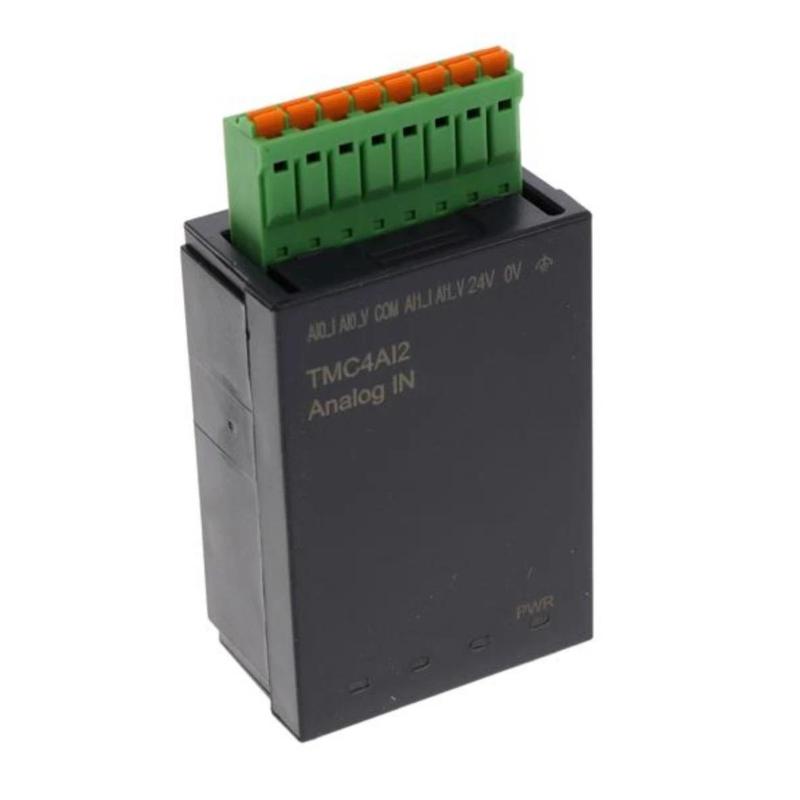
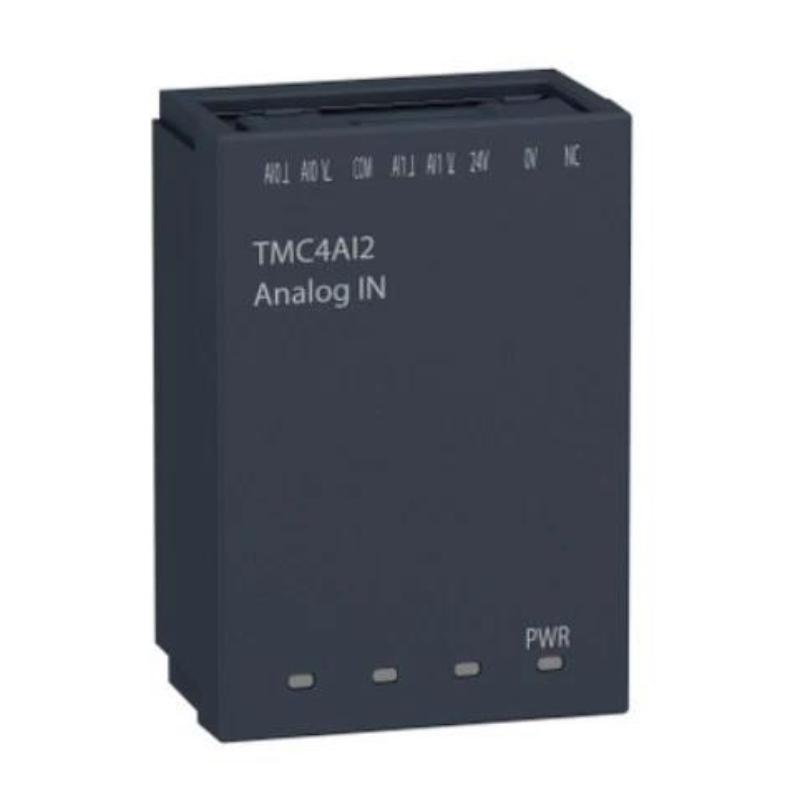
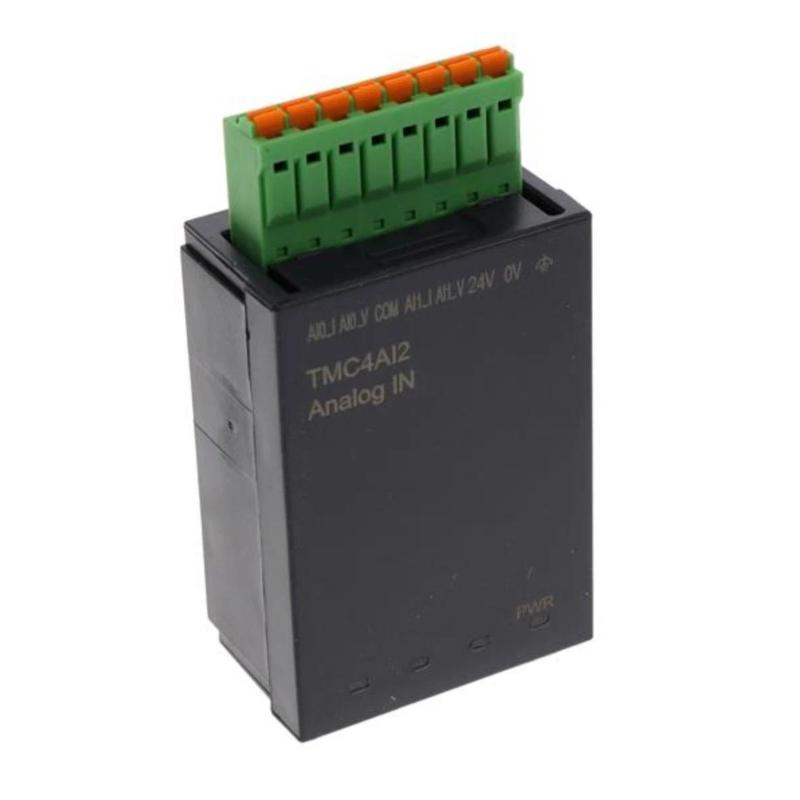
The Schneider Electric TMC4AI2 Analog Input Card is a compact analog input cartridge designed for the Modicon M241 logic controller family. It enables compatible controllers to receive analog signals from industrial field devices and convert those signals into digital values that can be processed by the control program.
The TMC4AI2 supports two analog input channels. Depending on the selected input configuration, these channels can accept voltage signals from 0 to 10 V DC or current signals from 0 to 20 mA and 4 to 20 mA. These signal ranges are widely used in industrial instrumentation, allowing the controller to monitor process variables such as pressure, temperature transmitted through a suitable signal converter, liquid level, flow, and equipment status.
By providing analog signal acquisition in a compact cartridge format, the TMC4AI2 helps expand the measurement capabilities of compatible Modicon M241 controllers without requiring a separate full-size expansion module.
The module has dimensions of 50 × 21 × 34 mm and a weight of 0.055 kg. Its compact design is suitable for control panels and machinery where installation space is limited.
The TMC4AI2 is intended for compatible Modicon M241 controllers. Before installation or replacement, users should verify the controller model, available cartridge slot, electrical wiring, and application configuration.
2. Technical Specifications
| Parameter | Description |
|---|---|
| Brand | Schneider Electric |
| Model | TMC4AI2 |
| Product Type | Analog Input Cartridge |
| Product Range | Modicon M241 |
| Compatible Controller Family | Modicon M241 |
| Number of Analog Inputs | 2 |
| Voltage Input Range | 0–10 V DC |
| Current Input Ranges | 0–20 mA, 4–20 mA |
| Resolution | 12-bit in the controller programming documentation; verify the applicable hardware and firmware specification |
| Sampling Duration | Approximately 1 ms per enabled channel in the referenced cartridge characteristics; verify the applicable configuration documentation |
| Typical Accuracy at 25°C | ±0.2% of full scale |
| Maximum Accuracy Error Across Operating Temperature | ±0.5% of full scale |
| Temperature Drift | ±0.006% of full scale per °C |
| Non-Linearity | ±0.05% of full scale |
| Input Isolation | 500 V DC between inputs and internal logic |
| Isolation Between Inputs | Inputs are not isolated from one another |
| External Supply | 24 V DC, ±15% |
| Maximum Power Consumption | 2 W |
| Input Cable Recommendation | Shielded or twisted shielded-pair cable, as applicable |
| Maximum Input Cable Length | Less than 30 m |
| Dimensions | 50 × 21 × 34 mm |
| Weight | 0.055 kg |
Important: Confirm the resolution and sampling specifications against the applicable Schneider Electric hardware and programming documentation for the exact controller and cartridge revision before using these values for precision measurement or time-critical applications.
3. Function and Working Principle
The TMC4AI2 converts analog electrical signals into numerical values that a PLC program can use for monitoring, control, alarms, and process calculations.
3.1 Analog Signal Acquisition
Industrial sensors and transmitters often produce continuous voltage or current signals. Unlike a digital input, which typically represents an ON or OFF state, an analog input represents a value that changes over a defined range.
The TMC4AI2 receives supported voltage or current signals through its two input channels. The controller then processes the resulting input values according to the configured application.
For example, a pressure transmitter may provide a 4–20 mA signal corresponding to a defined pressure range. The PLC program can scale the measured current into engineering units, such as bar or psi, and use the calculated value for display, alarm generation, or control.
3.2 Voltage and Current Input Modes
The cartridge supports the following signal types:
- 0–10 V DC: Commonly used with compatible voltage-output sensors, signal conditioners, and instrumentation.
- 0–20 mA: Used in applications where a current signal represents a measured process variable.
- 4–20 mA: Widely used for industrial transmitters because the nonzero lower endpoint can help distinguish a valid low-end signal from certain fault conditions.
The input mode must match the connected field device and the PLC configuration. Incorrect selection can result in inaccurate readings or unexpected diagnostic behavior.
3.3 Analog-to-Digital Conversion
The cartridge samples the input signal and converts it into a digital value. The PLC program can then apply scaling, filtering, limit checking, and other processing functions.
For example, if a 4–20 mA transmitter represents a pressure range of 0–10 bar, the application can scale the valid current range into a pressure value:
- 4 mA represents 0 bar.
- 12 mA represents approximately 5 bar.
- 20 mA represents 10 bar.
These values assume a linear transmitter response and correct scaling configuration. The actual engineering range must be configured to match the connected instrument.
4. Role in Industrial Automation Systems
The TMC4AI2 provides analog measurement capability to compatible Modicon M241 control systems. It can help a controller move beyond basic digital switching and monitor continuously changing process conditions.
Its principal functions include:
- Process monitoring: Acquires analog values from compatible transmitters and sensors.
- Control feedback: Supplies measurement values for PLC-based control algorithms.
- Alarm management: Enables the application to detect values outside configured operating limits.
- Equipment monitoring: Supports measurement-based monitoring of pressure, flow, level, and other variables when connected to suitable instruments.
- Compact system expansion: Adds two analog input channels in a small cartridge format.
The cartridge is an input device rather than a standalone controller. Its performance depends on the host PLC, connected instrumentation, wiring quality, and application configuration.
5. Industrial Applications
Process Instrumentation
The TMC4AI2 can acquire signals from compatible pressure, flow, and level transmitters. The PLC can use these measurements to monitor process conditions, trigger alarms, or adjust equipment operation.
Packaging Machinery
Packaging equipment may use analog sensors to monitor tension, pressure, position-related measurements, or other process variables. Where the sensor output matches the cartridge’s supported ranges, the TMC4AI2 can provide input data to the machine-control program.
Water and Wastewater Equipment
Compatible transmitters can provide analog measurements for tank level, pipeline pressure, and flow monitoring. The PLC can process these values to support pump sequencing and alarm functions.
Manufacturing and Assembly Lines
Some manufacturing systems use analog sensors and signal conditioners to monitor operating parameters. The cartridge can support these applications when the signal type, measurement range, and controller configuration are suitable.
HVAC and Utility Systems
Suitable instrumentation can provide analog signals representing pressure, flow, or other monitored conditions. The TMC4AI2 can acquire these signals for compatible PLC-based control applications.
In every application, the sensor’s electrical output and engineering range must match the cartridge configuration. A physical connection alone does not guarantee correct measurement.
6. Installation and System Integration
Correct installation helps ensure accurate measurements and stable PLC operation.
Step 1: Verify Controller Compatibility
Confirm that the host device is a compatible Modicon M241 controller and that the required cartridge slot is available. Check the exact controller reference and its hardware documentation before installation.
Step 2: Isolate the Equipment
Follow the machine’s electrical isolation procedure before inserting or removing the cartridge or modifying field wiring. Confirm that the equipment is in a safe maintenance state.
Do not insert or remove the cartridge while powered unless the specific host equipment explicitly permits that procedure.
Step 3: Install the Cartridge
Insert the TMC4AI2 into the designated cartridge position according to the controller’s installation instructions. Ensure that it is properly seated and that the surrounding components are not damaged.
Do not force the cartridge into the slot.
Step 4: Connect the Analog Signals
Connect each sensor to the appropriate input terminals according to the wiring diagram for the exact cartridge and controller configuration.
Before wiring, confirm:
- Whether the sensor produces voltage or current.
- The signal’s expected operating range.
- The correct terminal assignments and polarity.
- Whether the transmitter requires a separate power supply.
- The appropriate common-reference and grounding arrangement.
Do not assume that terminal assignments are identical across different cartridge models.
Step 5: Use Suitable Signal Cable
Use shielded or twisted shielded-pair cable as appropriate for the installation. Keep analog signal wiring away from high-current conductors, variable-frequency drives, contactors, and other potential sources of electrical interference.
The referenced specifications indicate an input cable length below 30 m. Longer cable runs require an engineering review of noise immunity, signal quality, and installation requirements.
Step 6: Configure the PLC Application
Use the supported Schneider Electric programming environment to configure the cartridge and its input channels. Select the appropriate voltage or current range and establish the correct scaling parameters.
For a 4–20 mA transmitter, configure the engineering range to match the instrument’s measurement range. For a 0–10 V sensor, configure the voltage range and scaling accordingly.
Step 7: Commission and Validate the Readings
After restoring power, confirm that the controller recognizes the cartridge and that its status indications are normal.
Compare the PLC reading with a known reference or calibrated instrument. Verify zero, mid-range, and full-scale behavior where practical, and confirm that the PLC program responds correctly to the measured values.
7. Troubleshooting Common Problems
Problem 1: The Analog Reading Remains at Zero
Possible causes:
- The sensor has no power.
- The signal wiring is open or incorrectly connected.
- The input mode does not match the sensor output.
- The PLC application is reading the wrong channel or variable.
- The transmitter is producing a signal below the expected range.
Recommended checks:
- Verify the sensor’s supply voltage.
- Measure the signal at the appropriate test point.
- Inspect the input wiring and terminal connections.
- Confirm the channel configuration and application variable mapping.
- Compare the measured signal with the expected operating range.
Problem 2: The Reading Is Unstable
Possible causes:
- Electrical interference from nearby power equipment.
- Poor cable shielding or grounding.
- Loose terminal connections.
- An unstable sensor supply.
- An unsuitable filtering or sampling configuration.
Recommended checks:
Inspect cable routing and grounding, verify the transmitter supply, and check all signal connections. If the electrical signal itself is unstable, investigate the sensor and its process conditions before changing PLC filtering parameters.
Problem 3: The PLC Reading Does Not Match the Instrument
Incorrect scaling is a common reason for a difference between the measured value and the displayed engineering value.
Check the configured lower and upper signal limits, the transmitter’s calibrated range, the units used in the PLC program, and any conversion formulas. Confirm that a 4–20 mA signal is not being scaled as a 0–20 mA signal.
Problem 4: An Out-of-Range Diagnostic Appears
A diagnostic may indicate that the input signal is outside the expected range or that the configured values do not match the diagnostic behavior implemented by the cartridge.
Check the physical signal, input range, scaling parameters, and diagnostic thresholds. Schneider Electric has documented limitations involving analog input range diagnostics with customized scaling values on this cartridge. Where diagnostics are used, retain the supported default raw input ranges specified for the application and verify the behavior using the applicable firmware documentation.
Problem 5: The Controller Does Not Recognize the Cartridge
Possible causes:
- The cartridge is not fully seated.
- The controller model does not support the cartridge.
- The controller configuration is incorrect.
- The cartridge or slot is damaged.
Verify the controller’s compatibility and cartridge-slot requirements, inspect the installation, and review the controller diagnostics. If necessary, test with a known-good compatible component following the approved maintenance procedure.
8. Compatible System Components
The TMC4AI2 is designed for compatible Modicon M241 controller configurations. Related components may include:
| Component | Function |
|---|---|
| Schneider Modicon M241 PLC | Host logic controller |
| Analog Pressure Transmitter | Provides a pressure-related voltage or current signal |
| Analog Flow Transmitter | Supplies a compatible flow measurement signal |
| Level Transmitter | Provides a supported level-related signal |
| Signal Conditioner | Converts or conditions signals for the supported input range |
| 24 V DC Power Supply | Supplies compatible equipment where required |
| Shielded Signal Cable | Helps reduce interference in analog signal transmission |
| EcoStruxure Machine Expert | Used for supported PLC programming and configuration tasks |
Compatibility must be verified for the complete hardware and software configuration. Field sensors and signal conditioners must produce signals within the cartridge’s supported electrical ranges.
9. Replacement and Alternative Selection
When sourcing a replacement for the TMC4AI2, matching the original part number is the preferred starting point.
| Selection Criterion | What to Verify |
|---|---|
| Manufacturer | Schneider Electric |
| Model | TMC4AI2 |
| Product Type | Analog Input Cartridge |
| Number of Channels | 2 |
| Supported Signals | 0–10 V DC, 0–20 mA, 4–20 mA |
| Controller Compatibility | Compatible Modicon M241 model |
| Dimensions | 50 × 21 × 34 mm |
| Weight | 0.055 kg |
| Wiring | Correct terminal assignment and signal polarity |
| Application Configuration | Input range, scaling, and diagnostics |
Other TMC4 cartridges may provide temperature measurement, analog output, or application-specific functions. They should not be treated as direct replacements because their channel types and operating characteristics can differ.
Before approving an alternative, verify the complete part number, controller compatibility, electrical interface, and software configuration requirements.
10. Key Advantages of the Schneider TMC4AI2
Two Analog Input Channels
The cartridge provides two analog input channels in a compact format, enabling compatible controllers to monitor multiple process variables.
Flexible Signal Types
Support for 0–10 V DC, 0–20 mA, and 4–20 mA signals makes it suitable for a range of common industrial instrumentation applications.
Compact Design
With dimensions of 50 × 21 × 34 mm and a weight of 0.055 kg, the cartridge occupies little space within a compatible controller installation.
Integration with Modicon M241
The cartridge is designed for supported Modicon M241 configurations, allowing analog measurement to be integrated into a controller-based automation solution.
Diagnostic and Signal Processing Support
When correctly configured, the cartridge and host PLC can support input monitoring, scaling, filtering, and application-level diagnostics.
11. Technical FAQs
Q1: What is the Schneider TMC4AI2?
The TMC4AI2 is a two-channel analog input cartridge for compatible Schneider Electric Modicon M241 logic controllers.
Q2: Which signal types does it support?
It supports 0–10 V DC voltage signals and 0–20 mA or 4–20 mA current signals.
Q3: What are its dimensions and weight?
The dimensions are 50 × 21 × 34 mm, and the weight is 0.055 kg.
Q4: Can it connect directly to a 4–20 mA transmitter?
It can receive a compatible 4–20 mA signal when the transmitter wiring, power requirements, input configuration, and scaling are correct.
Q5: Is the cartridge suitable for every Modicon PLC?
No. It is intended for supported Modicon M241 controller configurations. Confirm the exact controller model and available cartridge slots before purchasing.
Q6: What causes inaccurate analog readings?
Common causes include incorrect scaling, mismatched input configuration, unstable sensor power, wiring errors, electrical interference, and faulty instrumentation.
Q7: Are the two analog input channels isolated from each other?
No. The referenced specifications indicate that the inputs are not isolated from one another, although isolation is provided between the inputs and internal logic. The wiring design must account for this distinction.
Q8: What should be checked before replacing the TMC4AI2?
Confirm the model number, controller compatibility, input signal types, terminal assignment, physical dimensions, and application configuration.
12. Conclusion
The Schneider Electric TMC4AI2 Analog Input Card is a compact two-channel analog input cartridge designed to extend the measurement capabilities of compatible Modicon M241 controllers. Its support for 0–10 V DC, 0–20 mA, and 4–20 mA signals makes it suitable for many industrial measurement and monitoring tasks.
With dimensions of 50 × 21 × 34 mm and a weight of 0.055 kg, it can be integrated into space-constrained control systems. Reliable operation depends on correct controller compatibility, sensor wiring, signal-range selection, scaling, grounding, and commissioning.
For maintenance teams and industrial spare-parts purchasers, verifying the complete TMC4AI2 model reference and its compatibility with the target PLC is essential for a reliable replacement and successful system integration.