

ProductPRODUCT
Featured products
Contact Us
- Allen Bradley
- 1788-EN2DNR
- Linking Device
- USA
- 134 × 26 × 112 mm
- 0.24 kg
- Xiamen, China
- New & In Stock
- T/T, PayPal, Western Union
- 1 Year
- 1-3 Working Days
- DHL, UPS, TNT, FedEx and EMS.
- 24-Hour Service
- COO
- 7
Our advantage

Global Logistics
We have a 10-year logistics and express cooperation agreement, so our products can be shipped to any place in the world.

Brand new and original
Our products are imported in bulk from the place of origin. Because of the cooperative relationship, our products are all original and 100% new.

24-hour service
We provide 7*24 hours service to our customers. We will be there whenever you need us.

Price advantage
All our products are priced very favorably because we have our own warehouse and supply.
| Company Information | |||
| [email protected] | |||
| Mobile | +8615980777398 | ||
| +8615980777398 | |||
| 15980777398 |
Product Overview
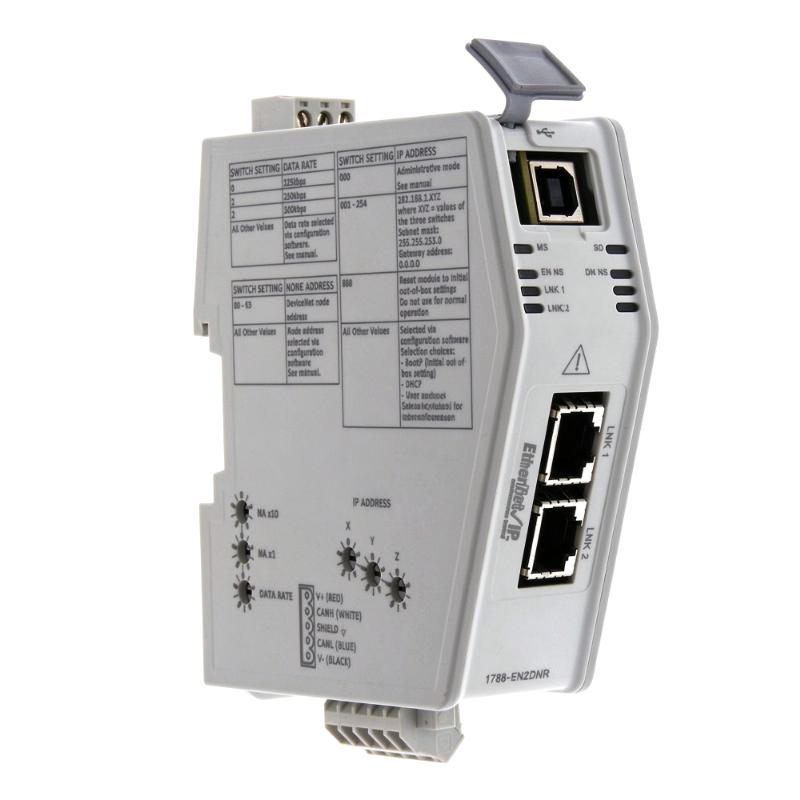
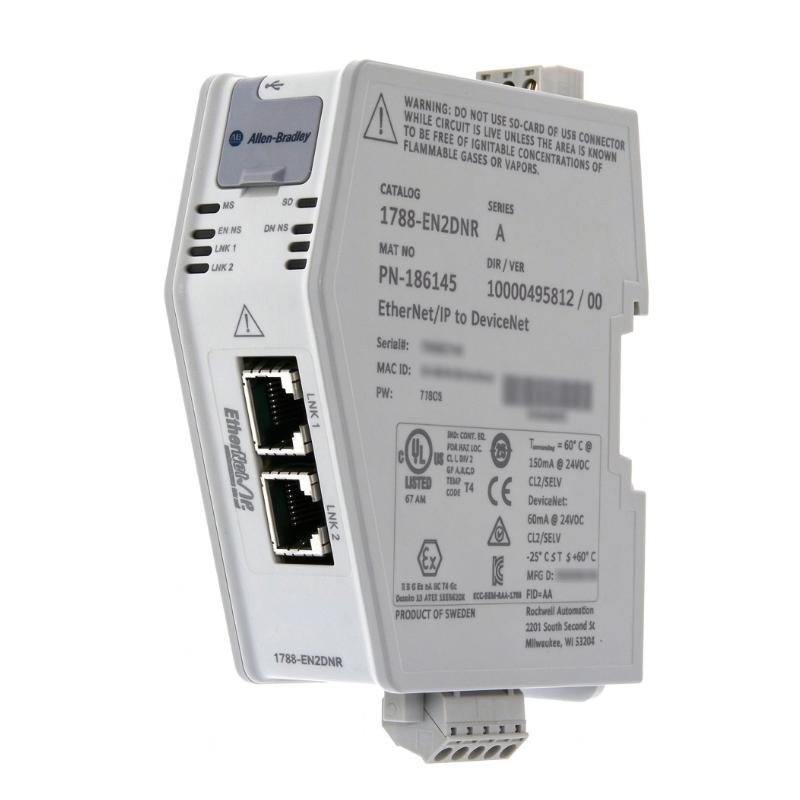
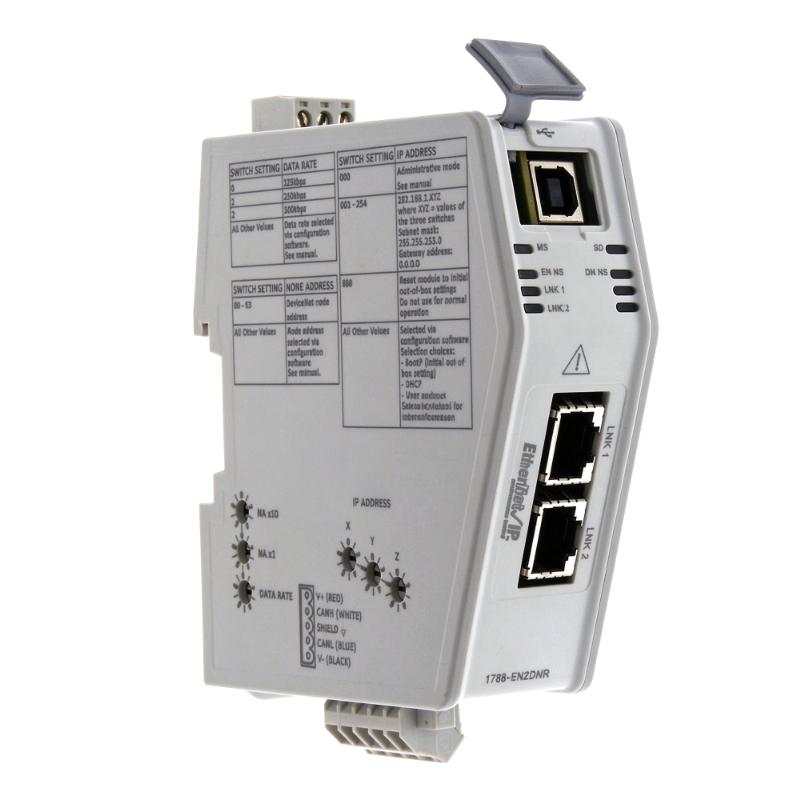
The Allen Bradley 1788-EN2DNR is an EtherNet/IP to DeviceNet Linking Device designed to connect information-level or control-level Ethernet networks with DeviceNet field-level equipment. It belongs to the Allen-Bradley Bulletin 1788 Linking Devices family and provides a communication bridge between two industrial network protocols.
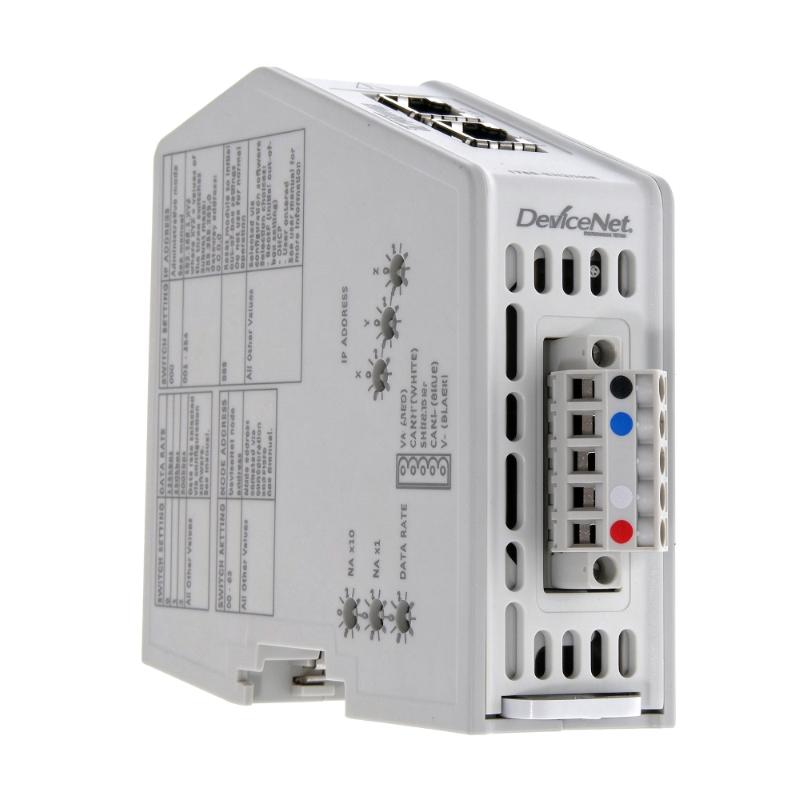
The device connects to an EtherNet/IP network through two RJ45 Ethernet ports and provides a DeviceNet interface for connecting field devices. It supports Device Level Ring (DLR), allowing it to participate in redundant Ethernet network architectures.
On the DeviceNet side, the 1788-EN2DNR provides full DeviceNet scanner functionality and can manage up to 63 follower devices. Supported equipment includes motor starters, drives, distributed I/O modules, sensors, and other DeviceNet-compatible automation components.
A centralized I/O data table manages the information exchanged between the two networks. Data received from DeviceNet devices can be mapped into the linking device’s input table and transferred to the EtherNet/IP controller. Output data follows the reverse path.
The 1788-EN2DNR also supports CIP Safety connections, online scanlist changes, Automatic Device Replacement (ADR), and an integrated diagnostic web server. These functions make it suitable for integrating existing DeviceNet equipment into modern EtherNet/IP-based automation systems.
Technical Specifications
| Parameter | Specification |
|---|---|
| Manufacturer | Allen-Bradley |
| Brand Owner | Rockwell Automation |
| Model | 1788-EN2DNR |
| Product Series | Bulletin 1788 Linking Devices |
| Product Type | EtherNet/IP to DeviceNet Linking Device |
| Communication Protocols | EtherNet/IP and DeviceNet |
| Ethernet Ports | 2 RJ45 Ports |
| Ethernet Network | EtherNet/IP |
| Ethernet Redundancy | Device Level Ring (DLR) |
| DeviceNet Interface | 5-Pin DeviceNet Connector |
| Maximum DeviceNet Nodes | 63 Follower Devices |
| DeviceNet Functionality | Scanner and Adapter/Follower |
| DeviceNet Communication | Polling, Bit Strobe, Cyclic and Change of State |
| CIP Safety | Supported |
| CIP Safety Connections | Up to 32 Class 0 Connections |
| Maximum Network-to-Network Delay | 5 ms |
| Input Power | 24V DC, 150 mA |
| DeviceNet Power | 24V DC, 60 mA |
| Isolation Voltage | 30V Continuous |
| Isolation Test Voltage | 500V AC for 60 Seconds |
| Enclosure Type | Open-Style |
| Mounting | DIN Rail |
| Configuration Software | RSNetWorx for DeviceNet |
| Controller Integration | Studio 5000 Logix Designer |
| Diagnostic Interface | Integrated Web Server |
| USB Interface | Mini-B USB |
| Operating Temperature | -20 to +60°C |
| Storage Temperature | -40 to +85°C |
| Dimensions | 134 × 26 × 112 mm |
| Weight | 0.24 kg |
Product Features
- Dual EtherNet/IP Ports: Provides two RJ45 Ethernet connections for integration with industrial Ethernet networks.
- Device Level Ring Support: Supports beacon-based DLR for Ethernet network redundancy.
- 63-Node DeviceNet Capacity: Supports communication with up to 63 DeviceNet follower devices.
- Integrated DeviceNet Scanner: Manages DeviceNet network scanning and exchanges I/O data with connected devices.
- CIP Safety Support: Supports up to 32 Class 0 CIP Safety connections for compatible safety applications.
- Centralized I/O Data Tables: Organizes input and output information exchanged between EtherNet/IP and DeviceNet.
- Online Scanlist Modification: Supports Online Scanlist Changes Allowed in Run (OSCAR), allowing supported configuration changes while the scanner remains in Run mode.
- Automatic Device Replacement: Supports ADR with a 256 KB capacity for DeviceNet device replacement operations.
- Multiple I/O Messaging Types: Supports bit strobe, polling, cyclic, and change-of-state communication.
- Integrated Web Server: Provides access to network status, diagnostic information, and Ethernet statistics.
- DIN Rail Mounting: Supports installation inside industrial control cabinets.
- USB Configuration Interface: Provides a local connection for configuration and maintenance.
Product Working Principle
The 1788-EN2DNR operates as a protocol linking device between EtherNet/IP and DeviceNet. Its internal communication architecture allows information from both networks to be exchanged through centralized input and output data tables.
The communication process involves several stages.
1. EtherNet/IP Network Communication
The device connects to the industrial Ethernet network through its two RJ45 ports. It communicates with the EtherNet/IP controller and supports DLR network arrangements for redundant Ethernet communication.
2. DeviceNet Network Scanning
The DeviceNet interface operates as a scanner and manages communication with connected follower devices. It supports up to 63 nodes and handles different I/O communication methods, including polling, cyclic, bit strobe, and change of state.
3. Input Data Collection
Data received from DeviceNet devices is organized in the linking device’s input table. This information is then made available to the EtherNet/IP scanner for use by the controller.
4. Output Data Distribution
The EtherNet/IP controller sends output information to the linking device. The device maps this information into its DeviceNet output table and transmits the corresponding commands to the configured field devices.
5. Safety Communication
The 1788-EN2DNR also supports CIP Safety connections. Compatible safety communication can pass between the two network levels, with a maximum internal network-to-network delay of 5 ms.
6. Network Diagnostics
The integrated web server provides information about DeviceNet nodes, Ethernet statistics, communication status, and diagnostic conditions. This helps maintenance personnel identify network faults without relying exclusively on controller-side diagnostics.
A simplified network arrangement is:
ControlLogix Controller → EtherNet/IP Network → 1788-EN2DNR → DeviceNet Network → Field Devices
The linking device manages network communication and I/O data exchange rather than executing the main machine or process control logic.
Role in Allen-Bradley EtherNet/IP and DeviceNet Control Architecture
Within an Allen-Bradley automation system, the 1788-EN2DNR provides the communication connection between the EtherNet/IP controller network and DeviceNet field equipment.
EtherNet/IP is commonly used for communication between Logix controllers, Ethernet communication modules, and distributed automation equipment. DeviceNet provides connectivity to field-level devices such as motor starters, drives, sensors, and remote I/O modules.
The linking device allows existing DeviceNet equipment to remain connected while exchanging process and machine data with an EtherNet/IP-based controller.
| System Component | Function |
|---|---|
| 1788-EN2DNR | Connects EtherNet/IP and DeviceNet networks |
| ControlLogix Controller | Executes machine and process control logic |
| 1756-EN2TR | Provides two-port EtherNet/IP communication with DLR support |
| 1756-EN2T | Provides EtherNet/IP communication for ControlLogix systems |
| 1788-EN2DNROM | On-machine EtherNet/IP-to-DeviceNet linking device |
| DeviceNet Motor Starters | Provide motor control through DeviceNet |
| DeviceNet Drives | Receive speed and control commands |
| DeviceNet Remote I/O | Provides distributed input and output connections |
| DeviceNet Sensors | Supply field measurement and status information |
| 24V DC Power Supply | Supplies operating power to the linking device |
The 1788-EN2DNR is particularly useful when upgrading an existing DeviceNet installation while retaining the field-level equipment and integrating it into a newer EtherNet/IP control architecture.
Industrial Applications
The 1788-EN2DNR is suitable for industrial installations where DeviceNet field equipment needs to communicate with EtherNet/IP-based controllers.
| Industrial Application | Typical Use |
|---|---|
| Manufacturing Automation | Connecting DeviceNet production equipment to EtherNet/IP controllers |
| Automotive Production | Integrating motor starters, drives, and distributed I/O |
| Packaging Machinery | Connecting DeviceNet field devices to machine controllers |
| Material Handling | Linking conveyor drives and distributed control equipment |
| Industrial Robotics | Integrating DeviceNet peripherals into Ethernet-based control systems |
| Food and Beverage | Connecting field-level automation equipment |
| Water Treatment | Integrating DeviceNet monitoring and control devices |
| Process Automation | Collecting field data through DeviceNet networks |
| Power Distribution | Connecting compatible monitoring and control equipment |
| Factory Modernization | Retaining existing DeviceNet equipment during network upgrades |
Installation and Maintenance
- Verify the Model Number: Confirm that 1788-EN2DNR is the required EtherNet/IP-to-DeviceNet linking device and distinguish it from the IP67 1788-EN2DNROM version.
- Check Power Requirements: Prepare a suitable 24V DC power source for the linking device and verify that the supply meets the specified electrical requirements.
- Inspect the Device: Examine the RJ45 ports, DeviceNet connector, power terminals, USB port, and housing for visible damage.
- Prepare the Installation Location: Select a suitable control cabinet location with sufficient ventilation and protection for open-style equipment.
- Mount the Linking Device: Install the module on a compatible DIN rail and ensure that it is securely positioned.
- Connect the EtherNet/IP Network: Connect the Ethernet cable to either of the two RJ45 ports. Use both network connections when the configured DLR topology requires them.
- Connect the DeviceNet Network: With power disconnected, connect the DeviceNet cable to the designated five-pin connector, observing the correct wiring assignments.
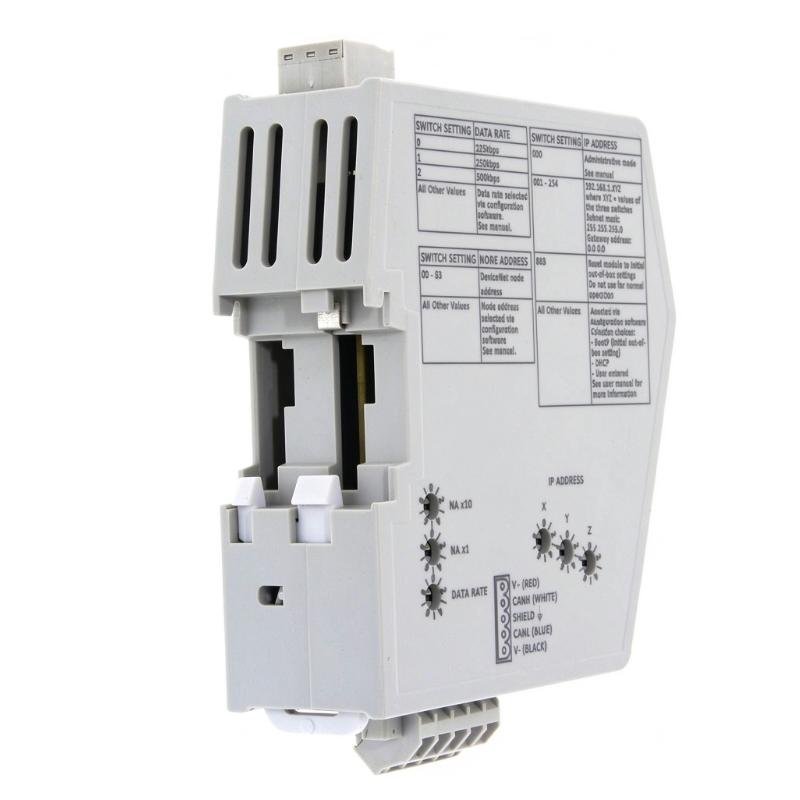
- Set the DeviceNet Node Address: Configure the DeviceNet node address and communication rate using the rotary switches or RSNetWorx for DeviceNet software.
- Configure the IP Address: Set the linking device IP address using the rotary switches, DHCP/BOOTP, or the device’s web configuration interface.
- Configure DeviceNet I/O: Use RSNetWorx for DeviceNet to establish the scanlist and organize the input and output data tables.
- Integrate with the Controller: Add the linking device to the EtherNet/IP controller architecture and verify communication using the appropriate Studio 5000 configuration.
- Perform Routine Inspection: Check the Ethernet connections, DeviceNet wiring, power terminals, status indicators, and diagnostic webpages for communication problems.
Compatible System Components
| Component | Function |
|---|---|
| Allen-Bradley 1788-EN2DNR | EtherNet/IP to DeviceNet Linking Device |
| Allen-Bradley 1788-EN2DNROM | IP67 On-Machine EtherNet/IP to DeviceNet Linking Device |
| Allen-Bradley 1756-EN2TR | ControlLogix Two-Port EtherNet/IP Bridge |
| Allen-Bradley 1756-EN2T | ControlLogix EtherNet/IP Bridge Module |
| Allen-Bradley 1784-U2DN | USB-to-DeviceNet Interface |
| Allen-Bradley 1485C-P1-Cxxx | DeviceNet Trunk Cable |
| Allen-Bradley 1606-XLE240E | 24V DC Power Supply |
| Allen-Bradley DeviceNet I/O Modules | Distributed Field Input and Output |
| Allen-Bradley DeviceNet Motor Starters | DeviceNet Motor Control Equipment |
Recommended Related Models
| Model | Product Type | Application |
|---|---|---|
| Allen-Bradley 1788-EN2DNROM | EtherNet/IP to DeviceNet On-Machine Linking Device | Sealed DeviceNet network integration |
| Allen-Bradley 1788-CN2DN | ControlNet to DeviceNet Linking Device | ControlNet and DeviceNet integration |
| Allen-Bradley 1788-CN2FFR | ControlNet to FOUNDATION Fieldbus H1 Linking Device | Process instrument network integration |
| Allen-Bradley 1788-EN2FFR | EtherNet/IP to FOUNDATION Fieldbus H1 Linking Device | EtherNet/IP and FOUNDATION Fieldbus integration |
| Allen-Bradley 1788-CN2PAR | ControlNet to PROFIBUS-PA Linking Device | PROFIBUS-PA field instrument integration |
| Allen-Bradley 1788-EN2PAR | EtherNet/IP to PROFIBUS-PA Linking Device | EtherNet/IP and PROFIBUS-PA integration |
Key Advantages
- Bridges EtherNet/IP and DeviceNet networks.
- Supports up to 63 DeviceNet follower devices.
- Provides two RJ45 Ethernet ports.
- Supports Device Level Ring network redundancy.
- Supports standard and safety DeviceNet communication.
- Includes centralized I/O data mapping.
- Supports online scanlist modifications and ADR.
- Provides an integrated web-based diagnostic interface.
Technical FAQs
1. How many DeviceNet devices can the 1788-EN2DNR connect?
The 1788-EN2DNR supports up to 63 DeviceNet follower devices. The actual network configuration depends on the connected devices, communication requirements, and DeviceNet installation specifications.
2. What is the difference between 1788-EN2DNR and 1788-EN2DNROM?
Both models connect EtherNet/IP and DeviceNet networks. The 1788-EN2DNR is an IP20 open-style module intended for DIN rail mounting inside a control cabinet. The 1788-EN2DNROM is an IP67-rated On-Machine version designed for direct machine or panel mounting.
3. Does the 1788-EN2DNR support CIP Safety communication?
Yes. The linking device supports CIP Safety and up to 32 Class 0 safety connections. The maximum internal communication delay between networks is 5 ms. Safety applications must use compatible safety controllers and field devices.
4. Can the DeviceNet scanlist be modified while the 1788-EN2DNR is running?
Yes. The device supports Online Scanlist Changes Allowed in Run (OSCAR). This feature allows supported scanner configuration changes, including scanlist, ADR, and InterScan Delay settings, while the scanner remains in Run mode. Safety I/O cannot be added to the scanlist through this feature.