

ProductPRODUCT
Featured products
Contact Us
- Allen Bradley
- 2080-L50E-24QWB
- Micro850 Programmable Controller
- USA
- 158 x 80 x 90 mm
- 0.423 kg
- Xiamen, China
- New & In Stock
- T/T, PayPal, Western Union
- 1 Year
- 1-3 Working Days
- DHL, UPS, TNT, FedEx and EMS.
- 24-Hour Service
- COO
- 6
Our advantage

Global Logistics
We have a 10-year logistics and express cooperation agreement, so our products can be shipped to any place in the world.

Brand new and original
Our products are imported in bulk from the place of origin. Because of the cooperative relationship, our products are all original and 100% new.

24-hour service
We provide 7*24 hours service to our customers. We will be there whenever you need us.

Price advantage
All our products are priced very favorably because we have our own warehouse and supply.
| Company Information | |||
| [email protected] | |||
| Mobile | +8615980777398 | ||
| +8615980777398 | |||
| 15980777398 |
Product Overview
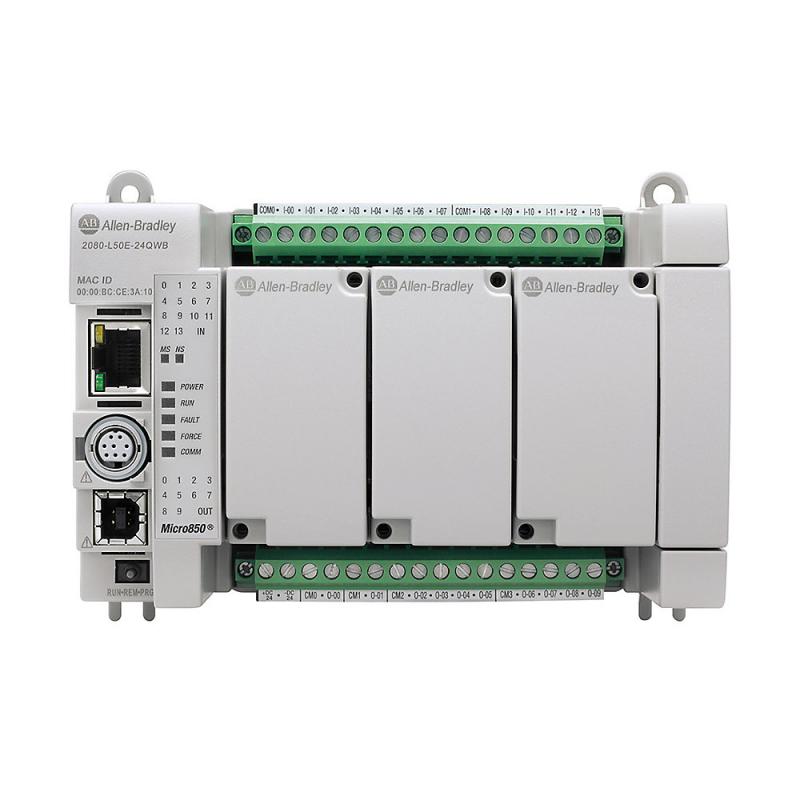
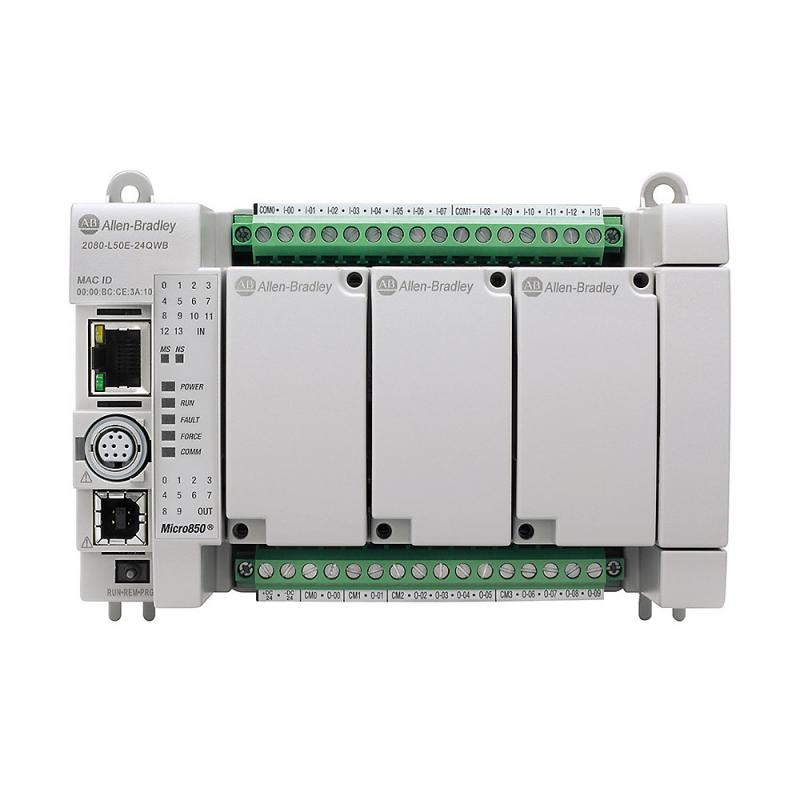
The Allen-Bradley 2080-L50E-24QWB Micro850 Programmable Controller is a compact programmable logic controller (PLC) developed by Rockwell Automation for industrial machine control and small automation systems. It belongs to the Micro800 controller family and combines embedded digital inputs, relay outputs, and Ethernet communication in a compact controller.
The Micro850 series is designed for applications that require reliable logic processing, flexible I/O configuration, and communication with other industrial devices. It can coordinate motors, sensors, actuators, valves, switches, and other automation equipment through programmed control logic.
The 2080-L50E-24QWB provides 24 embedded digital I/O points, consisting of 14 digital inputs and 10 relay outputs. Its input channels support 24 V DC/AC input signals, while the relay outputs allow the controller to switch compatible external loads through appropriately designed circuits.
An integrated Ethernet interface supports EtherNet/IP communication, making the controller suitable for networked automation applications. It also provides USB programming access and serial communication capabilities. Three plug-in slots allow additional functionality to be added according to application requirements.
With its compact design and embedded I/O, the 2080-L50E-24QWB can serve as the central controller for standalone machines, packaging equipment, material-handling systems, and small production lines.
Technical Specifications
| Parameter | Specification |
|---|---|
| Brand | Allen-Bradley |
| Manufacturer | Rockwell Automation |
| Model | 2080-L50E-24QWB |
| Product Series | Micro850 |
| Product Family | Micro800 |
| Product Type | Programmable Logic Controller |
| Controller Type | Micro850 24 I/O EtherNet/IP Controller |
| Total Embedded I/O | 24 points |
| Digital Inputs | 14 points |
| Input Signal Type | 24 V DC/AC |
| Digital Outputs | 10 points |
| Output Type | Relay |
| Controller Supply Voltage | 24 V DC |
| Ethernet Communication | EtherNet/IP |
| Serial Communication | RS-232 / RS-485 |
| Programming Interface | USB |
| Plug-in Slots | 3 |
| High-Speed Counter Support | Up to 4 channels, subject to configuration |
| Dimensions Provided | 158 × 80 × 90 mm |
| Weight Provided | 0.423 kg |
| Mounting | Industrial control panel installation |
| Typical Applications | Machine automation, packaging, conveyors, and process equipment |
Note: Dimensions are presented in the supplied width × depth × height order. Rockwell Automation’s technical data lists the dimensions as 90 × 158 × 80 mm (H × W × D). The supplied weight of 0.423 kg is consistent with the manufacturer’s approximate shipping-weight specification.
Function and Working Principle
The Micro850 2080-L50E-24QWB operates by executing a user-defined control program that processes input signals and determines the appropriate output actions. It receives information from field devices, evaluates programmed conditions, and controls connected equipment through its embedded outputs or additional expansion hardware.
1. Digital Input Signal Processing
The controller provides 14 digital input points for receiving signals from external devices.
Typical input devices include:
- Proximity sensors
- Photoelectric sensors
- Limit switches
- Push buttons
- Selector switches
- Pressure switches
- Level switches
- Equipment status contacts
When an input device changes state, the controller detects the corresponding signal and updates its internal input information. The control program can then use that information to determine whether a motor should start, a valve should operate, or a machine sequence should continue.
The 24 V DC/AC input capability provides flexibility when connecting compatible industrial field devices. Input wiring and signal characteristics must still follow the manufacturer’s electrical specifications.
2. Relay Output Control
The 2080-L50E-24QWB has 10 embedded relay outputs.
Relay outputs allow the controller to switch compatible external circuits according to programmed logic. They may be used for controlling:
- Motor starter control circuits
- Industrial relays
- Solenoid valves
- Indicator lamps
- Alarm devices
- Contactors
- Auxiliary machine equipment
The relay outputs provide switching functionality rather than directly supplying power to every connected load. Output voltage, current, load type, and switching frequency must be checked before connecting field equipment.
For larger loads or applications requiring frequent switching, suitable external relays or contactors should be considered.
3. Program Execution
The controller executes a user-developed automation program to coordinate machine operation.
The program may contain logic for:
- Start and stop control
- Automatic operating sequences
- Interlocking conditions
- Timing functions
- Equipment status monitoring
- Alarm handling
- Production-cycle coordination
- Motor and actuator control
A typical machine sequence may require a sensor to detect a product before activating a conveyor. The PLC evaluates the sensor signal, checks operating conditions, and changes the output state according to the programmed sequence.
This approach allows multiple devices to operate in a coordinated manner.
4. Ethernet Communication
The integrated Ethernet interface supports EtherNet/IP communication.
EtherNet/IP allows the Micro850 controller to exchange industrial control information with compatible devices. Depending on the network architecture and configuration, these devices may include operator interfaces, other controllers, drives, and industrial communication equipment.
The network can be used for controller data exchange, monitoring, and integration into a larger automation system.
Network configuration should account for IP addressing, device compatibility, firmware versions, and communication requirements.
5. Expansion and Additional Functions
The controller includes three plug-in slots for compatible Micro800 accessories.
These slots can be used to add selected functions, depending on the installed module and controller configuration. Possible applications include additional communication capabilities, display functionality, and specialized control features.
The Micro850 platform also supports compatible local expansion modules. Engineers should verify module compatibility, supported firmware, and the controller’s expansion limits before designing an expanded system.
Role in Industrial Automation Systems
The 2080-L50E-24QWB can serve as the main logic controller for compact industrial machines. It collects field signals, executes programmed instructions, and coordinates the operation of connected equipment.
PLC-Based Machine Control
In a typical automation installation, sensors provide information about machine conditions while actuators carry out physical operations.
The Micro850 processes these signals according to the control program. For example, it may monitor product position, control a conveyor motor starter, activate a pneumatic valve, and detect whether a machine has completed a production cycle.
Its embedded I/O reduces the need for separate I/O modules in smaller installations.
Integration with HMI Systems
A human-machine interface allows operators to interact with the automation system.
An HMI connected through the Ethernet network can provide functions such as:
- Start and stop commands
- Operating-mode selection
- Machine status displays
- Alarm notifications
- Production counters
- Parameter entry
- Maintenance information
The PLC remains responsible for executing the control logic, while the HMI provides an operator interface.
Communication with Variable Frequency Drives
The controller can be integrated into motor-control systems containing compatible variable frequency drives.
For example, a PLC may coordinate conveyor operation by sending suitable commands and monitoring available drive status information through the selected communication architecture.
The exact integration method depends on the drive model, available interfaces, controller firmware, and application design.
Data Monitoring and Equipment Coordination
EtherNet/IP communication can support the exchange of data between the controller and other compatible automation devices.
This allows machine information to be shared with supervisory systems or other controllers. The resulting architecture can improve equipment coordination and make troubleshooting more convenient.
Industrial Applications
The Micro850 2080-L50E-24QWB is suitable for compact machine-control applications where 24 embedded I/O points and Ethernet communication meet the system requirements.
1. Packaging Machinery
Packaging equipment often requires coordinated control of sensors, conveyors, pneumatic actuators, and product-positioning mechanisms.
The Micro850 can monitor product detection signals and execute programmed sequences for feeding, positioning, and packaging operations.
Its relay outputs can control suitable external switching devices, while Ethernet communication can connect the controller to an operator interface or other compatible equipment.
2. Conveyor Systems
Conveyor systems use sensors and motor-control devices to transport materials between production stages.
The controller can monitor product presence, manage operating sequences, and coordinate motor starter circuits or compatible drive-control arrangements.
For example, when a sensor detects a product at a transfer point, the PLC can evaluate the machine conditions before activating the next conveyor section.
3. Small Assembly Machines
Assembly equipment often contains multiple sensors, pneumatic cylinders, motors, and operator controls.
The Micro850 can coordinate these devices through programmed logic. It may monitor component position, control actuator sequences, and detect abnormal operating conditions.
This makes it suitable for selected small assembly machines that do not require a larger controller architecture.
4. Pump and Fan Control Systems
The controller can be used in auxiliary pump and fan installations where the number of signals and control requirements are within its capacity.
It may monitor pressure switches, level switches, temperature contacts, and other field signals while controlling suitable external contactors or drive interfaces.
Motor protection and power switching should be implemented using correctly rated equipment rather than relying solely on the PLC relay outputs.
5. Water Treatment Equipment
Small water-treatment systems may use pumps, valves, level sensors, and alarm devices.
The Micro850 can coordinate basic operating sequences, monitor tank levels, and control compatible external switching circuits.
Ethernet connectivity can also support communication with an HMI or another compatible industrial device.
6. General Industrial Machine Automation
The controller can be applied to a range of compact industrial machines, including:
- Material feeding equipment
- Small production machines
- Inspection stations
- Automated workstations
- Auxiliary machinery
- Industrial test equipment
- Machine tool accessories
The suitability of the controller depends on the total I/O requirements, program complexity, communication architecture, and required control performance.
Installation and System Integration
Correct installation is essential for stable controller operation and reliable communication with field devices.
1. Power Supply Requirements
The 2080-L50E-24QWB uses a 24 V DC controller supply.
Before applying power, verify the supply voltage, polarity, current capacity, and grounding arrangement. The power supply should be selected according to the controller and the total electrical load of connected accessories.
Use an industrial-grade power supply with suitable protection against electrical disturbances.
2. Digital Input Wiring
The controller provides 14 digital input points supporting 24 V DC/AC input signals.
Before wiring, identify the input terminal assignments and confirm the electrical characteristics of each connected device.
Use suitable conductors and follow the manufacturer’s wiring instructions. Separate low-level signal wiring from high-current power conductors where necessary to reduce electrical interference.
3. Relay Output Wiring
The 10 relay outputs can switch compatible external circuits.
When connecting output devices, verify the relay contact ratings and the electrical characteristics of the load. Inductive loads such as contactor coils and solenoid valves may require suitable suppression components.
For high-current motors or other substantial loads, use properly rated contactors and protective devices.
4. Ethernet Network Configuration
Connect the controller to compatible network equipment using suitable Ethernet cabling.
Configure the controller’s network settings according to the system architecture. Ensure that the PLC, HMI, drives, and other network devices have compatible communication settings.
For larger installations, network segmentation and suitable industrial Ethernet switches may help improve communication organization and reliability.
5. Programming and Commissioning
The Micro850 controller is programmed using Rockwell Automation’s supported Micro800 programming environment.
During commissioning, engineers should:
- Confirm the controller catalog number and hardware series.
- Verify the installed firmware revision.
- Configure the project and communication settings.
- Develop or load the required control program.
- Verify the digital input states.
- Test each relay output with suitable equipment.
- Confirm Ethernet communication.
- Test machine sequences and interlocks.
- Record the final configuration and program backup.
The programming software and firmware must be compatible with the installed controller revision.
6. Environmental and Electrical Protection
Install the controller inside a suitable industrial enclosure. Protect it from excessive dust, moisture, vibration, and electrical interference.
Maintain appropriate separation between control wiring and high-voltage power wiring. Ensure that the cabinet provides suitable ventilation and that all wiring connections are properly secured.
The controller should be installed and maintained according to applicable electrical safety requirements.
Compatible System Components
The 2080-L50E-24QWB can be used with a range of compatible Micro800 accessories and industrial automation equipment.
| Component | Function | Integration Considerations |
|---|---|---|
| 24 V DC power supply | Provides controller operating power | Verify voltage, current capacity, and polarity |
| Digital sensors | Detect machine and process conditions | Confirm input voltage and signal type |
| Relay contactors | Switch motors and larger electrical loads | Select according to motor and load ratings |
| Solenoid valves | Control pneumatic or hydraulic functions | Check coil voltage and output switching requirements |
| HMI | Provides operator monitoring and control | Verify communication and software compatibility |
| Industrial Ethernet switch | Connects networked automation devices | Use suitable industrial Ethernet equipment |
| Micro800 plug-in modules | Add selected controller functions | Verify module and firmware compatibility |
| Micro800 expansion I/O modules | Extend available I/O capacity | Check controller expansion limits |
| Variable frequency drives | Control AC motor speed | Confirm communication or hardwired control arrangements |
| Industrial sensors | Provide position, pressure, level, and other signals | Check electrical specifications and wiring |
The components listed above are examples of equipment that may be integrated into a Micro850-based control system. They are not necessarily included with the controller.
Alternative Models and Replacement Considerations
The Micro850 family includes several controller configurations with different I/O arrangements and output types.
| Model | General Configuration | Selection Considerations |
|---|---|---|
| 2080-L50E-24QWB | 24 I/O, 14 DC/AC inputs, 10 relay outputs | Original model configuration |
| 2080-L50E-24QVB | 24 I/O, 14 DC/AC inputs, 10 DC sink outputs | Output type differs from the relay version |
| 2080-L50E-24QBB | 24 I/O, 14 DC/AC inputs, 10 DC source outputs | Requires compatible output wiring and loads |
| 2080-L50E-24AWB | 24 I/O with AC input configuration and relay outputs | Input electrical requirements differ |
| 2080-L50E-48QWB | 48 I/O Micro850 configuration | Provides a larger embedded I/O capacity |
These models belong to related Micro850 configurations, but they should not be treated as automatic replacements.
Before selecting an alternative, compare:
- Input signal type and voltage.
- Output type and electrical ratings.
- Number of embedded I/O points.
- Controller supply requirements.
- Communication interfaces.
- Plug-in and expansion module compatibility.
- Firmware revision.
- Program compatibility.
- Physical mounting and wiring requirements.
A controller with the same number of I/O points may still have different electrical characteristics. In particular, relay, DC sink, and DC source outputs require different wiring arrangements.
Key Advantages
1. Compact Controller Design
The Micro850 combines the CPU and 24 embedded I/O points in a compact housing. This can reduce the number of separate components needed in smaller control panels.
2. Integrated Ethernet Communication
The Ethernet interface supports EtherNet/IP communication with compatible industrial devices. This provides a convenient way to integrate the controller into a networked machine-control system.
3. Flexible Digital I/O
The controller provides 14 digital inputs and 10 relay outputs. This configuration supports a variety of basic machine-control requirements.
4. Relay Output Switching
Relay outputs can be used to switch suitable external control circuits, including compatible contactor coils, indicator devices, and solenoid valves.
5. Expansion Capability
Three plug-in slots provide options for adding compatible functions. Supported expansion hardware can help adapt the controller to different application requirements.
6. Serial and USB Connectivity
USB programming access and serial communication capabilities provide additional options for programming, configuration, and communication with compatible equipment.
7. Micro800 Platform Integration
As part of the Micro800 family, the Micro850 can be used in automation systems built around compatible Rockwell Automation controllers, accessories, and programming tools.
Technical FAQs
1. What is the Allen-Bradley 2080-L50E-24QWB?
The 2080-L50E-24QWB is a Micro850 programmable logic controller manufactured by Rockwell Automation. It is designed for compact industrial automation systems and provides 24 embedded digital I/O points.
2. How many inputs and outputs does this controller have?
It has 14 digital inputs and 10 relay outputs, providing a total of 24 embedded I/O points.
3. What input voltage does the controller support?
Its digital input channels support 24 V DC/AC signals. The controller itself uses a 24 V DC power supply.
4. What type of outputs does the 2080-L50E-24QWB use?
It uses 10 relay outputs. These outputs switch compatible external circuits, subject to the manufacturer’s electrical ratings.
5. Does this controller support Ethernet communication?
Yes. The controller has an integrated Ethernet interface and supports EtherNet/IP communication with compatible devices.
6. Can the Micro850 connect to an HMI?
Yes. It can communicate with a compatible HMI through an appropriate communication configuration, commonly using its Ethernet interface.
7. Can additional I/O modules be installed?
The Micro850 platform supports compatible local expansion I/O modules. The permitted number and type depend on the controller configuration and the manufacturer’s compatibility requirements.
8. How many plug-in slots are available?
The 2080-L50E-24QWB provides three plug-in slots for compatible Micro800 accessories.
9. What programming software is used?
The Micro850 family is programmed using Rockwell Automation’s supported Micro800 programming software. The selected software version must support the controller’s hardware and firmware revision.
10. What is the weight of the 2080-L50E-24QWB?
The supplied weight is 0.423 kg. Rockwell Automation’s technical data identifies approximately 0.423 kg as the shipping weight for the Micro850 24-point controller configuration.
Procurement and Maintenance Recommendations
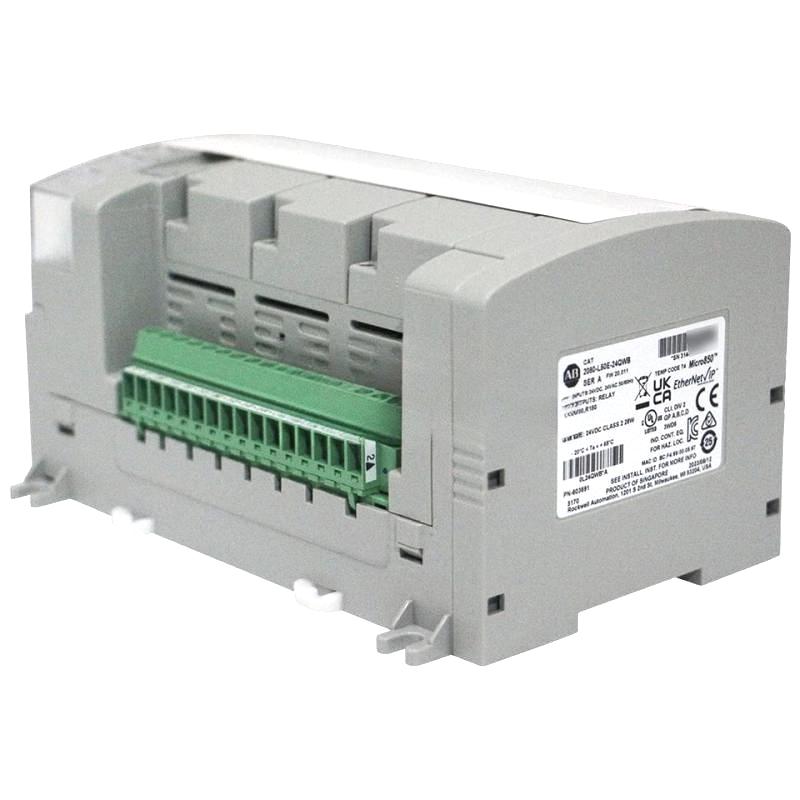
When purchasing the Allen-Bradley 2080-L50E-24QWB, verify the complete catalog number and hardware series printed on the product label. Although several Micro850 models have similar housings, their input and output configurations may differ.
For replacement projects, pay particular attention to the 24 V DC/AC input arrangement and 10 relay outputs. A DC sink or source output controller is not necessarily a direct replacement for the relay-output model.
Buyers should also confirm the controller’s hardware series, firmware compatibility, physical condition, and included accessories. For used or refurbished units, request clear photographs of the nameplate and terminal connections, along with available testing information.
During maintenance, inspect terminal connections, wiring condition, power supply stability, and communication cables. Keep the controller installed in a suitable enclosure and protect it from excessive dust, moisture, and electrical interference.
Back up the control program and document configuration changes. Keeping a verified program backup can simplify troubleshooting and reduce recovery time if the controller needs to be replaced.
For long-term system maintenance, maintain an accurate list of the controller model, firmware revision, connected expansion modules, communication settings, and field wiring assignments.
Conclusion
The Allen-Bradley 2080-L50E-24QWB Micro850 Programmable Controller is a compact industrial PLC designed for machine automation and small control systems. Its 24 embedded I/O points, including 14 digital inputs and 10 relay outputs, provide the basic signal-handling and switching capabilities required by many compact automation applications.
With integrated EtherNet/IP communication, USB programming access, serial connectivity, and three plug-in slots, the controller offers flexibility for machine-level control and integration with compatible industrial devices.
For industrial procurement, installation, and replacement projects, verifying the exact catalog number, I/O configuration, power requirements, and firmware compatibility is essential to maintaining reliable automation system operation.