
NewsNEWCENTER
Featured products
Contact Us
Allen Bradley 1606-XLE120E Power Supply Troubleshooting Guide
2026-08-28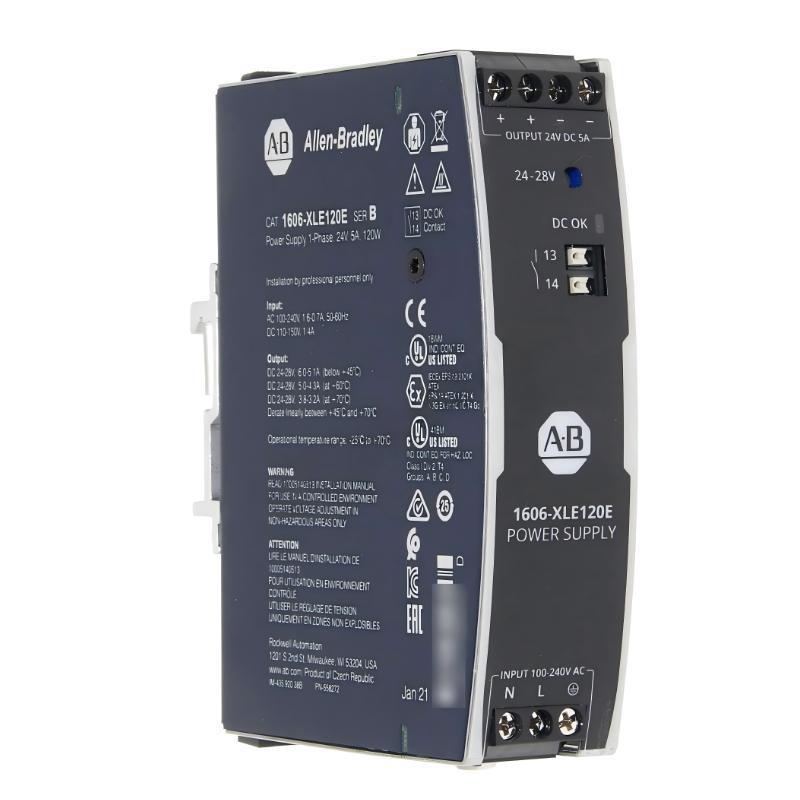
Table of Contents
- Allen Bradley 1606-XLE120E Fault Diagnosis Strategy
- Allen Bradley 1606-XLE120E Power Supply Fault Symptoms
- Allen Bradley 1606-XLE120E Troubleshooting Workflow
- Allen Bradley 1606-XLE120E DC Distribution Analysis
- Allen Bradley 1606-XLE120E Repair Strategy
- Allen Bradley 1606-XLE120E Field Troubleshooting Example
- Allen Bradley 1606-XLE120E Troubleshooting FAQ
- Allen Bradley 1606-XLE120E Overall Technical Summary
Allen Bradley 1606-XLE120E Fault Diagnosis Strategy
Allen Bradley 1606-XLE120E Power Supply faults are more frequently caused by wiring, excessive load, poor grounding or voltage distribution issues than by internal hardware failure. Effective Troubleshooting begins by identifying where voltage becomes unstable instead of immediately replacing the power supply.
Successful Fault Diagnosis follows the electrical path from incoming power through the power supply to every downstream PLC Controller, Module and Sensor.
Allen Bradley 1606-XLE120E Power Supply Fault Symptoms
- PLC Controller randomly restarts.
- Communication interruptions.
- Remote I/O disappears.
- Sensors produce unstable values.
- HMI unexpectedly reboots.
- Output voltage fluctuates under load.
- System operates normally until production begins.
The timing of the fault often provides valuable engineering clues. A failure occurring only during heavy production usually indicates loading or distribution problems.
Allen Bradley 1606-XLE120E Troubleshooting Workflow
Incoming AC
      │
      ▼
Check Input Voltage
      │
      ▼
Check DC Output
      │
      ▼
Check Distribution Voltage
      │
      ▼
Check PLC Controller
      │
      ▼
Check Remote Modules
      │
      ▼
Determine Root Cause
Measure voltage during the exact operating condition that creates the fault. Static measurements taken while the machine is idle often fail to reveal intermittent problems.
Allen Bradley 1606-XLE120E DC Distribution Analysis
Many Troubleshooting investigations eventually identify problems outside the Power Supply itself.
- Loose DC terminals.
- Damaged field wiring.
- Undersized conductors.
- High resistance connections.
- Overloaded power distribution.
- Poor grounding.
- Improper cabinet modifications.
Compare voltage at multiple locations instead of relying on a single measurement.
Allen Bradley 1606-XLE120E Repair Strategy
Only consider replacing the 1606-XLE120E after confirming that upstream power, downstream wiring and connected equipment operate correctly.
- Verify AC input.
- Inspect protective devices.
- Check output voltage.
- Inspect distribution wiring.
- Measure voltage under full load.
- Compare with commissioning records.
- Replace hardware only when measurements support that conclusion.
Allen Bradley 1606-XLE120E Field Troubleshooting Example
During maintenance on a beverage production system, operators reported intermittent PLC communication failures approximately one hour after startup.
Engineers first suspected the Power Supply because all affected devices shared the same DC source. However, continuous monitoring showed the power supply output remained stable at approximately 24 VDC.
Voltage measured at a remote communication cabinet periodically dropped to about 22.1 VDC whenever multiple servo drives accelerated simultaneously.
Inspection revealed oxidation inside a DC distribution terminal block, increasing resistance as current demand rose.
After replacing the terminal block and cleaning the distribution connections, voltage remained above 23.9 VDC throughout production. Communication faults were eliminated without replacing the Allen Bradley 1606-XLE120E.
This troubleshooting process demonstrates that engineers should isolate the actual location of voltage loss before replacing power hardware.
Allen Bradley 1606-XLE120E Troubleshooting FAQ
Why do PLC Controllers restart while the power supply appears normal?
Voltage loss may occur in downstream distribution wiring rather than inside the power supply itself.
What measurement should be taken first?
Verify incoming power and then compare the DC output under both idle and production load.
Can overloaded I/O circuits create power supply symptoms?
Yes. Excessive current demand may cause voltage drop that appears to be a power supply fault.
How valuable are commissioning records?
Baseline measurements allow engineers to identify changes in electrical performance quickly during future maintenance.
Allen Bradley 1606-XLE120E Overall Technical Summary
The Allen Bradley 1606-XLE120E Power Supply Troubleshooting Guide should combine systematic measurements, engineering judgment and field experience instead of simple component replacement. Comparing voltage at the source, distribution network and actual automation equipment enables faster Fault Diagnosis, reduces unnecessary downtime and improves the long-term reliability of PLC Controllers, Modules, Sensors and the complete industrial control system.