

ProductPRODUCT
Featured products
Contact Us
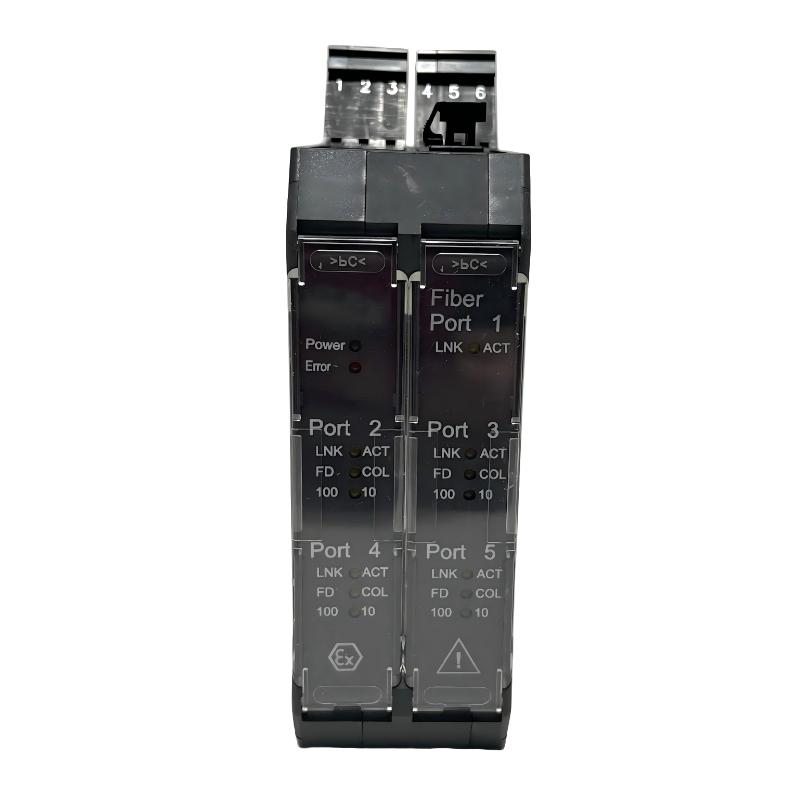
- Emerson
- KJ1740X1-BA1
- Four Port Fiber Switch
- USA
- 115 × 87 × 30 mm
- 0.45 kg
- Xiamen, China
- New & In Stock
- T/T, PayPal, Western Union
- 1 Year
- 1-3 Working Days
- DHL, UPS, TNT, FedEx and EMS.
- 24-Hour Service
- COO
- 48
Our advantage

Global Logistics
We have a 10-year logistics and express cooperation agreement, so our products can be shipped to any place in the world.

Brand new and original
Our products are imported in bulk from the place of origin. Because of the cooperative relationship, our products are all original and 100% new.

24-hour service
We provide 7*24 hours service to our customers. We will be there whenever you need us.

Price advantage
All our products are priced very favorably because we have our own warehouse and supply.
| Company Information | |||
| [email protected] | |||
| Mobile | +8615980777398 | ||
| +8615980777398 | |||
| 15980777398 |
Product Overview
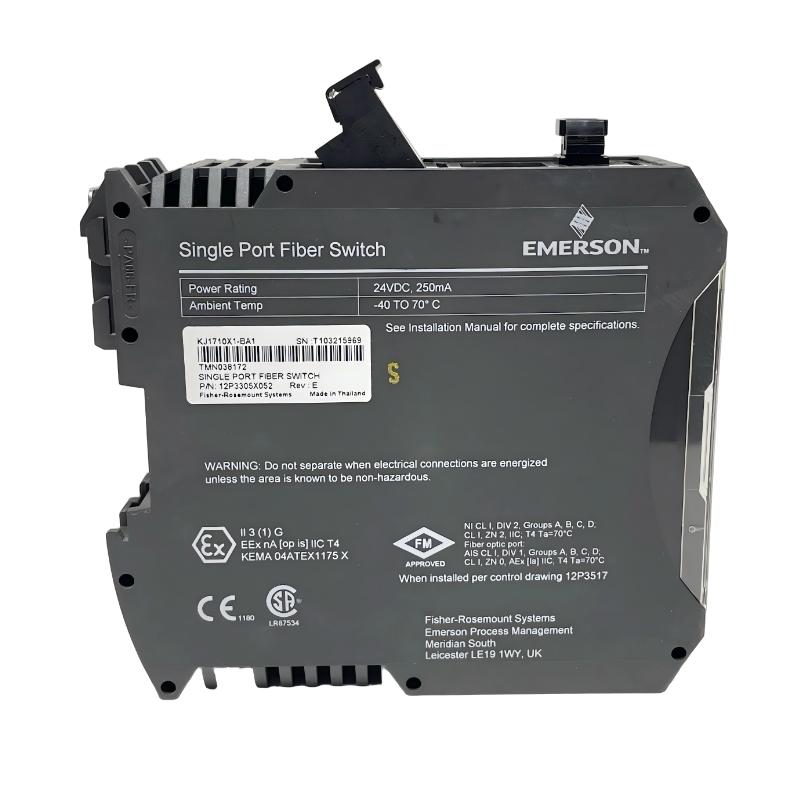
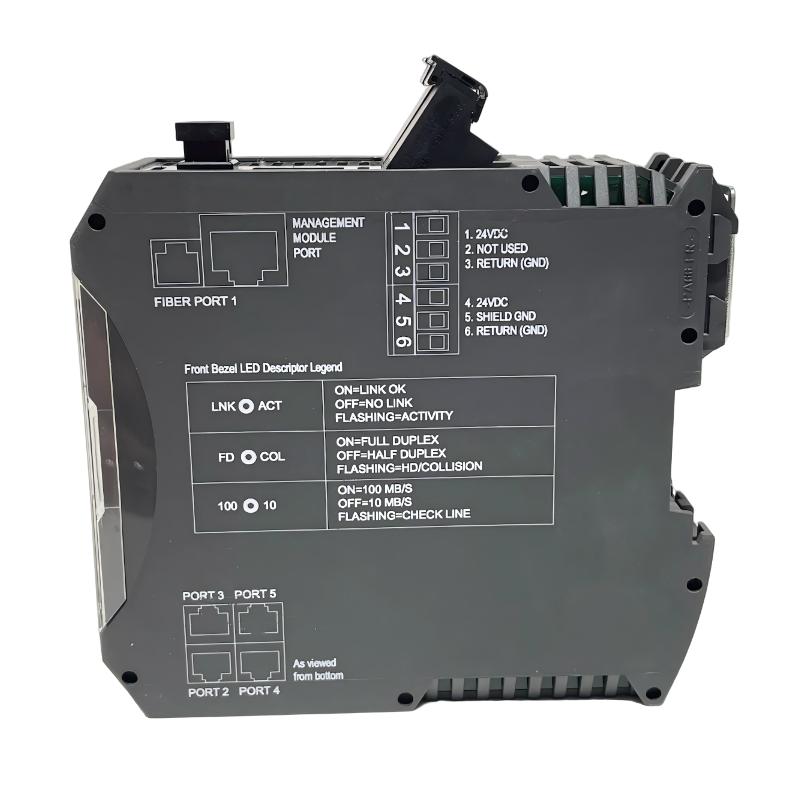
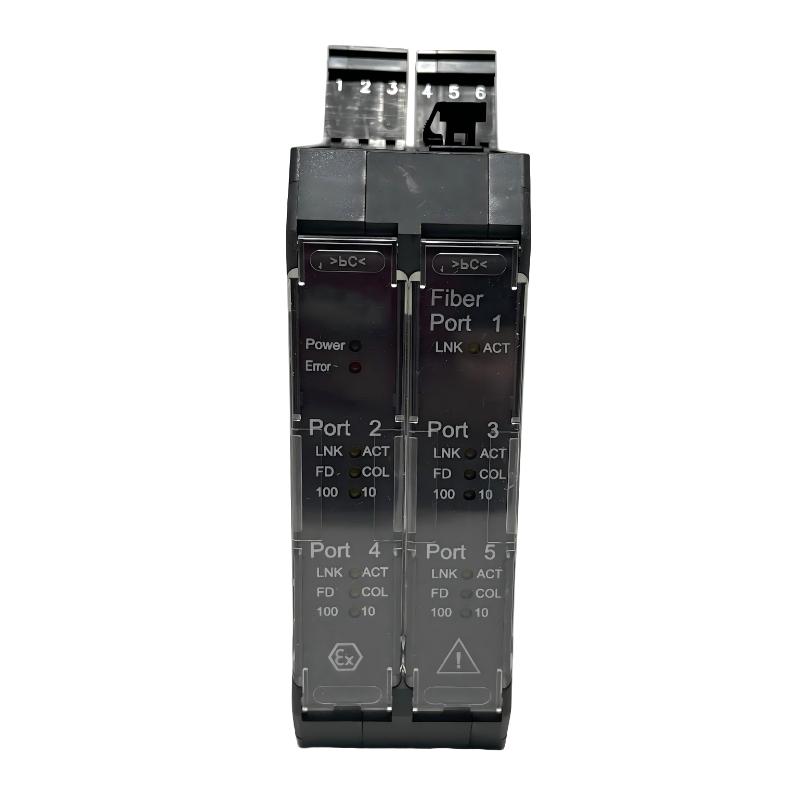
The Emerson KJ1740X1-BA1 Four Port Fiber Switch is an industrial communication device designed to provide fiber-optic connectivity within process automation and control system networks. It is intended for applications where reliable data communication between automation equipment is required over electrically noisy or physically distributed environments.
Fiber communication is widely used in industrial plants because it provides electrical isolation and is not affected by electromagnetic interference in the same way as conventional copper communication wiring. This makes fiber-based networking useful around motors, drives, switchgear, and other equipment that can generate significant electrical noise.
The KJ1740X1-BA1 provides four fiber communication ports in a compact industrial enclosure. It can be used as part of a network infrastructure to connect compatible automation devices and extend communication paths between different areas of a plant.
The module is particularly useful in distributed control environments where controllers, I/O systems, operator stations, and other networked devices may be installed in separate cabinets or plant areas.
Technical Specifications
| Parameter | Details |
|---|---|
| Manufacturer | Emerson |
| Model | KJ1740X1-BA1 |
| Product Type | Four-Port Fiber Switch |
| Communication Medium | Fiber Optic |
| Number of Fiber Ports | 4 Ports |
| Application | Industrial Network Communication |
| System Environment | Process Automation |
| Installation | Industrial Control Cabinet |
| Network Function | Fiber Network Connectivity |
| Dimensions | 115 × 87 × 30 mm |
| Weight | 0.45 kg |
| Application Area | Industrial Automation Networks |
Product Features
The Emerson KJ1740X1-BA1 is designed to provide reliable fiber-based communication for industrial automation networks.
Key features include:
- Four-port fiber network connectivity
- Fiber-optic communication
- Compact industrial enclosure
- Suitable for process automation systems
- Helps provide electrical isolation between network segments
- Suitable for electrically noisy industrial environments
- Supports distributed network architectures
- Useful for communication over extended plant areas
- Suitable for control cabinet installation
- Compact 30 mm enclosure depth
The use of fiber communication can be particularly beneficial in facilities where long communication paths or strong electromagnetic interference make conventional copper connections less desirable.
Working Principle
The KJ1740X1-BA1 operates as a network switching component within a fiber-based industrial communication system.
When compatible network devices are connected to its fiber ports, the switch manages the movement of Ethernet communication traffic between connected network segments. Data arriving through one port can be forwarded toward the appropriate connected device or network segment.
A typical communication process includes:
- Connecting compatible network devices to the fiber ports
- Establishing physical fiber communication paths
- Detecting connected network links
- Receiving communication data
- Processing network traffic within the switch
- Forwarding data toward the required network segment
Because the communication path uses optical transmission, the network can maintain electrical separation between connected sections. This can help reduce problems caused by electromagnetic interference and ground potential differences.
Role in Industrial Control Systems
The KJ1740X1-BA1 can serve as part of the communication infrastructure supporting a distributed automation system.
| Function | Description |
| Network Switching | Directs communication traffic between connected network segments |
| Fiber Connectivity | Provides optical network connections |
| Network Expansion | Allows additional fiber-based devices to be integrated |
| Electrical Isolation | Helps separate electrically connected areas through optical transmission |
| Distributed Communication | Supports communication between equipment in different plant locations |
| Network Organization | Provides a structured connection point for fiber network segments |
The switch does not replace the controller or automation processor. Its primary role is to provide communication infrastructure for the devices connected to the network.
Industrial Applications
The KJ1740X1-BA1 can be used in industrial environments where fiber communication provides advantages over conventional copper networking.
| Industry | Typical Applications |
| Oil & Gas | Distributed process control networks |
| Chemical Processing | Plant-wide automation communication |
| Power Generation | Control and monitoring networks |
| Water Treatment | Remote equipment communication |
| Manufacturing | Industrial machine networking |
| Pharmaceutical | Process automation infrastructure |
| Energy | Distributed monitoring systems |
| Process Industry | Fiber-based control network connections |
Fiber communication is particularly useful when network devices are separated by long distances or installed in areas with substantial electrical equipment.
Installation and System Integration
The KJ1740X1-BA1 should be integrated into the network after confirming the required fiber type, connector arrangement, network topology, and equipment compatibility.
Recommended installation steps include:
- Verify the exact switch model.
- Confirm compatibility with the existing network architecture.
- Determine the required fiber communication type.
- Mount the switch securely inside the control cabinet.
- Route fiber cables away from excessive mechanical stress.
- Connect each fiber link to the appropriate port.
- Check the transmit and receive paths.
- Verify network link status.
- Test communication between connected devices.
- Confirm stable network operation after commissioning.
Fiber cables should be installed with appropriate bending radius and mechanical protection. Care should also be taken to keep optical connectors clean because contamination can reduce signal quality.
Compatible System Components
The KJ1740X1-BA1 can work with a range of networked automation equipment depending on the overall system architecture.
| Compatible Component | Function |
| DeltaV Controllers | Execute process control strategies |
| Remote I/O Systems | Acquire and transmit field signals |
| Industrial Ethernet Devices | Exchange automation data |
| Fiber Network Cables | Provide optical communication paths |
| Network Interface Modules | Connect automation equipment to the network |
| Engineering Workstations | Configure and maintain automation systems |
| Operator Stations | Provide process monitoring and control |
| Industrial Network Switches | Extend or organize network infrastructure |
The exact network configuration should be determined according to the communication requirements and architecture of the installed automation system.
Recommended Alternative Models
| Model | Type | Key Feature | Application |
| Emerson KJ1740X1-BA1 | Four-Port Fiber Switch | Compact fiber network connectivity | Industrial automation networks |
| Emerson KJ1740X1-BB1 | Fiber Network Module | Alternative optical communication configuration | Process control systems |
| Emerson KJ1740X1-BC1 | Industrial Network Module | Distributed network integration | Industrial automation |
| Emerson Fiber Network Switch Modules | Fiber Switch | Optical network expansion | Plant-wide communication |
| Emerson Industrial Ethernet Switches | Ethernet Switch | Network segmentation and expansion | Distributed control architectures |
Alternative selection should consider fiber type, optical interface, network topology, communication speed, environmental requirements, and compatibility with the existing control system. A switch with the same number of ports is not necessarily a direct replacement.
Key Advantages
- Four-port fiber communication design
- Supports industrial optical networking
- Helps provide electrical isolation
- Suitable for electrically noisy environments
- Compact 115 × 87 × 30 mm dimensions
- Lightweight 0.45 kg construction
- Suitable for control cabinet installation
- Supports distributed automation architectures
- Useful for connecting equipment across separated plant areas
- Helps organize fiber-based industrial communication networks
Technical FAQs
Why would a process automation system use fiber instead of copper Ethernet?
Fiber provides optical transmission and electrical isolation, making it useful where electromagnetic interference, ground potential differences, or long communication distances are concerns. This is particularly relevant in plants containing large motors, drives, transformers, and high-power electrical equipment.
What is the purpose of having four fiber ports on the KJ1740X1-BA1?
The four ports allow multiple fiber-connected network segments or devices to be interconnected through the same switching component. This can simplify network organization and provide greater flexibility when designing a distributed industrial communication architecture.
What installation issues can affect fiber network performance?
Incorrect fiber type, contaminated connectors, excessive cable bending, damaged optical surfaces, and poor cable routing can all affect communication quality. Fiber installation should therefore include proper cable handling, connector inspection, and link testing.
Can the KJ1740X1-BA1 replace an industrial Ethernet switch with copper ports?
Not necessarily. The physical port type, optical characteristics, network protocol support, communication speed, topology, and system compatibility all need to match. A copper Ethernet switch and a fiber switch may perform similar network functions but are not automatically interchangeable.