

ProductPRODUCT
Featured products
Contact Us
- Siemens
- 6AG1151-7AA21-2AB0
- SIPLUS ET 200S IM 151-1 Standard
- Germany
- 60 × 119.5 × 75 mm
- 0.2kg
- Xiamen, China
- New & In Stock
- T/T, PayPal, Western Union
- 1 Year
- 1-3 Working Days
- DHL, UPS, TNT, FedEx and EMS.
- 24-Hour Service
- COO
- 4
Our advantage

Global Logistics
We have a 10-year logistics and express cooperation agreement, so our products can be shipped to any place in the world.

Brand new and original
Our products are imported in bulk from the place of origin. Because of the cooperative relationship, our products are all original and 100% new.

24-hour service
We provide 7*24 hours service to our customers. We will be there whenever you need us.

Price advantage
All our products are priced very favorably because we have our own warehouse and supply.
| Company Information | |||
| [email protected] | |||
| Mobile | +8615980777398 | ||
| +8615980777398 | |||
| 15980777398 |
Siemens 6AG1151-7AA21-2AB0 — Product Profile, Technical Parameters, Applications and Related Models
1. Product Overview
The Siemens 6AG1151-7AA21-2AB0 is an industrial automation part number associated with the SIPLUS product range. The SIPLUS range includes automation hardware designed for specified demanding environmental conditions.
The model number appears to be related to the SIMATIC ET 200S distributed I/O platform. In this type of system, an interface module or other station component connects local input and output modules to a controller, allowing field signals to be exchanged without routing every individual signal cable back to the main control cabinet.
However, the exact product designation and technical function of 6AG1151-7AA21-2AB0 cannot be established confidently from the part number alone. It would be misleading to assign it a specific interface type, communication protocol, or electrical rating without confirming the exact variant.
The profile below therefore separates the general characteristics of the product family from specifications that still require confirmation. Dimensions and weight are included in the parameter tables, with unverified values clearly identified rather than guessed.
2. Brand and Product Series
| Parameter | Specification |
|---|---|
| Brand | Siemens |
| Complete model number | 6AG1151-7AA21-2AB0 |
| Product designation | SIPLUS ET 200S IM 151-7 CPU |
| Standard base model | 6ES7151-7AA21-0AB0 |
| Product family | SIPLUS |
| Automation series | SIMATIC ET 200S |
| Product type | Distributed automation CPU / interface module |
| Main function | Executes decentralized control tasks and connects the station to PROFIBUS DP as a slave |
| Integrated memory | 128 KB work memory |
| Integrated fieldbus interface | PROFIBUS DP |
| PROFIBUS connector | 9-pin D-sub socket |
| Environmental design | Conformal coating |
| Operating temperature | -25°C to +60°C |
| Dimensions (W × H × D) | 60 × 119.5 × 75 mm |
| Approximate module weight | 0.200 kg |
| Net weight for logistics | 0.251 kg |
| Required memory medium | SIMATIC MMC |
| Battery requirement | No battery required |
| Product lifecycle | Discontinued; listed as a spare part |
The key distinction is that the IM 151-7 CPU is not simply a passive I/O interface. It incorporates CPU functionality, allowing decentralized control tasks to be executed at the ET 200S station. This can reduce the processing burden on a central controller and provide more flexibility when dividing an automation system into machine sections.
3. Detailed Technical Parameters
3.1 General Product Specifications
| Parameter | Specification |
|---|---|
| Model | 6AG1151-7AA21-2AB0 |
| Product name | SIPLUS ET 200S IM 151-7 CPU |
| Base model | 6ES7151-7AA21-0AB0 |
| Product category | Distributed automation CPU |
| Automation platform | SIMATIC ET 200S |
| CPU work memory | 128 KB |
| Integrated communication interface | PROFIBUS DP |
| PROFIBUS connector | 9-pin D-sub socket |
| PROFIBUS operating role | DP slave |
| Additional DP master capability | Requires the compatible separate DP master module |
| Memory card | SIMATIC MMC required |
| Battery | Not required |
| Isochronous mode | Not supported |
| Maximum peripheral modules per station | Up to 63, subject to station configuration |
| Maximum station width | Configuration-dependent; ET 200S station limits apply |
| Operating temperature | -25°C to +60°C |
| Conformal coating | Yes |
| Width | 60 mm |
| Height | 119.5 mm |
| Depth | 75 mm |
| Approximate module weight | 0.200 kg |
| Net logistics weight | 0.251 kg |
| Product status | Discontinued; spare-part application |
| Typical application | Decentralized machine control and distributed I/O |
The distinction between the module’s approximate hardware weight and its logistics net weight is important. The hardware specification gives an approximate mass of 0.200 kg, while the ordering information lists 0.251 kg. For shipping and stock-management purposes, the logistics value is generally the more useful figure.
3.2 CPU and Memory Parameters
| Parameter | Specification |
|---|---|
| CPU type | IM 151-7 CPU |
| Work memory | 128 KB |
| User program storage | SIMATIC MMC required |
| Battery-backed memory | Not required |
| Programming languages | LAD, FBD, STL; additional languages depend on engineering configuration |
| S7 communication | Supported |
| S7 communication role | Server supported |
| S7 communication client role | Not supported |
| Maximum total communication connections | 12 |
| Diagnostic buffer | Available |
| Program status monitoring | Supported |
| Variable monitoring and control | Supported |
| Forcing functions | Supported for supported variables |
| Password protection | Supported |
| Isochronous operation | Not supported |
The integrated CPU allows the ET 200S station to run its own control program rather than relying entirely on a central PLC for every local decision.
The 128 KB work memory is intended for the CPU’s program and working data. The SIMATIC MMC provides the required memory medium for the user program and associated data. Because a memory card is required, it should be included in spare-parts planning and commissioning checks.
The available memory is modest by modern controller standards, but it can be suitable for localized control tasks in an established ET 200S installation. The actual program capacity depends on the application, the amount of working data, and the system’s programming requirements.
3.3 Communication Parameters
| Parameter | Specification |
|---|---|
| Main fieldbus | PROFIBUS DP |
| Physical interface | RS-485 |
| Connector | 9-pin D-sub socket |
| Integrated PROFIBUS role | DP slave |
| S7 communication | Supported |
| Programming-device communication | Supported within connection limits |
| Operator-panel communication | Supported within connection limits |
| Diagnostic messages | Supported |
| Routing | Supported in specified configurations |
| Integrated PROFINET interface | No |
| Integrated Industrial Ethernet interface | No |
| Direct PROFINET IO controller function | Not provided by the integrated PROFIBUS interface |
| DP master operation | Requires the compatible additional DP master module |
| Network configuration | Must match the controller and connected field devices |
The integrated PROFIBUS DP interface allows the CPU to exchange data with a higher-level DP master. In a typical application, the central controller communicates with the IM 151-7 CPU as a DP slave, while the local CPU handles its own control logic.
This arrangement can be useful where a machine section needs some local autonomy but still has to exchange status and commands with the main automation system.
The product does not have an integrated PROFINET interface. If the existing installation uses PROFINET, a replacement should be selected only after checking the required communication architecture and whether a gateway, different CPU, or system redesign is necessary.
3.4 Electrical and Environmental Parameters
| Parameter | Specification |
|---|---|
| Operating temperature, minimum | -25°C |
| Operating temperature, maximum | +60°C |
| Environmental protection design | SIPLUS |
| Conformal coating | Yes |
| Battery | Not required |
| Power-supply requirements | Follow the ET 200S station and CPU installation specifications |
| Power consumption | Confirm from the detailed electrical data for the hardware revision |
| Grounding | Follow the system installation requirements |
| PROFIBUS cable shielding | Required according to the network installation specification |
| Unused interface protection | Supplied protective covers must remain fitted where required |
| Environmental resistance | Limited to the specified environmental classifications |
| Condensation tolerance | Do not assume operation under condensation unless explicitly permitted |
| Installation location | Suitable industrial enclosure or control cabinet |
The SIPLUS design and conformal coating are relevant when the module is used in environments with demanding temperature or environmental conditions. The coating provides additional protection under specified conditions, but it does not make the module universally waterproof or resistant to every chemical.
The complete installation should be designed around the actual site conditions, including humidity, temperature, contamination, cable routing, and the protection of unused connectors.
4. Product Introduction
4.1 What Is the IM 151-7 CPU?
The 6AG1151-7AA21-2AB0 is a SIPLUS version of the ET 200S IM 151-7 CPU. It combines local CPU functionality with a PROFIBUS DP communication interface, making it suitable for decentralized automation architectures.
In a conventional centralized system, most control logic is executed in a central PLC. In a decentralized arrangement, selected machine sections can have their own local CPU or control capability. This can allow local sequences and interlocks to be handled close to the equipment while the central controller supervises the wider production process.
The IM 151-7 CPU is designed for this type of architecture. Its local processing capability distinguishes it from interface modules that merely exchange I/O data with a remote controller.
4.2 Difference Between a CPU and a Standard Interface Module
A standard distributed I/O interface mainly transfers process data between the controller and the connected I/O modules. It does not necessarily execute a standalone user program.
The IM 151-7 CPU has its own work memory and executes a user program. It can therefore perform local logic and communicate with a higher-level controller through PROFIBUS DP.
This arrangement may help distribute control tasks across a machine, reduce the amount of central processing required for local sequences, and make certain applications easier to organize.
4.3 Role of the PROFIBUS DP Interface
PROFIBUS DP is an industrial fieldbus used to exchange process data between controllers and distributed devices.
The IM 151-7 CPU’s integrated interface operates as a DP slave. It can exchange data with a compatible DP master, allowing the local station to be incorporated into a wider automation system.
Where DP master functionality is required, the compatible separate DP master module must be considered. The integrated slave interface should not be mistaken for a complete built-in master interface.
4.4 Why the Memory Card Matters
The product requires a SIMATIC MMC and does not require a battery.
For maintenance, the correct memory card and program backup should be treated as part of the control-system documentation. When replacing the CPU, verify the memory-card compatibility, program version, and any configuration data needed to restore the original machine operation.
5. Product Applications
5.1 Decentralized Machine Control
The CPU can execute local logic for a machine section while exchanging information with a central controller.
Examples include managing operating sequences, monitoring local machine states, controlling compatible distributed I/O modules, and coordinating status information between a machine section and the main automation system.
This approach can be helpful when a machine contains several functional areas with clearly separated control responsibilities.
5.2 Conveyor Systems
Conveyor equipment often contains multiple local sections, including transfer points, sensor groups, and actuator assemblies.
The IM 151-7 CPU can be used in a suitable ET 200S installation to handle local sequencing and status processing. The PROFIBUS connection allows the local CPU to communicate with the central control system.
Potential applications include:
-
Local conveyor-section control.
-
Monitoring product-presence sensors.
-
Managing transfer-point sequences.
-
Reporting faults and machine status.
-
Coordinating local operations with the central PLC.
The suitability of the CPU depends on the control program’s size, the I/O requirements, and the communication design.
5.3 Packaging Machinery
Packaging machinery often requires a sequence of operations to be coordinated across several stations. A local CPU can handle selected machine-section logic while communicating with the main controller.
The product may be relevant to established packaging equipment built around the ET 200S platform, particularly where the existing control architecture already uses PROFIBUS DP.
The CPU should not be treated as a dedicated motion controller or safety controller unless the complete system design explicitly provides the required functions through appropriate hardware and software.
5.4 Assembly Equipment
Assembly systems may use multiple workstations with their own sensors, actuators, and local operating sequences.
A decentralized CPU can manage selected local tasks while reporting operating status and faults to a central controller. This can help separate the control logic for different machine sections.
The benefit is greatest when the local program is clearly defined and the communication interface between the local CPU and the main controller is well documented.
5.5 Retrofit and Legacy Automation
One of the most relevant use cases for this model is maintaining existing ET 200S installations.
If the machine was originally designed around the IM 151-7 CPU and PROFIBUS DP, keeping the original architecture may reduce the engineering effort involved in a repair. Replacing it with a different CPU or communication system may require hardware changes, program adaptation, and network reconfiguration.
Because this model is discontinued, maintenance teams should plan spare-parts availability and evaluate compatible alternatives before a failure occurs.
5.6 Industrial Environments With Wider Temperature Requirements
The SIPLUS variant supports an operating-temperature range of -25°C to +60°C and includes conformal coating.
This may make it suitable for specified industrial conditions where temperature or environmental exposure is an important selection factor. The actual application must remain within the product’s environmental ratings and installation requirements.
6. Product Advantages
6.1 Integrated Local Processing
The CPU can execute its own user program, allowing certain control tasks to run locally at the distributed station.
This can reduce reliance on a central controller for every local operation and help organize complex machinery into functional sections.
6.2 Compact Distributed Automation
The CPU is integrated into the ET 200S platform, allowing local control and compatible I/O modules to be arranged within a modular station.
This can simplify the design of machine sections where control logic and field signals are physically close to each other.
6.3 Established PROFIBUS DP Connectivity
The integrated PROFIBUS DP slave interface allows the CPU to communicate with a compatible DP master.
For existing PROFIBUS installations, this can be useful because the machine can retain its established network architecture without immediately converting every device to another protocol.
6.4 Battery-Free Design
The CPU does not require a battery.
This reduces the need for battery replacement and associated maintenance procedures. The required SIMATIC MMC must still be managed properly, and the correct program backup should be available for restoration.
6.5 SIPLUS Environmental Design
The conformal coating and operating-temperature range of -25°C to +60°C support use in specified demanding environments.
This can be an advantage for equipment that operates outside the conditions normally expected in a clean, climate-controlled control cabinet.
6.6 Diagnostics and Maintenance Functions
The CPU supports diagnostic and commissioning functions such as diagnostic-buffer access, program monitoring, variable status/control, and supported forcing operations.
These capabilities can help engineers troubleshoot program behavior and identify faults during commissioning or maintenance. The available functions depend on the engineering configuration and the specific system setup.
6.7 Clear Separation of Control Responsibilities
A decentralized CPU can handle a local section’s control logic while exchanging selected information with the central controller.
This separation can make a large machine easier to understand and maintain, provided that the local and central programs have clearly defined responsibilities.
7. Five Related Models in the Same Series or Related Families
The models below are useful for comparison when maintaining an ET 200S installation or evaluating a replacement. They do not all have the same CPU capabilities, communication interfaces, or environmental ratings.
| Model | Product designation | Main parameters | Dimensions (W × H × D) | Weight (kg) |
|---|---|---|---|---|
| 6ES7151-7AA21-0AB0 | ET 200S IM 151-7 CPU | Standard base model; 128 KB work memory; integrated PROFIBUS DP slave interface; SIMATIC MMC required | 60 × 119.5 × 75 mm | Approx. 0.200 |
| 6ES7151-7AA20-0AB0 | ET 200S IM 151-7 CPU | Related CPU variant; confirm exact memory, firmware, and communication features before substitution | Verify exact dimensions | Verify exact value |
| 6AG1151-7AA20-7AB0 | SIPLUS ET 200S IM 151-7 CPU | Related SIPLUS CPU variant with a different environmental specification; check exact temperature limits and hardware compatibility | Verify exact dimensions | Approx. 0.245 |
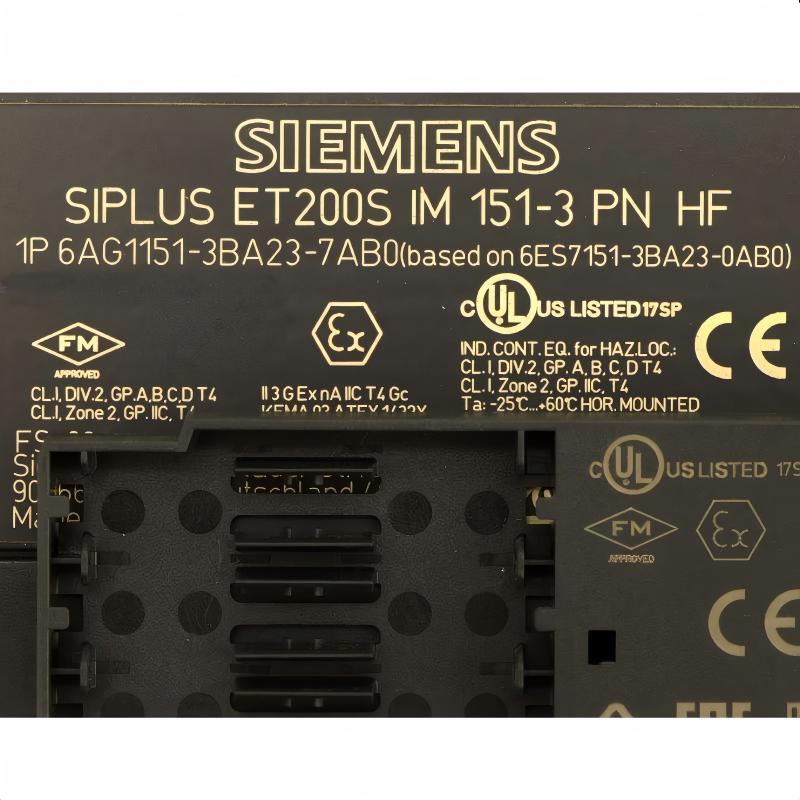
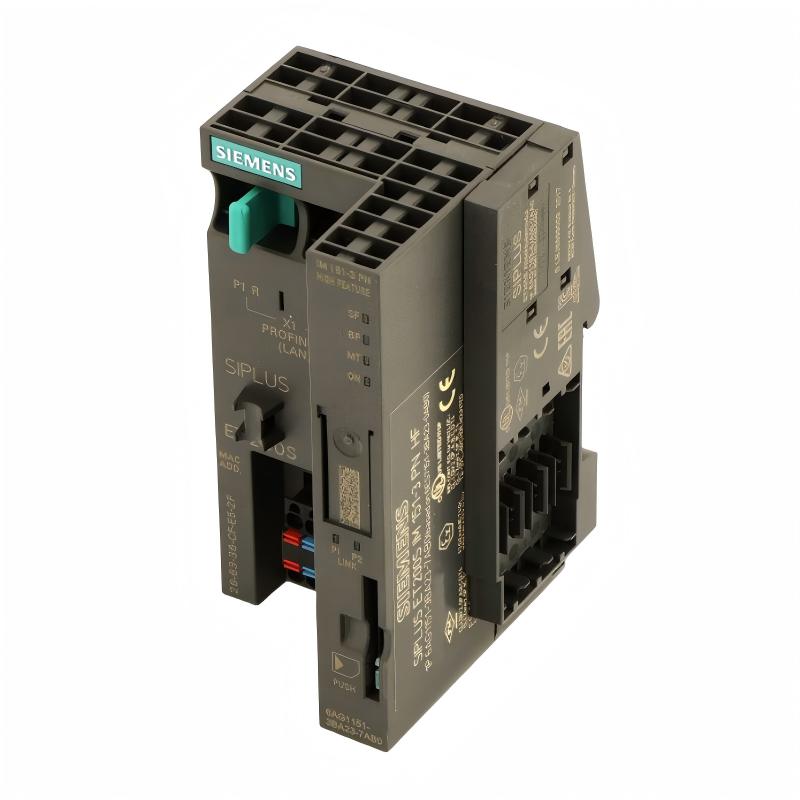
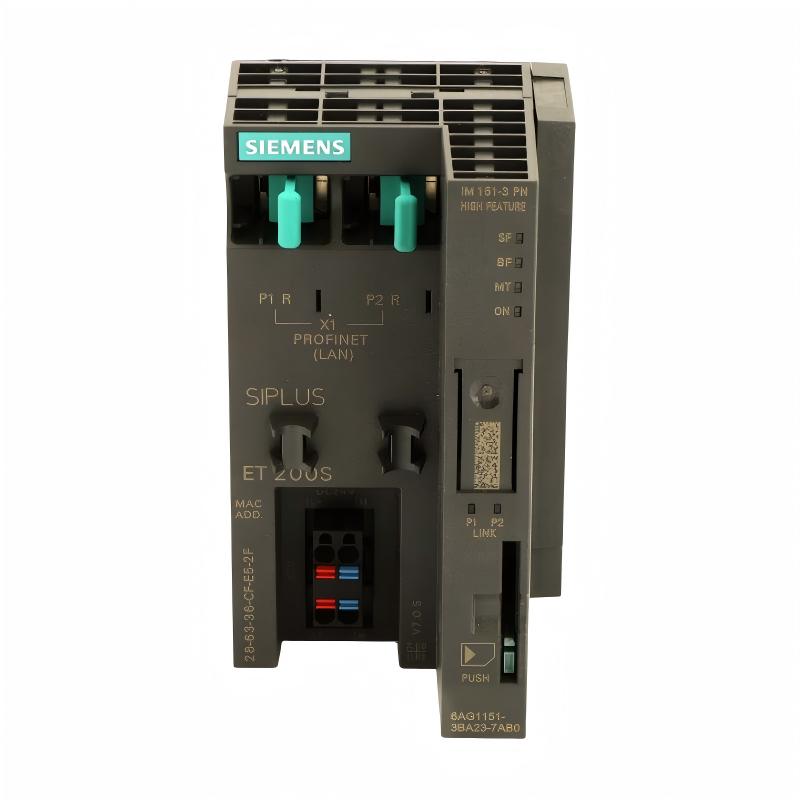
| 6AG1151-3BA23-7AB0 | SIPLUS ET 200S IM 151-3 PN HF | High-feature distributed I/O interface; PROFINET IO; not a direct CPU replacement for the IM 151-7 CPU | 60 × 119.5 × 75 mm | Approx. 0.205 |
| 6AG1151-1BA02-2AB0 | SIPLUS ET 200S IM 151 HF | High-feature PROFIBUS DP interface variant; verify its feature set and station compatibility | Verify exact dimensions | Verify exact value |
The closest comparison is 6ES7151-7AA21-0AB0, the standard base model for the target CPU. When considering this option, verify whether the environmental characteristics of the standard model are suitable for the installation.
The 6AG1151-7AA20-7AB0 is another related CPU variant, but its environmental rating and hardware characteristics must be checked before replacement.
The IM 151-3 PN HF and IM 151 HF models are interface modules rather than equivalent CPU models. They may be relevant when redesigning a system, but they should not be assumed to run the same user program or provide the same local processing functions.
8. Five Popular Models for a Broader Automation System
These models represent commonly used categories of industrial automation hardware. Their functions differ from the IM 151-7 CPU, so they are alternatives for broader system design rather than direct replacements.
| Model | Product series | Product type | Main parameters | Dimensions (W × H × D) | Weight (kg) |
|---|---|---|---|---|---|
| 6ES7214-1AG40-0XB0 | SIMATIC S7-1200 | PLC | Compact controller for machine automation; integrated I/O and communication features depend on the CPU variant | Verify exact model data | Verify exact value |
| 6ES7511-1AK02-0AB0 | SIMATIC S7-1500 | PLC | Controller for industrial automation; memory, processing performance, and interfaces depend on the CPU configuration | Verify exact model data | Verify exact value |
| 6ES7155-6AU01-0BN0 | SIMATIC ET 200SP | Distributed I/O interface | Interface for a modular distributed I/O station; network and module compatibility depend on the selected configuration | Verify exact model data | Verify exact value |
| 6EP1333-2BA20 | SITOP | Industrial power supply | 24 V DC supply for suitable automation applications; confirm rated output current and protection features | Verify exact model data | Verify exact value |
| 6AV2123-2GB03-0AX0 | SIMATIC HMI Basic Panel | Operator interface | Human-machine interface for displaying machine states, alarms, and operator controls | Verify exact model data | Verify exact value |
A broader automation system typically combines several different product categories. A PLC executes control logic, a distributed I/O interface exchanges field data, a power supply provides the required DC power, and an HMI gives operators a way to monitor and control the equipment.
The ET 200SP model belongs to a different distributed I/O platform and should be assessed as part of a suitable system redesign, not as a direct drop-in replacement for the ET 200S CPU.
9. Installation and Configuration Considerations
9.1 Confirm the Original Hardware Configuration
Before replacing the CPU, record the complete order number, hardware revision where applicable, installed I/O modules, PROFIBUS address, and controller configuration.
A similar-looking CPU may have different memory, communication, or environmental capabilities.
9.2 Check the SIMATIC MMC
The CPU requires a SIMATIC MMC and does not require a battery.
Confirm the correct memory-card arrangement and make sure the user program and required configuration data are backed up before maintenance.
9.3 Review PROFIBUS Settings
The integrated PROFIBUS interface operates as a DP slave. Verify the bus address, network configuration, cable termination, shielding, and communication parameters.
If DP master operation is required, confirm that the compatible additional DP master module is present and correctly configured.
9.4 Check Station Power and Module Limits
The station must comply with the configuration limits for the CPU, connected I/O modules, power modules, and mounting arrangement.
The number of modules that can be installed depends on the full configuration. Do not assume that every combination of modules can be used simply because the nominal maximum module count has not been reached.
9.5 Plan for Environmental Conditions
The SIPLUS model’s stated operating-temperature range is -25°C to +60°C.
The installation must also meet the relevant requirements for humidity, contamination, chemical exposure, cable routing, and protection of unused interfaces.
9.6 Prepare for Discontinuation
The model is discontinued and identified as a spare part. Before an emergency replacement is needed, establish whether the original unit is available and identify a technically compatible alternative.
Any migration should account for the control program, memory card, PROFIBUS configuration, I/O arrangement, and the behavior of the existing machine.
10. Product Selection Summary
| Requirement | Recommended approach |
|---|---|
| Maintaining the original CPU | Confirm the full model number and original system configuration |
| Finding the closest standard equivalent | Evaluate 6ES7151-7AA21-0AB0 |
| Considering a related SIPLUS CPU | Evaluate 6AG1151-7AA20-7AB0 after checking its environmental specifications |
| Replacing with a standard interface module | Confirm whether local CPU functionality is still required |
| Changing from PROFIBUS to PROFINET | Treat this as a system migration, not a simple module swap |
| Planning spare parts | Confirm availability because the target model is discontinued |
| Replacing the CPU with a newer platform | Review program migration, I/O compatibility, network changes, and commissioning requirements |
11. Final Assessment
The Siemens 6AG1151-7AA21-2AB0 is the SIPLUS ET 200S IM 151-7 CPU, based on 6ES7151-7AA21-0AB0. It combines local CPU functionality with an integrated PROFIBUS DP slave interface and provides 128 KB of work memory.
Its main advantages include decentralized program execution, established PROFIBUS connectivity, battery-free operation, diagnostic functions, and environmental design for specified demanding industrial conditions. It is particularly relevant to existing ET 200S installations that use PROFIBUS DP and require local control capability.
The main technical values are a 128 KB work memory, an operating-temperature range of -25°C to +60°C, dimensions of 60 × 119.5 × 75 mm, an approximate module weight of 0.200 kg, and a logistics net weight of 0.251 kg. The CPU requires a SIMATIC MMC and does not require a battery.
Because the model is discontinued, the most practical first comparison is 6ES7151-7AA21-0AB0, followed by a review of related CPU variants and the actual needs of the installed system. Any replacement should be checked for program compatibility, memory requirements, communication functions, environmental ratings, and mechanical fit before installation.