

ProductPRODUCT
Featured products
Contact Us
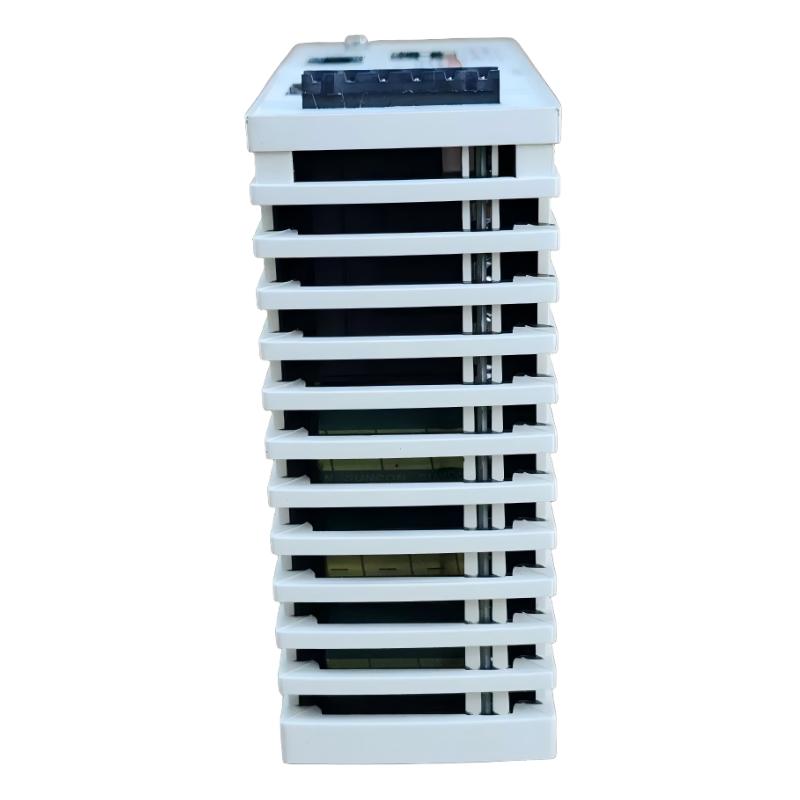
- Schneider
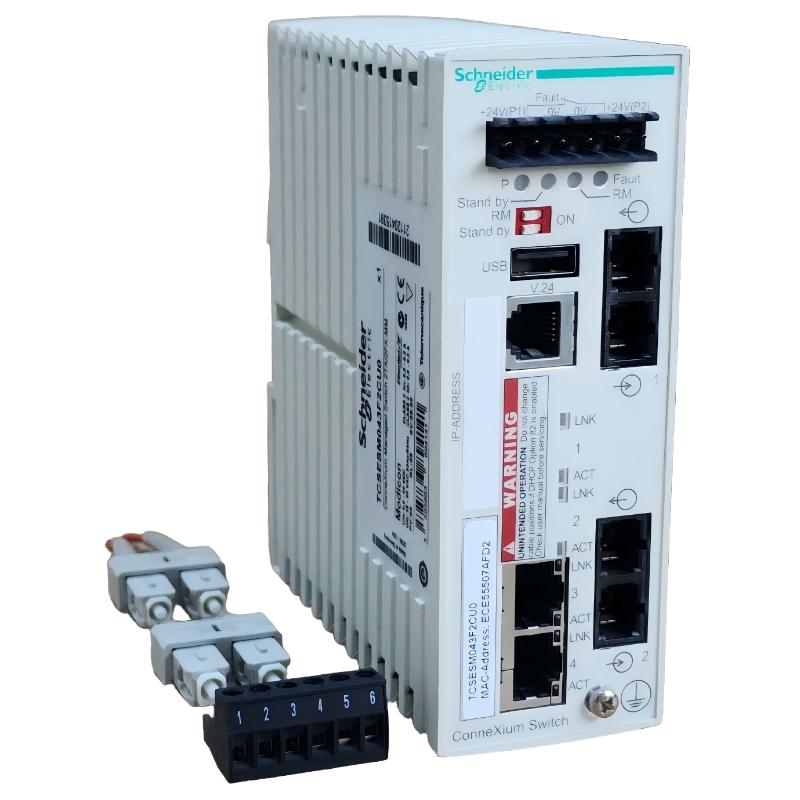
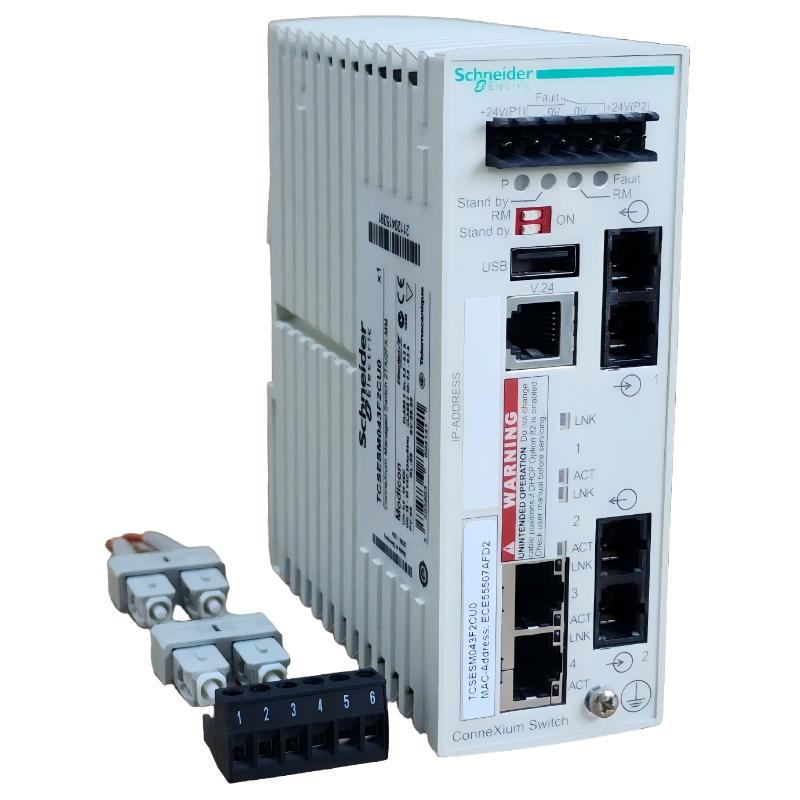
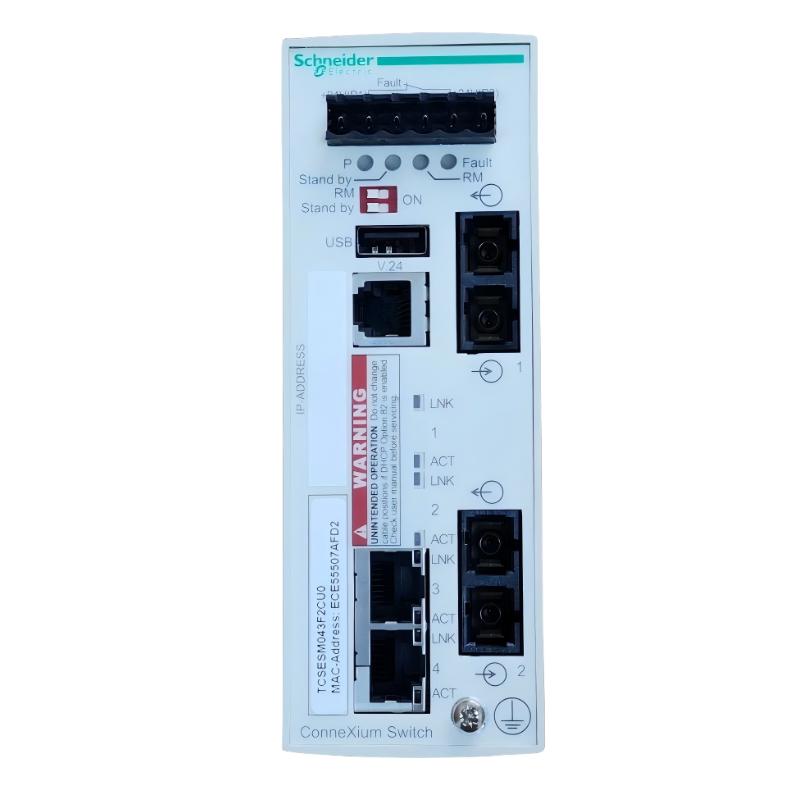
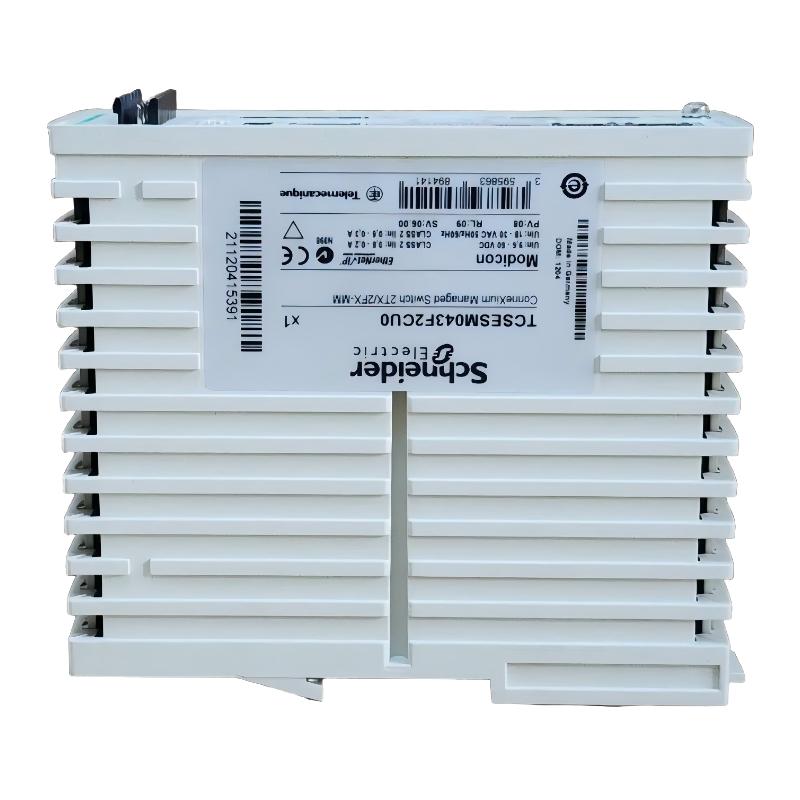
- TCSESM043F2CU0
- ConneXium Managed Switch
- France
- 131 x 111 x 47 mm
- 0.4 kg
- Xiamen, China
- New & In Stock
- T/T, PayPal, Western Union
- 1 Year
- 1-3 Working Days
- DHL, UPS, TNT, FedEx and EMS.
- 24-Hour Service
- COO
- 15
Our advantage

Global Logistics
We have a 10-year logistics and express cooperation agreement, so our products can be shipped to any place in the world.

Brand new and original
Our products are imported in bulk from the place of origin. Because of the cooperative relationship, our products are all original and 100% new.

24-hour service
We provide 7*24 hours service to our customers. We will be there whenever you need us.

Price advantage
All our products are priced very favorably because we have our own warehouse and supply.
| Company Information | |||
| [email protected] | |||
| Mobile | +8615980777398 | ||
| +8615980777398 | |||
| 15980777398 |
Product Overview
The Schneider Electric TCSESM043F2CU0 ConneXium Managed Switch is an industrial Ethernet TCP/IP managed switch designed to connect automation equipment through copper Ethernet and multimode fiber-optic communication. It belongs to Schneider Electric’s ConneXium industrial networking product family and is intended for applications where reliable communication, network management, and connection redundancy are important.
Industrial automation networks commonly connect programmable logic controllers (PLCs), human-machine interfaces (HMIs), industrial computers, remote I/O stations, drives, and supervisory systems. As the number of connected devices increases, network infrastructure must provide more than basic data transmission. Network segmentation, traffic management, fault detection, and redundant communication paths can all contribute to more stable plant operations.
The TCSESM043F2CU0 provides four Ethernet communication ports in a mixed-media configuration. It has two 10BASE-T/100BASE-TX copper Ethernet ports using shielded RJ45 connections and two 100BASE-FX multimode fiber-optic ports using duplex SC connectors. This combination allows copper-connected automation devices to communicate with equipment located farther away through fiber-optic links.
The switch supports industrial network functions such as VLAN, Rapid Spanning Tree Protocol (RSTP), IGMP Snooping, multicast filtering, network diagnostics, and redundant ring configurations. It also supports management through a web interface and provides features intended to improve network visibility and operational control.
The unit operates from a nominal 24 V supply and supports redundant power inputs. Its compact design allows installation on a standard 35 mm DIN rail inside an industrial control cabinet.
The TCSESM043F2CU0 is now discontinued. It remains relevant to maintenance teams managing existing ConneXium installations, particularly when an original switch must be identified or replaced. Schneider Electric identifies MCSESM063F2CU0 as a recommended replacement, but the network configuration and port requirements should be reviewed before substitution.
Technical Specifications
| Parameter | Specification |
|---|---|
| Brand | Schneider Electric |
| Product Family | ConneXium |
| Model | TCSESM043F2CU0 |
| Product Type | Industrial Ethernet TCP/IP Managed Switch |
| Network Concept | Transparent Ready |
| Copper Ethernet Ports | 2 × 10/100BASE-TX |
| Fiber Ethernet Ports | 2 × 100BASE-FX multimode |
| Copper Connector | Shielded RJ45 |
| Fiber Connector | Duplex SC |
| Copper Cable Type | Shielded twisted-pair CAT 5E |
| Maximum Copper Cable Distance | 100 m |
| Fiber Medium | Multimode optical fiber |
| Nominal Supply Voltage | 24 V |
| DC Supply Range | 9.6–60 V DC SELV |
| AC Supply Range | 18–30 V AC SELV |
| Power Consumption | 7.7 W |
| Power Supply Arrangement | Redundant power inputs |
| Network Management | Web-based configuration |
| Network Functions | VLAN, RSTP, IGMP Snooping, multicast filtering |
| Redundancy Functions | Redundant ring and ring coupling |
| Maximum Switches in a Ring | 50 |
| Mounting | 35 mm DIN rail |
| Protection Rating | IP20 |
| Alarm Output | Volt-free contact, maximum 1 A |
| Dimensions | 131 × 111 × 47 mm |
| Weight | 0.4 kg |
| Product Lifecycle | Discontinued |
| Recommended Replacement | MCSESM063F2CU0 |
Specifications are based on the documented product configuration. Confirm the exact hardware revision, firmware, and installation requirements when maintaining an existing network.
Function and Working Principle
The TCSESM043F2CU0 operates as a managed Ethernet switch within an industrial communication network. It receives Ethernet frames from connected devices, examines the destination information, and forwards the frames through the appropriate network ports.
Unlike an unmanaged switch, a managed switch provides configuration and diagnostic functions that allow network administrators to control how traffic moves through the network.
1. Ethernet Data Switching
The switch connects PLCs, HMIs, industrial computers, and other Ethernet-enabled devices. When a connected device transmits data, the switch uses its forwarding information to determine the appropriate destination port.
This reduces unnecessary traffic on unrelated connections and supports communication between multiple automation devices.
The two copper ports support 10/100BASE-TX Ethernet, while the two fiber ports support 100BASE-FX multimode communication. This mixed-media design is useful when an industrial network contains both conventional Ethernet devices and fiber-connected network segments.
2. Copper and Fiber-Optic Communication
Copper Ethernet is commonly used for connections within control cabinets, equipment rooms, and nearby machines. The documented maximum copper cable distance is 100 meters.
Fiber-optic communication is useful for connections between separated equipment areas, particularly where electrical isolation or resistance to electromagnetic interference is important.
The TCSESM043F2CU0 uses multimode fiber with duplex SC connectors. Fiber compatibility depends on the installed optical interface, fiber type, attenuation, and cable quality. The manufacturer’s documentation identifies different supported fiber distances according to the fiber specifications.
3. VLAN Network Segmentation
Virtual Local Area Network (VLAN) functionality allows network administrators to separate devices into logical network groups.
For example, a plant may organize PLC communication, engineering workstations, and supervisory equipment into different VLANs. This can help control broadcast traffic and establish a clearer network structure.
VLAN configuration must be coordinated across connected switches and network devices. Incorrect VLAN assignments can interrupt communication between devices that need to exchange data.
4. Rapid Spanning Tree Protocol
Rapid Spanning Tree Protocol (RSTP) helps manage redundant Ethernet paths and prevent switching loops.
In a network with multiple physical connections, an uncontrolled loop can cause excessive traffic and disrupt communication. RSTP manages the available paths and can activate an alternate connection when the network topology changes.
The actual recovery behavior depends on the network design, switch configuration, and connected equipment.
5. IGMP Snooping and Multicast Filtering
Industrial Ethernet applications may use multicast traffic for communication between multiple devices. If multicast packets are distributed unnecessarily across every port, network traffic can increase.
IGMP Snooping allows the switch to monitor multicast group membership and forward relevant traffic to the appropriate ports. Multicast filtering further supports more controlled distribution of network traffic.
These functions can be useful in automation systems where multiple devices exchange process data or monitoring information.
6. Redundant Power and Network Monitoring
The switch supports redundant power inputs, allowing two suitable power sources to be connected. This arrangement can improve power availability when one supply becomes unavailable, provided the power sources and wiring are correctly designed.
The unit also provides local status indicators and an alarm output. These features help maintenance personnel identify power supply faults, switch faults, link conditions, and redundancy-related events.
Role in Industrial Control Systems
Industrial Ethernet infrastructure connects control equipment across different levels of an automation system. The TCSESM043F2CU0 can serve as a managed switching point between field-level devices, controller networks, and supervisory systems.
PLC Communication
PLCs exchange information with remote I/O stations, HMIs, engineering workstations, and other controllers. The switch provides Ethernet connectivity for devices that use compatible network interfaces.
For example, a PLC may exchange process data with an HMI while also communicating with an industrial computer. The managed switch forwards the Ethernet traffic according to its configured network structure.
Network addresses, VLAN settings, and communication protocols must be configured consistently across the connected devices.
HMI and SCADA Integration
HMIs and SCADA systems depend on network communication to display equipment status, alarms, production values, and process information.
The TCSESM043F2CU0 can connect Ethernet-enabled operator stations and supervisory equipment to the wider industrial network. VLAN and traffic-management functions can help organize communication between different system segments.
The switch does not perform PLC logic or process control. Its role is to provide and manage the communication paths used by these systems.
Fiber-Optic Network Distribution
Large facilities may have control cabinets distributed across production areas, utility rooms, and equipment buildings. Fiber-optic connections can link these locations without relying entirely on long copper Ethernet runs.
The two multimode fiber ports allow the TCSESM043F2CU0 to participate in networks that combine local copper connections with fiber-optic backbone links.
Fiber type, connector condition, optical attenuation, and supported transmission distance should be checked during network planning.
Network Redundancy
Communication interruptions can affect production monitoring and machine coordination. Redundant network paths and appropriate ring configurations can help maintain connectivity when a link fails.
The switch supports RSTP and industrial redundancy functions. Engineers should design the topology carefully and confirm that all participating devices support the selected redundancy method.
Industrial Applications
The ConneXium TCSESM043F2CU0 is designed for industrial Ethernet networks where managed communication and mixed copper/fiber connectivity are required.
1. Manufacturing Automation
Manufacturing facilities use Ethernet networks to connect PLCs, HMIs, industrial PCs, and production monitoring systems.
The switch can provide a central connection point for automation equipment within a production area. VLAN and multicast management functions can help organize traffic between different equipment groups.
2. Process Control Systems
Chemical processing, water treatment, and other process industries often contain distributed control equipment and supervisory systems.
Fiber-optic links can connect remote control cabinets, while copper ports provide local connections for compatible Ethernet devices. The switch can support communication between these network segments.
3. Power and Utility Facilities
Power generation and utility installations may use industrial Ethernet networks to connect monitoring equipment, controllers, and operator stations.
The switch’s redundant power inputs and network redundancy functions can be useful in appropriately designed communication architectures. The complete system must still meet the facility’s electrical, environmental, and cybersecurity requirements.
4. Water and Wastewater Treatment
Water treatment facilities commonly distribute PLCs, remote I/O, operator interfaces, and monitoring equipment across multiple process areas.
A managed Ethernet switch can help connect these devices and organize network traffic. Fiber connections are particularly useful where equipment is separated by long distances or where electrical isolation is desirable.
5. Material Handling and Logistics
Conveyors, sorting equipment, automated storage systems, and packaging machines rely on communication between controllers and supervisory equipment.
The TCSESM043F2CU0 can provide Ethernet connectivity between suitable devices and support a structured network architecture for distributed machinery.
6. Distributed Industrial Networks
Factories with multiple control cabinets may need to connect copper-based equipment to a fiber-optic backbone.
The switch’s 2TX/2FX configuration is suitable for installations where two copper connections and two multimode fiber connections meet the network design requirements.
Installation and System Integration
Correct installation and configuration are essential for reliable industrial Ethernet communication.
1. DIN-Rail Mounting
The TCSESM043F2CU0 is designed for installation on a standard 35 mm symmetrical DIN rail.
Before mounting, confirm that the control cabinet provides sufficient clearance for wiring, fiber connections, ventilation, and maintenance access.
The supplied dimensions are 131 × 111 × 47 mm. Check the physical unit and cabinet layout before finalizing the installation.
2. Power Supply Connection
The switch operates from a nominal 24 V supply and supports a documented DC input range of 9.6–60 V DC SELV. It also supports an AC supply range of 18–30 V AC SELV.
The removable six-way power connector accommodates the power supply connections. The redundant power inputs should be wired according to the manufacturer’s terminal diagram.
Where redundant power is required, use suitable independent or appropriately designed power sources. Confirm polarity, voltage, protective devices, and grounding before energizing the switch.
3. Copper Ethernet Cabling
The two copper Ethernet ports use shielded RJ45 connections and support 10BASE-T/100BASE-TX communication.
Use suitable shielded CAT 5E twisted-pair cable and follow industrial cable-routing practices. Keep communication wiring away from high-power conductors where required to reduce electromagnetic interference.
The maximum documented copper cable distance is 100 meters between devices.
4. Fiber-Optic Connections
The two fiber ports use duplex SC connectors and support 100BASE-FX multimode communication.
Before connecting fiber, confirm the fiber type and optical specifications. Inspect connectors for contamination and damage, and use the correct cleaning procedure where necessary.
Avoid sharp bends and excessive pulling force. Fiber connections should be tested after installation to confirm acceptable optical performance.
5. Network Configuration
The switch can be configured through its web-based management interface. Configuration tasks may include:
- Assigning the management IP address.
- Setting VLAN membership.
- Configuring RSTP behavior.
- Establishing the required redundancy topology.
- Configuring multicast filtering and IGMP Snooping.
- Reviewing port status and diagnostic information.
- Setting management access and security controls.
Maintain a record of the network configuration so that it can be restored after hardware replacement or maintenance.
6. Alarm and Diagnostic Connections
The switch provides local LED indicators and a volt-free alarm contact rated up to 1 A.
The alarm output can be connected to a suitable monitoring circuit, depending on the system design. Documented alarm conditions include power supply faults, switch faults, data-link status, and redundancy-ring faults.
The alarm contact should be wired according to the manufacturer’s electrical specifications and the receiving system’s input requirements.
7. Commissioning and Testing
After installation, verify the power supply, port status, fiber connections, copper links, and network configuration.
Test communication between the connected PLCs, HMIs, and other network devices. Where redundancy is configured, perform controlled link-failure tests to confirm that the intended recovery behavior works correctly.
Record the firmware version, management settings, port assignments, and network topology for future maintenance.
Compatible System Components
The TCSESM043F2CU0 operates as part of an industrial Ethernet network. It may be connected to compatible devices and infrastructure components such as the following:
| Component | Function | Integration Considerations |
|---|---|---|
| PLC | Executes machine and process control logic | Requires a compatible Ethernet interface and correct IP configuration |
| HMI | Provides operator control and visualization | Confirm network addressing and communication protocol |
| SCADA workstation | Supervises industrial processes | Review VLAN, access, and network-security settings |
| Industrial computer | Performs data collection and engineering tasks | Confirm Ethernet speed and network configuration |
| Remote I/O station | Connects distributed field signals | Verify supported industrial Ethernet protocol |
| Fiber-optic patch cable | Connects multimode fiber ports | Use compatible duplex SC multimode fiber |
| Shielded CAT 5E cable | Connects copper Ethernet devices | Maximum documented copper link distance is 100 m |
| 24 V power supply | Provides operating power | Confirm input range and redundant supply arrangement |
| DIN rail | Supports cabinet installation | Use standard 35 mm symmetrical DIN rail |
| Network monitoring system | Monitors communication and device status | Confirm supported management and diagnostic functions |
These are examples of system components, not necessarily items supplied with the switch.
Alternative Models and Replacement Considerations
Schneider Electric has discontinued the TCSESM043F2CU0 and identifies the MCSESM063F2CU0 as a recommended replacement.
The replacement should not be treated as automatically interchangeable. The original switch has two copper ports and two multimode fiber ports, so the replacement must be checked against the actual network topology and connected equipment.
| Model | Description | Replacement Considerations |
|---|---|---|
| TCSESM043F2CU0 | Original ConneXium managed switch, 2TX/2FX multimode | Existing installed model |
| MCSESM063F2CU0 | Modicon managed switch, copper and multimode fiber configuration | Schneider Electric recommended replacement; verify detailed specifications |
| TCSESM043F1CU0 | ConneXium managed switch, 3TX/1FX multimode | Different copper-to-fiber port allocation |
| TCSESM043F2CS0 | ConneXium managed switch, 2TX/2FX single-mode | Uses single-mode fiber rather than multimode |
| TCSESM043F23F0 | ConneXium managed switch with four copper Ethernet ports | Does not provide the same fiber-port configuration |
Before replacing the original unit, compare:
- Number of copper Ethernet ports.
- Number of fiber-optic ports.
- Multimode or single-mode fiber compatibility.
- Connector type and optical transmission specifications.
- Ethernet speed and supported network functions.
- VLAN and redundancy configuration.
- Power input range and redundant power arrangement.
- DIN-rail mounting and cabinet dimensions.
- Alarm output and diagnostic functions.
- Firmware and network management requirements.
A replacement may require changes to fiber connections, network settings, VLAN configuration, or ring topology. Test the updated network before returning the system to normal production.
Key Advantages
Mixed Copper and Fiber Connectivity
The 2TX/2FX configuration supports both conventional copper Ethernet and multimode fiber-optic connections. This is useful for industrial networks that connect local equipment to remote network segments.
Managed Network Functions
VLAN, RSTP, IGMP Snooping, and multicast filtering provide tools for organizing and controlling Ethernet traffic.
Redundant Network Support
The switch supports industrial redundancy functions, including redundant ring configurations and ring coupling. These functions can help improve network availability when correctly engineered.
Redundant Power Inputs
Two power supply inputs allow the switch to be integrated into an appropriately designed redundant power arrangement.
Compact DIN-Rail Installation
Its 131 × 111 × 47 mm dimensions and 0.4 kg weight make it suitable for installation in industrial control cabinets where mounting space is limited.
Diagnostic and Alarm Functions
LED indicators and the alarm output help maintenance personnel identify power, switch, link, and redundancy-related conditions.
Industrial Network Integration
The ConneXium family provides managed Ethernet networking for industrial automation environments where PLCs, HMIs, controllers, and supervisory systems need structured communication.
Technical FAQs
1. What is the Schneider Electric TCSESM043F2CU0?
It is a ConneXium industrial Ethernet TCP/IP managed switch designed for automation networks. It provides two copper Ethernet ports and two multimode fiber-optic ports.
2. How many Ethernet ports does the TCSESM043F2CU0 have?
It has four ports in total: two 10/100BASE-TX copper ports and two 100BASE-FX multimode fiber ports.
3. What type of fiber does this switch support?
The model uses multimode fiber-optic communication with duplex SC connectors. Confirm the fiber specifications and supported distance before installation.
4. What is the power supply requirement?
The nominal supply voltage is 24 V. The documented input ranges are 9.6–60 V DC SELV and 18–30 V AC SELV.
5. Does the switch support redundant power?
Yes. It supports redundant power inputs. The power sources and wiring must be designed according to the manufacturer’s instructions.
6. Can the TCSESM043F2CU0 be used with PLC systems?
Yes. It can connect PLCs and other compatible Ethernet devices within an industrial network. The communication protocol and network settings must be supported by the connected equipment.
7. Does the switch support VLAN?
Yes. VLAN functionality allows network administrators to organize devices into logical network segments and manage traffic separation.
8. What is the maximum copper Ethernet cable distance?
The documented maximum copper cable distance is 100 meters between devices, using suitable shielded twisted-pair cabling.
9. Is the TCSESM043F2CU0 still available from Schneider Electric?
The model is discontinued. Schneider Electric identifies MCSESM063F2CU0 as a recommended replacement. Existing stock and refurbished units may still be available through industrial spare-parts suppliers.
10. What should be checked before replacing this switch?
Check the copper and fiber port configuration, fiber type, connector type, power requirements, VLAN settings, redundancy protocol, alarm connections, and network topology. A replacement should be tested before the production network is returned to service.
Procurement and Maintenance Recommendations
When sourcing the Schneider Electric TCSESM043F2CU0, verify the complete model number and inspect the product label. Confirm that the unit has the required two copper and two multimode fiber ports. Similar ConneXium switches may use different fiber types or port allocations, so the model suffix is important.
For new-old-stock, used, or refurbished units, request clear photographs of the front panel, connectors, terminal block, and product label. Check the condition of the RJ45 ports, SC fiber connectors, DIN-rail mounting mechanism, and power terminals. Where possible, request functional testing and confirmation of the firmware version.
Before installation, confirm the power supply range, fiber specifications, cable condition, and network configuration. Keep a backup of the management settings, including IP addressing, VLAN membership, redundancy settings, and port assignments.
During routine maintenance, inspect the power connections, fiber-optic connectors, copper cabling, and cabinet environment. Check the status LEDs and alarm output for unexpected conditions. Any configuration changes should be documented so that the network can be restored accurately after maintenance.
For replacement planning, Schneider Electric’s recommended MCSESM063F2CU0 should be evaluated against the existing network. Confirm that its interfaces and functions meet the actual installation requirements before ordering or modifying the network.
Conclusion
The Schneider Electric TCSESM043F2CU0 ConneXium Managed Switch is an industrial Ethernet TCP/IP networking device featuring two 10/100BASE-TX copper ports and two 100BASE-FX multimode fiber ports. It supports managed network functions such as VLAN, RSTP, IGMP Snooping, multicast filtering, and industrial network redundancy.
With 24 V power input, redundant power support, DIN-rail mounting, and diagnostic alarm functions, it is designed for integration into industrial automation communication systems.
Although this model has been discontinued, it remains relevant for maintaining existing ConneXium installations. Accurate identification of the port configuration, fiber type, power requirements, and network settings is essential when sourcing a replacement or planning an upgrade.