Product Overview
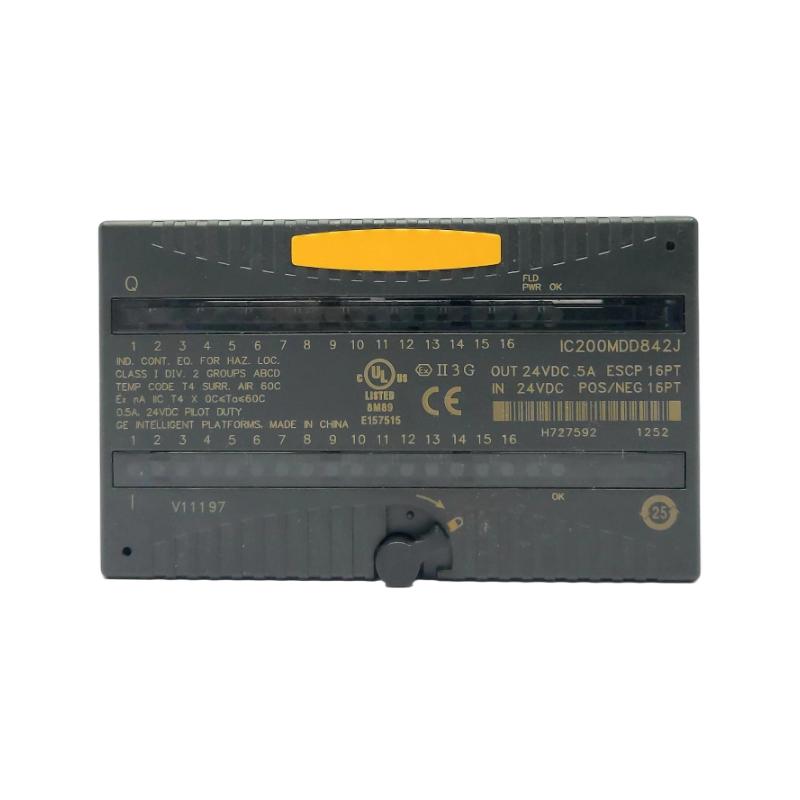
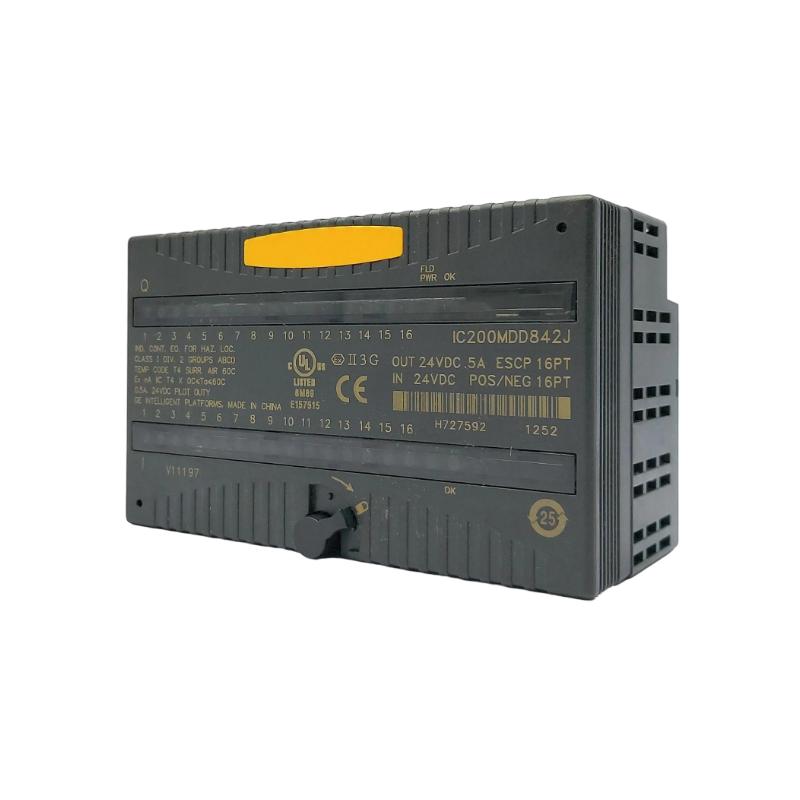
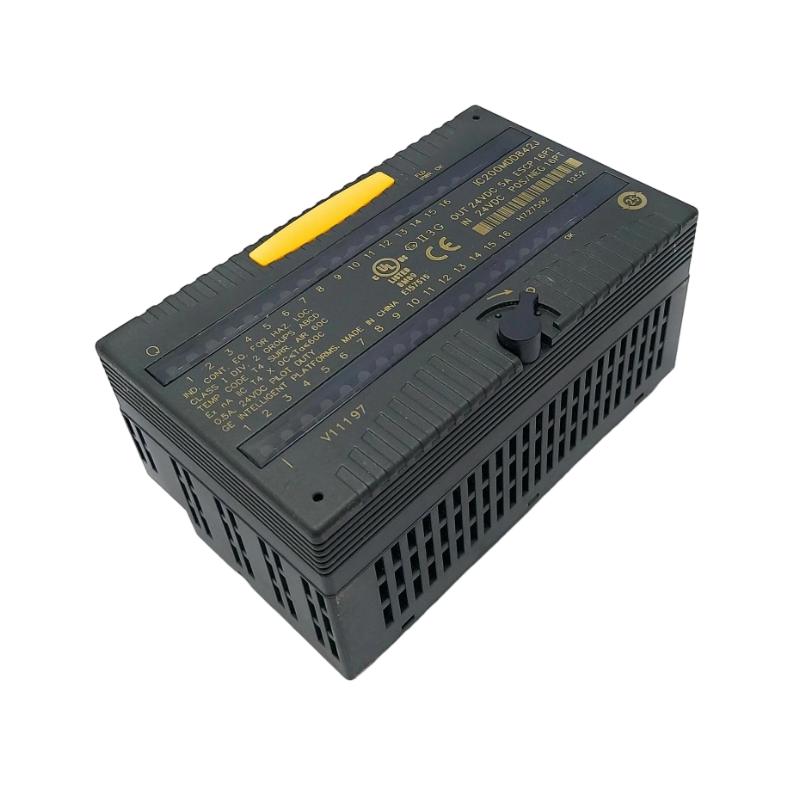
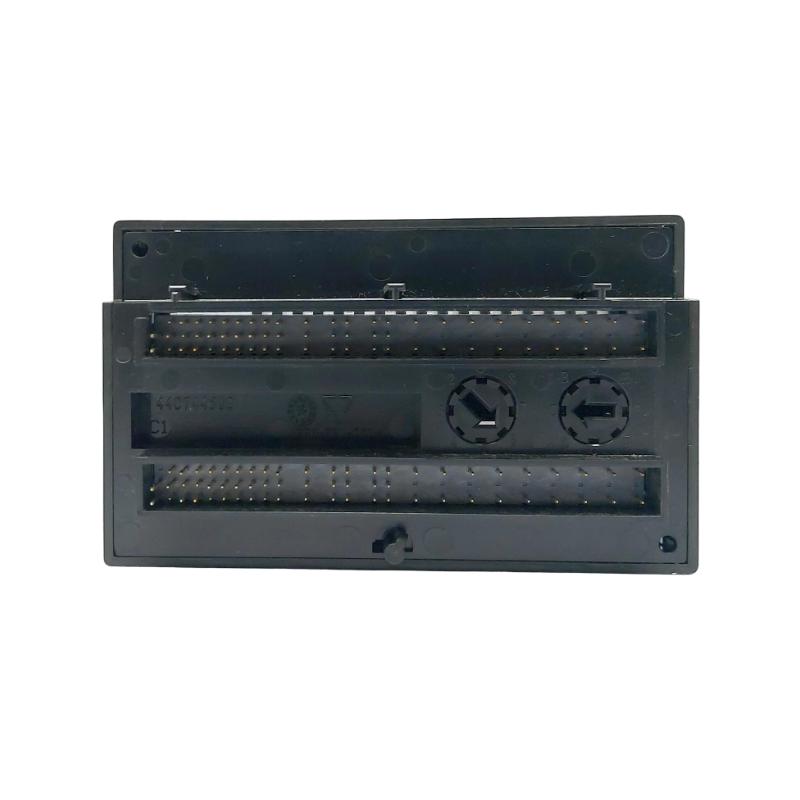
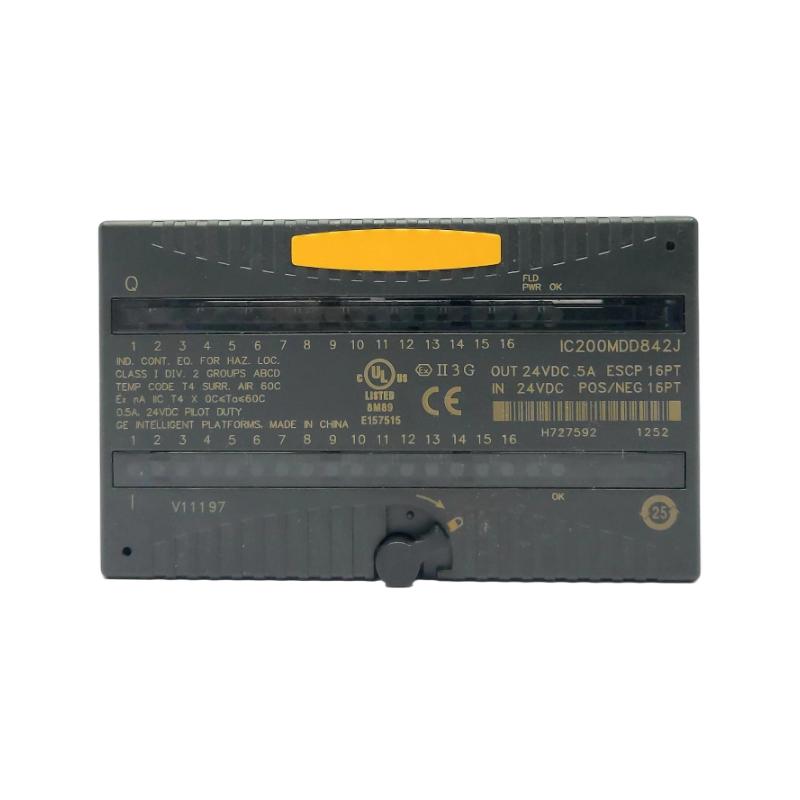
The GE IC200MDD842 VersaMax Discrete Hybrid I/O Module is a modular I/O component designed for GE VersaMax industrial automation systems. As a discrete hybrid I/O module, it is intended to combine discrete signal acquisition and discrete control functions within a compact VersaMax system architecture.
In industrial PLC applications, field devices are commonly divided into two major categories: devices that provide information to the controller and devices that receive commands from the controller. Input devices such as switches, sensors and status contacts provide information, while output devices such as relays, solenoids and indicators respond to PLC commands.
A hybrid I/O module provides an integrated solution for applications requiring both types of discrete signals. Instead of using completely separate hardware for every input and output function, a suitable hybrid configuration can simplify the physical organization of the control system.
The IC200MDD842 is designed as an I/O interface rather than a CPU, power supply or network communication module. The VersaMax controller remains responsible for executing the application program, while the I/O module provides the interface between the controller and compatible field devices.
The specified dimensions of the IC200MDD842 are 133.4 × 85.9 × 69.1 mm, with a weight of approximately 0.14 kg. Its compact form factor makes it suitable for modular industrial control cabinets, machine-control panels and VersaMax-based automation equipment.
Technical Specifications
| Parameter |
Details |
| Manufacturer |
GE / GE Fanuc |
| Product Series |
VersaMax |
| Model |
IC200MDD842 |
| Product Type |
Discrete Hybrid I/O Module |
| I/O Category |
Discrete / Digital |
| Main Function |
Combined discrete input and output interface |
| Application |
Industrial automation and machine control |
| Dimensions |
133.4 × 85.9 × 69.1 mm |
| Weight |
0.14 kg |
| Installation |
VersaMax modular I/O system |
| Input Function |
Discrete field-signal acquisition |
| Output Function |
Discrete field-device control |
| Signal Category |
Two-state digital signals |
| System Architecture |
Modular PLC / I/O system |
| Controller Relationship |
Interfaces field devices with the VersaMax control system |
| Application Type |
Machine and process automation |
| Maintenance |
Modular I/O replacement |
| Environment |
Industrial control cabinet |
| Mounting |
VersaMax system-dependent installation |
Function and Working Principle
The main purpose of the IC200MDD842 is to provide discrete I/O functionality within a VersaMax automation system.
Unlike an analog module, which processes continuously variable signals such as temperature or pressure, discrete I/O deals primarily with defined states.
Typical examples include:
- ON / OFF
- Open / Closed
- Active / Inactive
- Running / Stopped
- Present / Not present
A simplified control architecture is:
Field Sensors / Switches → IC200MDD842 → VersaMax CPU
and:
VersaMax CPU → IC200MDD842 → Field Devices
This allows the module to participate in both monitoring and machine-control functions.
Discrete Input Function
The input portion of a hybrid I/O configuration receives signals from compatible field devices.
Typical input devices include:
- Pushbuttons
- Limit switches
- Proximity sensors
- Machine-status contacts
- Auxiliary contacts
- Presence sensors
- Position switches
- Equipment status signals
When a field device changes state, the corresponding electrical signal is detected by the I/O interface and made available to the control system.
A typical sequence is:
Sensor Detects Condition → IC200MDD842 → PLC Input Status → Control Logic
The PLC application can then determine what action should occur.
Discrete Output Function
The output portion provides discrete control signals to compatible field equipment.
Typical output applications include:
- Relay interfaces
- Solenoid valves
- Indicator devices
- Contactors
- Machine actuators
- Control circuits
The general sequence is:
PLC Application → IC200MDD842 → Output Circuit → Field Device
This enables the control system to perform programmed machine operations.
Role in Industrial Control Systems
The IC200MDD842 acts as a field-level interface between the VersaMax controller and the physical equipment being controlled.
A typical system can be represented as:
Sensors / Switches
↓
IC200MDD842
↓
VersaMax CPU
↓
IC200MDD842
↓
Relays / Solenoids / Actuators
The CPU performs the actual application logic. The hybrid I/O module provides the electrical interface that allows information to move between the PLC program and the machine.
This separation of functions is fundamental to PLC architecture.
The controller determines what should happen, while the I/O hardware provides the connection to the real-world devices.
Industrial Applications
The GE IC200MDD842 can be integrated into a variety of VersaMax-based industrial automation applications.
Typical applications include:
- Factory automation
- Packaging equipment
- Conveyor systems
- Assembly machinery
- Material handling
- Manufacturing lines
- Automated production equipment
- Machine-control panels
- OEM machinery
- Industrial equipment
- Process-support systems
- Equipment status monitoring
- Automated handling systems
- Production machinery
A hybrid I/O configuration can be especially useful in compact machines where both discrete input monitoring and discrete output control are required within the same general control area.
Discrete Input Applications
Discrete inputs allow the PLC to monitor the condition of equipment and machine components.
For example, a packaging machine may use input signals for:
- Product detection
- Door status
- Cylinder position
- Emergency-stop status
- Conveyor position
- Motor auxiliary status
- Limit-switch feedback
The control sequence can be represented as:
Field Condition → Sensor / Switch → IC200MDD842 → PLC Program
The PLC can then use the input status to make decisions within the programmed machine sequence.
For example, when a product reaches a defined position, a sensor can provide an input signal. The controller can then use this information to trigger the next machine operation.
Discrete Output Applications
The output portion of the module can be used to control compatible discrete devices.
Examples include:
- Solenoid valves
- Relay coils
- Indicator lamps
- Control interfaces
- Actuator circuits
- Machine-control devices
A typical sequence is:
PLC Logic → IC200MDD842 Output → Control Circuit → Machine Device
The exact load that can be connected depends on the electrical characteristics of the applicable output circuit and the connected equipment.
For replacement applications, the field-device electrical requirements should always be checked before connecting a replacement module.
Hybrid I/O vs. Standard Digital I/O
The IC200MDD842 belongs to a different application category from a dedicated input-only or output-only module.
| I/O Type |
Main Function |
Typical Application |
| Discrete Input Module |
Receives ON/OFF signals |
Sensors and switches |
| Discrete Output Module |
Sends ON/OFF control signals |
Solenoids and relays |
| Discrete Hybrid I/O Module |
Combines input and output functions |
Mixed machine-control applications |
| Analog Input Module |
Measures variable signals |
Temperature and pressure |
| Analog Output Module |
Generates variable control signals |
Valves and analog devices |
The hybrid approach can simplify system design where the application requires both types of discrete I/O.
Installation and System Integration
Correct installation is important for reliable operation of the IC200MDD842 within a VersaMax control system.
Mechanical Installation
Before installation, verify:
- Correct model number
- Compatible VersaMax system
- Correct module position
- Adequate cabinet space
- Suitable environmental conditions
- Proper mechanical engagement
The specified dimensions are 133.4 × 85.9 × 69.1 mm. Adequate clearance should be provided around the module for installation, wiring and maintenance.
Field Wiring
The input and output circuits should be identified before field wiring begins.
Input wiring may connect to:
- Sensors
- Switches
- Contacts
- Position devices
- Equipment status signals
Output wiring may connect to:
- Relays
- Solenoids
- Indicators
- Actuator interfaces
- Other compatible control devices
Correct terminal identification and secure connections are important for reliable operation.
Electrical Verification
Before energizing the system, verify:
- Correct module installation.
- Correct field wiring.
- Proper terminal connections.
- Appropriate electrical characteristics.
- Correct polarity where applicable.
- No unintended short circuits.
- Correct PLC configuration.
A wiring error can result in incorrect input states or unexpected output behavior.
Commissioning
A practical commissioning procedure includes:
- Install the IC200MDD842.
- Verify the module position.
- Connect the required field devices.
- Inspect the wiring.
- Verify the VersaMax power system.
- Confirm the control configuration.
- Energize the system.
- Test input signals.
- Confirm the input status in the PLC.
- Test output commands.
- Confirm the response of connected devices.
- Perform a controlled machine test.
Compatible System Components
The IC200MDD842 should be considered as part of a complete VersaMax automation system.
| Component |
Function |
| VersaMax CPU Module |
Executes PLC application logic |
| VersaMax Power Module |
Provides system power support |
| IC200MDD842 |
Provides discrete hybrid I/O functionality |
| Digital Input Modules |
Provides additional discrete inputs |
| Digital Output Modules |
Provides additional discrete outputs |
| Analog Input Modules |
Processes analog measurements |
| Analog Output Modules |
Provides analog control signals |
| I/O Carriers |
Provides module mounting/interface |
| Terminal Bases |
Provides field-wiring connections |
| Sensors |
Generates machine-status signals |
| Relays |
Provides switching and isolation interfaces |
| Solenoid Valves |
Performs pneumatic or hydraulic actions |
| Actuators |
Performs machine operations |
The exact system configuration should be selected according to the machine’s I/O requirements.
Application Example: Automated Packaging Machine
A packaging machine provides a good example of how a hybrid I/O module can participate in an industrial control system.
The machine may have several discrete input devices:
- Product sensor
- Door switch
- Cylinder position sensor
- Conveyor limit switch
- Motor status contact
The PLC receives these signals through the appropriate I/O architecture.
At the same time, the control system may need to operate:
- Solenoid valves
- Indicator devices
- Relay interfaces
- Machine actuators
The overall sequence can be represented as:
Sensors → IC200MDD842 → VersaMax CPU → IC200MDD842 → Actuators
The PLC application uses the input conditions to determine when and how the outputs should operate.
This type of arrangement is common in automated production equipment where discrete machine conditions and discrete control commands are continuously exchanged.
Discrete I/O Troubleshooting
When the IC200MDD842 does not operate as expected, troubleshooting should begin with the complete signal path rather than immediately replacing the module.
A useful diagnostic sequence is:
Power → Field Device → Wiring → I/O Module → PLC Configuration → Application Logic
Input Troubleshooting
If an expected input remains inactive:
- Check the field sensor or switch.
- Verify the field-device power.
- Inspect the wiring.
- Check the terminal connection.
- Verify the electrical signal.
- Check the module status.
- Verify the PLC input configuration.
If only one input is affected, the field device or its wiring should be investigated first.
If multiple inputs are affected simultaneously, common power, wiring or module-level problems should also be considered.
Output Troubleshooting
If a PLC output command is generated but the field device does not respond:
- Verify the PLC command.
- Check the output status.
- Inspect the field wiring.
- Verify the connected load.
- Check the control circuit.
- Verify electrical compatibility.
- Inspect the field device.
A module replacement should normally be considered only after the external wiring and connected equipment have been checked.
Common Fault Conditions
| Symptom |
Possible Area to Check |
| Input remains OFF |
Sensor, wiring, power or configuration |
| Input remains ON |
Field device, wiring or input circuit |
| Multiple inputs unavailable |
Power, common wiring or module |
| Output does not activate |
PLC logic, configuration, wiring or load |
| Output command is present but device does not respond |
Field circuit or connected device |
| Unexpected output operation |
PLC logic, wiring or configuration |
| Intermittent I/O behavior |
Loose connection, electrical noise or field-device problem |
| Entire module unavailable |
System power, installation or module-level fault |
A systematic diagnostic process helps separate PLC-program problems from hardware and field-wiring problems.
Recommended Alternative Models
Depending on the required system function, the following VersaMax components may be considered.
| Recommended Model |
Type |
Key Feature |
Application |
| IC200MDD840 |
Discrete Hybrid I/O Module |
Combined discrete I/O |
Mixed machine-control applications |
| IC200MDD841 |
High-Speed Counter Module |
High-speed pulse processing |
Encoder and counting applications |
| IC200MDL650 |
Discrete Input Module |
Discrete signal acquisition |
Sensor and switch monitoring |
| IC200MDL750 |
Discrete Output Module |
Discrete output control |
Actuator and relay control |
| IC200CPU001 |
VersaMax CPU Module |
PLC processing |
Central machine control |
| IC200CPU002 |
VersaMax CPU Module |
PLC control processing |
Automation systems |
| IC200CPWR102 |
Power Module |
System power support |
VersaMax control systems |
| IC200ERM001 |
Extended Receiver Module |
Extended I/O architecture |
Distributed I/O |
| IC200ERM002 |
Extended Receiver Module |
Extended I/O expansion |
Expanded VersaMax systems |
These models have different functions and should not automatically be treated as direct replacements. Selection should be based on the required I/O type, electrical characteristics, system configuration and application requirements.
Key Advantages
- Designed for GE VersaMax automation systems
- Provides discrete hybrid I/O functionality
- Combines input and output functions within a modular architecture
- Suitable for machine-control applications
- Supports monitoring of discrete field conditions
- Supports control of compatible discrete devices
- Suitable for packaging machinery
- Useful for conveyor and material-handling systems
- Suitable for assembly equipment
- Supports OEM machine automation
- Compact industrial form factor
- Suitable for modular control cabinets
- Dimensions of approximately 133.4 × 85.9 × 69.1 mm
- Weight of approximately 0.14 kg
Technical FAQs
What is GE IC200MDD842?
The GE IC200MDD842 is a VersaMax Discrete Hybrid I/O Module designed to provide discrete input and output functionality within a GE VersaMax automation system.
What is the main function of IC200MDD842?
Its primary function is to provide an interface between the VersaMax control system and compatible discrete field devices.
What are the dimensions of IC200MDD842?
The specified dimensions are 133.4 × 85.9 × 69.1 mm.
What is the weight of IC200MDD842?
The specified weight is approximately 0.14 kg.
Is IC200MDD842 a CPU module?
No. The IC200MDD842 is an I/O module. The VersaMax CPU is responsible for executing the PLC application program.
What does “hybrid I/O” mean?
Hybrid I/O refers to an I/O configuration that combines discrete input and output functionality within the same module.
What type of signals does IC200MDD842 handle?
It is designed for discrete or digital signal applications involving defined states such as ON/OFF or active/inactive.
Where can IC200MDD842 be used?
Typical applications include factory automation, packaging equipment, conveyors, assembly machines, material-handling systems and other VersaMax-based industrial machinery.
What should be checked if an input does not work?
Check the field device, power supply, wiring, terminal connection, I/O module and PLC configuration.
What should be checked if an output does not operate?
Check the PLC command, output status, field wiring, connected load and electrical compatibility of the output circuit.
Can IC200MDD842 replace any VersaMax digital I/O module?
Not automatically. Because it is a hybrid I/O module, the replacement must match the required input/output configuration and system requirements.
Is IC200MDD842 suitable for high-speed pulse applications?
Applications requiring dedicated high-speed pulse counting should use an appropriate high-speed counter module such as a compatible VersaMax high-speed counting solution rather than assuming that a standard hybrid I/O module provides the same function.
Conclusion
The GE IC200MDD842 VersaMax Discrete Hybrid I/O Module is a compact industrial I/O component designed to provide discrete signal interfacing within GE VersaMax automation systems. By combining discrete input and output functionality, it can support machine architectures where the controller needs to monitor field conditions while also controlling compatible discrete devices.
With specified dimensions of 133.4 × 85.9 × 69.1 mm and a weight of approximately 0.14 kg, the IC200MDD842 is suitable for modular control cabinets and industrial machine-control applications where space and I/O organization are important considerations.
The module can participate in control sequences involving sensors, switches, relays, solenoids, indicators and other discrete field devices. Its role is complementary to the VersaMax CPU, power modules, I/O carriers, terminal interfaces and other system components.
For replacement and integration projects, engineers should verify the complete I/O architecture, field-device requirements, wiring configuration and PLC application before installation. When the application requires a compact discrete hybrid I/O solution within a VersaMax automation system, the GE IC200MDD842 provides a practical interface between PLC logic and industrial field equipment.