

ProductPRODUCT
Featured products
Contact Us
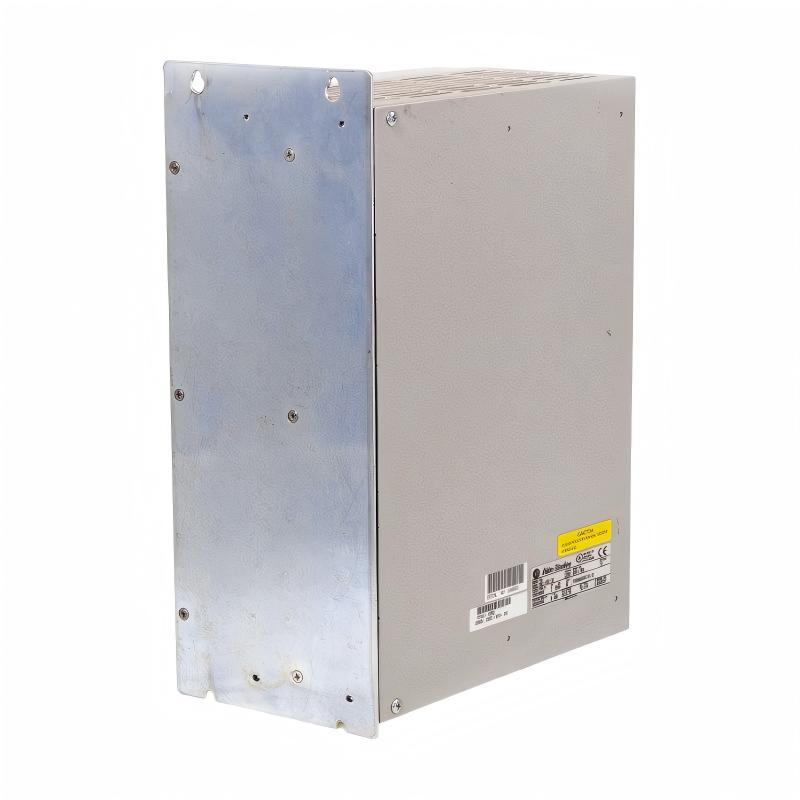
- Allen Bradley
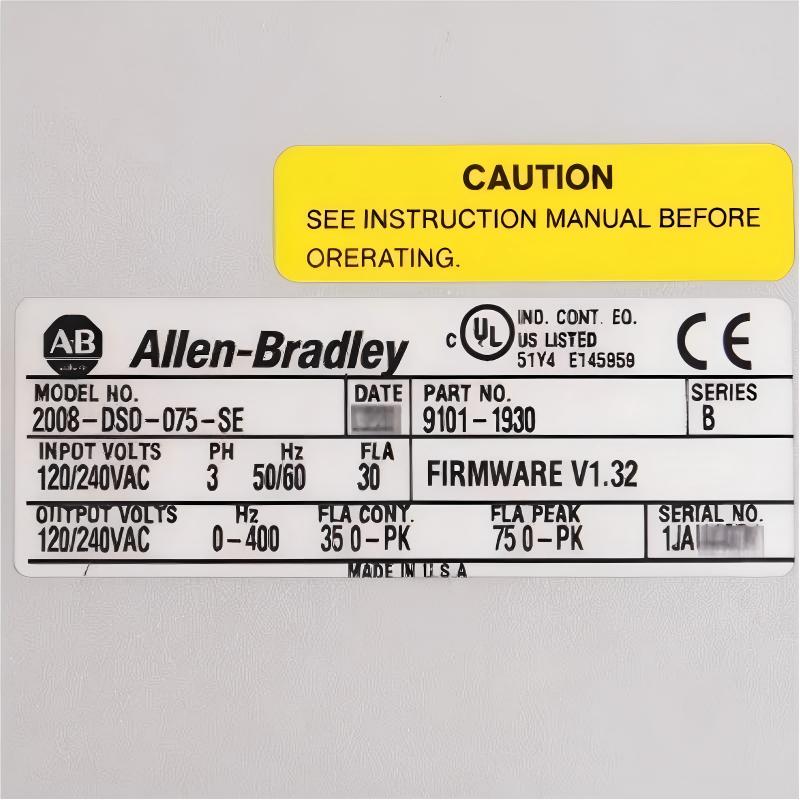
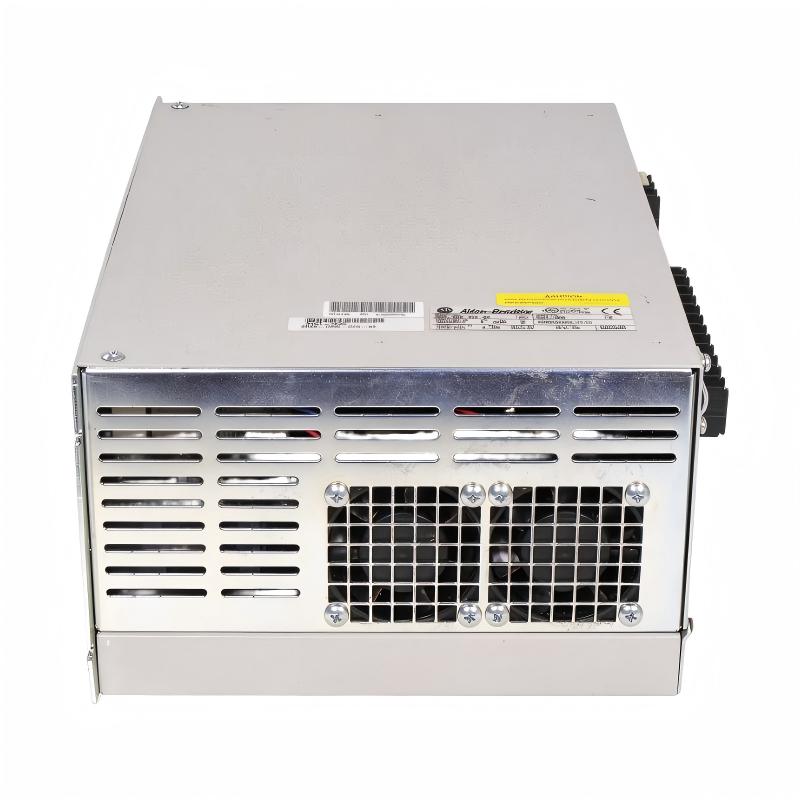
- 2098-DSD-075-SE
- High-performance Digital Servo Drive
- USA
- 349.25 × 138.68 × 247.14 mm
- 4.5kg
- Xiamen, China
- New & In Stock
- T/T, PayPal, Western Union
- 1 Year
- 1-3 Working Days
- DHL, UPS, TNT, FedEx and EMS.
- 24-Hour Service
- COO
- 3
Our advantage

Global Logistics
We have a 10-year logistics and express cooperation agreement, so our products can be shipped to any place in the world.

Brand new and original
Our products are imported in bulk from the place of origin. Because of the cooperative relationship, our products are all original and 100% new.

24-hour service
We provide 7*24 hours service to our customers. We will be there whenever you need us.

Price advantage
All our products are priced very favorably because we have our own warehouse and supply.
| Company Information | |||
| [email protected] | |||
| Mobile | +8615980777398 | ||
| +8615980777398 | |||
| 15980777398 |
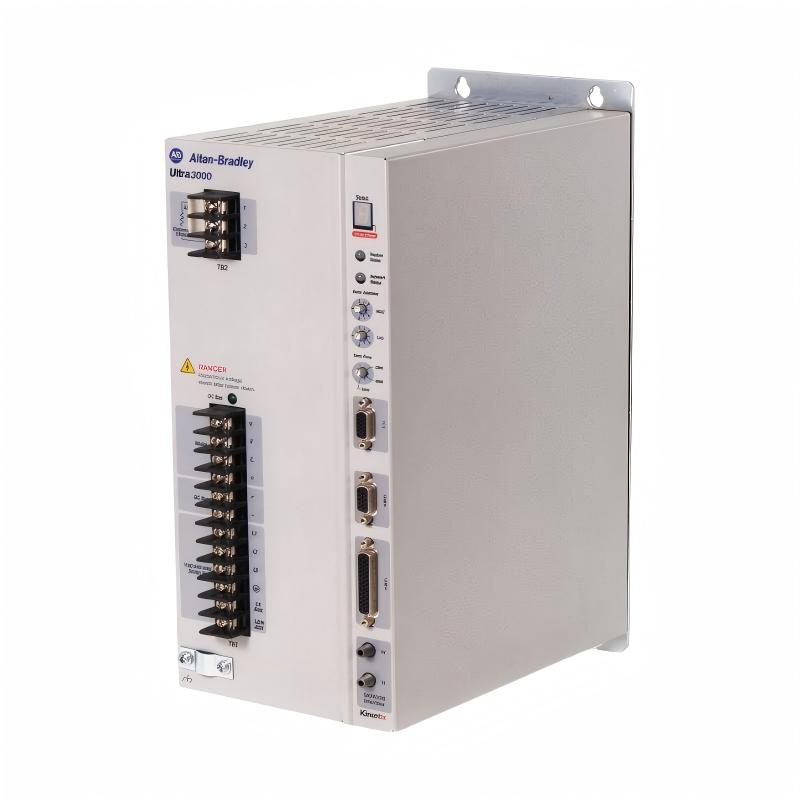
Allen-Bradley 2098-DSD-075-SE Servo Drive: Product Overview, Technical Specifications, Applications, Advantages, and Model Recommendations
1. Product Overview
The Allen-Bradley 2098-DSD-075-SE is an industrial servo drive designed for precision motion control in automated machinery. It belongs to the Ultra 3000 series, a family of servo drives developed for applications that require accurate motor positioning, controlled acceleration and deceleration, repeatable movement, and coordinated machine operation.
Servo drives are essential components in modern industrial automation systems. Unlike conventional motor control devices that primarily regulate motor starting and stopping, a servo drive works with feedback from a compatible motor to control motion more precisely. Depending on the system configuration, it can regulate position, velocity, and torque to support demanding production processes.
The 2098-DSD-075-SE is associated with the 7.5 A output-current class of the Ultra 3000 family. Its suitability for a particular machine depends on the motor specifications, power supply, feedback configuration, control interface, mechanical load, and required motion profile.
This model is particularly relevant to industrial equipment where repeatable movement and accurate motion sequencing are important. Typical examples include packaging machinery, material handling systems, assembly equipment, automated positioning mechanisms, and other machinery that relies on controlled servo motion.
When evaluating this model for a new installation or replacement project, the exact electrical ratings, supported feedback devices, connector configuration, firmware compatibility, and dimensional requirements should be confirmed against the nameplate and the documentation for the specific hardware revision.
2. Product Identification and Basic Information
| Item | Product information |
|---|---|
| Brand | Allen-Bradley |
| Model number | 2098-DSD-075-SE |
| Product category | Industrial servo drive |
| Product series | Ultra 3000 |
| Main function | Precision servo motor control |
| Rated output-current class | 7.5 A class; verify the exact rating and rating conditions for the unit |
| Control objectives | Position, velocity, and torque control, subject to configuration |
| Installation type | Industrial electrical control cabinet |
| Typical system components | Servo drive, compatible servo motor, feedback device, controller, power supply, protective devices, and wiring |
| Typical operating environment | Industrial automation and machine-control environments |
| Primary purpose | Accurate, repeatable, electronically controlled mechanical motion |
| Product selection considerations | Motor compatibility, supply voltage, peak current, feedback, control interface, load inertia, and machine duty cycle |
| Dimensions | Exact dimensions require confirmation for the specific hardware revision |
| Weight (kg) | Exact net weight requires confirmation from the unit’s product documentation or physical measurement |
The model number identifies a particular product configuration within the broader servo-drive family. Similar-looking model numbers should not automatically be considered interchangeable because differences in current rating, supply requirements, feedback support, or interface configuration may affect compatibility.
For industrial purchasing and maintenance, it is good practice to record the complete catalog number, serial number, hardware revision, and any applicable option codes before ordering a replacement.
3. Detailed Technical Specifications
The following table summarizes the principal technical and installation characteristics of the 2098-DSD-075-SE. Where a value depends on the hardware revision or cannot be confirmed reliably, it is identified accordingly rather than presented as an exact factory rating.
| Parameter | Specification |
|---|---|
| Model | 2098-DSD-075-SE |
| Brand | Allen-Bradley |
| Series | Ultra 3000 |
| Product type | Digital servo drive |
| Nominal power class | 7.5 kW class |
| Continuous output current | Confirm against the exact SE model nameplate and rating table |
| Peak output current | Confirm against the exact model rating table |
| Input supply | AC supply; confirm the applicable voltage and phase configuration |
| Control interface | SERCOS interface, indicated by the -SE suffix |
| Control functions | Servo position, velocity, and torque regulation, according to system configuration |
| Motor compatibility | Compatible servo motors within the drive’s electrical and feedback limits |
| Feedback | Must match the supported motor feedback type |
| Position reference | Determined by the controller, communication configuration, and system setup |
| Mounting | Panel mounting inside an appropriately designed industrial control cabinet |
| Cooling | Cabinet ventilation and installation clearances must meet the applicable requirements |
| Protection | Requires suitable branch-circuit protection, grounding, and installation measures |
| Operating environment | Industrial environment within the specified temperature, humidity, and contamination limits |
| Overall height | Approximately 349.25 mm for the applicable 230 V Ultra 3000 frame drawing |
| Overall width | Approximately 138.68 mm for the 075 frame |
| Frame dimension B | 88.90 mm |
| Frame dimension C | 24.89 mm |
| Dimension J | 247.14 mm |
| Approximate envelope reference | About 349.25 × 138.68 × 247.14 mm (H × W × D reference; confirm the drawing’s mounting and connector-clearance dimensions) |
| Weight (kg) | Not reliably confirmed; use the exact model’s shipping or net-weight record |
| Product status | Legacy/discontinued product; verify current serviceability and replacement availability |
| Typical installation | OEM machinery, industrial automation panels, and servo-controlled equipment |
Important dimensional note: The manufacturer’s mechanical drawing uses several separate dimension references, including mounting dimensions and connector clearances. The values above are not a substitute for the complete mechanical drawing. Allow sufficient room for connectors, cables, ventilation, electrical isolation, and maintenance access.
The weight is intentionally left unconfirmed. A drive’s shipping weight may include packaging and accessories, so it should not be confused with the net weight of the installed unit.
3.1 Electrical Performance
The 2098-DSD-075-SE is intended for servo applications requiring coordinated electrical power conversion and motor control. The drive receives electrical energy from the designated supply and converts it into controlled output for the connected servo motor.
Its actual operating capability depends on more than the nominal power class. Continuous torque, acceleration, peak current, and permissible duty cycle are affected by motor characteristics, operating speed, ambient temperature, regenerative energy, and the drive’s thermal conditions.
Before installation, the following information should be checked:
-
The drive’s exact input voltage and phase requirements.
-
The motor’s rated current and peak current requirements.
-
Continuous and intermittent torque requirements.
-
Feedback-device type and electrical compatibility.
-
Regenerative braking requirements during deceleration.
-
Required circuit protection and grounding arrangements.
-
Compatibility with the motion controller and communication network.
A drive with a nominally suitable power rating can still be unsuitable if its peak-current capability, feedback interface, or communication protocol does not match the intended machine.
3.2 Communication and Motion Control
The -SE designation identifies the SERCOS-interface version of the Ultra 3000 drive family. SERCOS is an industrial communication interface used in coordinated motion-control systems.
In a compatible system, the controller can coordinate the servo drive with other motion axes and synchronize commands according to the machine’s operating sequence. This is especially useful when several mechanical movements must occur at precise times or maintain a defined relationship with one another.
The specific communication hardware, controller support, configuration software, and firmware compatibility must be checked before integrating the drive into an existing control system.
3.3 Dimensions and Weight Considerations
Physical dimensions are important when replacing a servo drive inside an existing electrical cabinet. A replacement that has the correct power rating may still require different mounting holes, connector space, cable routing, or ventilation arrangements.
For the 2098-DSD-075-SE, cabinet planning should account for the frame dimensions, mounting orientation, cable bend radius, and space required to access terminals and connectors.
Weight should also be considered when designing mounting plates and determining the mechanical support required for transportation or installation. Because the exact net weight has not been confirmed here, it should be recorded from the physical unit or its product-specific technical record before finalizing a mechanical design.
4. Product Description and Operating Principle
The 2098-DSD-075-SE is a digital servo drive that acts as the electrical control stage between a motion controller and a servo motor.
A typical servo system contains a controller, a servo drive, a servo motor, a feedback device, and the mechanical load. Each component has a distinct function, and reliable operation depends on the correct coordination of all five elements.
The controller determines the required movement. The drive processes the motion commands and regulates the motor’s electrical output. The motor converts electrical energy into mechanical movement, while the feedback device provides information used to monitor and correct the motor’s behavior.
For example, in an automated packaging machine, a controller may command a mechanism to move a product by a specified distance. The drive operates the servo motor according to the configured motion profile, and the feedback system helps the control system achieve the required position and speed.
This closed-loop approach allows servo systems to deliver repeatable movement and controlled acceleration, provided that the motor, feedback system, controller, and mechanical assembly are correctly configured.
The drive should not be treated as a standalone motor that can operate independently of its intended system. Its suitability depends on the complete electrical and mechanical application.
5. Main Applications

5.1 Packaging and Filling Machinery
Servo drives can control indexing conveyors, product positioning mechanisms, cutting assemblies, and synchronized packaging movements. Accurate motion helps reduce positioning errors and maintain consistent production cycles.
Typical uses include film feeding, sealing mechanisms, carton positioning, and coordinated material transfer.

5.2 Automated Assembly Equipment
In assembly machinery, servo motion can provide controlled movement for pressing, inserting, transferring, and positioning components.
Repeatable motion is valuable when a process requires a specific travel distance, a controlled approach speed, or a defined sequence of movements.

5.3 Machine Tools and Positioning Systems
Servo drives are used in suitable machine-tool and positioning applications where the movement of an axis must follow a programmed position or velocity profile.
The final application must be evaluated against the drive’s supported feedback, controller interface, current rating, and mechanical requirements.

5.4 Material Handling Systems
In automated transfer equipment, servo motion can control indexing tables, positioning carriages, transfer mechanisms, and other moving assemblies.
The main benefits are controlled acceleration, repeatable positioning, and the ability to coordinate movement with sensors and other machine functions.

5.5 Printing and Converting Equipment
Suitable printing and converting machinery may use servo drives for feed rollers, indexing sections, cutting mechanisms, and synchronized material movement.
Application suitability depends on the required speed range, tension-control strategy, motor selection, and synchronization architecture.
6. Main Advantages
6.1 Precise Motion Control
A servo system can regulate motor movement using feedback and configured control loops. This is useful when machinery requires accurate positioning or consistent movement from one production cycle to the next.
The achievable accuracy is determined by the complete system, including the feedback device, mechanical transmission, controller, tuning, and load characteristics.
6.2 Repeatable Machine Operation
Once the motion system has been properly configured and tuned, the same motion profile can be executed repeatedly. This supports consistent production sequences and helps reduce variations caused by uncontrolled motor movement.
6.3 Coordinated Multi-Axis Movement
The SERCOS interface makes the SE version relevant to compatible coordinated-motion architectures. In applications with multiple axes, the control system can synchronize movement and manage relationships between different machine mechanisms.
This is useful when the timing of one axis must remain coordinated with another axis or with the production cycle.
6.4 Flexible Motion Profiles
Depending on the controller and system configuration, servo applications can use programmed acceleration, deceleration, velocity, and positioning commands.
This flexibility can help equipment designers optimize cycle times, reduce mechanical shock, and adapt motion sequences to different operating requirements.
6.5 Integration into Existing Industrial Equipment
The model may be useful when maintaining machinery originally designed around the Ultra 3000 family. Retaining a compatible drive can reduce the extent of changes required to the existing controller, motor, wiring, and machine software.
However, replacement with an identical catalog number is generally more straightforward than substituting a drive from a newer product family.
6.6 Support for Demanding Production Cycles
When correctly selected and thermally managed, a servo drive can support repeated starts, stops, acceleration, and deceleration within its rated operating limits.
The actual permissible duty cycle must be calculated using the motor and drive ratings rather than assumed from the product’s nominal power class alone.
6.7 Better Control of Machine Dynamics
Servo control can improve the management of motion transitions. Appropriate tuning and motion-profile design can reduce overshoot, excessive vibration, and unnecessary mechanical stress.
These benefits depend on the mechanical system and the quality of commissioning; they are not automatic results of installing a servo drive.
7. Installation, Maintenance, and Replacement Considerations
The 2098-DSD-075-SE is a legacy product, so maintenance planning should include the condition of the existing hardware and the availability of compatible spare parts.
A practical inspection should cover the following areas:
1. Nameplate verification: Confirm the complete catalog number, hardware revision, and serial number.
2. Electrical compatibility: Verify the supply, protective devices, grounding, motor ratings, and wiring.
3. Feedback compatibility: Confirm that the installed motor and feedback device are supported by the selected drive configuration.
4. Communication compatibility: Check the SERCOS interface and the compatibility of the motion controller, configuration software, and firmware.
5. Mechanical installation: Confirm mounting-hole positions, cabinet dimensions, cooling clearances, and connector access.
6. Condition assessment: Inspect for visible damage, contamination, overheating, loose connections, and signs of deterioration.
7. Commissioning: Test the drive under controlled conditions and verify motor direction, feedback operation, motion limits, braking behavior, and fault responses.
Electrical work must be performed by qualified personnel using the applicable isolation and stored-energy discharge procedures. Servo-drive DC buses can retain hazardous energy after the supply is disconnected.
8. Five Recommended Models from the Same Series or Related Models
The following five models are useful starting points when comparing the 2098-DSD-075-SE with other Ultra 3000 servo drives. The smaller models may suit lower-power axes, while the larger models may be relevant to applications with greater power requirements.
The catalog numbers alone do not establish interchangeability. In particular, the -SE, standard, -DN, and indexing variants may have different communication or control functions.
| Model | Series / type | Power class | Interface / configuration | Dimensions (H × W × D) | Weight (kg) |
|---|---|---|---|---|---|
| 2098-DSD-005-SE | Ultra 3000 servo drive | 500 W class | SERCOS | Confirm exact drawing | Not verified |
| 2098-DSD-010-SE | Ultra 3000 servo drive | 1 kW class | SERCOS | Confirm exact drawing | Not verified |
| 2098-DSD-020-SE | Ultra 3000 servo drive | 2 kW class | SERCOS | Confirm exact drawing | Not verified |
| 2098-DSD-030-SE | Ultra 3000 servo drive | 3 kW class | SERCOS | Approx. 349.25 × 91.44 × 243.84 mm, subject to drawing interpretation | Not verified |
| 2098-DSD-150-SE | Ultra 3000 servo drive | 15 kW class | SERCOS | Approx. 349.25 × 188.97 × 241.05 mm, subject to drawing interpretation | Not verified |
Dimensions for the 005, 010, and 020 models should be taken from their specific mechanical drawings. For the 030 and 150 models, the listed values use the relevant family drawing references and are intended for preliminary comparison, not final cabinet design.
8.1 Recommended Model: 2098-DSD-005-SE
The 2098-DSD-005-SE is a lower-power option for applications that require servo control but do not need the power capacity of the 075 model.
It may be worth considering for smaller positioning axes, lightweight indexing mechanisms, and compact automated equipment. The motor and mechanical load must still be checked to confirm that the drive can provide the necessary torque and acceleration.
| Parameter | Specification |
|---|---|
| Model | 2098-DSD-005-SE |
| Brand | Allen-Bradley |
| Series | Ultra 3000 |
| Nominal power class | 500 W |
| Interface | SERCOS |
| Product category | Digital servo drive |
| Typical application | Small servo axes and positioning mechanisms |
| Motor compatibility | Must be confirmed for the specific motor and feedback type |
| Dimensions | Exact model drawing required |
| Weight (kg) | Not verified |
8.2 Recommended Model: 2098-DSD-010-SE
The 2098-DSD-010-SE provides a higher nominal power class than the 005-SE while remaining within the smaller-drive portion of the Ultra 3000 family.
It may be appropriate for compact machinery with moderate motion demands, depending on the required speed, acceleration, and motor torque.
| Parameter | Specification |
|---|---|
| Model | 2098-DSD-010-SE |
| Brand | Allen-Bradley |
| Series | Ultra 3000 |
| Nominal power class | 1 kW |
| Interface | SERCOS |
| Product category | Digital servo drive |
| Typical application | Automated positioning and indexing |
| Motor compatibility | Confirm against the complete motor and drive ratings |
| Dimensions | Exact model drawing required |
| Weight (kg) | Not verified |
8.3 Recommended Model: 2098-DSD-020-SE
The 2098-DSD-020-SE is another option for applications that need a higher power class than the 010-SE.
Potential uses include positioning tables, automated assembly mechanisms, and machinery with moderate dynamic loads. It should be evaluated against the actual motion profile rather than selected solely on the basis of nominal power.
| Parameter | Specification |
|---|---|
| Model | 2098-DSD-020-SE |
| Brand | Allen-Bradley |
| Series | Ultra 3000 |
| Nominal power class | 2 kW |
| Interface | SERCOS |
| Product category | Digital servo drive |
| Typical application | Assembly equipment and medium-duty positioning |
| Motor compatibility | Confirm motor current, feedback, and voltage requirements |
| Dimensions | Exact model drawing required |
| Weight (kg) | Not verified |
8.4 Recommended Model: 2098-DSD-030-SE
The 2098-DSD-030-SE is a higher-power member of the same series. It can be considered for machinery with greater torque or acceleration requirements, provided that the complete servo system is correctly sized.
For an existing installation, confirm that the proposed model matches the original system’s communication interface and that its electrical ratings are appropriate.
| Parameter | Specification |
|---|---|
| Model | 2098-DSD-030-SE |
| Brand | Allen-Bradley |
| Series | Ultra 3000 |
| Nominal power class | 3 kW |
| Interface | SERCOS |
| Product category | Digital servo drive |
| Typical application | Higher-load positioning and automated machinery |
| Frame dimension A | 91.44 mm |
| Frame dimension B | 50.80 mm |
| Frame dimension C | 20.32 mm |
| Dimension J | 243.84 mm |
| Weight (kg) | Not verified |
8.5 Recommended Model: 2098-DSD-150-SE
The 2098-DSD-150-SE belongs to the higher-power end of the Ultra 3000 family and is worth evaluating for machinery that requires substantially greater servo power.
It is not a direct substitute for the 075-SE simply because both models belong to the same family. Motor sizing, supply requirements, current limits, braking arrangements, and cabinet capacity must all be reassessed.
| Parameter | Specification |
|---|---|
| Model | 2098-DSD-150-SE |
| Brand | Allen-Bradley |
| Series | Ultra 3000 |
| Nominal power class | 15 kW |
| Interface | SERCOS |
| Product category | Digital servo drive |
| Typical application | High-power servo motion applications |
| Frame dimension A | 188.97 mm |
| Frame dimension B | 139.70 mm |
| Frame dimension C | 24.60 mm |
| Dimension J | 241.05 mm |
| Weight (kg) | Not verified |
8.6 How to Choose Among These Five Models
| Selection factor | Smaller models: 005 / 010 / 020 | 030 model | 150 model |
|---|---|---|---|
| Nominal power class | Lower | Medium | Higher |
| Typical design focus | Compact mechanisms | Higher-load machinery | High-power applications |
| Cabinet requirements | Confirm specific frame and clearances | Confirm frame and cooling | Reassess cabinet capacity and clearances |
| Motor matching | Required | Required | Required |
| Feedback compatibility | Required | Required | Required |
| Communication compatibility | Confirm SERCOS configuration | Confirm SERCOS configuration | Confirm SERCOS configuration |
| Direct replacement for 075-SE | Not assumed | Not assumed | Not assumed |
The most appropriate model is the one that matches the required continuous and peak torque, motor speed, feedback system, communication interface, and physical installation. A higher nominal power rating does not automatically make a drive a better replacement.
9. Five Popular or Relevant Models from the Same Brand
For a broader comparison, the following models cover modern servo drives, legacy servo products, and programmable automation equipment from the Allen-Bradley range.
These models do not all belong to the Ultra 3000 series. They are included because they may be relevant to different replacement, upgrade, or machine-control projects.
The dimensions and weights of these additional models are not supplied as exact figures where a model-specific mechanical specification has not been established. This avoids confusing estimates with verified installation data.
| Model | Product family | Product type | Principal function | Power / rating information | Dimensions (mm) | Weight (kg) |
|---|---|---|---|---|---|---|
| 2198-E2075-ERS | Kinetix 5500 | Servo drive | Modern servo motion control | Verify exact electrical and motor ratings | Confirm exact drawing | Not verified |
| 2198-E1007-ERS | Kinetix 5500 | Servo drive | Servo-axis control | Verify exact electrical and motor ratings | Confirm exact drawing | Not verified |
| 2198-D006-ERS3 | Kinetix 5700 | Servo drive | Multi-axis servo system component | Verify exact electrical and motor ratings | Confirm exact drawing | Not verified |
| 25B-D024N114 | PowerFlex 525 | AC variable-frequency drive | General-purpose motor speed control | 24 A-class catalog designation; verify voltage and duty ratings | Confirm exact frame drawing | Not verified |
| 1769-L33ER | CompactLogix 5370 | Programmable automation controller | Logic, communications, and machine control | Controller; not rated as a servo motor power drive | Confirm exact mechanical drawing | Not verified |
Important distinction: A programmable controller such as the 1769-L33ER is not a servo drive, and a PowerFlex variable-frequency drive is not automatically interchangeable with a servo drive. These products address different parts of an automation system.
9.1 2198-E2075-ERS — Kinetix 5500 Servo Drive
The 2198-E2075-ERS is a relevant modern servo-drive model to investigate when planning a migration from an older Ultra 3000 system.
Its suitability depends on the motor and feedback technology, the controller architecture, the network, the electrical supply, and the machine’s performance requirements.
| Parameter | Specification |
|---|---|
| Model | 2198-E2075-ERS |
| Brand | Allen-Bradley |
| Series | Kinetix 5500 |
| Product type | Servo drive |
| Primary function | Servo motion control |
| Communication | EtherNet/IP-based architecture; verify system configuration |
| Motor compatibility | Must be verified for the intended drive and motor |
| Replacement suitability | Requires a system-level migration assessment |
| Dimensions (mm) | Exact model drawing required |
| Weight (kg) | Not verified |
This model is worth evaluating when the objective is to modernize an older servo system rather than merely replace a failed drive with another legacy unit.
9.2 2198-E1007-ERS — Kinetix 5500 Servo Drive
The 2198-E1007-ERS is another Kinetix 5500 family model that may be relevant to modern machine-control projects.
The exact rating, supply configuration, supported motor combinations, and physical envelope must be confirmed before comparing it with the 2098-DSD-075-SE.
| Parameter | Specification |
|---|---|
| Model | 2198-E1007-ERS |
| Brand | Allen-Bradley |
| Series | Kinetix 5500 |
| Product type | Servo drive |
| Primary function | Controlled servo motor operation |
| Communication | EtherNet/IP-based architecture; verify configuration |
| Power rating | Confirm model-specific rating |
| Feedback compatibility | Verify the intended motor and feedback combination |
| Dimensions (mm) | Exact model drawing required |
| Weight (kg) | Not verified |
This model is more relevant to a redesign or modernization project than to a simple drive-for-drive exchange. Controller compatibility and machine software changes should be considered early in the project.
9.3 2198-D006-ERS3 — Kinetix 5700 Servo Drive
The 2198-D006-ERS3 belongs to the Kinetix 5700 product family, which is intended for industrial motion-control architectures.
It can be considered when evaluating a more modern motion platform, particularly where the project involves coordinated axes or a wider automation-system upgrade.
| Parameter | Specification |
|---|---|
| Model | 2198-D006-ERS3 |
| Brand | Allen-Bradley |
| Series | Kinetix 5700 |
| Product type | Servo drive |
| Primary function | Servo-axis motion control |
| System architecture | Modern coordinated motion-control system |
| Motor compatibility | Verify the complete drive and motor combination |
| Electrical rating | Confirm the exact model rating table |
| Dimensions (mm) | Exact model drawing required |
| Weight (kg) | Not verified |
This model should be evaluated in the context of the complete drive system, rather than as a standalone component. The control platform, power architecture, feedback arrangement, and commissioning requirements may differ considerably from those of the Ultra 3000.
9.4 25B-D024N114 — PowerFlex 525 Variable-Frequency Drive
The 25B-D024N114 is a PowerFlex 525 variable-frequency drive model. It is relevant when the application requires conventional AC motor speed control rather than the precision servo positioning of the 2098-DSD-075-SE.
A variable-frequency drive adjusts the frequency and voltage supplied to a compatible AC motor. It is often suitable for pumps, fans, conveyors, and other equipment where speed regulation is required without the full capabilities of a servo positioning system.
| Parameter | Specification |
|---|---|
| Model | 25B-D024N114 |
| Brand | Allen-Bradley |
| Series | PowerFlex 525 |
| Product type | AC variable-frequency drive |
| Nominal current class | 24 A class; confirm the exact rating conditions |
| Primary function | AC motor speed and operation control |
| Typical application | Conveyors, pumps, fans, and general machinery |
| Servo positioning | Not a direct substitute for a servo drive |
| Dimensions (mm) | Confirm exact frame and voltage-specific drawing |
| Weight (kg) | Not verified |
This model is most appropriate when the mechanical process needs variable-speed operation rather than precise closed-loop positioning. The motor type, voltage, current, overload duty, and control requirements must be assessed before selection.
9.5 1769-L33ER — CompactLogix Programmable Controller
The 1769-L33ER is a programmable automation controller intended for industrial machine-control applications. It can form part of a larger system containing servo drives, variable-frequency drives, sensors, and other automation devices.
Unlike a servo drive, the controller executes the machine logic and coordinates supported automation functions. The controller does not directly replace the power-conversion and motor-regulation functions of the 2098-DSD-075-SE.
| Parameter | Specification |
|---|---|
| Model | 1769-L33ER |
| Brand | Allen-Bradley |
| Series | CompactLogix 5370 |
| Product type | Programmable automation controller |
| Primary function | Logic execution and machine control |
| Communications | Ethernet-based communications; verify supported configuration |
| Motion-system role | Controller-level function, subject to system support |
| Motor power output | Not a servo-drive power rating |
| Dimensions (mm) | Confirm exact mechanical drawing |
| Weight (kg) | Not verified |
This model is relevant when an upgrade involves replacing or redesigning the controller as well as the drive. Controller compatibility, motion instructions, network configuration, and application software may all require review.
10. Comparison of the Original Product and the Recommended Alternatives
| Comparison factor | 2098-DSD-075-SE | Smaller Ultra 3000 models | Kinetix servo drives | PowerFlex 525 |
|---|---|---|---|---|
| Product category | Servo drive | Servo drive | Modern servo drive | AC variable-frequency drive |
| Primary purpose | Precision servo control | Lower-power servo control | Modern servo motion control | General AC motor speed control |
| Original series compatibility | Ultra 3000 | Ultra 3000 | Different product family | Different product family |
| SERCOS compatibility | Model-specific SERCOS interface | Depends on model suffix | Do not assume compatibility | Not a substitute for the original SERCOS servo interface |
| Existing Ultra 3000 system | Original model | Verify electrical and interface matching | Migration assessment required | Application redesign may be required |
| Positioning capability | Servo-system dependent | Servo-system dependent | Servo-system dependent | Depends on drive features and application; not equivalent to a precision servo axis |
| Mechanical compatibility | Original cabinet drawing required | Verify each frame | Verify each frame | Verify each frame |
| Weight | Not verified | Not verified | Not verified | Not verified |
| Best selection basis | Existing system requirements | Lower-power servo requirements | Modernization requirements | General-purpose motor speed control |
11. Product Selection Recommendations
The recommended approach depends on the purpose of the purchase.
For an exact replacement: Start with the complete 2098-DSD-075-SE catalog number and verify the existing motor, feedback wiring, SERCOS configuration, power supply, and cabinet dimensions. A replacement should not be approved on model-family similarity alone.
For a lower-power application: Compare the 005-SE, 010-SE, and 020-SE against the motor’s continuous and peak torque requirements. The smallest drive that meets all electrical and dynamic requirements may be appropriate, provided it also supports the required control interface.
For a higher-power application: Evaluate the 030-SE or 150-SE only after checking the actual motor and load requirements. Moving to a larger power class may require changes to the electrical supply, protective devices, wiring, cooling, and cabinet layout.
For a modern servo-system upgrade: Investigate the Kinetix family as part of a complete migration plan. Review the controller, communication network, motor and feedback compatibility, safety architecture, configuration software, and machine program.
For general motor speed control: Consider the PowerFlex family when the application does not require the same servo positioning and feedback capabilities. This is a different design decision, not a direct catalog-number substitution.
12. Final Technical Summary
The Allen-Bradley 2098-DSD-075-SE is a digital servo drive in the Ultra 3000 family, associated with a 7.5 kW power class and a SERCOS communication interface. It is designed for applications in which accurate, repeatable, and coordinated motor movement is important.
Its principal strengths are the precision available from a properly configured servo system, the ability to coordinate motion with compatible controllers, and its relevance to existing machinery designed around the Ultra 3000 platform.
The most important selection criteria are the motor and feedback combination, continuous and peak current requirements, supply voltage, controller compatibility, communication interface, mechanical dimensions, and cooling arrangements.
For the five same-series comparisons, the 005-SE, 010-SE, and 020-SE represent lower power classes, while the 030-SE and 150-SE provide other power-class options. For broader projects, the Kinetix servo-drive family, PowerFlex variable-frequency drives, and CompactLogix controllers may be relevant, but each serves a different function.
One final point is particularly important for purchasing and maintenance: the exact dimensions and weight in kilograms should be recorded from the specific unit’s technical documentation or physical measurement before finalizing shipping arrangements, cabinet design, or a replacement order. Unverified weight figures and assumed cross-family compatibility should not be used as engineering specifications.