
NewsNEWCENTER
Featured products
Contact Us
Allen-Bradley 100S-D210EA22BC Safety Contactor Fault Diagnosis Guide
2026-06-10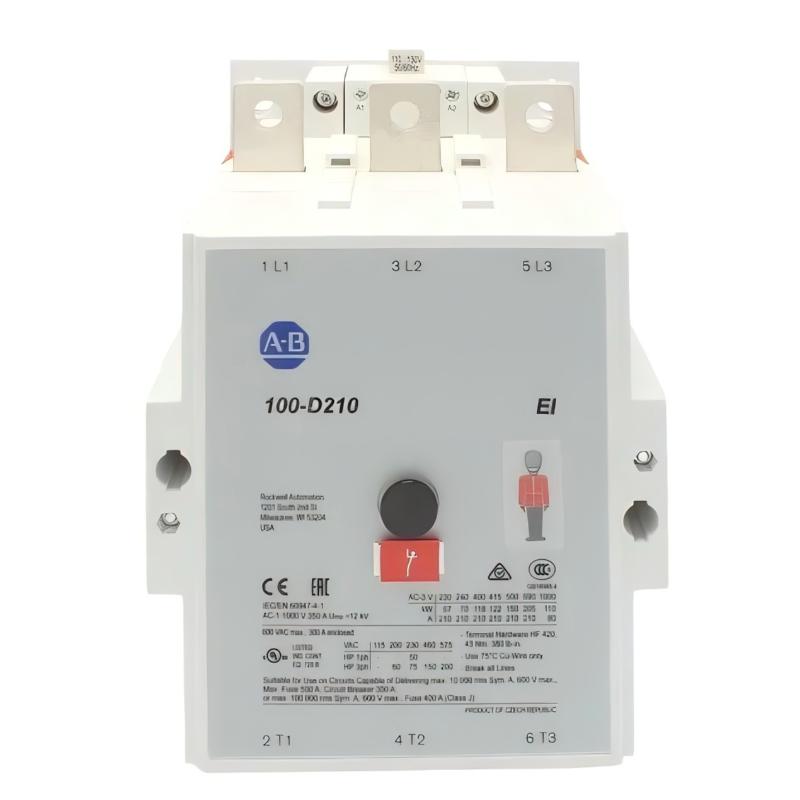
Table of Contents
- Field Case: Safety Circuit Failure During E-Stop Test
- Fault Symptoms of 100S-D210EA22BC Safety Contactor
- Observed Electrical & Mechanical Behavior
- Root Cause Analysis (Load Stress & Contact Welding)
- Diagnostic Workflow for Safety Contactor
- Repair & Recovery Actions
- Prevention Strategy for Safety Systems
- FAQs on 100S-D210EA22BC Faults
- Engineering Summary
Field Case: Safety Contactor Not Dropping During Emergency Stop Test
Allen-Bradley 100S-D210EA22BC safety contactor faults are frequently misdiagnosed as PLC safety relay or wiring logic failures. In one conveyor system, the emergency stop command was correctly issued, and the safety relay output de-energized, but the motor continued running. The investigation revealed welded main contacts inside the contactor, not a control-side failure.
Fault Symptoms of 100S-D210EA22BC Safety Contactor
Typical field symptoms include:
- Contactor coil drops but load remains energized
- Safety feedback loop mismatch alarms in PLC
- Intermittent failure during E-stop validation tests
- Overheating or abnormal buzzing under high load switching
Observed Electrical & Mechanical Behavior
During field measurements, engineers observed abnormal contact behavior despite correct coil control signals:
COIL_CONTROL = 24V DC stable ON/OFF
MAIN_CONTACT_STATE = welded CLOSED even after coil OFF
AUX_FEEDBACK = inconsistent NC/NO transition
CONTACT_RESISTANCE = near-zero (abnormal welding condition)
THERMAL_LOAD = 70°C peak during repeated switching
The failure was strongly correlated with frequent high inrush motor starts in a conveyor drive system without proper arc suppression.
Root Cause Analysis (Load Stress & Contact Welding)
The 100S-D210EA22BC safety contactor is designed for high-current safety switching, but field conditions often exceed design assumptions:
- Contact welding due to repeated high inrush AC-3/AC-4 motor switching
- Insufficient arc suppression in inductive load circuits
- Undersized protection coordination (fuse/breaker mismatch)
- Frequent emergency stop cycling causing thermal stress buildup
In one real commissioning case, replacing the contactor without addressing motor inrush current resulted in repeated failure within weeks.
Diagnostic Workflow for Safety Contactor
Proper diagnosis avoids unnecessary replacement and focuses on system-level issues:
- Verify coil voltage drops fully during E-stop activation
- Measure voltage on load side after contactor OFF command
- Inspect auxiliary feedback contact consistency (NC/NO logic)
- Test mechanical contact separation resistance
- Analyze motor inrush current and switching duty cycle
SAFETY_DIAG /MODEL=100S-D210EA22BC /E_STOP_TEST /CONTACT_CHECK /LOAD_ANALYSIS
Repair & Recovery Actions
- Replaced welded contactor after confirming mechanical failure
- Installed arc suppression network on inductive motor loads
- Optimized motor starting sequence to reduce simultaneous inrush
- Verified correct coordination between contactor and protection devices
After corrective actions, E-stop response returned to expected safety performance with stable load isolation under repeated testing.
Prevention Strategy for Safety Systems
- Match contactor rating with real motor duty class (AC-3 / AC-4)
- Use proper surge suppression for inductive loads
- Avoid excessive E-stop cycling under high load conditions
- Ensure correct coordination with upstream protection devices
- Perform periodic functional safety validation tests
FAQs on 100S-D210EA22BC Faults
Why does the motor keep running after E-stop?
This is typically caused by welded main contacts, not control circuit failure.
Can safety contactors fail even if coil control is correct?
Yes. Mechanical contacts can fail independently of the coil due to load stress and arcing.
Is feedback contact enough to confirm safety isolation?
No. Feedback only reflects internal state; load-side voltage verification is required for true safety confirmation.
Engineering Summary
The Allen-Bradley 100S-D210EA22BC safety contactor is a high-capacity safety switching device, but field failures are typically driven by system-level issues such as load mismatch, excessive inrush current, and insufficient arc suppression rather than internal defects. Proper application design, correct duty classification, and robust safety circuit engineering are essential to ensure reliable emergency shutdown performance.