
NewsNEWCENTER
Featured products

Contact Us
ABB to Invest ¥79 Billion for Controlling Stake in Mitsubishi Electric’s Low-Voltage Power Distribution Business
2026-10-21ABB Strengthens Its Position in Asia-Pacific Through a Strategic Joint Venture
ABB has announced a strategic joint venture involving Mitsubishi Electric’s low-voltage power distribution product business, marking a significant development in the global electrical equipment and industrial automation markets. Under the agreement announced on October 20, 2026, ABB will invest approximately ¥79 billion, equivalent to around US$495 million, to acquire a controlling 51% stake in the new company. Mitsubishi Electric will retain the remaining 49% ownership.
The transaction is designed to combine ABB’s electrical technology portfolio and international sales network with Mitsubishi Electric’s established products, manufacturing capabilities, and customer relationships. The companies aim to strengthen their competitive positions in Japan and expand their reach across the broader Asia-Pacific region.
The transaction is expected to close in the second half of 2027, subject to regulatory approvals and customary closing conditions. Until completion, the existing businesses will continue to operate under their current arrangements.
Overview of the ABB and Mitsubishi Electric Agreement
The joint venture will bring together Mitsubishi Electric’s low-voltage power distribution product business and the associated sales operations outside Japan. ABB will hold a majority stake in the new company, while Mitsubishi Electric will remain a significant shareholder and strategic partner.
The agreement also includes an option that could allow ABB to acquire full ownership of the joint venture in the medium term, subject to the terms of the arrangement.
The transaction reflects ABB’s broader strategy of expanding its electrification business through targeted investments in established product portfolios and regional markets. Rather than building an entirely new operation, ABB will gain access to an existing business with manufacturing resources, technical expertise, and a substantial customer base.
For Mitsubishi Electric, the arrangement provides an opportunity to combine its low-voltage distribution product expertise with ABB’s international commercial infrastructure while retaining an ownership interest in the business.
Key Transaction Details
| Item | Details |
|---|---|
| Companies | ABB and Mitsubishi Electric |
| Transaction structure | Joint venture |
| ABB ownership | 51% controlling stake |
| Mitsubishi Electric ownership | 49% stake |
| Announced ABB investment | Approximately ¥79 billion |
| Approximate investment value | US$495 million |
| Expected closing | Second half of 2027 |
| Main business | Low-voltage power distribution products |
| Geographic focus | Japan and Asia-Pacific, with associated sales operations outside Japan |
| Transaction conditions | Regulatory approvals and customary closing conditions |
The investment gives ABB majority control of the new company while preserving Mitsubishi Electric’s participation. This structure may help maintain product continuity and existing customer relationships during the transition, although the precise operational arrangements will depend on the implementation plan.
Mitsubishi Electric’s Low-Voltage Product Portfolio
Low-voltage power distribution equipment is essential for delivering electricity safely and reliably throughout industrial facilities, commercial buildings, infrastructure projects, and other electrical installations.
Mitsubishi Electric’s business includes a range of products used for circuit protection, power switching, motor control, and electrical monitoring. These products support the distribution of electrical power from incoming supplies to individual machines, production lines, and building systems.
The portfolio includes the following product categories:
1. Low-Voltage Circuit Breakers
Circuit breakers protect electrical circuits against conditions such as overloads and short circuits. By interrupting current when a fault occurs, they help reduce the risk of equipment damage, electrical fires, and unplanned production interruptions.
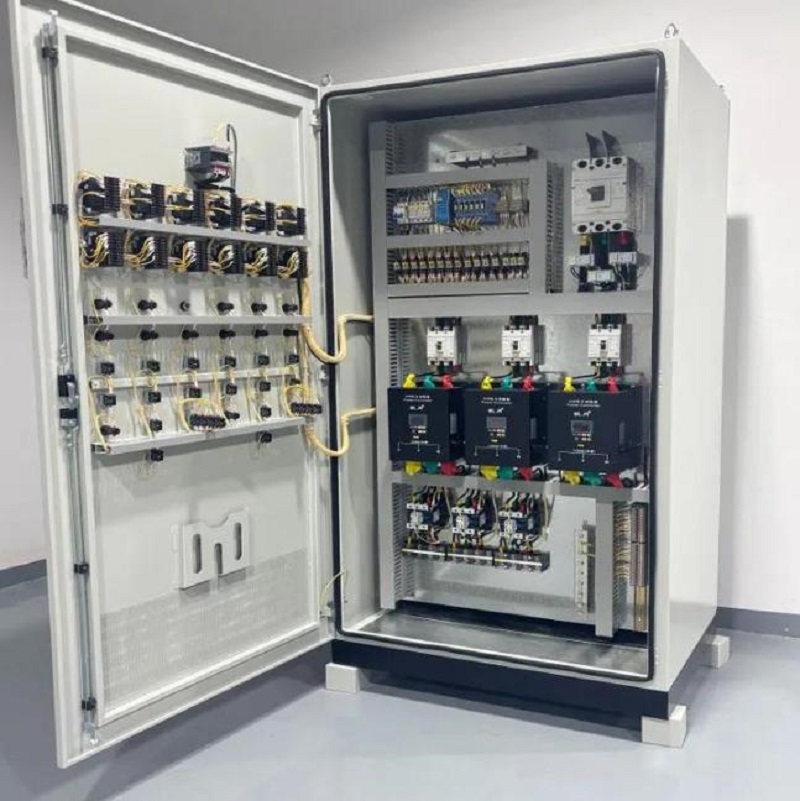
In industrial control panels, circuit breakers are commonly installed upstream of motor starters, drives, power supplies, and other electrical loads. Correct selection depends on rated current, fault-current requirements, operating conditions, and coordination with other protective devices.
2. Switches and Electrical Switching Devices
Switches are used to connect, disconnect, and isolate electrical circuits. Depending on their design and application, they may support routine operation, maintenance isolation, or the control of specific sections of an electrical distribution system.
Reliable switching devices are important in factories where electrical equipment must be operated and maintained safely.
3. Motor Starters and Contactors
Motor starters and contactors are widely used in manufacturing environments to control electric motors and other electrical loads. They are found in conveyor systems, pumps, compressors, fans, machine tools, and automated production equipment.
When integrated with appropriate overload protection and control circuits, these components help support reliable motor operation and simplify equipment control.
4. Control and Electrical Monitoring Devices
Electrical control and monitoring products help operators and maintenance teams observe equipment status and understand operating conditions. Depending on the specific device, monitoring functions may include current, voltage, power consumption, and other electrical parameters.
These capabilities can support energy management, preventive maintenance, troubleshooting, and operational improvement.
5. Uninterruptible Power Supply Systems
Uninterruptible power supply systems help maintain power to selected loads when the primary supply is interrupted or becomes unstable. They can be important for control systems, communication equipment, monitoring devices, and other applications that require a stable power source.
The suitability of any UPS depends on its capacity, runtime requirements, battery configuration, and the characteristics of the connected equipment.
Manufacturing Footprint and Business Scale
The Mitsubishi Electric business covered by the agreement employs approximately 2,800 people and has manufacturing facilities in Fukuyama, Japan, and Hanoi, Vietnam. These locations provide an established industrial foundation for the joint venture.
The business reported sales of approximately ¥102 billion for the financial year ended March 2026, equivalent to roughly US$640 million. Its EBITDA margin was in the low double digits.
The associated sales operations outside Japan account for approximately 15% of the business’s revenue. Including these operations in the transaction structure is intended to support a broader international distribution strategy.
ABB has also indicated that the combined business is expected to contribute positively to earnings per share after the first year. The company has set a target of achieving an operational EBITA margin of at least 20% within five years. These figures represent ABB’s stated expectations and targets rather than guaranteed outcomes.
Achieving these goals will depend on successful integration, market demand, cost management, manufacturing efficiency, and the ability to expand sales without disrupting existing customer relationships.
Why the Joint Venture Matters for the Industrial Automation Market
The agreement is significant because low-voltage distribution equipment forms part of the electrical foundation of modern industrial automation. Although circuit breakers, contactors, and switching devices may not receive as much attention as robots, industrial controllers, or artificial intelligence systems, they are indispensable to the safe and dependable operation of automated facilities.
Stronger Integration Between Electrification and Automation
Industrial facilities increasingly require coordinated solutions for electrical distribution, motor control, machine protection, power monitoring, and energy management.
A broader product portfolio can help equipment suppliers serve customers across more stages of an electrical installation. For ABB, the joint venture may create additional opportunities to connect low-voltage distribution products with its existing electrification and automation offerings.
For system integrators and industrial users, the practical value will depend on product compatibility, technical documentation, regional support, and the availability of suitable engineering solutions.
Greater Access to the Japanese Market
Japan has a mature industrial sector with established standards, demanding quality expectations, and long-standing relationships between manufacturers and equipment suppliers.
Mitsubishi Electric’s local presence and customer familiarity could help ABB strengthen its position in this market. At the same time, ABB’s international network may create opportunities to introduce the joint venture’s products to customers in other regions.
The effectiveness of this strategy will depend on how well the companies coordinate product development, distribution, technical service, and customer support.
Expansion Across Asia-Pacific
Asia-Pacific remains an important region for industrial manufacturing, infrastructure investment, commercial construction, and electrical equipment demand.
Manufacturers in the region require dependable electrical distribution systems for new factories, facility upgrades, machinery installations, and energy-efficiency projects. A joint venture with established products and manufacturing capabilities may be better positioned to address these requirements than a newly developed business without an existing customer base.
The combined operation could also benefit from a more extensive regional sales network, provided that product availability and service capabilities are aligned with local market requirements.
Potential Impact on Industrial Equipment Buyers
For industrial end users, maintenance departments, OEMs, and system integrators, a corporate transaction of this scale raises several practical questions.
Product Availability and Continuity
Customers will want to know whether existing product models will remain available, whether ordering channels will change, and how spare parts will be supplied after the transaction closes.
Because the transaction is not expected to close until the second half of 2027, customers should not assume that immediate changes to product availability or ordering procedures will occur. Any future changes should be confirmed through official company communications and authorized sales channels.
Technical Support and Documentation
Low-voltage equipment is frequently incorporated into established electrical designs and control-panel configurations. Changes to documentation, product identification, technical support arrangements, or ordering references can affect maintenance planning and engineering workflows.
Customers should continue to use the technical documentation applicable to their installed equipment and confirm any future product or support changes with the relevant supplier.
Replacement Parts and Lifecycle Management
Industrial facilities often operate electrical systems for many years. During this period, circuit breakers, contactors, motor starters, and power-related components may need inspection, replacement, or redesign.
When evaluating replacement components, buyers should verify the exact model, electrical ratings, mounting arrangement, connection requirements, applicable standards, and compatibility with the existing system. Similar product names do not necessarily indicate direct interchangeability.
The joint venture may eventually influence regional product availability and support arrangements, but specific lifecycle changes should not be assumed before they are formally announced.
Implications for Industrial Control Panel Manufacturers and System Integrators
Control-panel builders and system integrators depend on consistent electrical component specifications, dependable supply, and predictable technical support.
A combined ABB and Mitsubishi Electric business could create a broader commercial offering for customers who purchase electrical distribution and control equipment for industrial projects. It may also provide opportunities to coordinate product portfolios and regional distribution.
However, engineering decisions should remain based on technical suitability rather than corporate ownership alone. A circuit breaker, contactor, motor starter, or monitoring device must meet the electrical and environmental requirements of its intended application.
For panel manufacturers, important evaluation criteria include:
- Rated operational voltage and current.
- Short-circuit breaking capacity and protection coordination.
- Motor and load characteristics.
- Mounting dimensions and wiring requirements.
- Operating temperature and installation environment.
- Applicable electrical standards and certifications.
- Product availability and maintenance support.
These considerations remain essential regardless of changes in ownership or distribution arrangements.
What to Watch Before the Transaction Closes
The expected closing in the second half of 2027 leaves time for regulatory review and transaction preparation. Several developments will be important for customers and industry observers to monitor.
Regulatory approval: The transaction remains subject to the required approvals and customary closing conditions.
Operational integration: The companies will need to determine how manufacturing, product management, distribution, and customer service will be coordinated within the joint venture.
Product and brand strategy: Further announcements may clarify how existing product lines and commercial identities will be managed.
Regional sales expansion: The joint venture’s ability to grow outside Japan will depend on distribution coverage, customer demand, product positioning, and local technical support.
Profitability targets: ABB’s stated margin and earnings expectations will depend on execution after completion and should be assessed against actual results over time.
Until more details are announced, customers should rely on current product documentation and established support channels rather than assume that the transaction will immediately change their installed equipment or purchasing arrangements.
Conclusion
ABB’s planned investment of approximately ¥79 billion for a 51% stake in a joint venture with Mitsubishi Electric’s low-voltage power distribution business represents a strategic move in the global electrification market.
By combining ABB’s international reach with Mitsubishi Electric’s established product portfolio, manufacturing footprint, and market presence, the new company aims to strengthen its position in Japan and expand across Asia-Pacific.
For industrial automation users, the transaction highlights the continuing importance of dependable low-voltage electrical infrastructure. Circuit breakers, switches, contactors, motor starters, monitoring devices, and UPS systems remain fundamental to safe power distribution and reliable industrial operations.
The key development to watch will be how the companies implement the joint venture after the expected 2027 closing, particularly in product availability, technical support, regional distribution, and operational integration. Until official implementation details are available, industrial buyers should continue to evaluate equipment according to its specifications, compatibility, and suitability for the application.
SEO Keywords: ABB Mitsubishi Electric joint venture, ABB low-voltage power distribution, Mitsubishi Electric electrical products, ABB 51 percent stake, industrial electrical distribution equipment, low-voltage circuit breakers, industrial motor starters, electrical control components, Asia-Pacific electrification market, industrial automation news.