
NewsNEWCENTER
Featured products



Contact Us
ABB Robotics China President Says SoftBank Acquisition Remains on Track, Reaffirms Commitment to China Market
2026-10-15ABB Robotics Confirms Continued Progress on SoftBank Acquisition
ABB Robotics has reaffirmed its long-term commitment to the Chinese market as its planned acquisition by SoftBank Group continues through the regulatory and transaction process. Han Chen, President of ABB Robotics in China, said the transaction was progressing normally and remained within the originally anticipated completion window of mid-to-late 2026.
The update was reported following remarks made during the China International Industry Fair (CIIF) in Shanghai on October 12, 2026. According to the report, Han said that feedback from the relevant parties was positive and that the procedures were proceeding as expected.
The proposed acquisition, announced in October 2025, represents a significant development in the global industrial robotics sector. It is intended to combine ABB Robotics’ established industrial automation expertise with SoftBank’s capabilities in artificial intelligence, robotics and next-generation computing.
However, the transaction should not be regarded as completed until the required approvals and closing conditions have been satisfied.
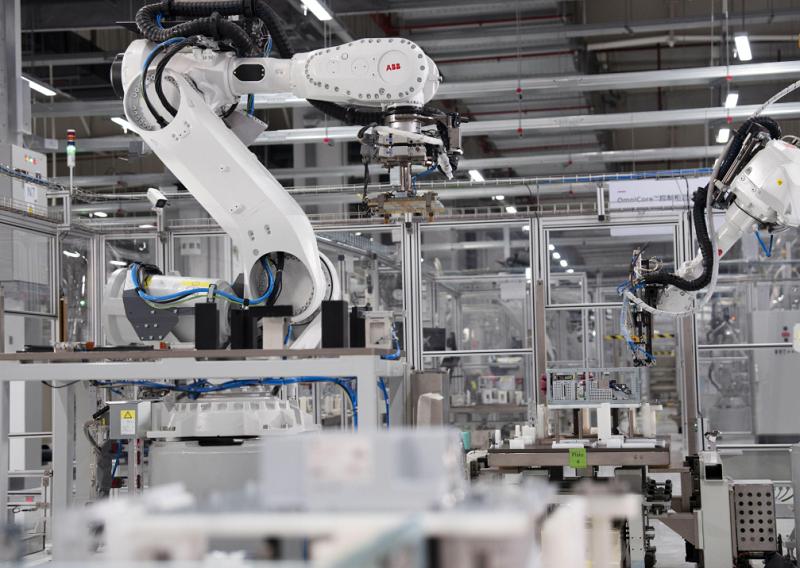
SoftBank’s $5.375 Billion Acquisition Targets Physical AI
On October 8, 2025, ABB announced an agreement to divest its Robotics division to SoftBank Group for an enterprise value of $5.375 billion.
The transaction was originally expected to close in mid-to-late 2026, subject to regulatory approvals in relevant jurisdictions, including China, the European Union and the United States, as well as other customary closing conditions.
For SoftBank, the acquisition forms part of a broader strategy focused on physical AI, which connects artificial intelligence with machines capable of interacting with the physical world.
Industrial robots are an important part of this strategy because they combine mechanical motion, sensing, control systems and software to perform tasks in real manufacturing environments. Integrating these capabilities with advanced AI could create opportunities for more adaptive robotic systems, intelligent automation and improved human-machine interaction.
For ABB Robotics, the proposed transaction could provide access to SoftBank’s broader AI and robotics ecosystem while maintaining the industrial robotics expertise and customer relationships developed over decades.
The final impact on products, organization, customer services and commercial arrangements will depend on the transaction’s completion and subsequent business decisions.
ABB Robotics Reaffirms Its Commitment to China
A key message from Han Chen’s remarks is that the proposed ownership change will not alter ABB Robotics’ commitment to the Chinese market.
China is a major market for industrial robots, supported by extensive manufacturing activity across automotive production, electronics, machinery, logistics and other industrial sectors. These industries require reliable automation equipment, engineering support, replacement parts and solutions that can adapt to changing production requirements.
According to the October 14 media report, Han stated that ABB Robotics would maintain its established strategy and continue deepening localization in China, regardless of the eventual ownership structure.
This position is consistent with ABB’s existing In China, for China approach, which emphasizes local manufacturing, research and development, supply chains and customer support.
For industrial customers, localization can have practical benefits. Locally manufactured equipment and stronger regional supply chains may help shorten delivery times, improve responsiveness to customer requirements and facilitate technical support.
Nevertheless, individual delivery schedules, product availability, warranty arrangements and service policies should still be confirmed with the relevant ABB sales or service organization.
Shanghai Mega Factory Remains Central to ABB’s Localization Strategy
ABB’s Shanghai Robotics Mega Factory is an important part of its manufacturing and localization strategy.
Opened in December 2022, the Kangqiao facility covers approximately 67,000 square meters and represents an investment of $150 million. It combines robot manufacturing, digital production technologies and research and development activities.
ABB has previously stated that more than 90% of the robots it sells to Chinese customers are manufactured locally. In the October 14, 2026 report, the proportion was cited as approximately 90%, with further localization planned.
The Shanghai facility uses flexible manufacturing cells and digitally connected production processes rather than relying exclusively on conventional fixed assembly lines. These capabilities support the production of different robot configurations and help the company respond to changing manufacturing requirements.
A continued emphasis on local production is particularly relevant to Chinese manufacturers seeking industrial robots for automated assembly, material handling, machine tending, welding and other production tasks.
For international buyers sourcing ABB industrial automation equipment, the development also highlights the importance of checking the specific manufacturing origin, product configuration and applicable supply arrangements when evaluating procurement options.
Physical AI Moves Closer to Industrial Production
Alongside the acquisition news, ABB Robotics is advancing applications associated with physical AI.
At CIIF 2026, the company demonstrated how AI-enabled perception, imitation learning and autonomous path planning could help robots perform tasks that traditionally require extensive manual programming.
One demonstration featured a GoFa collaborative robot learning the process of preparing pour-over coffee by observing human movements. The application combined ABB’s OmniCore EyeMotion vision system, AI Robot Trainer and AI-assisted path planning.
The demonstration illustrates how robots may become more adaptable when working with variable objects or tasks that require adjustments to movement and timing.
ABB has also described the potential of physical AI for manufacturing environments with frequent product changes and high levels of customization. These applications are relevant to factories producing multiple product variants in relatively small batches.
However, demonstrations and potential performance improvements should not be confused with guaranteed production results. Actual performance depends on the application, hardware configuration, system integration, validation procedures and operating conditions.
What the Acquisition Means for Industrial Automation Customers
For manufacturers, system integrators and industrial equipment buyers, the immediate priority is to distinguish the confirmed transaction status from potential future developments.
The proposed acquisition may strengthen the connection between industrial robotics and AI technologies. At the same time, customers need clarity regarding product continuity, technical support, spare parts, software compatibility and long-term service commitments.
Several areas deserve attention as the transaction progresses:
Product and controller continuity: Existing robotic installations often depend on established controllers, engineering software, communication interfaces and validated application programs. Customers should confirm compatibility requirements before planning upgrades or equipment replacements.
Spare parts and maintenance: Industrial facilities depend on predictable maintenance schedules and access to replacement components. Procurement teams should verify stock availability, lead times and service arrangements for installed equipment.
System integration: ABB robots are frequently integrated with PLCs, variable frequency drives, HMIs, machine vision systems, safety equipment and manufacturing execution systems. Any future technical changes should be evaluated against the requirements of the complete automation architecture.
AI and digitalization: Physical AI may introduce new opportunities for adaptive automation, but implementation requires appropriate validation, cybersecurity controls, functional safety measures and operator training.
Local supply and technical support: China’s established manufacturing base and ABB’s Shanghai operations remain important considerations for customers seeking localized equipment supply and engineering assistance.
These factors are relevant whether a manufacturer is installing a new robotic production cell or maintaining an existing automation system.
Outlook: A Strategic Transition for the Global Robotics Industry
The proposed SoftBank acquisition reflects a broader shift in the industrial robotics industry, where traditional automation technologies are increasingly being combined with AI, advanced computing and data-driven engineering.
ABB Robotics brings established industrial robot technology, application expertise and a global customer base. SoftBank’s strategic focus on AI and robotics creates the possibility of further development in intelligent machines and physical AI applications.
For the Chinese market, ABB’s latest statements indicate that localization and customer support remain central priorities while the transaction moves toward its anticipated closing period.
The acquisition’s longer-term effects on technology development, product strategy and customer service will become clearer after completion and the implementation of subsequent business plans.
Until then, industrial customers should rely on confirmed company announcements and direct communication with authorized suppliers when making decisions about new equipment purchases, spare parts and long-term automation investments.
Conclusion
ABB Robotics’ planned acquisition by SoftBank remains an important development for the global industrial automation market. As of October 15, 2026, media reports indicate that the transaction was progressing within its previously announced completion window, while ABB Robotics China President Han Chen reaffirmed the company’s commitment to the Chinese market.
The combination of established industrial robotics capabilities, localized manufacturing and potential advances in physical AI could shape the next stage of industrial automation. For manufacturers and system integrators, the key priorities remain equipment reliability, product continuity, technical support and the practical value of new automation technologies.
SEO Keywords: ABB Robotics SoftBank acquisition 2026, ABB Robotics China, Han Chen ABB Robotics, SoftBank industrial robotics, ABB Robotics Shanghai Mega Factory, industrial automation news, physical AI in manufacturing, ABB industrial robots, robotics market China, industrial robot supply chain, AI-powered robotics, industrial automation equipment.