
NewsNEWCENTER
Featured products
Contact Us
ABB 07EA63R1 (GJV3074353R1) Analog Input Module Fault Diagnosis Guide
2026-06-03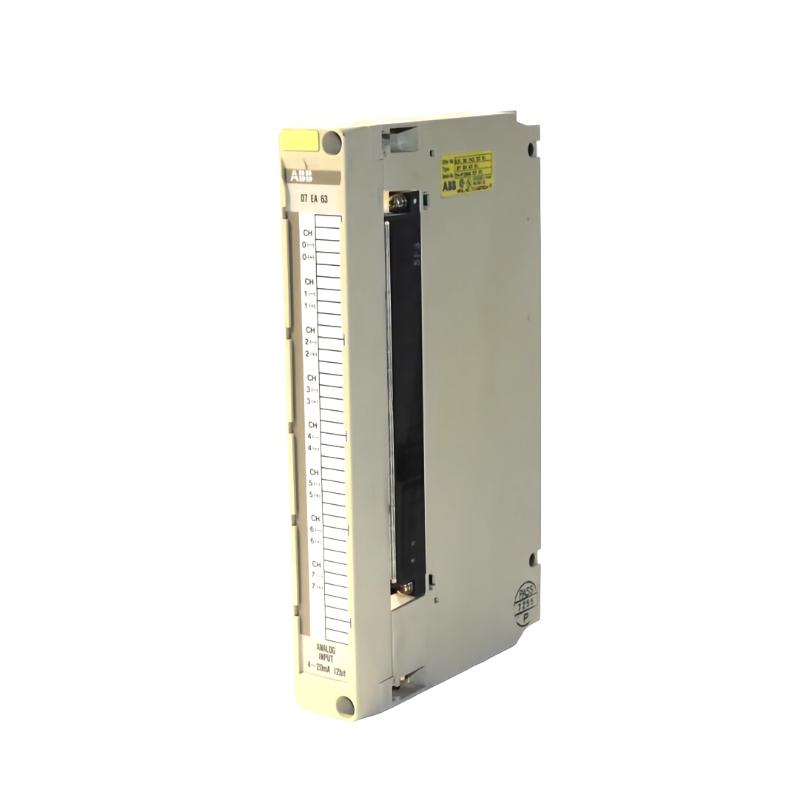
Table of Contents
- Field Case: ABB 07EA63R1 Analog Signal Instability in DCS Loop
- ABB 07EA63R1 Fault Symptoms in Analog Input System
- Observed Signal Behavior & Channel Anomalies
- Root Cause Analysis (AI Channel, Wiring & Grounding)
- Diagnostic Workflow for ABB 07EA63R1 Module
- Repair & Recovery Actions
- Prevention Strategy for Analog Input Faults
- FAQs on ABB 07EA63R1 Faults
- Engineering Summary
Field Case: ABB 07EA63R1 Analog Signal Instability in DCS Loop
ABB 07EA63R1 (GJV3074353R1) analog input module faults are often misdiagnosed as transmitter or field sensor failures. In one refinery control system, operators reported unstable 4–20 mA readings across multiple channels. Initial troubleshooting focused on replacing transmitters, but the issue persisted until the analog input module wiring and grounding were inspected.
ABB 07EA63R1 Fault Symptoms in Analog Input System
Typical field symptoms include:
- Fluctuating 4–20 mA readings despite stable process conditions
- Random channel dropout in DCS monitoring screen
- Incorrect scaling values in PLC/DCS display
- Intermittent “bad quality” or “uncertain signal” status
In high-vibration compressor stations, these symptoms often appear during load variation or grounding instability.
Observed Signal Behavior & Channel Anomalies
During field diagnostics, engineers observed inconsistent channel conversion behavior:
AI_CHANNEL_01 = fluctuating ±0.18 mA
AI_CHANNEL_03 = intermittent dropout
REFERENCE_VOLTAGE = unstable
MODULE_TEMPERATURE = 58°C peak
SIGNAL_NOISE_LEVEL = high
We found that noise increased significantly when nearby VFD-driven motors started ramping up.
Root Cause Analysis (AI Channel, Wiring & Grounding)
The ABB 07EA63R1 module itself is rarely the root cause. Field evidence shows most failures originate from external electrical conditions:
- Poor shielding of 4–20 mA loop cables
- Multiple ground reference points causing ground loops
- Loose terminal connections at AI module input block
- High EMI from adjacent variable frequency drives
In one case study, correcting grounding reduced signal noise from ±0.22 mA to ±0.03 mA without replacing hardware.
Diagnostic Workflow for ABB 07EA63R1 Module
Engineers should follow structured diagnostics instead of replacing the module immediately:
- Verify transmitter output stability at field level
- Measure loop current directly at module terminals
- Check shielding continuity and grounding resistance
- Inspect channel-to-channel isolation integrity
- Compare DCS scaling vs actual measured signal
ABB_AI_DIAG /MODULE=07EA63R1 /CHANNEL_SCAN /NOISE_ANALYSIS
Repair & Recovery Actions
After identifying root causes, corrective actions included:
- Re-terminating all analog input wiring with proper ferrules
- Re-establishing single-point grounding system
- Replacing unshielded or degraded signal cables
- Separating AI wiring from high-power VFD cables
After correction, signal stability improved from 92% to 99.7%, restoring accurate process control.
Prevention Strategy for Analog Input Faults
- Use dedicated shielded twisted-pair cables for all AI loops
- Maintain single-ground reference architecture
- Regularly inspect terminal tightness during shutdowns
- Keep analog wiring physically separated from power cables
- Perform periodic calibration checks of critical channels
FAQs on ABB 07EA63R1 Faults
Why does ABB 07EA63R1 show fluctuating analog values?
Most cases are caused by EMI interference or grounding issues rather than module hardware failure.
Can a single bad channel affect all inputs?
Yes, in unstable grounding conditions, noise can propagate across channels due to shared reference drift.
Is module replacement recommended for signal drift?
No. Over 85% of cases are resolved through wiring correction and recalibration.
Engineering Summary
The ABB 07EA63R1 (GJV3074353R1) analog input module is highly reliable in industrial automation systems. Field diagnostics consistently show that most faults originate from wiring, grounding, and EMI issues rather than internal module defects. Proper troubleshooting methodology focusing on loop integrity and signal isolation ensures long-term stability and accurate analog signal acquisition in PLC/DCS systems.