

ProductPRODUCT
Featured products
Contact Us
- Woodward
- 9907-014
- Speed Controller
- USA
- 162 × 131 × 57 mm
- 1.05 kg
- Xiamen, China
- New & In Stock
- T/T, PayPal, Western Union
- 1 Year
- 1-3 Working Days
- DHL, UPS, TNT, FedEx and EMS.
- 24-Hour Service
- COO
- 5
Our advantage

Global Logistics
We have a 10-year logistics and express cooperation agreement, so our products can be shipped to any place in the world.

Brand new and original
Our products are imported in bulk from the place of origin. Because of the cooperative relationship, our products are all original and 100% new.

24-hour service
We provide 7*24 hours service to our customers. We will be there whenever you need us.

Price advantage
All our products are priced very favorably because we have our own warehouse and supply.
| Company Information | |||
| [email protected] | |||
| Mobile | +8615980777398 | ||
| +8615980777398 | |||
| 15980777398 |
Product Overview
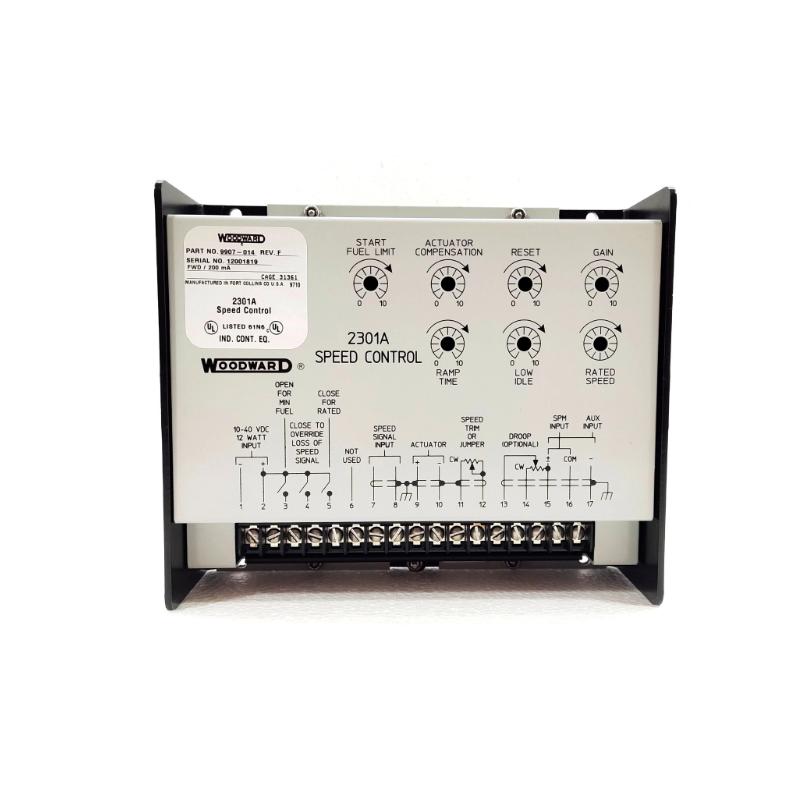
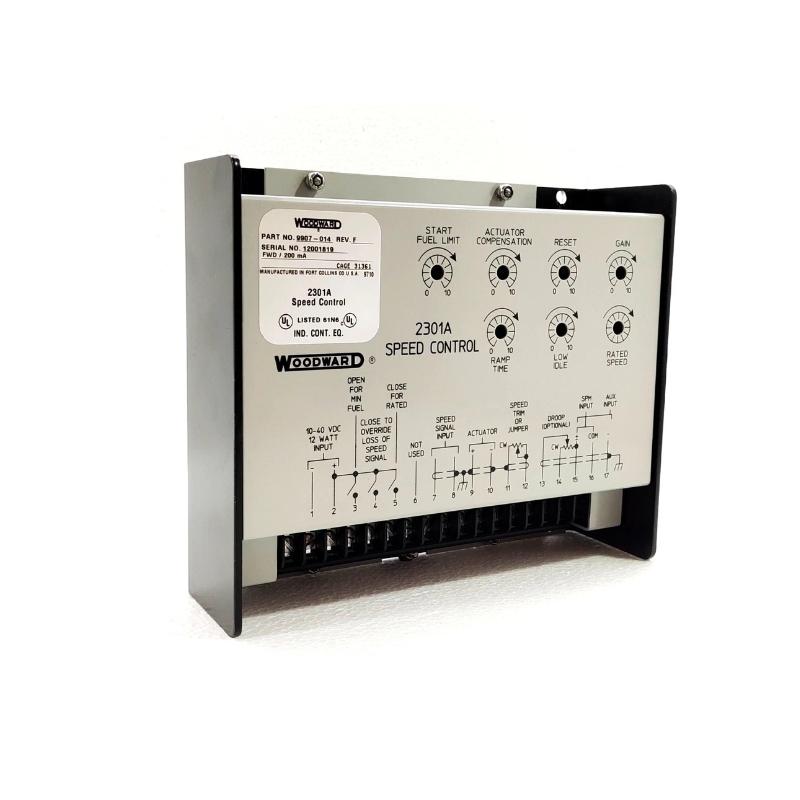
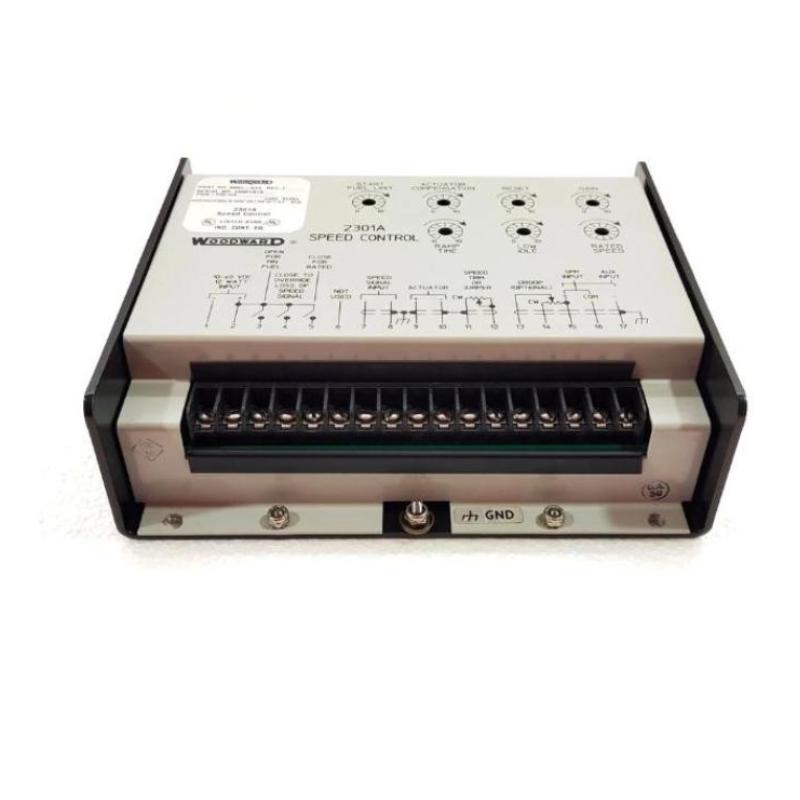
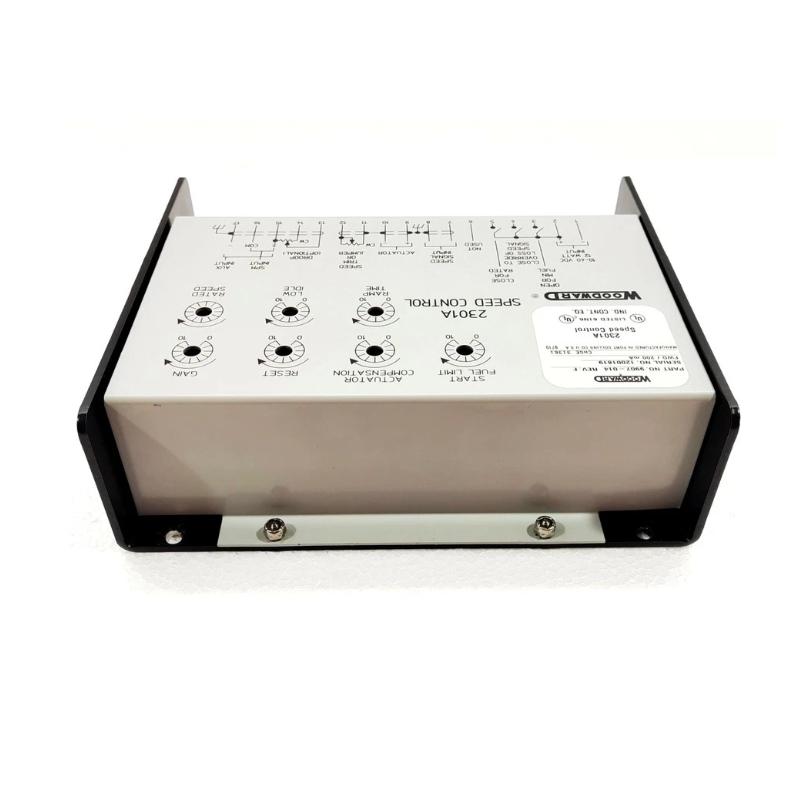
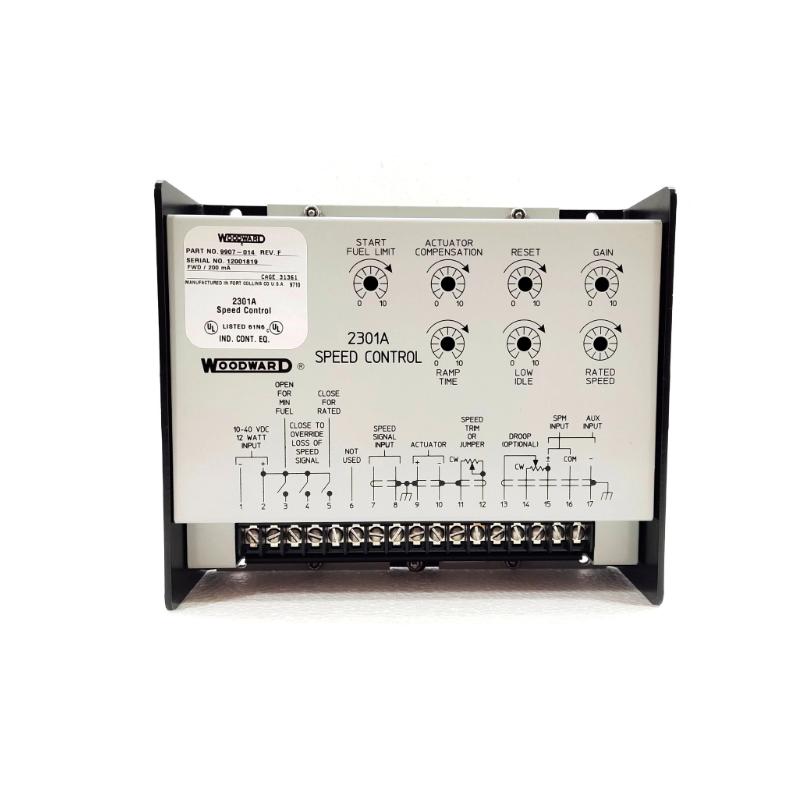
The Woodward 9907-014 Speed Controller is an electronic engine speed control designed to regulate the rotational speed of industrial prime movers. It belongs to the Woodward 2301A series and is used in applications involving diesel engines, gas engines, and certain steam or gas turbine installations.
In industrial power generation and mechanical drive systems, maintaining stable rotational speed is essential for reliable equipment operation. Changes in electrical load or mechanical demand can cause engine speed to fluctuate. An electronic speed controller processes the speed signal from a sensor and adjusts the connected actuator to regulate the fuel or steam supply to the prime mover.
The 9907-014 is a low-voltage, forward-acting speed control configuration. It operates from a 10–40 V DC supply and provides a 0–200 mA actuator output. It receives speed information from a compatible magnetic pickup or speed-sensing device and uses this information to determine whether the prime mover is operating at the required speed.
The controller can support isochronous and droop speed-control arrangements, depending on the system configuration. Isochronous control is generally used when a prime mover must maintain a relatively constant speed as load changes. Droop control allows a defined speed reduction as load increases and is commonly used in applications involving coordinated operation of multiple generating units.
The Woodward 9907-014 is suitable for industrial engine-control and power-generation systems where dependable speed regulation is required. Correct selection depends on the power supply, speed-sensor signal, actuator characteristics, control mode, and mechanical requirements of the prime mover.
Technical Specifications
| Parameter | Specification |
|---|---|
| Brand | Woodward |
| Model | 9907-014 |
| Product Series | 2301A |
| Product Type | Electronic Speed Controller |
| Control Function | Prime Mover Speed Regulation |
| Control Action | Forward Acting |
| Supply Voltage | 10–40 V DC |
| Nominal Supply | Low-voltage DC system |
| Speed Sensing | Magnetic Pickup / Compatible Speed Sensor |
| Speed Sensor Input | Approximately 1–30 V, subject to installation requirements |
| Actuator Output | 0–200 mA |
| Control Modes | Isochronous / Droop |
| Typical Applications | Diesel Engines, Gas Engines, Steam and Gas Turbines |
| Mounting | Chassis / Surface Mounting |
| Dimensions Provided | 162 × 131 × 57 mm |
| Weight Provided | 1.05 kg |
| Manufacturer | Woodward |
Note: Dimensions and weight are supplied listing values. Verify the exact housing, mounting arrangement, and shipping weight against the physical unit before publication or shipment.
Function and Working Principle
The Woodward 9907-014 regulates prime mover speed through a closed-loop control process. It compares the measured rotational speed with the required speed reference and adjusts the actuator output to correct any difference.
The controller works with three important elements:
- A power source supplying the controller’s operating voltage.
- A speed-sensing device providing information about actual rotational speed.
- A proportional actuator controlling the fuel or steam metering mechanism.
Together, these components form an electronic speed-regulation system.
1. Speed Signal Acquisition
The controller receives speed information from a compatible magnetic pickup or other supported speed-sensing arrangement.
A magnetic pickup detects the passage of teeth on a rotating gear or flywheel. Each detected tooth produces an electrical pulse. The frequency of these pulses corresponds to the rotational speed of the monitored shaft.
The controller processes this frequency and determines the actual operating speed of the prime mover.
Correct sensor installation is essential. The sensor gap, mounting stability, wiring, shielding, and signal amplitude must comply with the applicable installation instructions. An unstable or weak speed signal can lead to inaccurate speed measurement or unreliable control.
2. Speed Reference Comparison
The controller compares the measured speed with the configured speed reference.
If the engine speed is below the required value, the controller can increase the actuator command to provide additional fuel or steam, depending on the prime mover and actuator arrangement.
If the engine speed rises above the target, the controller adjusts the output in the opposite direction to reduce the driving input.
This continuous comparison helps maintain the required operating speed as mechanical demand changes.
3. Actuator Output Regulation
The 9907-014 provides a forward-acting 0–200 mA actuator output. The actuator converts the electrical command into mechanical movement that adjusts the fuel or steam metering mechanism.
The output must be matched to the connected actuator’s electrical and mechanical characteristics. Incorrect actuator selection, wiring, or polarity can prevent the control loop from operating as intended.
The actuator’s response also affects the stability of the complete speed-control system.
4. Isochronous Speed Control
Isochronous operation is used when the prime mover must maintain a nearly constant speed despite changes in load.
For example, a generator operating independently may need to maintain a stable rotational speed to support the required electrical frequency. When the electrical load increases, the controller adjusts the actuator to provide the additional mechanical input needed to maintain speed.
The final regulation performance depends on engine capability, actuator response, system tuning, and load characteristics.
5. Droop Speed Control
Droop control allows engine speed to decrease by a defined amount as load increases.
This characteristic can be useful when multiple generating units operate in parallel. It provides a means of coordinating load distribution between units rather than having every controller attempt to maintain exactly the same speed under all conditions.
The droop setting must be configured according to the generator arrangement and operating requirements.
Role in Industrial Control Systems
The Woodward 9907-014 is a dedicated prime mover control device. It performs speed regulation within an engine or turbine control system and can work alongside other equipment responsible for generator operation, process monitoring, and equipment protection.
Engine Control Systems
In diesel and gas engine installations, the controller receives speed feedback and adjusts the actuator to regulate engine speed.
It can be used in generator sets, industrial engine-driven equipment, and other applications where stable rotational speed is required.
Generator Control Systems
For generator applications, engine speed is closely related to output frequency. The speed controller therefore plays an important role in maintaining the prime mover’s operating speed.
The 9907-014 can form part of a generator control arrangement that also includes voltage regulation, electrical protection, synchronization equipment, and load-management functions.
It should not be confused with an automatic voltage regulator. The speed controller regulates the prime mover, while voltage regulation is handled by the generator excitation system.
PLC and Supervisory Control Integration
A PLC or supervisory control system may monitor generator status, coordinate start and stop sequences, manage alarms, and exchange operating information with other equipment.
The 9907-014 performs the dedicated speed-control function. Its integration with a PLC should be designed around the actual available signals and the requirements of the complete control system.
A PLC should not be assumed to replace the dedicated speed-control loop without a properly engineered alternative.
Turbine and Mechanical Drive Systems
In suitable steam or gas turbine installations, speed control is achieved by adjusting the energy supplied to the turbine. The controller’s actuator output must be matched to the relevant valve or fuel-control mechanism.
The turbine’s operating limits, protection system, and manufacturer requirements must be considered during system design.
Industrial Applications
1. Diesel Generator Sets
Diesel generator sets require stable engine speed to maintain the required electrical output frequency.
The 9907-014 can regulate the engine actuator in response to speed changes caused by variations in electrical demand. It is therefore relevant to generator installations requiring a compatible Woodward 2301A control arrangement.
2. Gas Engine Power Generation
Gas engines used in industrial power generation require coordinated fuel control and speed regulation.
The controller can process speed feedback and adjust the actuator output to maintain the selected operating condition. The fuel system and actuator must be compatible with the controller’s output characteristics.
3. Industrial Standby Power Systems
Standby generator systems must be capable of responding to changes in electrical demand after starting.
A speed controller helps regulate the engine as the generator transitions from no-load operation to supplying connected equipment. Its performance depends on the engine, actuator, generator, and overall control arrangement.
4. Steam Turbine Applications
Certain steam turbine control arrangements use electronic speed controllers to regulate the steam supply through an actuator-operated valve.
The controller can contribute to maintaining the required turbine speed. Turbine overspeed protection and emergency shutdown functions must remain separate, properly engineered safety provisions.
5. Gas Turbine Applications
In suitable gas turbine installations, speed regulation requires coordination between the controller, speed sensor, and fuel-control actuator.
The controller’s output and operating characteristics must be verified against the turbine’s control-system design before installation.
6. Industrial Mechanical Drives
Some industrial machines use engine-driven equipment rather than electric motors. Examples include pumps, compressors, and other mechanical systems powered by diesel or gas engines.
In these applications, the 9907-014 can help regulate prime mover speed when its electrical and control characteristics match the equipment.
Installation and System Integration
Correct installation is essential for stable speed regulation and safe operation.
1. Verify the DC Power Supply
The 9907-014 is a low-voltage model designed for a 10–40 V DC supply.
Before installation, confirm the actual supply voltage, polarity, available current, and grounding arrangement. The supply must remain within the controller’s permitted operating range during starting and normal operation.
Unstable power can cause controller malfunction or unexpected interruptions in speed regulation.
2. Install the Speed Sensor Correctly
The magnetic pickup must be installed securely and positioned according to the applicable sensor and controller instructions.
Check the following:
- Sensor alignment with the rotating gear or flywheel.
- Correct sensor-to-target clearance.
- Signal voltage during cranking and normal operation.
- Cable condition and connector security.
- Shielding and grounding arrangements.
- Absence of excessive electrical interference.
A reliable speed signal is fundamental to accurate speed control.
3. Connect the Actuator
The actuator output must match the electrical requirements of the connected actuator.
Verify the rated current, polarity, operating direction, mechanical travel, and fuel or steam control mechanism. The controller is a forward-acting configuration, so the actuator response must be consistent with the intended control arrangement.
Do not assume that an actuator used with another speed controller will automatically be compatible.
4. Configure the Speed-Control Mode
Select and configure the required operating mode according to the application.
Isochronous operation may be appropriate for a standalone generator, while droop operation may be required for load-sharing arrangements.
The speed reference, droop adjustment, gain, stability, and other relevant settings should be commissioned according to the engine and generator requirements.
5. Check Wiring and Electrical Interference
Speed-sensor and control wiring should follow the manufacturer’s recommendations. Use appropriate shielding and grounding practices, especially where the controller is installed near generators, contactors, ignition systems, or other sources of electrical interference.
Avoid routing sensitive signal cables alongside high-current power conductors unless the installation instructions permit it.
6. Commission the Complete System
After installation, verify the power supply, speed-sensor signal, actuator movement, and control response.
Commissioning should include controlled testing of starting, acceleration, rated-speed operation, load changes, and shutdown sequences.
Overspeed protection and emergency shutdown systems must be independently verified. The speed controller should not be treated as the sole protection against dangerous overspeed conditions.
Compatible System Components
The 9907-014 operates as part of a complete engine or turbine speed-control system.
| Component | Function | Compatibility Considerations |
|---|---|---|
| Magnetic Pickup Sensor | Measures rotational speed | Confirm signal level, frequency range, mounting, and wiring |
| Electric Actuator | Adjusts fuel or steam supply | Match the 0–200 mA output and actuator response |
| DC Power Supply | Provides controller operating power | Maintain the specified 10–40 V DC range |
| Diesel or Gas Engine | Prime mover being regulated | Verify engine control requirements and rated speed |
| Generator | Converts mechanical energy into electrical energy | Coordinate speed regulation with generator frequency requirements |
| Speed Reference Device | Provides the required operating speed | Confirm supported adjustment and control arrangement |
| Droop Adjustment Device | Sets load-dependent speed characteristics | Configure according to the system design |
| PLC | Coordinates operating sequences and monitoring | Verify available signals and interface requirements |
| Overspeed Protection System | Provides independent protection against excessive speed | Must be designed and tested separately |
| Emergency Shutdown System | Initiates safe shutdown when required | Verify the complete safety and shutdown logic |
These components are examples of equipment that may be used in a complete installation. They are not necessarily included with the 9907-014.
Alternative Models and Replacement Considerations
The Woodward 2301A family includes different configurations with variations in supply voltage, control action, and actuator arrangements. Replacement selection should be based on the complete control-system requirements.
| Related Model or Option | Replacement Considerations |
|---|---|
| Woodward 9907-016 | Related reverse-acting low-voltage 2301A configuration; not a direct substitute for a forward-acting unit without system review |
| Woodward 9907-015 | Related high-voltage forward-acting configuration; supply requirements differ |
| Woodward 9907-017 | Related high-voltage reverse-acting configuration |
| Woodward 9905-131 | Related low-voltage forward-acting 2301A speed-control configuration |
| Woodward 9905-133 | Related low-voltage reverse-acting 2301A configuration |
| Newer Woodward electronic speed controllers | May be considered for system upgrades after detailed engineering evaluation |
Before selecting a replacement, compare:
- Supply voltage and power requirements.
- Forward-acting or reverse-acting configuration.
- Actuator current and electrical characteristics.
- Magnetic pickup signal requirements.
- Speed range and reference settings.
- Isochronous or droop control requirements.
- Wiring terminal assignments.
- Mounting dimensions and mechanical arrangement.
- Engine and generator control requirements.
- Overspeed protection and shutdown arrangements.
A controller with a similar product description is not necessarily interchangeable. Differences in actuator output, control action, and wiring can affect engine operation and system safety.
Key Advantages
Dedicated Prime Mover Speed Regulation
The 9907-014 provides electronic speed regulation for compatible diesel engines, gas engines, and turbine applications.
Low-Voltage DC Operation
Its 10–40 V DC supply range supports installations designed around low-voltage control power.
Magnetic Pickup Speed Feedback
The controller can use a magnetic pickup signal to monitor rotational speed and provide feedback for the control loop.
Forward-Acting Control
The forward-acting configuration provides a defined relationship between the controller output and the connected actuator. The actuator and fuel-control mechanism must be configured accordingly.
0–200 mA Actuator Output
The specified output range supports compatible proportional actuators used in engine and turbine governing systems.
Isochronous and Droop Operation
The control system can be configured for different speed-regulation requirements, including constant-speed operation and load-dependent droop control.
Established 2301A Platform
The 2301A series is used in industrial prime mover control applications. Correct model identification can help maintenance teams source replacement equipment and preserve existing system configurations.
Technical FAQs
1. What is the Woodward 9907-014?
The Woodward 9907-014 is a 2301A electronic speed controller used to regulate the speed of compatible diesel engines, gas engines, and certain turbine installations.
2. What is the operating voltage?
It is a low-voltage model with a specified supply range of 10–40 V DC. Confirm the actual unit’s label and installation documentation before connecting power.
3. What type of speed sensor does it use?
The controller can receive speed feedback from a compatible magnetic pickup sensor. The sensor detects rotating gear teeth and generates a pulse signal corresponding to shaft speed.
4. What is the actuator output?
The 9907-014 provides a forward-acting 0–200 mA actuator output. The connected actuator must be compatible with this output range and the control direction.
5. What is the difference between isochronous and droop control?
Isochronous control aims to maintain a constant speed as load changes. Droop control allows speed to decrease by a configured amount as load increases. The appropriate mode depends on whether the prime mover operates independently or as part of a coordinated multi-unit system.
6. Can the 9907-014 be used with a diesel generator?
Yes, it can be used in a compatible diesel generator speed-control system. The engine actuator, magnetic pickup, generator requirements, and control settings must all be verified.
7. Can it control a gas turbine?
The 2301A family has applications involving gas turbines, but suitability depends on the turbine control architecture and actuator requirements. Confirm compatibility with the turbine manufacturer’s documentation.
8. Is the 9907-014 a generator voltage regulator?
No. It regulates prime mover speed. Generator output voltage is normally controlled by a separate excitation and voltage-regulation system.
9. Can it replace a reverse-acting controller?
Not automatically. The 9907-014 is a forward-acting model. A reverse-acting configuration has a different control relationship and may require different system wiring or actuator behavior.
10. What should be checked before purchasing?
Verify the complete part number, supply voltage, control action, actuator output, speed-sensor compatibility, physical condition, and available test information. For critical installations, confirm the controller’s compatibility with the existing engine and actuator before ordering.
Procurement and Maintenance Recommendations
When sourcing the Woodward 9907-014, verify the complete part number and confirm that the replacement matches the original controller’s low-voltage and forward-acting configuration.
For used or refurbished units, request clear photographs of the nameplate, terminal connections, housing, and adjustment controls. Check the controller’s physical condition and request available functional test information. Confirm whether accessories, connectors, or mounting hardware are included.
During maintenance, inspect the DC supply connections, grounding, speed-sensor wiring, actuator wiring, and mounting hardware. Pay particular attention to magnetic pickup signal quality and electrical interference. Record the existing control settings before making adjustments.
For engine and generator applications, speed-control commissioning should be performed by qualified personnel familiar with the prime mover and its protection system. Test the complete system under controlled conditions and independently verify overspeed protection and emergency shutdown functions.
Conclusion
The Woodward 9907-014 2301A Speed Controller is an electronic governing device designed for speed regulation in compatible diesel engine, gas engine, and turbine applications. It operates from a 10–40 V DC supply, receives speed feedback from a compatible sensor, and provides a forward-acting 0–200 mA actuator output.
Its ability to support isochronous and droop control arrangements makes it relevant to standalone prime movers and selected generator systems. For replacement and maintenance projects, verifying the supply voltage, actuator characteristics, speed-sensor signal, control action, and installation requirements is essential for reliable operation.