

ProductPRODUCT
Featured products
Contact Us
- Schneider
- LTMR27CBD
- Motor Controller
- France
- 91 x 61 x 122.5 mm
- 0.53 kg
- Xiamen, China
- New & In Stock
- T/T, PayPal, Western Union
- 1 Year
- 1-3 Working Days
- DHL, UPS, TNT, FedEx and EMS.
- 24-Hour Service
- COO
- 6
Our advantage

Global Logistics
We have a 10-year logistics and express cooperation agreement, so our products can be shipped to any place in the world.

Brand new and original
Our products are imported in bulk from the place of origin. Because of the cooperative relationship, our products are all original and 100% new.

24-hour service
We provide 7*24 hours service to our customers. We will be there whenever you need us.

Price advantage
All our products are priced very favorably because we have our own warehouse and supply.
| Company Information | |||
| [email protected] | |||
| Mobile | +8615980777398 | ||
| +8615980777398 | |||
| 15980777398 |
Product Overview
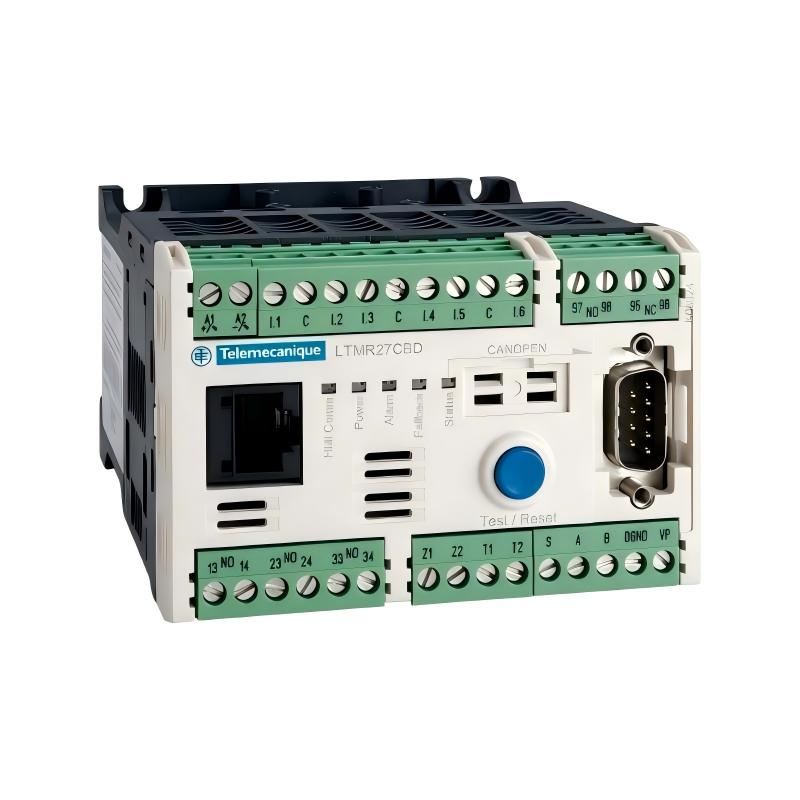
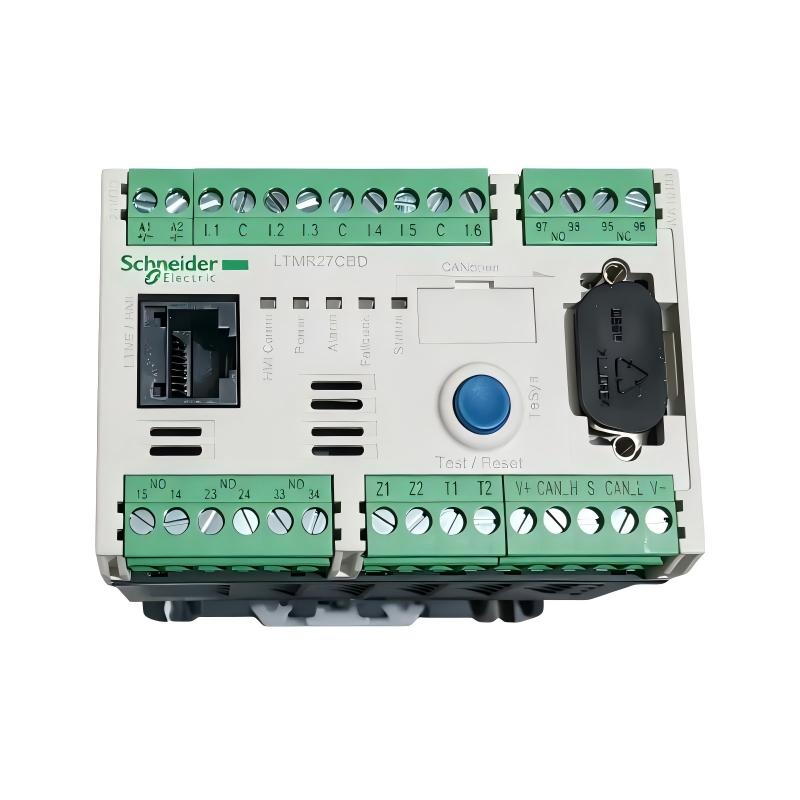
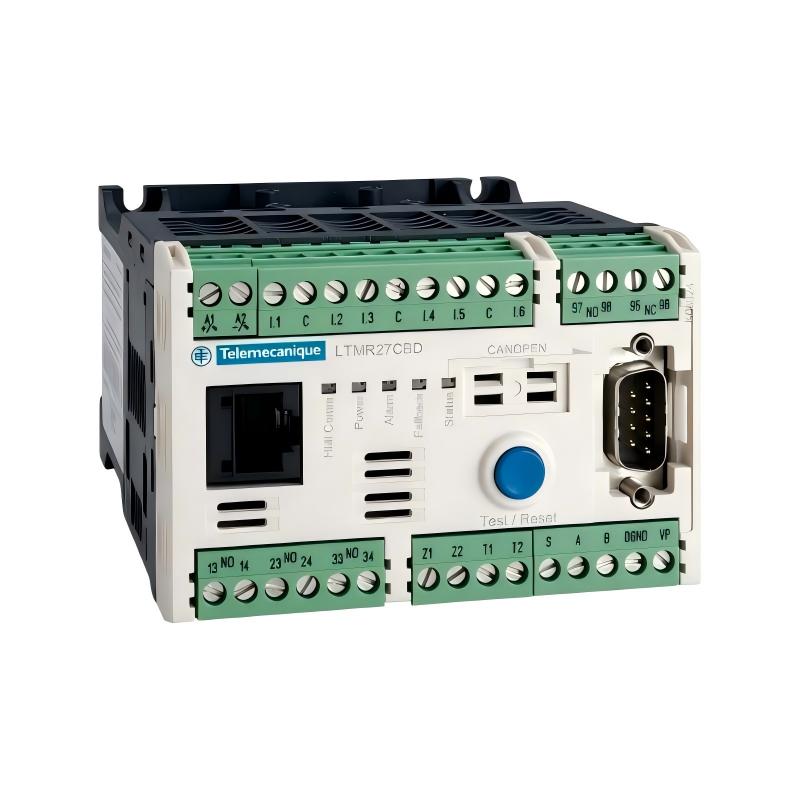
The Schneider Electric LTMR27CBD TeSys T Motor Controller is an intelligent motor management controller designed for monitoring, controlling, and protecting industrial electric motors. As part of the TeSys T motor management system, it combines motor-current measurement, configurable control logic, communication capabilities, and diagnostic functions in a compact industrial control device.
Motor management is essential in industrial facilities where pumps, fans, conveyors, compressors, and other motor-driven equipment operate continuously or under changing load conditions. Electrical overloads, phase-related faults, excessive starting time, locked-rotor conditions, and abnormal operating temperatures can interrupt production and damage equipment. A motor management controller helps detect these conditions and coordinate appropriate control or protective responses.
The LTMR27CBD is designed for a motor-current measurement range of 1.35–27 A and uses a 24 V DC control supply. Its communication interface supports the CANopen protocol, allowing it to exchange operating information and control data with compatible automation equipment.
The controller includes six discrete logic inputs, three relay logic outputs, and a separate relay output for fault signalling. It also provides connections for motor temperature monitoring and an external ground-current sensor. These functions support a more comprehensive approach to motor supervision than a conventional overload relay alone.
The LTMR27CBD can be integrated into PLC-based control architectures and used with compatible TeSys T system components. However, successful integration depends on the CANopen network configuration, electrical wiring, motor parameters, and protective devices selected for the application.
The model is now discontinued, so maintenance teams and purchasing departments should verify the exact catalog number, condition, and availability when sourcing replacement equipment.
Technical Specifications
| Parameter | Specification |
|---|---|
| Brand | Schneider Electric |
| Product Family | TeSys T |
| Model | LTMR27CBD |
| Product Type | Motor Management Controller |
| Device Application | Motor monitoring and control |
| Control Supply Voltage | 24 V DC |
| Permitted Supply Range | 20.4–26.4 V DC, subject to the applicable product documentation |
| Motor Current Measurement Range | 1.35–27 A |
| Communication Protocol | CANopen |
| Logic Inputs | 6 discrete inputs |
| Relay Logic Outputs | 3 relay outputs |
| Fault Signalling Output | 1 relay output with normally open and normally closed contacts |
| Motor Temperature Monitoring | Connection for a compatible temperature probe |
| Ground-Current Monitoring | Connection for an external ground-current sensor |
| Communication Interface | CANopen-compatible interface |
| Dimensions Provided | 91 × 61 × 122.5 mm |
| Weight Provided | 0.53 kg |
| Product Lifecycle | Discontinued |
| Typical Application | Industrial motor monitoring, control, and protection |
Always confirm the product nameplate and applicable technical documentation before installation. Electrical ratings, sensor compatibility, and communication settings must be checked against the actual system configuration.
Function and Working Principle
The LTMR27CBD operates as the central monitoring and control component of a TeSys T motor management installation. It receives measurements and control signals, evaluates them against configured parameters, and communicates operating status or fault information to connected automation equipment.
1. Motor Current Measurement
Motor current provides important information about electrical loading and operating conditions. The LTMR27CBD measures motor current within its specified 1.35–27 A range, allowing it to support current-based monitoring and protection functions.
When the motor is operating normally, the controller can track current values and provide information for supervisory control. If the current exceeds configured limits or a monitored condition indicates a fault, the controller can initiate an alarm or trip response according to its settings.
Correct configuration is important because motor current varies with load, starting conditions, and the characteristics of the connected equipment.
2. Motor Protection
The controller supports configurable motor-protection functions. Depending on the selected settings and system arrangement, these may include thermal overload, phase failure, phase imbalance, locked-rotor detection, and ground-fault monitoring through an appropriate external sensor.
These functions help identify abnormal conditions before they cause extended downtime or damage to motor windings and mechanical components.
The controller should be used with the short-circuit protection and switching equipment required by the application. Its motor-protection features do not eliminate the need for properly rated fuses or circuit breakers, contactors, and compliant electrical installation practices.
3. Motor Control Logic
The LTMR27CBD supports configurable motor-control modes. The available logic inputs and relay outputs allow the controller to interact with external control circuits and switching equipment.
Depending on the application configuration, control functions may include overload management, independent motor operation, reversing, two-speed operation, or other supported control arrangements.
The specific control mode must be selected and tested during commissioning. The controller should not be assumed to replace every component in a motor starter or safety circuit.
4. Temperature Monitoring
Motor temperature is an important indicator of operating stress. The LTMR27CBD provides a connection for a compatible temperature probe, allowing temperature-related information to be incorporated into motor monitoring.
Temperature monitoring can help identify conditions associated with inadequate cooling, excessive loading, or abnormal operating environments. The sensor type and configuration must be compatible with the controller’s specifications.
5. Fault Detection and Diagnostics
The controller provides diagnostic information to help maintenance personnel identify abnormal motor conditions. Depending on configuration, this can include trip history, alarm information, current-related data, and operating statistics.
Such information can support troubleshooting and help maintenance teams distinguish between electrical problems, load-related issues, and control-system faults.
Role in Industrial Automation Systems
The LTMR27CBD is designed to operate as part of a wider motor management and automation architecture. It connects motor measurements and local control functions with supervisory equipment, enabling motor status and faults to be incorporated into the plant’s operating strategy.
PLC Integration
A programmable logic controller can communicate with the LTMR27CBD through a compatible CANopen network. This arrangement allows the PLC to exchange supported data with the motor controller and coordinate motor operation with other equipment.
For example, a PLC may monitor motor status, respond to a fault indication, prevent a downstream machine from starting, or report an abnormal condition to the operator.
Successful integration requires compatible CANopen interfaces, correct node addressing, matching communication settings, and appropriate network wiring.
HMI and Operator Monitoring
A human-machine interface can display motor status, alarms, and relevant operating information. Operators can use this information to identify abnormal conditions and follow the plant’s established response procedures.
The HMI may communicate through the PLC or use a compatible TeSys T interface, depending on the system design. The exact arrangement should be confirmed before commissioning.
Motor Starter Coordination
The controller can be integrated with a compatible motor starter and contactor arrangement. It monitors operating conditions and coordinates control or protection responses, while the associated switching equipment performs the required power switching.
For dependable operation, the controller, contactor, short-circuit protection, and motor must be selected as a coordinated system.
Plant-Level Monitoring
When integrated into a supervisory control system, the LTMR27CBD can help provide motor-related information for maintenance planning and operational analysis. Motor status and fault records may help teams investigate repeated trips, unusual loading, or recurring process interruptions.
The available information depends on the configured controller, communication network, and supervisory software.
Industrial Applications
The LTMR27CBD is intended for industrial motor management where monitoring, control, and protection are important to equipment availability.
1. Pumping Systems
Industrial pumps are used in water treatment, chemical processing, cooling systems, and general manufacturing. Motor current and fault monitoring can help identify abnormal loading and protect the motor from selected electrical operating conditions.
When used with a compatible starter and control system, the LTMR27CBD can contribute to pump supervision and fault reporting.
2. Conveyor Systems
Conveyor motors operate under changing material loads and may be affected by mechanical obstruction, overload, or starting problems. Motor management functions can help detect abnormal operating conditions and communicate faults to the PLC.
The controller can be incorporated into a conveyor control architecture to support coordinated shutdowns and maintenance alerts.
3. Fans and Ventilation Equipment
Industrial fans are used in ventilation, cooling, extraction, and process-air systems. Motor monitoring can help detect electrical abnormalities and provide information for troubleshooting.
The appropriate current range, motor characteristics, switching arrangement, and protection settings must be confirmed for each fan installation.
4. Compressors and Auxiliary Machinery
Compressors and auxiliary motor-driven machines can experience changing load conditions and demanding operating cycles. Motor protection and diagnostic information can help maintenance teams respond to abnormal current, temperature, or phase conditions.
The LTMR27CBD should only be used where its ratings and supported control functions match the application requirements.
5. Water and Wastewater Facilities
Pumps, mixers, and ventilation motors are widely used in water and wastewater facilities. Motor management controllers can help improve visibility into motor status and support fault reporting within a plant’s PLC or supervisory system.
The controller’s role is to support monitoring and protection; it does not independently guarantee uninterrupted operation or replace process-level safety measures.
6. Manufacturing and Process Industries
Manufacturing plants rely on motors for material handling, machine auxiliaries, and production equipment. The LTMR27CBD can support centralized monitoring of compatible motor circuits and help maintenance teams identify faults before equipment is returned to service.
Installation and System Integration
Proper installation is necessary for reliable motor monitoring, communication, and protective operation.
1. Verify the Motor Current Range
Before installation, confirm that the motor’s operating current falls within the controller’s 1.35–27 A measurement range.
The selection should account for the motor nameplate, expected operating load, starting characteristics, and applicable protection requirements. A motor should not be considered compatible based only on its rated power.
2. Provide the Correct Control Supply
The LTMR27CBD requires a 24 V DC control supply. Verify polarity, voltage stability, available current, and the requirements of connected control devices.
Use appropriate protective measures for the control circuit and ensure that wiring follows the manufacturer’s installation instructions.
3. Configure the CANopen Network
The controller communicates using CANopen. Network commissioning should include node addressing, communication speed, device configuration, cable routing, termination, and verification of the network topology.
Incorrect addressing or termination can prevent reliable communication between the controller and PLC.
The controller should not be treated as a Modbus or Ethernet device simply because other models in the TeSys T family support those protocols. The exact model suffix identifies the communication variant.
4. Connect Sensors and Control Wiring
Connect the motor-current measurement circuits, temperature probe, external ground-current sensor, logic inputs, and relay outputs according to the product documentation.
Use compatible sensors and observe the specified wiring requirements. Incorrect sensor selection or wiring may result in unreliable measurements or inappropriate protection responses.
5. Coordinate the Contactor and Protective Devices
The LTMR27CBD should be used with appropriate short-circuit protection and motor-switching equipment. Confirm the contactor ratings, protective-device coordination, motor current, and control-circuit arrangement.
If the system includes reversing or other complex control modes, verify the interlocks and control sequence before allowing normal operation.
6. Test the Protection Functions
During commissioning, test the configured motor-control logic, communication, fault signalling, and relevant protective functions using the manufacturer’s recommended procedures.
Confirm that faults are reported correctly and that the associated contactor or control logic responds as intended. Do not rely on a fault indicator alone without validating the overall protection sequence.
7. Document the Configuration
Record the controller settings, CANopen node address, communication parameters, motor nameplate information, and protection thresholds. Keep these records available for troubleshooting and replacement.
A documented configuration helps reduce commissioning time when a controller must be replaced.
Compatible System Components
The LTMR27CBD is part of a TeSys T motor management architecture. The exact compatible components depend on the application, motor circuit, communication design, and required functions.
| Component | Function | Integration Considerations |
|---|---|---|
| PLC with CANopen support | Supervisory control and motor coordination | Verify network compatibility and supported data exchange |
| Compatible HMI | Displays motor status and alarms | Confirm the interface and software configuration |
| TeSys T expansion module | Adds supported measurement or I/O capabilities | Check the specific module and system configuration |
| Motor contactor | Switches the motor power circuit | Select according to motor duty and electrical ratings |
| Short-circuit protection | Protects against short-circuit faults | Coordinate with the motor starter and applicable regulations |
| Motor temperature probe | Supplies temperature-related information | Confirm sensor compatibility |
| External ground-current sensor | Supports ground-fault monitoring | Select and connect according to the controller documentation |
| 24 V DC power supply | Powers the controller and compatible control circuits | Verify voltage stability and current capacity |
| CANopen network cable and accessories | Connects the controller to the automation network | Follow the required cable, topology, and termination specifications |
| Three-phase AC motor | Driven equipment being monitored and controlled | Confirm motor current and operating characteristics |
These components are examples of equipment used in a complete motor management system. They are not necessarily included with the LTMR27CBD.
Alternative Models and Replacement Considerations
Schneider Electric lists the LTMR27CBD as discontinued and does not identify a direct replacement for this exact catalog number. Replacement selection should therefore begin with the application’s requirements rather than assuming another TeSys T controller is a drop-in substitute.
| Alternative or Related Model | Key Difference |
|---|---|
| LTMR27MBD | 24 V DC TeSys T controller with Modbus communication |
| LTMR27EBD | 24 V DC TeSys T controller with Ethernet-based Modbus TCP and EtherNet/IP communication |
| LTMR27PBD | 24 V DC TeSys T controller with PROFIBUS DP communication |
| LTMR27DBD | 24 V DC TeSys T controller with DeviceNet communication |
| LTMR27CFM | CANopen variant with a 100–240 V AC control supply rather than 24 V DC |
These are related models, not automatic replacements. Their communication protocols or control supply requirements differ, and the availability of each model should be checked independently.
Before approving a replacement, compare:
- Motor-current measurement range.
- Control supply voltage.
- CANopen network requirements and PLC compatibility.
- Number and type of logic inputs and outputs.
- Motor-control modes and protection functions.
- Temperature and ground-current sensor compatibility.
- Physical dimensions and mounting requirements.
- PLC configuration, network addressing, and commissioning requirements.
If the existing installation uses CANopen, replacing the LTMR27CBD with a controller using another protocol may require network changes, PLC program modifications, and a new commissioning process.
Key Advantages
Integrated Motor Monitoring
The controller combines current measurement and motor-management functions to provide information about operating conditions and selected fault states.
Configurable Protection
Supported protection functions help identify abnormal electrical and motor operating conditions when configured for the application.
CANopen Communication
The CANopen interface enables communication with compatible PLCs and other automation equipment, supporting centralized monitoring and coordinated control.
Multiple Logic Inputs and Relay Outputs
Six logic inputs and three relay logic outputs provide interfaces for control signals and external equipment. A separate relay output supports fault signalling.
Temperature and Ground-Current Monitoring Connections
The controller supports connection of compatible motor-temperature and external ground-current sensors, expanding the range of conditions that can be monitored.
Industrial Motor Management
The TeSys T architecture allows motor monitoring, protection, and control to be incorporated into a coordinated motor starter and automation system.
Diagnostic Support
Operating and fault information can help maintenance personnel investigate trips and identify potential causes of motor-related downtime.
Technical FAQs
1. What is the Schneider Electric LTMR27CBD?
The LTMR27CBD is a TeSys T motor management controller designed to monitor, control, and protect compatible industrial motors.
2. What is its motor-current range?
Its specified measurement range is 1.35–27 A. Confirm the motor’s actual current and application requirements before using the controller.
3. What control supply does it require?
The LTMR27CBD uses a 24 V DC control supply. It should not be confused with related TeSys T variants designed for a 100–240 V AC control supply.
4. Which communication protocol does it use?
The LTMR27CBD uses CANopen. PLC and network compatibility should be verified before installation.
5. How many logic inputs and outputs are available?
The controller has six discrete logic inputs, three relay logic outputs, and a separate relay output for fault signalling.
6. Can it be used with a PLC?
Yes. It can communicate with a compatible PLC over CANopen. Network addressing, communication settings, and the PLC configuration must be set correctly.
7. Does it provide motor protection?
It supports configurable motor-protection functions, including relevant overload and phase-related protection. The actual protection arrangement depends on the configuration, sensors, and associated switching and short-circuit protection equipment.
8. Is the LTMR27CBD still in production?
Schneider Electric lists this model as discontinued, with a discontinuation date of July 31, 2025. The manufacturer does not list a direct replacement for this exact reference.
9. Can the LTMR27MBD replace the LTMR27CBD?
Not as a direct protocol-equivalent replacement. The LTMR27MBD uses Modbus, while the LTMR27CBD uses CANopen. Replacing one with the other may require network and PLC changes.
10. What should be checked before purchasing a replacement?
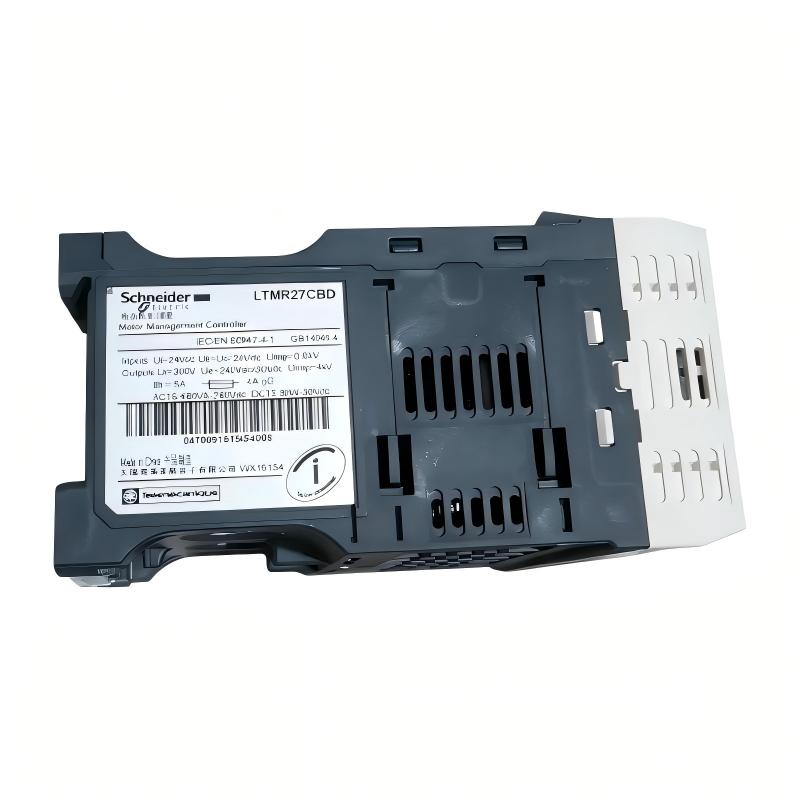
Verify the complete model number, control supply, current range, communication protocol, physical condition, and required accessories. For used or refurbished equipment, request clear nameplate photographs and available functional-test information.
Procurement and Maintenance Recommendations
Since the LTMR27CBD is discontinued, procurement teams should confirm availability and condition before placing an order. The complete catalog number must match the intended CANopen and 24 V DC configuration.
For used or surplus units, request photographs of the nameplate and terminals, confirm the condition of the connectors and housing, and ask whether functional testing has been performed. Verify warranty and return terms, particularly when the controller will be installed in a critical motor-control circuit.
During maintenance, review trip history and motor operating data where available. Check control wiring, CANopen communication, terminal connections, and the condition of associated contactors and protective devices. Sensor wiring should be inspected according to the applicable maintenance procedure.
Keep a record of the motor parameters, protection settings, CANopen node address, and PLC configuration. When replacing the controller, test communication and protection responses before returning the motor to normal operation.
If a direct replacement cannot be sourced, evaluate related TeSys T models or a current motor management solution based on the required communication protocol, control voltage, current range, and protection functions. A change in protocol may require engineering modifications and recommissioning.
Conclusion
The Schneider Electric LTMR27CBD TeSys T Motor Controller is an industrial motor management device with a 1.35–27 A measurement range, 24 V DC control supply, and CANopen communication. Its six logic inputs, relay outputs, motor-temperature connection, and external ground-current sensor interface support monitoring, control, and protection within a suitable motor starter architecture.
For maintenance and replacement projects, the key selection criteria are the motor-current range, control supply, communication protocol, sensor compatibility, and protective-device coordination. Because the LTMR27CBD is discontinued, accurate identification and careful compatibility checks are essential when sourcing spare equipment or planning a system upgrade.