Product Overview
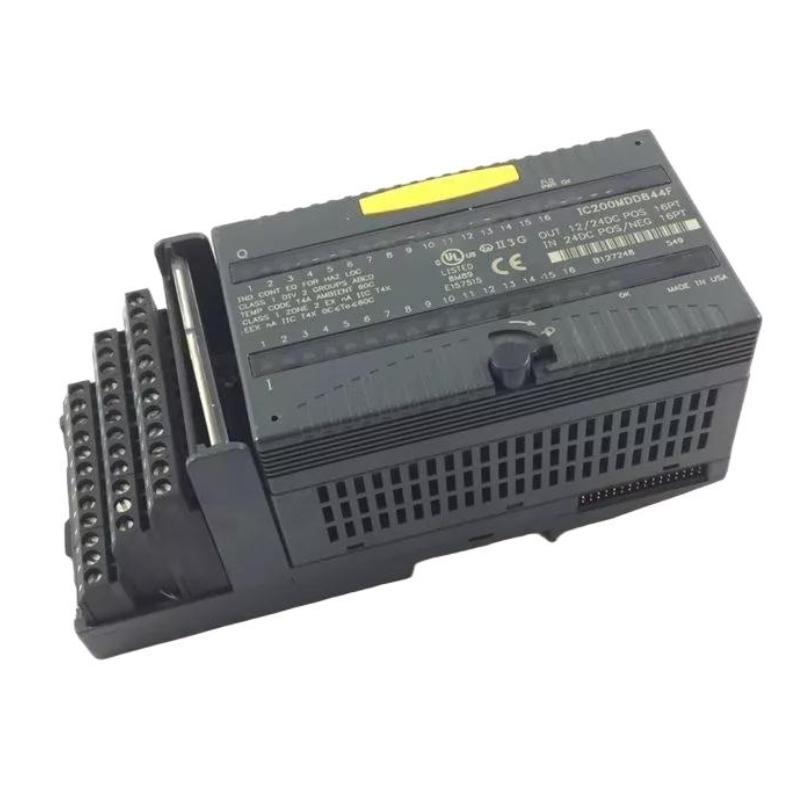
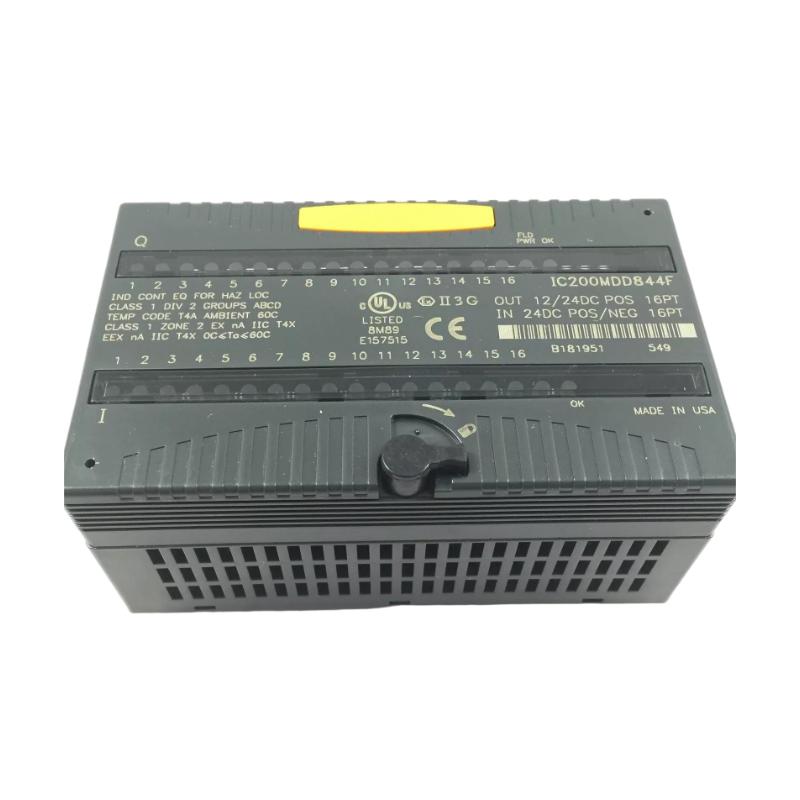
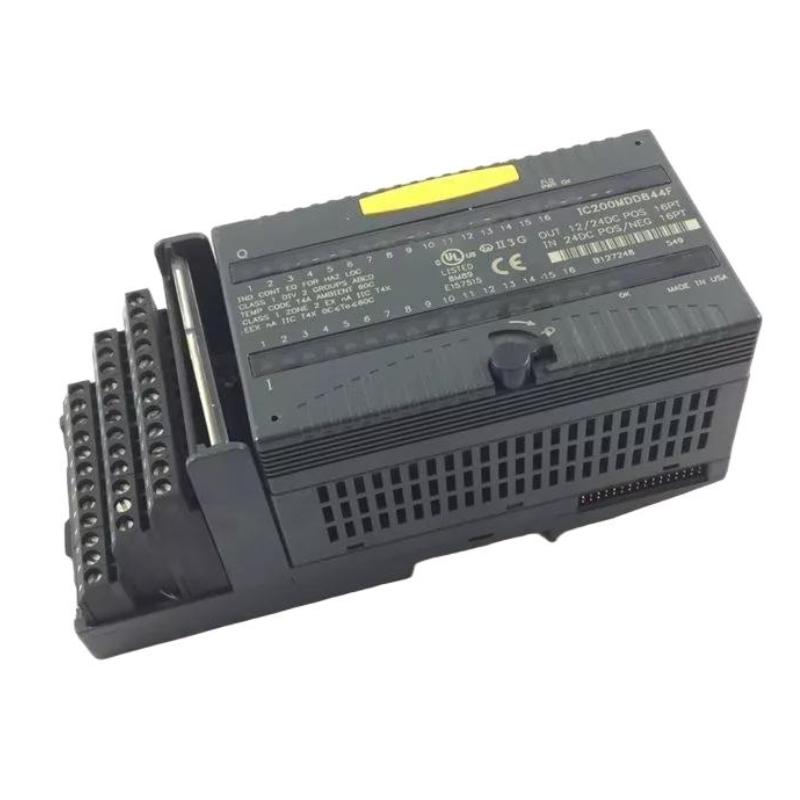
The GE IC200MDD844 VersaMax Discrete Hybrid I/O Module is a modular digital I/O component designed for GE VersaMax industrial automation systems. It is intended for applications where a control system needs to interface with discrete field devices while maintaining a compact and organized I/O architecture.
In an industrial PLC system, field signals generally fall into two basic categories. Input signals provide information about the machine, while output signals allow the controller to command external devices. Sensors, switches and auxiliary contacts can provide machine-status information, while relays, solenoids, indicators and other actuators can receive control commands.
A discrete hybrid I/O module combines these types of discrete interfacing within a modular control system. This makes the IC200MDD844 suitable for machinery where monitoring and control of discrete devices are both required.
The IC200MDD844 is not a central processing unit. Instead, it operates as part of the VersaMax I/O architecture, working with the system CPU and other supporting components. The CPU executes the application logic while the I/O module provides the interface between the control program and connected field equipment.
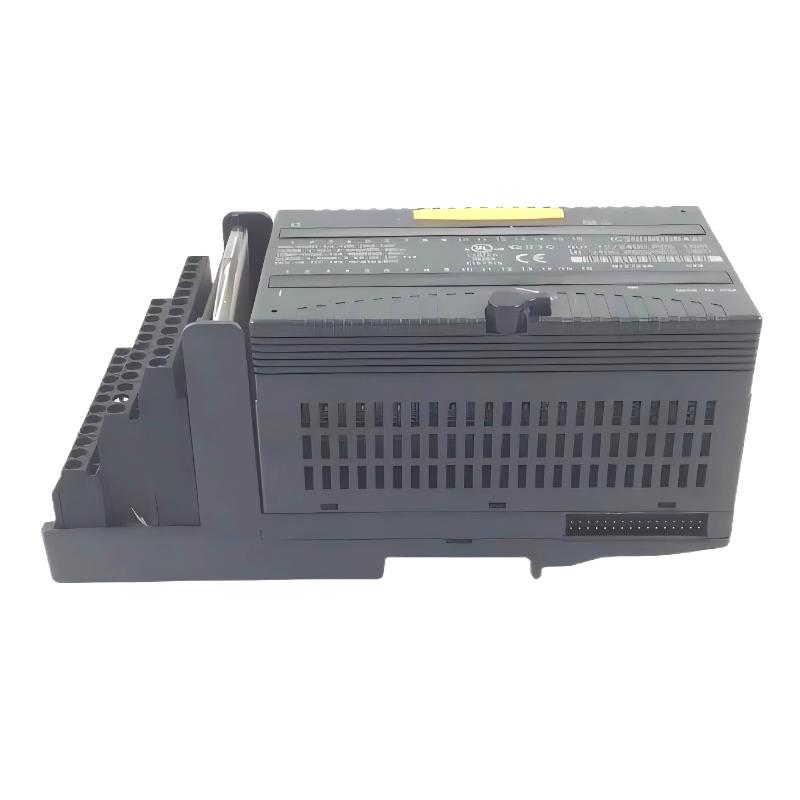
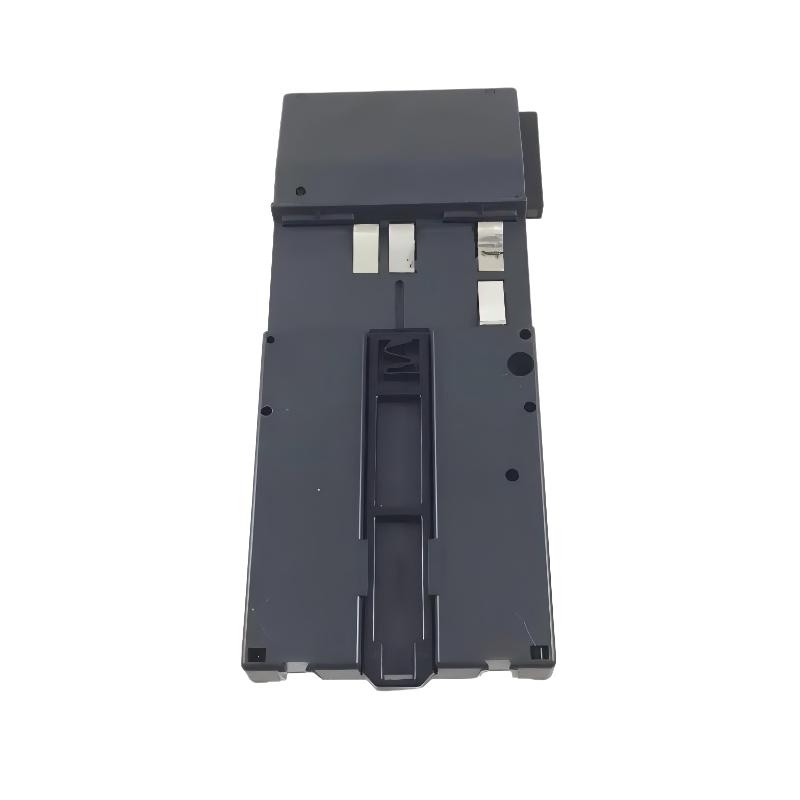
The specified dimensions of the IC200MDD844 are 133.4 × 85.9 × 69.1 mm, and the specified weight is approximately 0.159 kg. Its compact size makes it suitable for industrial control cabinets, machine-control panels and OEM automation equipment.
Technical Specifications
| Parameter |
Details |
| Manufacturer |
GE / GE Fanuc |
| Product Series |
VersaMax |
| Model |
IC200MDD844 |
| Product Type |
Discrete Hybrid I/O Module |
| I/O Category |
Discrete / Digital |
| Main Function |
Discrete field signal interfacing |
| Input Function |
Discrete signal acquisition |
| Output Function |
Discrete device control |
| Application |
Industrial automation and machine control |
| Dimensions |
133.4 × 85.9 × 69.1 mm |
| Weight |
0.159 kg |
| Installation |
VersaMax modular I/O system |
| Signal Category |
Digital / two-state signals |
| System Architecture |
Modular PLC / I/O |
| Controller Relationship |
Interfaces field devices with VersaMax control |
| Typical Application |
Machine and production automation |
| Installation Environment |
Industrial control cabinet |
| Maintenance |
Modular I/O replacement |
| Mounting |
VersaMax system-dependent installation |
Function and Working Principle
The primary purpose of the IC200MDD844 is to provide discrete I/O interfacing between a VersaMax control system and compatible industrial field devices.
Discrete signals normally represent clearly defined states, such as:
- ON / OFF
- Open / Closed
- Active / Inactive
- Running / Stopped
- Detected / Not detected
- Extended / Retracted
The I/O module transfers field information to the controller and allows control commands from the PLC to reach the appropriate field devices.
A simplified architecture is:
Sensors / Switches → IC200MDD844 → VersaMax CPU
and:
VersaMax CPU → IC200MDD844 → Control Devices
The CPU executes the control program. The IC200MDD844 provides the interface through which the machine communicates electrically with that control program.
Discrete Input Function
Discrete input signals can originate from sensors, switches and machine-status contacts.
Examples include:
- Proximity sensors
- Limit switches
- Pushbuttons
- Position switches
- Equipment auxiliary contacts
- Product-detection sensors
- Machine interlock signals
The general process is:
Physical Event → Field Sensor → IC200MDD844 → PLC Input Status
The PLC program can then evaluate the input and determine the next machine operation.
For example, when a proximity sensor detects a component, the corresponding discrete input can provide the PLC with confirmation that the component has reached the expected position.
Discrete Output Function
The output side of a hybrid I/O system provides control signals to compatible external devices.
Potential applications include:
- Relay interfaces
- Solenoid valves
- Indicator devices
- Actuator circuits
- Machine-control interfaces
The general process is:
PLC Logic → IC200MDD844 → Output Circuit → Field Device
This allows programmed commands to control machine operations.
Role in Industrial Control Systems
The IC200MDD844 serves as an interface between the VersaMax controller and the physical machine.
A simplified automation architecture is:
Field Sensors
↓
IC200MDD844
↓
VersaMax CPU
↓
Control Logic
↓
IC200MDD844
↓
Actuators / Control Devices
This architecture separates the processing function from the field interface.
The CPU is responsible for executing the application program, while the I/O module provides the electrical connection to external devices.
This arrangement is useful in machine automation applications where many physical conditions need to be monitored and corresponding control actions need to be performed.
Industrial Applications
The GE IC200MDD844 can be used as part of VersaMax-based industrial automation systems in applications such as:
- Factory automation
- Packaging machinery
- Conveyor systems
- Assembly machines
- Material-handling equipment
- Manufacturing lines
- Production machinery
- Machine-control panels
- OEM automation equipment
- Equipment status monitoring
- Automated handling systems
- Industrial machine control
- Production sequencing
- Process-support equipment
Its compact form factor is particularly useful in applications where control-panel space is limited.
Machine Status Monitoring
One important application for discrete I/O is machine-status monitoring.
A production machine may need to determine whether:
- A motor is running
- A guard is closed
- A cylinder has reached its position
- A product is present
- A conveyor has reached a limit
- A machine is ready
- A safety-related interlock is active
The signal path can be represented as:
Machine Condition → Sensor / Contact → IC200MDD844 → VersaMax CPU
The PLC program can then use the status information to determine whether the next step in the machine sequence is permitted.
For example, a machine may wait for a cylinder-retracted signal before activating a conveyor. This type of interlocking logic is common in automated machinery.
Discrete Output Control
The IC200MDD844 can also participate in discrete output control applications.
A PLC program may determine that a particular machine operation needs to occur. The control command is then transferred through the appropriate I/O interface to the connected field device.
Examples include:
PLC → Output → Solenoid → Pneumatic Cylinder
or:
PLC → Output → Relay → Motor Control Circuit
or:
PLC → Output → Indicator → Machine Status Display
The exact electrical interface must be compatible with the connected device and system configuration.
Hybrid I/O in Machine Automation
Hybrid I/O can simplify an automation architecture when both input and output functions are required.
| I/O Category |
Primary Function |
Typical Devices |
| Discrete Input |
Receives digital signals |
Sensors, switches, contacts |
| Discrete Output |
Sends digital commands |
Relays, solenoids, indicators |
| Discrete Hybrid I/O |
Combines discrete input and output functions |
Mixed machine devices |
| Analog Input |
Measures variable signals |
Temperature, pressure, flow |
| Analog Output |
Generates variable signals |
Control valves, drives |
| High-Speed Counter |
Processes pulse signals |
Encoders, pulse sensors |
The IC200MDD844 belongs to the discrete hybrid category. It should therefore be selected according to the actual input/output requirements of the machine.
Installation and System Integration
Correct installation is essential for reliable operation.
Mechanical Installation
Before installing the IC200MDD844, verify:
- Correct model number
- Compatible VersaMax architecture
- Appropriate mounting location
- Correct I/O arrangement
- Adequate cabinet clearance
- Proper mechanical engagement
The specified dimensions are 133.4 × 85.9 × 69.1 mm, so sufficient space should be maintained for installation, wiring and future maintenance.
Field Wiring
Field wiring should be planned according to the actual application.
Input connections may involve:
- Proximity sensors
- Limit switches
- Pushbuttons
- Auxiliary contacts
- Position sensors
- Equipment feedback
Output connections may involve:
- Relays
- Solenoid valves
- Indicators
- Actuator interfaces
- Other compatible control circuits
All connections should be inspected for secure termination and correct routing.
Electrical Verification
Before commissioning, verify:
- The correct IC200MDD844 model is installed.
- The module is properly seated.
- Field wiring matches the control design.
- Terminal connections are secure.
- Connected devices are electrically compatible.
- There are no unintended short circuits.
- System power is correct.
- PLC configuration matches the hardware installation.
Commissioning
A practical commissioning procedure is:
- Install the module.
- Verify the physical installation.
- Connect the required field devices.
- Inspect all wiring.
- Verify system power.
- Confirm the PLC configuration.
- Energize the system.
- Test each required input.
- Verify corresponding PLC status.
- Test output commands individually.
- Confirm field-device response.
- Run a controlled machine sequence.
Testing inputs and outputs individually before full automatic operation can make troubleshooting much easier.
Compatible System Components
The IC200MDD844 normally operates as part of a larger VersaMax system.
| Component |
Function |
| VersaMax CPU Module |
Executes PLC application logic |
| VersaMax Power Module |
Supports system power |
| IC200MDD844 |
Provides discrete hybrid I/O functionality |
| Digital Input Module |
Provides additional discrete inputs |
| Digital Output Module |
Provides additional discrete outputs |
| High-Speed Counter Module |
Handles high-speed pulse applications |
| Analog Input Module |
Processes analog measurements |
| Analog Output Module |
Provides analog control signals |
| I/O Carrier |
Provides module interface |
| Terminal Base |
Provides field wiring connections |
| Sensors |
Generates machine-status signals |
| Relays |
Provides switching interfaces |
| Solenoids |
Performs pneumatic or hydraulic control |
| Actuators |
Performs machine operations |
The exact combination depends on the system architecture and application requirements.
Application Example: Automated Assembly Machine
Consider an automated assembly machine that must detect components and operate mechanical actuators.
The machine may use:
- Component-detection sensors
- Position switches
- Cylinder feedback
- Motor-status contacts
- Guard switches
These signals can provide information to the PLC.
The PLC may then control:
- Solenoid valves
- Relays
- Indicators
- Actuator interfaces
A simplified control sequence is:
Component Detection
↓
IC200MDD844
↓
VersaMax CPU
↓
Application Logic
↓
IC200MDD844
↓
Actuator Operation
This architecture allows the machine to make decisions based on actual field conditions.
Application Example: Conveyor Control
A conveyor system can also benefit from a discrete I/O architecture.
Typical inputs may include:
- Product sensors
- End-of-conveyor switches
- Motor auxiliary contacts
- Jam-detection switches
- Position sensors
Typical outputs may include:
- Motor-control interfaces
- Warning indicators
- Solenoid mechanisms
- Diverter actuators
The PLC uses the input conditions to determine which output commands should be issued.
For example:
Product Detected → PLC Logic → Diverter Command → Actuator
The I/O module forms the field interface for this control sequence.
Installation Considerations for Replacement Projects
When replacing an existing module, physical dimensions should not be the only consideration.
Engineers should verify:
- Exact model number
- I/O type
- Existing field wiring
- System configuration
- CPU compatibility
- Terminal arrangement
- Application program
- Connected field devices
- Power requirements
- Environmental conditions
Two modules may have similar physical dimensions while serving different electrical or functional purposes.
For this reason, the complete control-system architecture should be reviewed before a replacement module is installed.
Discrete I/O Troubleshooting
If an input or output does not operate correctly, troubleshooting should follow the complete signal path.
A practical sequence is:
Power → Field Device → Wiring → I/O Module → PLC Configuration → Application Logic
Input Troubleshooting
If a field input is not detected:
- Check the sensor or switch.
- Verify its power supply.
- Inspect the field wiring.
- Check terminal connections.
- Verify the electrical signal.
- Check the module installation.
- Confirm the PLC configuration.
If only one point is affected, investigate the associated field circuit first.
If several points fail simultaneously, check common power, wiring and module-level conditions.
Output Troubleshooting
If an output does not control the expected device:
- Verify the PLC command.
- Check the output status.
- Inspect field wiring.
- Verify the connected device.
- Check the control circuit.
- Confirm electrical compatibility.
- Test the external device independently where appropriate.
This process can help distinguish an I/O problem from a field-device or PLC-program problem.
Common Fault Conditions
| Symptom |
Possible Area to Check |
| Input remains inactive |
Sensor, wiring, power or configuration |
| Input remains active |
Field device, wiring or input circuit |
| Multiple inputs fail |
Common power, wiring or module |
| Output does not activate |
PLC logic, configuration, wiring or load |
| Output status changes but field device does not respond |
Field circuit or connected device |
| I/O operation is intermittent |
Loose connection, noise or field-device issue |
| Unexpected output activation |
PLC logic, configuration or wiring |
| Module appears unavailable |
Power, installation or system configuration |
A structured troubleshooting procedure is generally more effective than immediately replacing the module.
Recommended Alternative Models
Depending on the system requirements, the following VersaMax models may be considered for related applications.
| Recommended Model |
Type |
Key Feature |
Application |
| IC200MDD840 |
Discrete Hybrid I/O Module |
Combined discrete I/O |
Mixed machine-control applications |
| IC200MDD841 |
High-Speed Counter Module |
High-speed pulse processing |
Encoder and counting applications |
| IC200MDD842 |
Discrete Hybrid I/O Module |
Combined digital I/O |
Machine automation |
| IC200MDD843 |
Discrete Hybrid I/O Module |
Discrete field interfacing |
Mixed I/O applications |
| IC200MDL650 |
Discrete Input Module |
Digital input acquisition |
Sensor and switch monitoring |
| IC200MDL750 |
Discrete Output Module |
Digital output control |
Relay and actuator applications |
| IC200CPU001 |
VersaMax CPU Module |
PLC processing |
Central machine control |
| IC200CPU002 |
VersaMax CPU Module |
PLC control processing |
Automation systems |
| IC200CPWR102 |
Power Module |
System power support |
VersaMax installations |
| IC200ERM002 |
Extended Receiver Module |
Extended I/O architecture |
Distributed I/O systems |
These models perform different functions. A suitable alternative should be selected only after comparing the required I/O configuration and complete VersaMax system architecture.
Key Advantages
- Designed for GE VersaMax automation systems
- Provides discrete hybrid I/O functionality
- Supports both field-signal monitoring and discrete control applications
- Suitable for modular PLC architectures
- Compact industrial form factor
- Suitable for machine-control panels
- Useful for packaging machinery
- Suitable for conveyor systems
- Useful for assembly equipment
- Suitable for material-handling applications
- Supports OEM automation equipment
- Integrates with VersaMax control architectures
- Dimensions of approximately 133.4 × 85.9 × 69.1 mm
- Weight of approximately 0.159 kg
- Suitable for applications requiring organized discrete I/O interfacing
Technical FAQs
What is GE IC200MDD844?
The GE IC200MDD844 is a VersaMax Discrete Hybrid I/O Module designed to interface compatible discrete field devices with a GE VersaMax control system.
What is the main function of IC200MDD844?
Its primary function is to provide discrete input and output interfacing for industrial automation applications.
What are the dimensions of IC200MDD844?
The specified dimensions are 133.4 × 85.9 × 69.1 mm.
What is the weight of IC200MDD844?
The specified weight is approximately 0.159 kg.
Is IC200MDD844 a PLC CPU?
No. It is an I/O module. The VersaMax CPU executes the application program and provides the main control processing.
What does “discrete hybrid I/O” mean?
It refers to an I/O module designed to provide a combination of discrete input and output functions within a modular automation system.
What devices can be monitored through discrete inputs?
Typical applications include compatible sensors, switches, position devices, auxiliary contacts and equipment-status signals.
What devices can be controlled through discrete outputs?
Depending on the applicable electrical interface, discrete outputs can be used for compatible relay circuits, solenoids, indicators and actuator interfaces.
Is IC200MDD844 an analog I/O module?
No. It is a discrete hybrid I/O module. Applications requiring variable analog measurements or analog control signals require appropriate analog I/O hardware.
Is IC200MDD844 designed for high-speed counting?
It is a discrete hybrid I/O module rather than a dedicated high-speed counter. Applications requiring specialized high-speed pulse counting should use an appropriate high-speed counter solution.
What should be checked when an input does not work?
Check the field sensor, power supply, wiring, terminal connections, I/O module installation and PLC configuration.
What should be checked when an output does not work?
Check the PLC logic, output status, field wiring, connected load and electrical compatibility of the external control circuit.
Can IC200MDD844 be used in a conveyor system?
Yes. A discrete hybrid I/O architecture can be used in conveyor applications involving product sensors, limit switches, equipment feedback and compatible discrete control devices.
Can IC200MDD844 be used in packaging machinery?
Yes. It can be incorporated into packaging-machine control architectures where compatible discrete input and output signals are required.
Conclusion
The GE IC200MDD844 VersaMax Discrete Hybrid I/O Module is a compact modular I/O component designed for discrete field interfacing in GE VersaMax industrial automation systems. Its role is to provide the connection between PLC control logic and compatible sensors, switches, relays, solenoids, indicators and other discrete field devices.
With specified dimensions of 133.4 × 85.9 × 69.1 mm and a weight of approximately 0.159 kg, the IC200MDD844 is suitable for applications where compact I/O hardware and organized machine-control architecture are important.
The module can support machine monitoring and control sequences in packaging systems, conveyor equipment, assembly machines, material-handling systems and other industrial automation applications. Working alongside a VersaMax CPU, power module, I/O carrier and field devices, it forms part of the interface between the PLC program and the physical production process.
For installation, maintenance or replacement projects, engineers should verify the exact I/O requirements, field wiring, system configuration and connected equipment before commissioning. When the application calls for discrete hybrid I/O within a VersaMax automation architecture, the GE IC200MDD844 provides a compact and practical solution for integrating field-level digital signals into the control system.