

ProductPRODUCT
Featured products
Contact Us
- Schneider
- OTB1E0DM9LP
- I/O Distributed Module
- France
- 55 × 90 × 70 mm
- 0.185 kg
- Xiamen, China
- New & In Stock
- T/T, PayPal, Western Union
- 1 Year
- 1-3 Working Days
- DHL, UPS, TNT, FedEx and EMS.
- 24-Hour Service
- COO
- 3
Our advantage

Global Logistics
We have a 10-year logistics and express cooperation agreement, so our products can be shipped to any place in the world.

Brand new and original
Our products are imported in bulk from the place of origin. Because of the cooperative relationship, our products are all original and 100% new.

24-hour service
We provide 7*24 hours service to our customers. We will be there whenever you need us.

Price advantage
All our products are priced very favorably because we have our own warehouse and supply.
| Company Information | |||
| [email protected] | |||
| Mobile | +8615980777398 | ||
| +8615980777398 | |||
| 15980777398 |
Product Overview
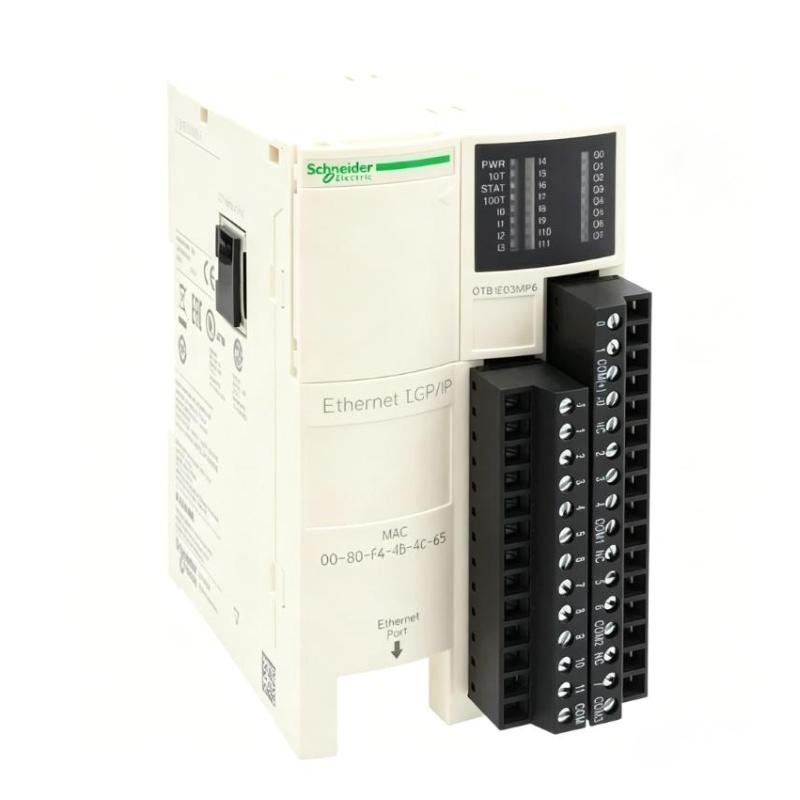
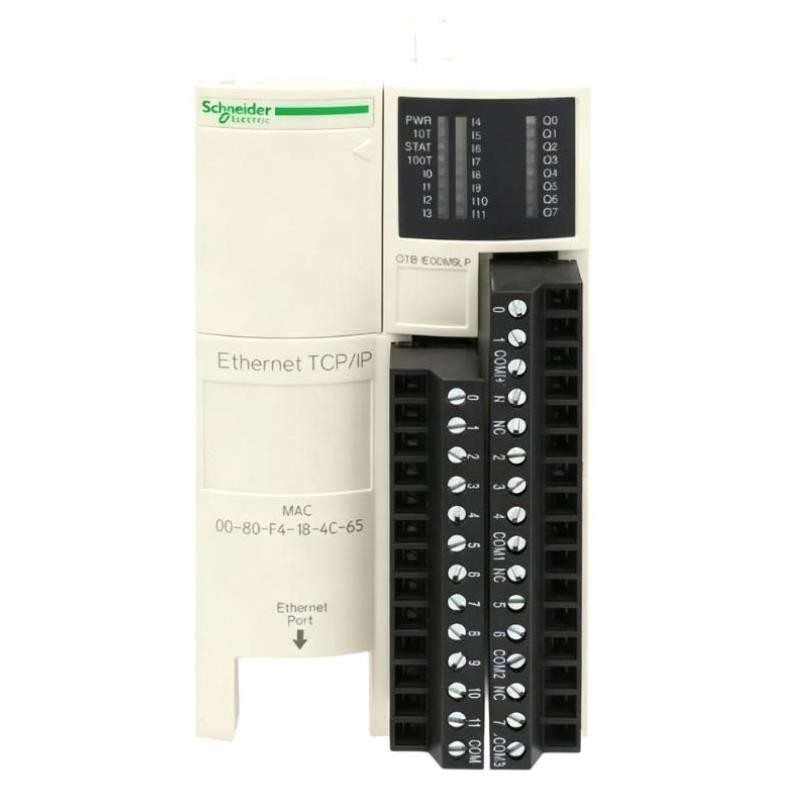
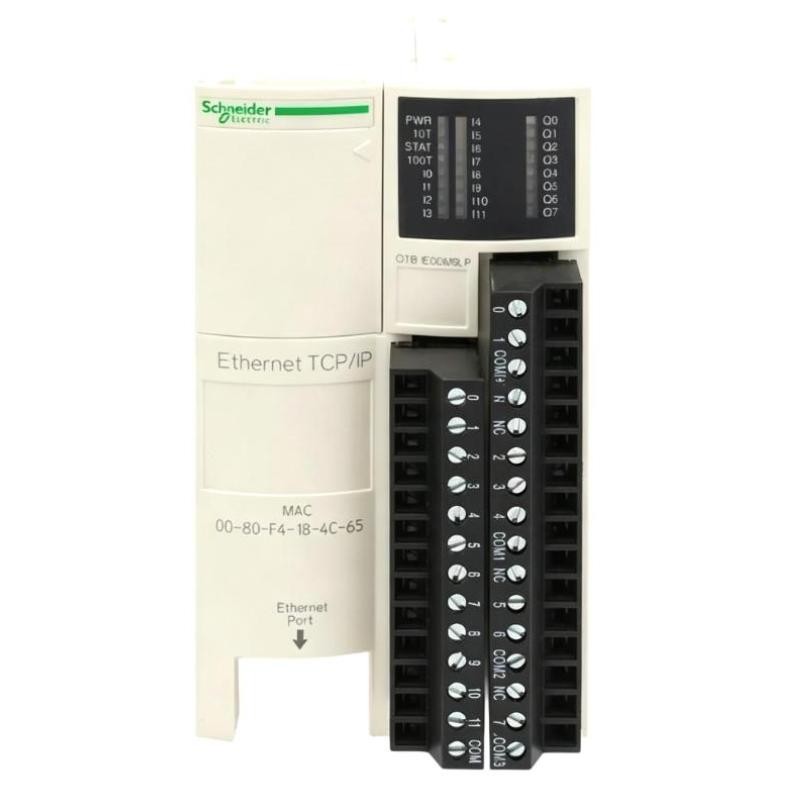
The Schneider OTB1E0DM9LP is an Advantys OTB distributed I/O module with an integrated Ethernet TCP/IP interface. It combines digital input and output channels with network communication in a single interface unit, allowing field devices to exchange signals with a compatible industrial controller over an Ethernet-based automation network.
The module has 12 discrete inputs, two solid-state transistor outputs, and six relay outputs. This combination allows it to handle different types of field signals within the same distributed I/O station. Push buttons, proximity sensors, limit switches, and other 24 V DC devices can be connected to the input channels, while the output channels can operate compatible control loads such as indicator lamps, interface relays, and small actuators within their electrical limits.
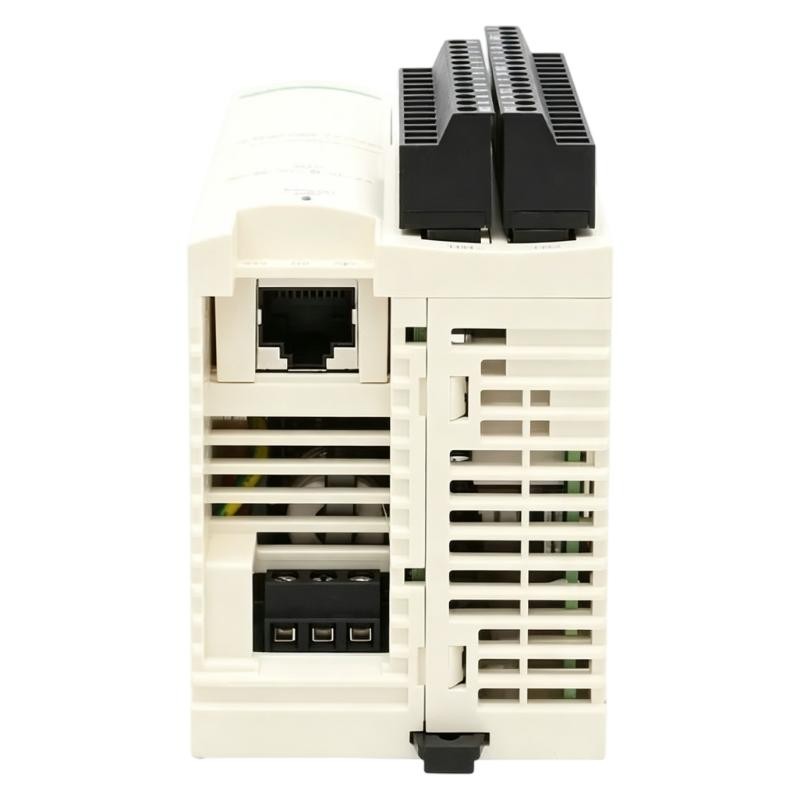
The Ethernet interface supports TCP/IP communication and Modbus messaging. In a machine with several field devices, this arrangement allows the controller to exchange input states and output commands with the distributed I/O station without routing every individual field signal back to a central control cabinet. The actual network architecture depends on the controller, communication settings, and connected equipment.
A practical application is a packaging machine where sensors detect product position, limit switches monitor moving assemblies, and output signals operate pneumatic valves or other control devices. The OTB1E0DM9LP collects the field signals and makes them available through the network interface, while output commands from the controller operate the connected loads.
The combination of transistor and relay outputs is useful when a machine contains different kinds of control loads. The transistor outputs are suited to compatible DC loads requiring electronic switching, while the relay outputs can switch compatible AC or DC circuits within their specified ratings. Each output type must be wired according to its electrical characteristics, and suitable external protection should be provided for the connected loads.
The module also supports expansion within the Advantys OTB system. Additional compatible I/O modules can be used where more field channels are needed, subject to the system’s configuration limits and installation requirements. This allows the distributed station to accommodate a wider range of machine signals without changing the overall control concept.
When integrating the OTB1E0DM9LP into an existing installation, the communication method and field wiring should be considered together. Ethernet communication handles the exchange of control data, while the input and output terminals connect directly to field devices. Correct addressing, network configuration, channel assignment, and output-load selection are essential to predictable operation.
The OTB1E0DM9LP is therefore suited to distributed control applications where Ethernet connectivity and a combination of digital input, transistor output, and relay output channels are needed in one interface module.
Technical Specifications
| Parameter | Specification |
|---|---|
| Manufacturer | Schneider Electric |
| Model | OTB1E0DM9LP |
| Product Family | Advantys OTB |
| Product Type | I/O Distributed Module |
| Integrated Communication Interface | Ethernet TCP/IP |
| Ethernet Port | RJ45 |
| Ethernet Data Rate | 10/100 Mbit/s |
| Communication Services | Modbus Messaging, Web Services |
| Discrete Inputs | 12 |
| Input Voltage | 24 V DC |
| Input Logic | Sink or source |
| Discrete Outputs | 8 |
| Transistor Outputs | 2, PNP source |
| Relay Outputs | 6 |
| Transistor Output Current | 300 mA rated, per output specification |
| Relay Output Current | 2 A per output |
| Maximum Relay Output Voltage | 240 V AC or 30 V DC |
| Input Voltage Range | 20.4–26.4 V DC |
| Solid-State Output Voltage Range | 20.4–28.8 V DC |
| Protection Rating | IP20 |
| Dimensions | 55 × 90 × 70 mm |
| Weight | 0.185 kg |
Product Features
- Integrated Ethernet TCP/IP interface: Exchanges control data with compatible automation equipment over an Ethernet network.
- 12 digital input channels: Collects signals from compatible field sensors, switches, and other 24 V DC devices.
- Two PNP transistor outputs: Provides electronic switching for compatible DC control loads.
- Six relay outputs: Supports switching of compatible AC or DC loads within the specified ratings.
- Mixed output technology: Combines solid-state and relay switching in one distributed I/O unit.
- Modbus messaging support: Allows compatible controllers to exchange process data with the module.
- Advantys OTB expansion capability: Supports compatible additional I/O modules within the system’s configuration limits.
- Sink or source input logic: Accommodates supported input wiring arrangements.
- Distributed field wiring: Reduces the need to route every field signal individually to a central controller cabinet.
- Industrial control applications: Suitable for compatible packaging, assembly, material-handling, and general machine automation systems.
Working Principle
The OTB1E0DM9LP collects discrete field signals, exchanges their states over Ethernet, and switches output loads in response to commands received from the control system.
Field Sensors and Switches → Digital Inputs → OTB1E0DM9LP → Ethernet TCP/IP → PLC
PLC Commands → Ethernet TCP/IP → OTB1E0DM9LP Outputs → Field Loads
The 12 digital input channels receive signals from compatible field devices. When a connected sensor or switch changes state, the corresponding input circuit detects the electrical condition and makes the input status available to the module’s control and communication functions.
The module’s input logic supports sink or source arrangements. This allows the field wiring to be matched to compatible sensor output types and the chosen control-circuit design. The input voltage and current requirements must be respected so that the module can distinguish valid ON and OFF states.
The Ethernet interface provides the communication path between the distributed I/O station and the controller. The network carries input-state information toward the controller and delivers output commands back to the module. Modbus messaging can be used where supported by the connected controller and configured network architecture.
The two solid-state outputs use PNP transistor switching. These outputs are suited to compatible DC loads and should be wired with the correct polarity and common arrangement. The load current must remain within the output rating, and inductive loads may require appropriate suppression to limit switching transients.
The six relay outputs use electromechanical switching contacts. They can switch compatible AC or DC loads within the specified voltage and current limits. Relay outputs are useful when the machine requires switching characteristics that differ from those of the transistor outputs. The contacts and common terminals must be wired according to the circuit diagram; the COM terminals are not internally connected together.
Output selection depends on the load being controlled. A low-current DC interface may suit a transistor output, while a compatible control circuit may be assigned to a relay output. Loads exceeding the channel ratings should be operated through appropriately rated interface equipment rather than connected directly.
The module can form part of an Advantys OTB station with compatible expansion I/O. The network interface provides communication for the station, while the connected I/O modules increase the available field channels. The total configuration must remain within the system’s supported expansion and power requirements.
During commissioning, technicians should verify the Ethernet connection, controller communication settings, input states, output assignments, and load wiring. If a field signal does not appear correctly in the controller, troubleshooting should include the sensor supply, input wiring, channel assignment, network configuration, and controller data mapping.
If an output fails to operate a connected device, check the controller command, output status, load power supply, common wiring, and the electrical condition of the load. For relay outputs, the condition of the switching contacts may also be relevant; for transistor outputs, polarity and load-current requirements should be checked.
The OTB1E0DM9LP combines field signal acquisition, output switching, and Ethernet data exchange in one distributed I/O interface, making it suitable for compact machine-control architectures that use compatible field devices and controllers.
Role in the Industrial Control Architecture
The OTB1E0DM9LP operates between the field devices and the PLC or other compatible controller. It collects local digital signals, switches connected loads, and communicates the relevant data over Ethernet.
Field Devices → OTB1E0DM9LP → Ethernet Network → PLC
PLC → Ethernet Network → OTB1E0DM9LP → Actuators and Control Loads
| System Component | Function |
|---|---|
| Schneider OTB1E0DM9LP | Collects digital inputs, switches outputs, and exchanges data over Ethernet |
| PLC or Compatible Controller | Executes machine logic and determines output commands |
| Ethernet Network | Carries input-state and output-command data |
| Proximity Sensors | Detect the presence or position of machine components |
| Limit Switches | Indicate end positions or mechanical states |
| Push Buttons | Provide operator commands to the control system |
| PNP Transistor Outputs | Switch compatible DC loads electronically |
| Relay Outputs | Switch compatible AC or DC control loads |
| 24 V DC Power Supply | Supplies the module’s field control circuits as required |
| Interface Relays | Switch loads that exceed the module’s direct output capabilities |
| Compatible OTB Expansion Modules | Add field I/O channels to the distributed station |
| Protective Devices | Protect field circuits and connected loads according to the installation design |
The module handles field-level I/O and communication, while the controller executes the machine sequence. Correct network configuration and channel mapping are necessary for the controller’s logic to correspond to the physical field wiring.
Industrial Applications
| Application | Typical Use |
|---|---|
| Packaging Machinery | Collects product sensors and operates compatible machine-control loads |
| Conveyor Systems | Monitors product presence, position switches, and conveyor-related control signals |
| Assembly Machines | Interfaces with sensors, push buttons, and actuator control circuits |
| Material-Handling Equipment | Exchanges field signals between local equipment and the PLC |
| Automated Inspection Stations | Collects discrete inspection and machine-state signals |
| Industrial Workcells | Provides local digital I/O for a network-connected machine station |
| Palletizing Equipment | Interfaces with position switches and compatible control devices |
| Small Production Machines | Combines field signal acquisition and output switching in one distributed module |
| Process Auxiliary Equipment | Monitors discrete states and operates compatible auxiliary loads |
| Machine Retrofit Projects | Adds distributed Ethernet-based I/O where the control architecture supports Advantys OTB |
Installation and Maintenance
- Verify the model reference: Confirm that the installed unit is OTB1E0DM9LP and that the planned system uses compatible Advantys OTB components.
- Prepare the control cabinet: Install the module in a suitable enclosure and provide the clearances required for wiring and maintenance access.
- Provide the required power supply: Wire the module and field circuits according to the applicable connection diagram and power requirements.
- Check the Ethernet connection: Use compatible cabling and connect the RJ45 interface to the intended network equipment.
- Configure network communication: Set the required addressing and communication parameters in accordance with the controller and network design.
- Identify the field inputs: Label each input channel and confirm the sensor’s voltage, polarity, and sink/source arrangement.
- Separate transistor and relay wiring: Connect each load to the appropriate output type and follow the specified terminal and common arrangements.
- Check output-load ratings: Verify the load voltage and current against the relevant transistor or relay output limits.
- Provide suitable load protection: Use appropriate fuses and suppression components where required, particularly for inductive loads.
- Verify controller mapping: Confirm that input states and output commands correspond to the intended channels in the controller program.
- Test the complete I/O sequence: Operate each field device and output under controlled conditions and check the corresponding controller response.
- Record configuration and maintenance details: Document network settings, channel assignments, wiring changes, and any faults found during inspection.
If communication is lost, check the network connection, addressing, controller configuration, and module status. If an input is not detected, inspect the field device, supply, polarity, and terminal wiring. If an output does not operate, verify the controller command, output type, load circuit, and applicable current limits before replacing the module.
Related Components
| Component | Function |
|---|---|
| Schneider Electric OTB1E0DM9LP | Provides distributed digital I/O and Ethernet TCP/IP communication |
| Schneider Electric TM3BCEIP | Ethernet interface bus coupler in the Modicon TM3 family |
| Compatible Advantys OTB Expansion I/O | Adds supported digital or other I/O channels |
| PLC or Compatible Controller | Executes the control logic and exchanges data with the I/O station |
| 24 V DC Power Supply | Supplies compatible control and field circuits |
| Proximity Sensors | Detect object presence and machine position |
| Limit Switches | Provide discrete mechanical-position signals |
| Push Buttons | Supply operator commands |
| Interface Relays | Switch loads requiring additional contact or current capacity |
| Ethernet Cable | Connects the module to the industrial network |
| Circuit Protection Devices | Protect the field wiring and connected loads |
| Industrial Control Cabinet | Houses the module and associated control equipment |
Recommended Related Models
| Model / Product Family | Product Type | Typical Application |
|---|---|---|
| Schneider Electric OTB1S0DM9LP | Advantys OTB Distributed I/O Module | Serial Modbus communication in compatible OTB systems |
| Schneider Electric OTB1C0DM9LP | Advantys OTB Distributed I/O Module | CANopen communication in compatible OTB systems |
| Schneider Electric TM3BCEIP | Modicon TM3 Ethernet Bus Coupler | Ethernet interface for compatible Modicon TM3 distributed I/O |
| Schneider Electric Modicon TM3 Series | Distributed I/O Modules | Expanding compatible controller I/O configurations |
| Schneider Electric Advantys OTB Series | Distributed I/O System | Distributed field signal acquisition and output control |
Key Advantages
- Combines 12 digital inputs, two transistor outputs, and six relay outputs in one module.
- Supports Ethernet TCP/IP communication and Modbus messaging.
- Provides both solid-state and relay output technologies for different control loads.
- Supports sink or source input wiring arrangements.
- Reduces the need to route every field signal directly to a central control cabinet.
- Supports compatible expansion within the Advantys OTB distributed I/O system.
Technical FAQs
How should the transistor and relay outputs be assigned in a machine-control circuit?
Use the transistor outputs for compatible DC loads that meet their voltage and current requirements. Relay outputs can switch compatible AC or DC control loads within their specified ratings. The load characteristics, switching frequency, and electrical protection requirements should guide channel assignment.
Can the OTB1E0DM9LP communicate with a PLC over Ethernet?
Yes. The module has an Ethernet TCP/IP interface and supports Modbus messaging. The controller must support a compatible communication method, and network addressing and data mapping must be configured correctly for the intended application.
What should be checked when a 24 V DC sensor does not appear in the controller?
Check the sensor’s power supply, output type, polarity, input wiring, and sink/source arrangement. Then verify the module’s input indication, network communication, and controller channel mapping. This helps distinguish a field-wiring fault from a communication or configuration issue.
What should be considered when adding expansion I/O to the OTB station?
The additional module must be compatible with the Advantys OTB system, and the complete station must remain within the supported expansion and power limits. Review the required channel types, field supply arrangements, terminal wiring, and controller configuration before adding modules.