
NewsNEWCENTER
Featured products

Contact Us
Siemens and Nanjing Sign 15th Five-Year Strategic Cooperation Agreement to Advance Next-Generation Manufacturing
2026-11-09Siemens and Nanjing Strengthen Strategic Cooperation for Industrial Transformation
Siemens and the Nanjing Municipal People’s Government have signed a strategic cooperation agreement for China’s 15th Five-Year Plan period, covering 2026–2030. The agreement was signed on November 5, 2026, during the ninth China International Import Expo (CIIE) in Shanghai.
The cooperation will focus on industrial artificial intelligence (AI), intelligent manufacturing, smart grids, and related infrastructure development. Both parties aim to strengthen Nanjing’s advanced manufacturing capabilities, accelerate industrial digital transformation, and promote the development of new quality productive forces.
The agreement marks another step in Siemens’ long-term cooperation with Nanjing, where the company has established manufacturing, research and development, sales, and service operations.
For the industrial automation sector, the partnership is particularly relevant to the development of digital factories, advanced motion control equipment, CNC systems, industrial AI applications, and intelligent energy infrastructure.
Three Key Areas of Cooperation
According to the published agreement information, Siemens and Nanjing will deepen cooperation in several industrial and technology areas.
1. Intelligent Manufacturing and Digital Factory Development
One major priority is to further strengthen the capabilities of Siemens’ Digital Native Factory in Nanjing.
The cooperation will focus on improving the factory’s production capabilities and strengthening the localization of advanced motion control equipment and key components for CNC systems.
Siemens will also support the planning and development of a Siemens ecosystem industrial park, with the proposed ecosystem intended to integrate research and development, manufacturing, supply chain operations, and industrial applications.
This direction reflects the growing importance of digital manufacturing infrastructure in the development of advanced industrial clusters.
A modern digital factory combines automation hardware, industrial software, data management, and production processes. By connecting these elements, manufacturers can improve production visibility, resource utilization, manufacturing flexibility, and operational efficiency.
The proposed ecosystem park is expected to provide another platform for cooperation among Siemens, local manufacturers, technology partners, and suppliers. Specific investment figures, construction schedules, and site details have not yet been publicly disclosed.
2. Industrial AI and Embodied Intelligence
Artificial intelligence is another major focus of the strategic agreement.
Siemens and Nanjing plan to cooperate on developing high-quality datasets for industrial applications and advancing research into embodied intelligence.
High-quality industrial datasets are important for training and evaluating AI models used in manufacturing environments. Unlike general-purpose data, industrial datasets may contain equipment operating parameters, production records, machine status information, process data, and maintenance histories.
These data sources can help AI systems better understand industrial processes and support more relevant applications.
Embodied intelligence is also attracting attention in manufacturing. It combines AI models with physical systems such as robots and intelligent machines, enabling them to perceive their surroundings, make decisions, and perform tasks in real-world environments.
Potential industrial applications include intelligent inspection, robotic manipulation, flexible production, and automated material handling.
However, practical deployment requires reliable sensing, motion control, system integration, and safety validation. The agreement establishes a direction for cooperation and does not mean that all these applications have already entered commercial operation.
3. Smart Grids and Energy Infrastructure
The smart grid is another important area of cooperation.
Siemens brings technology capabilities across the energy value chain, covering power generation, transmission, distribution, consumption, and energy storage.
The cooperation is intended to connect these capabilities with Nanjing’s local industrial ecosystem and support the development of intelligent energy infrastructure.
As industrial facilities adopt more automated production equipment and digital systems, electricity demand management and power system reliability become increasingly important.
Smart grid technologies can help improve energy monitoring, power distribution management, system coordination, and the integration of renewable energy resources.
For industrial users, these capabilities are relevant to factory energy management, electrical infrastructure modernization, and the efficient operation of large manufacturing facilities.
The cooperation also includes work related to smart urban rail transit, with an emphasis on technology innovation and application validation.
Siemens’ Digital Native Factory in Nanjing
Siemens has established a significant manufacturing and research presence in Nanjing.
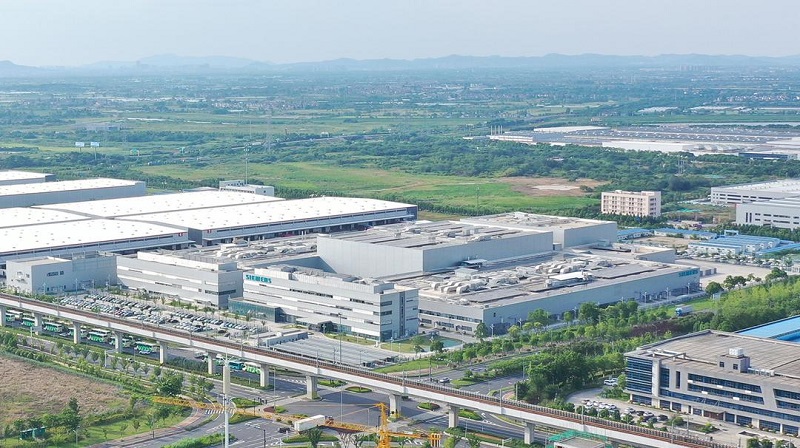
One of its major facilities is Siemens Numerical Control (Nanjing) Co., Ltd., also known as the Siemens Digital Native Factory in Nanjing.
The facility is an important production and research center for CNC systems, drives, and electric motors outside Germany.
In January 2026, Siemens announced that the Nanjing factory had been recognized by the World Economic Forum as a Global Lighthouse Factory.
The recognition highlighted the site’s use of digital twins, modular automation, manufacturing operations management systems, and more than 50 AI applications.
According to Siemens, compared with 2022, the factory achieved several improvements through its digital transformation initiatives:
- Lead times were reduced by 78%.
- Time-to-market was reduced by 33%.
- Productivity increased by 14% by 2024.
- Field failures decreased by 46%.
- Direct and energy-related carbon emissions were reduced by 28%.
These figures were reported by Siemens in connection with the factory’s digital transformation program.
The factory provides an example of how digital technologies can be applied throughout manufacturing operations, from production planning and engineering to execution and performance optimization.
The new strategic agreement aims to further improve the capabilities of this manufacturing base.
Strengthening Local Production of Motion Control and CNC Technologies
The agreement also places emphasis on local production capabilities for advanced motion control equipment and key CNC system components.
Motion control technologies are widely used in machine tools, robotics, packaging equipment, automated production lines, and precision manufacturing systems.
CNC systems are particularly important in industries that require accurate positioning, coordinated motion, and repeatable machining processes.
By strengthening local manufacturing and supply chain capabilities, Siemens and Nanjing aim to support the development of a more integrated industrial ecosystem.
For equipment manufacturers and system integrators, this direction is relevant to several product categories:
CNC controllers: Used to manage machining processes, axis movements, and machine tool operations.
Servo drives and motors: Provide precise motion control for industrial machinery, robotics, and automated production equipment.
Industrial automation controllers: Coordinate machine functions, process signals, and communication between equipment.
Industrial software: Supports engineering, production management, simulation, and digital factory operations.
Industrial communication systems: Connect controllers, drives, sensors, and other devices within integrated automation architectures.
These technologies form an important foundation for modern manufacturing systems.
Siemens and Nanjing: A Long-Term Industrial Partnership
Siemens’ relationship with Nanjing dates back to 1922, according to the company’s announcement.
Over more than a century, Siemens has developed local operations covering manufacturing, research and development, sales, and technical services.
The company’s presence in Nanjing reflects the city’s established manufacturing base and its role as an important industrial and technology center in eastern China.
In addition to its manufacturing operations, Siemens has also developed innovation platforms in the Yangtze River Delta region.
The Siemens Xcelerator Yangtze River Delta Technology Innovation Empowerment Center, established in Nanjing in 2024, is intended to support industrial digitalization through technology resources, ecosystem cooperation, and innovation services.
The new 2026–2030 strategic agreement builds on this existing industrial relationship and provides a framework for further cooperation in manufacturing, AI, and infrastructure development.
What the Agreement Means for Industrial Automation Companies
The cooperation between Siemens and Nanjing reflects several broader trends in the industrial automation market.
Digital Transformation of Manufacturing
Digital factories are increasingly integrating automation equipment, industrial software, digital twins, and production data.
Manufacturers can use these technologies to improve production planning, monitor equipment performance, and optimize manufacturing processes.
Growing Demand for Motion Control and CNC Equipment
As manufacturing moves toward higher precision and greater flexibility, demand for advanced CNC systems, servo drives, motors, and motion control technologies is expected to remain important.
These components are essential for machine tools, robotics, and automated production equipment.
Expansion of Industrial AI Applications
AI is moving into more practical manufacturing applications, including quality inspection, equipment diagnostics, production optimization, and intelligent robotics.
The development of high-quality industrial datasets will be important for making these applications more reliable and suitable for real production environments.
Integration of Industrial Automation and Energy Systems
The development of smart grids and intelligent energy infrastructure is closely connected to industrial digitalization.
Factories need reliable electrical systems, effective energy management, and coordinated control of power-consuming equipment.
This creates opportunities for cooperation between automation suppliers, electrical equipment manufacturers, energy technology companies, and system integrators.
Conclusion
The strategic cooperation agreement between Siemens and the Nanjing Municipal People’s Government marks an important development in their long-term industrial partnership.
Covering the 2026–2030 15th Five-Year Plan period, the agreement focuses on intelligent manufacturing, industrial AI, smart grids, and related infrastructure technologies.
Key areas include improving the production capabilities of Siemens’ Nanjing Digital Native Factory, strengthening local manufacturing of motion control and CNC technologies, exploring industrial AI and embodied intelligence, and supporting smart energy and urban rail transit development.
For the industrial automation industry, the agreement highlights the growing importance of combining advanced control equipment, industrial software, AI technologies, and energy infrastructure.
As manufacturing continues to move toward digital, intelligent, and low-carbon operations, cooperation between global technology companies and local industrial ecosystems will remain an important driver of industrial innovation.
SEO Keywords: Siemens Nanjing Strategic Cooperation Agreement 2026, Siemens China, Nanjing Intelligent Manufacturing, Siemens Digital Native Factory, Industrial AI China, Siemens CNC Systems, Siemens Motion Control, Smart Manufacturing, Embodied Intelligence, Smart Grid Technology, Industrial Automation, Digital Factory Development, Siemens Drives and Motors, 15th Five-Year Plan China.