
NewsNEWCENTER
Featured products
Contact Us
2026 ABB Startup Challenge China Concludes, Beijing Wansheng Intelligent Technology Wins AI Automation Competition
2026-10-29ABB Startup Challenge China Highlights AI Innovation in Industrial Automation
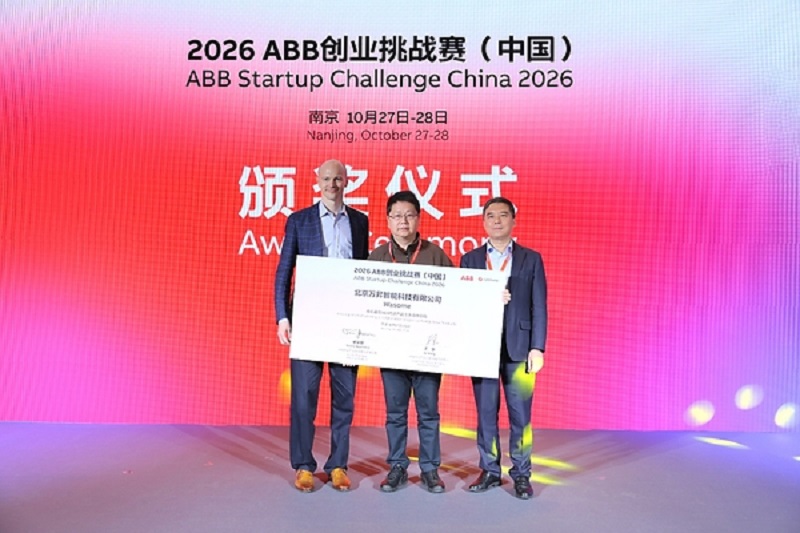
ABB has announced the conclusion of the 2026 ABB Startup Challenge China, with Beijing Wansheng Intelligent Technology Co., Ltd. named the winning company. The final took place in Nanjing, China, on October 29, 2026, marking the first time the international industrial innovation initiative has been held in China.
Organized by ABB in collaboration with its open innovation platform SynerLeap, the competition focused on applying artificial intelligence (AI) to simplify industrial automation engineering and maintenance. Seven finalist startups presented solutions designed to help original equipment manufacturers (OEMs), automation engineers, and industrial end users improve engineering efficiency and troubleshoot equipment more effectively.
The winning company will receive RMB 200,000 in project funding and work with ABB’s China Motion business to develop a minimum viable product (MVP). ABB also plans to explore collaboration opportunities with the other finalists, with the aim of turning promising technologies into practical solutions for industrial customers.
The event reflects growing interest in AI-assisted engineering, particularly in the configuration, commissioning, diagnosis, and maintenance of industrial automation equipment.
Why ABB Focused on AI-Assisted Automation Engineering
Modern industrial automation systems combine multiple technologies, including programmable logic controllers (PLCs), variable frequency drives (VFDs), servo systems, sensors, and industrial communication networks. Although these components enable accurate and efficient production, configuring and maintaining them can require specialized product knowledge.
For OEM engineers, a typical machine commissioning project may involve reviewing technical manuals, programming control logic, configuring drive parameters, checking communication settings, and testing equipment under different operating conditions.
When a fault occurs, maintenance personnel may need to interpret alarm codes, examine operating data, inspect electrical connections, and identify whether the problem originates in the controller, drive, motor, communication network, or mechanical system.
These tasks can be time-consuming, particularly when engineers are unfamiliar with a specific product or when experienced technical specialists are not immediately available.
ABB designed the 2026 challenge around the idea of an AI-powered technical assistant that can help engineers access product knowledge, understand equipment conditions, and follow structured engineering and troubleshooting procedures.
The goal is to reduce the complexity of working with automation products while allowing engineers to focus more time on machine design, production optimization, and reliable equipment operation.
Key Application Areas in the Competition
The challenge invited startups to develop AI-driven solutions addressing practical problems in industrial automation. The proposed applications focused on engineering support, commissioning, troubleshooting, and maintenance.
1. PLC Programming and Automation Configuration
PLC programming is a fundamental part of machine automation. Engineers must translate process requirements into control logic, configure inputs and outputs, establish communication with connected devices, and validate the behavior of the complete system.
An AI-assisted engineering tool could help users locate relevant documentation, explain programming concepts, identify configuration requirements, and prepare draft code or configuration instructions for review.
For example, an OEM engineer working with a PLC and a variable frequency drive may need to establish communication, configure operating parameters, and verify start-stop logic. An AI assistant could help organize the required steps and identify relevant technical references.
However, AI-generated code and configuration recommendations must be verified against the exact product model, firmware version, application requirements, and safety procedures before implementation.
2. Variable Frequency Drive Commissioning
Variable frequency drives regulate motor speed and torque in applications such as pumps, fans, conveyors, and compressors. Their configuration may involve motor nameplate data, control modes, acceleration and deceleration times, protection settings, and communication parameters.
Incorrect configuration can lead to unexpected machine behavior, motor trips, or inefficient operation.
AI-based engineering support could help technicians locate the correct parameter documentation, understand alarm messages, and follow a systematic commissioning procedure. The effectiveness of such assistance depends on whether the system has access to accurate product information and can distinguish between different drive models and software versions.
3. Fault Diagnosis and Maintenance
When industrial equipment stops unexpectedly, maintenance teams need to identify the cause quickly without compromising safety.
An AI assistant could help organize information from alarm codes, operating conditions, technical manuals, maintenance logs, and user-provided observations. Based on the available evidence, it could suggest a sequence of checks for an engineer to perform.
For instance, a drive-related fault may require checking the power supply, motor connections, load conditions, cooling, parameter settings, or communication status. The correct diagnostic path depends on the actual fault and the equipment configuration.
AI assistance can help structure this process, but it does not replace qualified personnel, electrical safety procedures, or manufacturer-approved maintenance instructions.
4. Learning from Technical Documentation and Practical Experience
Industrial knowledge is often distributed across product manuals, electrical drawings, commissioning records, service reports, and the practical experience of engineers.
The challenge emphasized the need for AI solutions that can combine formal technical documentation with customer-specific knowledge and fragmented operational experience.
If implemented effectively, such systems could help organizations retrieve relevant information more consistently and preserve knowledge that might otherwise remain with individual specialists.
The quality of the results would depend on the accuracy of the source information, the ability to identify the correct product version, and the system’s handling of incomplete or conflicting data.
Important Requirements for Industrial AI Solutions
Industrial AI tools face requirements that differ from those of general-purpose consumer applications. They must operate within real production environments, where incorrect advice can affect equipment availability, product quality, and worker safety.
ABB’s challenge highlighted several important considerations.
Compatibility with different automation products: Solutions should be designed to work with relevant ABB automation products and their associated technical information.
Integration with customer knowledge: Industrial users need tools that can incorporate their own documentation, maintenance history, and practical experience.
Support for unstructured information: Useful engineering knowledge may appear in text documents, images, videos, service records, and other formats rather than in a single structured database.
Continuous improvement: An industrial AI solution should support controlled updates as product information, application requirements, and customer knowledge change.
Information security and local deployment: Protecting customer data and proprietary engineering information is important, especially when solutions interact with operational technology environments.
These requirements demonstrate that developing industrial AI involves more than generating fluent answers. Solutions must be technically relevant, secure, compatible with the intended equipment, and suitable for real engineering workflows.
What the Winning Startup Will Do Next
Beijing Wansheng Intelligent Technology will receive RMB 200,000 in project funding to support joint development with ABB’s China Motion business. The stated objective is to develop an MVP that could eventually be offered to ABB customers.
SynerLeap, ABB’s open innovation platform, will also support the winning company in developing its relationship with ABB, its partners, and potential customers.
An MVP is an early product version intended to demonstrate core functionality and test whether a proposed solution addresses a practical need. It is not the same as a fully commercialized product.
The next stages will therefore be important. Development teams will need to verify technical accuracy, test integration with relevant automation products, evaluate information security, and demonstrate that the solution can provide practical value in industrial applications.
ABB has also stated that it will explore collaboration opportunities with the other seven finalists. This may create additional opportunities to develop AI applications for automation engineering and maintenance, although specific commercial products and release dates have not been confirmed in the announcement.
Potential Implications for Industrial Equipment Buyers
For industrial equipment buyers, system integrators, and maintenance providers, the competition highlights several areas where AI-assisted tools could become useful.
More Accessible Technical Support
Engineers often spend significant time searching for manuals, parameter descriptions, wiring instructions, and fault explanations. A well-designed AI assistant could help organize this information and make relevant technical guidance easier to find.
More Consistent Commissioning Procedures
AI tools may help engineers follow structured configuration and commissioning steps. This could be particularly useful for OEMs working with several automation products or supporting equipment across multiple customer sites.
Better Use of Maintenance Information
Combining fault histories, service reports, and product documentation could help maintenance teams identify recurring issues and improve troubleshooting procedures.
Reduced Dependence on Individual Knowledge Holders
Organizations can lose valuable expertise when experienced technicians leave or move to other roles. Tools that organize verified technical knowledge could help make that information more accessible to the wider engineering team.
These are potential benefits rather than measured outcomes from the competition. Actual results will depend on product maturity, integration quality, data availability, and validation under real operating conditions.
Why This Development Matters to the Automation Industry
The convergence of AI and industrial automation is creating new opportunities for equipment manufacturers, engineering software developers, and industrial service providers.
Traditionally, automation engineering has relied on specialized programming environments, product manuals, parameter tools, and technicians’ experience. AI may provide an additional interface for accessing these resources and helping engineers complete certain tasks more efficiently.
For manufacturers of PLCs, drives, servo systems, and related equipment, AI-assisted engineering could become a way to improve usability and customer support. For system integrators, it may offer new methods for organizing engineering knowledge and standardizing workflows across projects.
Nevertheless, AI should be treated as an engineering support tool rather than an automatic substitute for product expertise. Accurate technical references, appropriate access controls, testing, and human review remain essential.
The ABB Startup Challenge China provides a concrete example of how industrial companies are working with startups to explore these applications and move from early concepts toward potential commercial solutions.
Conclusion
The 2026 ABB Startup Challenge China concluded in Nanjing on October 29, with Beijing Wansheng Intelligent Technology Co., Ltd. named the winning company. The competition brought together seven finalist startups to demonstrate AI-driven solutions intended to make industrial automation engineering, commissioning, troubleshooting, and maintenance more efficient.
The winning company will receive RMB 200,000 in project funding and collaborate with ABB’s China Motion business on developing an MVP. ABB will also explore opportunities to work with the other finalists.
For the industrial control equipment market, the event highlights the growing importance of combining AI capabilities with reliable product knowledge and practical engineering experience. Potential applications include PLC programming support, drive commissioning, fault diagnosis, and maintenance knowledge management.
The next key milestone will be the development and validation of the proposed solution. Its industrial value will ultimately depend on technical accuracy, product compatibility, information security, and demonstrated benefits for customers.
SEO Keywords: 2026 ABB Startup Challenge China, ABB Startup Challenge winner, Beijing Wansheng Intelligent Technology, AI industrial automation, ABB PLC programming, ABB drive commissioning, industrial AI engineering assistant, industrial troubleshooting, variable frequency drive maintenance, smart manufacturing, industrial automation news.