

ProductPRODUCT
Featured products
Contact Us
- Siemens
- 1FT7046-5AF70-1CA0
- SIMOTICS S Synchronous Motor
- Germany
- 300 mm x 200 mm x 150 mm
- 11.4kg
- Xiamen, China
- New & In Stock
- T/T, PayPal, Western Union
- 1 Year
- 1-3 Working Days
- DHL, UPS, TNT, FedEx and EMS.
- 24-Hour Service
- COO
- 8
Our advantage

Global Logistics
We have a 10-year logistics and express cooperation agreement, so our products can be shipped to any place in the world.

Brand new and original
Our products are imported in bulk from the place of origin. Because of the cooperative relationship, our products are all original and 100% new.

24-hour service
We provide 7*24 hours service to our customers. We will be there whenever you need us.

Price advantage
All our products are priced very favorably because we have our own warehouse and supply.
| Company Information | |||
| [email protected] | |||
| Mobile | +8615980777398 | ||
| +8615980777398 | |||
| 15980777398 |
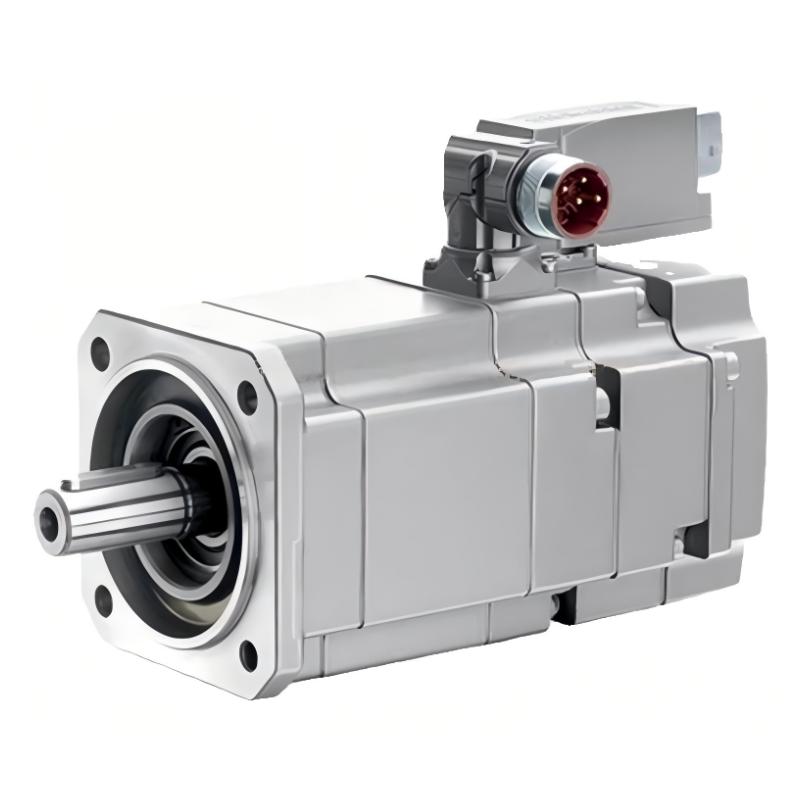
Siemens 1FT7046-5AF70-1CA0 Servo Motor: Technical Specifications, Product Introduction, Applications, Advantages, and Related Models
1. Product Overview
The Siemens 1FT7046-5AF70-1CA0 is a model designation associated with the SIMOTICS range of industrial motors. The 1FT7 family is designed for industrial motion-control applications in which controlled rotation, reliable torque delivery, and integration with a servo drive are important.
Servo motors are used in automated machinery that requires more than continuous rotation at a fixed speed. When paired with a compatible drive and controller, a servo motor can follow commands for speed, position, acceleration, and deceleration. This makes the technology useful for positioning axes, automated transfer systems, production equipment, and other machinery that requires repeatable movement.
The complete order number matters when identifying this motor. Differences in the final characters of a motor designation can represent changes to the feedback device, shaft configuration, brake, connector arrangement, or other options. Such differences may affect the electrical interface, installation dimensions, and compatibility with an existing drive.
This product overview explains the motor family, typical applications, key selection criteria, and related model options. Exact specifications for the complete order number should be distinguished from general characteristics of the wider motor family. Where a model-specific figure cannot be established confidently here, it is marked for confirmation rather than treated as a verified value.
2. Brand and Product Series
| Item | Description |
|---|---|
| Model | 1FT7046-5AF70-1CA0 |
| Brand | Siemens |
| Product family | SIMOTICS |
| Product series | SIMOTICS S-1FT7 |
| Product category | Industrial servo motor |
| Motor technology | Permanent-magnet synchronous motor family |
| Main function | Controlled rotary motion |
| Typical control arrangement | Compatible servo drive and motion controller |
| Feedback system | Confirm the exact encoder configuration |
| Holding brake | Confirm the exact model configuration |
| Cooling method | Confirm the complete motor specification |
| Mounting arrangement | Confirm the mechanical drawing |
| Typical installation | Industrial automation and production machinery |
| Main application areas | Positioning, material handling, machine axes, and automated production |
The SIMOTICS S-1FT7 family is intended for industrial motion-control applications where the motor must operate as part of a coordinated drive system.
When selecting this motor for a new machine or as a replacement, retain the complete designation 1FT7046-5AF70-1CA0. A motor with a similar base number should not automatically be regarded as interchangeable, even when its physical appearance is similar.
3. Detailed Technical Specifications
The following table summarizes the principal technical data associated with the 1FT7046-5AF70-1CA0 configuration. The model is a compact SIMOTICS S-1FT7 synchronous servo motor with a rated speed of 3,000 rpm and a rated torque of 5.6 Nm.
| Parameter | Specification |
|---|---|
| Model | 1FT7046-5AF70-1CA0 |
| Brand | Siemens |
| Product family | SIMOTICS |
| Product series | SIMOTICS S-1FT7 |
| Motor type | Permanent-magnet synchronous servo motor |
| Rated speed | 3,000 rpm |
| Rated torque at 100 K temperature rise | 5.6 Nm |
| Static torque at 60 K temperature rise | 6.0 Nm |
| Static torque at 100 K temperature rise | 7.0 Nm |
| Rated output power | 1.76 kW |
| Rated current | Approximately 3.5 A |
| Stall current at 100 K | Approximately 4.0 A |
| Maximum permissible mechanical speed | 9,000 rpm |
| Maximum torque | 31 Nm, subject to the applicable operating limits |
| Maximum current | 19 A, subject to the applicable drive limits |
| Number of poles | 6 |
| Motor technology | Permanent-magnet synchronous |
| Cooling method | Natural cooling |
| Mounting arrangement | IM B5; IM V1 and IM V3 where permitted |
| Frame size | Size I |
| Shaft height | 48 mm |
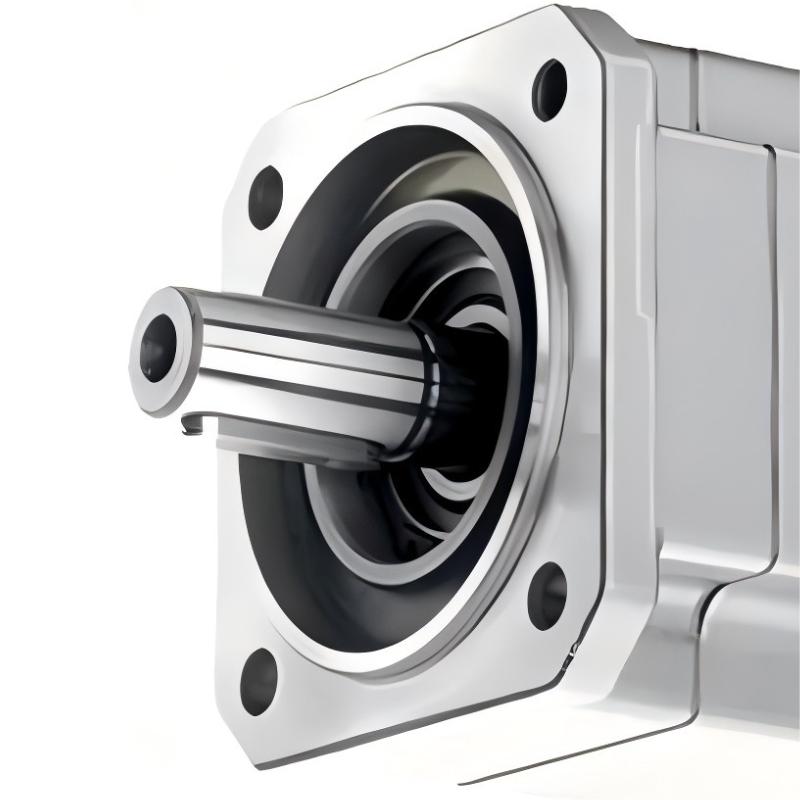
| Shaft design | Shaft with fitted key and keyway |
| Feedback device | Absolute encoder |
| Encoder interface | DRIVE-CLiQ |
| Encoder resolution | 24-bit single-turn measurement plus 12-bit multiturn information |
| Holding brake | No holding brake |
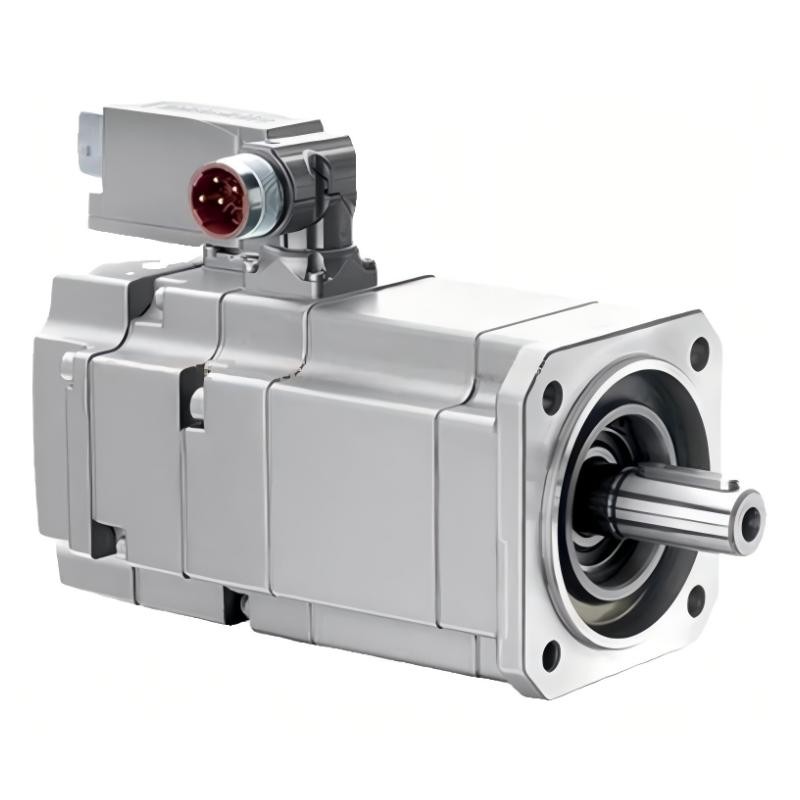
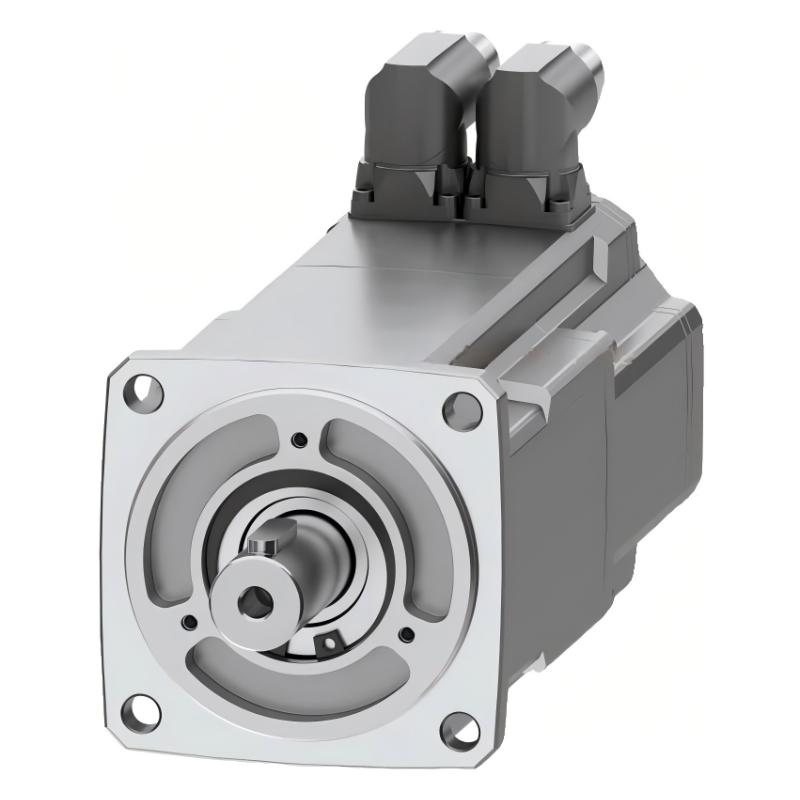
| Connector arrangement | Rotatable power connector |
| Protection rating | IP65 |
| Temperature monitoring | Confirm the exact sensor configuration |
| Approximate overall dimensions (L × W × H) | Confirm against the exact mechanical drawing; shaft height is 48 mm |
| Net weight | Approximately 11.4 kg |
| Main function | Controlled speed, torque, and rotary positioning |
Technical notes
Rated power and torque: The motor has a rated torque of 5.6 Nm at 3,000 rpm, corresponding to approximately 1.76 kW of mechanical output power. This is the normal rated operating point, not a guarantee that the motor can deliver its maximum torque continuously.
Maximum speed: The mechanical speed limit is not the same as the speed at which maximum torque can be maintained. The usable speed range depends on the drive, load, operating conditions, and motor limits.
Absolute encoder: The absolute encoder records shaft position information and provides it to a compatible drive. The DRIVE-CLiQ interface is an important compatibility requirement when selecting a replacement motor or drive.
Holding brake: This configuration does not include a holding brake. Applications that require the motor to hold a vertical or gravity-loaded axis need a separate assessment of the load-retention arrangement.
Dimensions and weight: The approximate net weight is 11.4 kg. The 48 mm shaft height identifies the frame-size geometry, but it is not the motor’s complete overall height. The exact length, width, shaft projection, flange dimensions, and connector clearances should be obtained from the mechanical drawing for the complete order number.
4. Product Introduction
The Siemens 1FT7046-5AF70-1CA0 is a compact permanent-magnet synchronous servo motor in the SIMOTICS S-1FT7 series. It is designed for industrial machinery that requires controlled movement, consistent torque, and accurate position feedback.
Unlike a conventional motor that is primarily used for continuous rotation, a servo motor operates as part of a controlled drive system. A motion controller provides commands, the servo drive regulates the electrical power supplied to the motor, and the encoder provides position information to support accurate control.
This arrangement allows the motor to be used in applications involving repeated positioning, speed changes, acceleration, deceleration, and coordinated movement between machine axes.
The motor’s rated torque of 5.6 Nm and rated speed of 3,000 rpm make it suitable for evaluating against compact industrial motion-control applications. With a rated output power of 1.76 kW, it can be considered for mechanisms where controlled speed and repeatable positioning are more important than simply obtaining the highest possible continuous power output.
The absolute encoder is a particularly important feature of this configuration. It provides position information through a compatible DRIVE-CLiQ interface, making it suitable for systems designed around that feedback technology. The drive, motor, and controller must be configured to work together correctly for the encoder’s capabilities to be used.
The motor uses natural cooling. This avoids the need for a separate forced-air cooling arrangement in configurations designed for natural cooling, but it does not eliminate the need to manage heat. Sufficient installation clearance and suitable ambient conditions are necessary to keep the motor within its operating limits.
The shaft has a fitted key and keyway, providing a mechanical interface for compatible couplings, pulleys, or other driven components. The mating component must be designed for the shaft dimensions and load conditions. Poor alignment or an unsuitable coupling can introduce vibration and excessive bearing loads.
The motor does not include a holding brake. This is an important distinction when comparing it with brake-equipped variants of the same series. If the machine must hold a load while the motor is disabled, the designer should determine whether the mechanical system can safely retain its position without a motor brake.
Overall, the 1FT7046-5AF70-1CA0 is best considered as one part of a complete servo system. The final performance depends on the motor, servo drive, feedback interface, controller, mechanical transmission, load inertia, and operating cycle.
5. Main Product Advantages
5.1 Compact design for industrial machinery
The 1FT7 motor family includes compact servo motor configurations intended for integration into industrial equipment.
A compact motor can help reduce the space required around a machine axis, leaving room for couplings, brackets, cable routing, sensors, and other components. This can be useful in machines where several mechanical functions must fit into a relatively small enclosure.
The exact mounting dimensions should still be checked before installation. Compact construction does not guarantee that the motor will fit an existing machine without changes to the mounting plate or coupling.
5.2 Controlled motion and repeatable positioning
The motor is designed to work with a compatible servo drive and controller. This enables the system to regulate movement in accordance with programmed commands.
Typical functions include:
-
Controlled acceleration and deceleration.
-
Repeatable rotary positioning.
-
Speed regulation during production cycles.
-
Coordinated movement between machine axes.
-
Controlled starts and stops.
-
Position feedback for closed-loop motion control.
The achievable positioning performance depends on the complete mechanical and electrical system. Encoder resolution is important, but backlash, shaft stiffness, coupling design, controller tuning, and load characteristics also influence the result.
5.3 Absolute encoder feedback
The absolute encoder is one of the defining characteristics of the 1FT7046-5AF70-1CA0.
Unlike a basic incremental feedback arrangement, an absolute encoder provides encoded position information. The specific capabilities available to the control system depend on the encoder design, drive compatibility, and configuration.
This can be useful for machines that need a defined position reference and reliable feedback during operation. However, the encoder should not automatically be assumed to eliminate every reference or homing procedure. That depends on the complete machine design and control configuration.
5.4 DRIVE-CLiQ integration
The DRIVE-CLiQ feedback interface allows the motor to be integrated into compatible drive architectures.
This can simplify system integration where the machine already uses the appropriate drive hardware and communication arrangement. The correct interface also helps ensure that feedback data can be interpreted and used properly by the drive.
When replacing an existing motor, confirm the feedback interface before ordering. A motor with a different encoder type or connector arrangement may require additional hardware, wiring changes, or commissioning work.
5.5 Efficient use of installation space
The motor’s compact form and natural-cooling arrangement can support a relatively straightforward mechanical layout.
For machinery with limited room, this can help simplify the positioning of the motor and its associated drive components. Proper planning is still required for cable bend radius, connector access, airflow, maintenance, and removal of the motor when service is needed.
5.6 Natural cooling
Natural cooling avoids dependence on a separate forced-air cooling unit for configurations designed to operate that way.
This can reduce the number of auxiliary components and simplify routine maintenance. The installation must still provide adequate heat dissipation, especially when the motor performs frequent acceleration cycles or operates near its torque limits.
If the motor is installed in a confined enclosure or exposed to high ambient temperatures, its thermal operating margin should be reviewed.
5.7 IP65 protection
The IP65 protection rating indicates protection against dust ingress and water jets under the conditions defined by the rating.
This can be useful in industrial environments where dust and occasional water exposure are present. It does not mean the motor is suitable for immersion, unrestricted pressure washing, or every type of industrial cleaning process.
The protection level also depends on proper installation of connectors, seals, and cables.
5.8 Flexible connector positioning
A rotatable power connector can help accommodate different cable-routing requirements.
This is particularly useful where the motor is installed close to machine guards, structural members, or adjacent equipment. The final connector orientation must allow safe cable routing without excessive bending or mechanical strain.
5.9 A practical option for automated machine axes
The motor’s rated torque and speed make it a candidate for compact automation axes that require controlled rotation.
It can be evaluated for rotary indexing, feed mechanisms, handling equipment, and other applications where the required load profile fits the motor’s ratings. Final suitability depends on peak torque, continuous torque, inertia, speed, duty cycle, and drive compatibility.
6. Typical Applications
The following are common application areas for compact industrial servo motors of this type. These are potential uses, not a claim that the motor is suitable for every machine in each category.
6.1 Packaging machinery
Packaging equipment often requires repeatable motion for feeding, indexing, cutting, sealing, and transferring products.
A servo motor can regulate movement according to the machine’s production sequence. The absolute encoder can provide position feedback to a compatible drive, helping the system control rotary movement during repeated production cycles.
For high-speed packaging, engineers should evaluate acceleration, deceleration, peak torque, and cycle time. A motor that meets the average torque requirement may still be undersized if it experiences frequent high-torque peaks.
6.2 Automated assembly equipment
Assembly machinery may require components to be moved into a defined position before fastening, insertion, inspection, or another operation.
A servo motor can be used for rotary positioning mechanisms, indexing tables, and suitable feed axes. Repeatable motion can help maintain consistent process timing and reduce variation between production cycles.
The motor should be selected according to the required load torque, motion profile, mechanical stiffness, and positioning tolerance.
6.3 Material handling
Automated handling systems move workpieces, trays, fixtures, or components between different stations.
Servo motors can control rotary mechanisms and other suitable axes within these systems. When several axes operate together, the controller can coordinate movement to achieve the required sequence.
The motor’s encoder, drive, and control interface must be compatible with the machine’s automation architecture.
6.4 Printing and converting machinery
Printing and converting machines can require synchronized rotary motion, controlled material feeding, and repeatable positioning.
Servo control can help coordinate machine movement and maintain consistent operating speed. This is especially useful where the timing of one axis affects the operation of another.
For rollers and other high-inertia loads, engineers should evaluate the reflected inertia and acceleration torque before selecting the motor.
6.5 Textile machinery
Textile equipment may use servo-controlled movement for winding, feeding, indexing, and related processes.
The motor can be considered where the required torque and speed fall within its operating range. The controller may need to coordinate the motor with other axes or sensors to maintain the required process sequence.
Dust, fibres, temperature, and installation clearance should be assessed as part of the environmental and thermal design.
6.6 Inspection and positioning equipment
Automated inspection equipment often moves cameras, sensors, fixtures, or workpieces into defined positions.
Servo control can help achieve repeatable movement between inspection points. An absolute encoder can provide useful position information where the drive and controller are configured to use it.
The required accuracy must be evaluated at the machine level, including the mechanical structure, transmission, mounting rigidity, and any external measurement system.
6.7 Industrial feeder mechanisms
Feed mechanisms move material or components into a machine at a controlled rate.
A servo motor can be used where the feed distance, speed, or timing must change according to the production sequence. Encoder feedback supports controlled movement, while the drive regulates the motor according to the required profile.
The designer should consider the mechanical load, friction, acceleration, and whether the mechanism experiences variable torque during operation.
6.8 Special-purpose machinery
Custom industrial machinery often combines several controlled movements in a compact structure.
The 1FT7 series can be evaluated for a suitable axis when the motor’s torque, speed, feedback, and mechanical interface meet the requirements. The exact model should be checked against the application’s installation space and drive architecture before selection.
7. Installation and Engineering Considerations
| Selection item | What to verify | Why it matters |
|---|---|---|
| Rated torque | Required continuous torque at the working speed | Determines whether the motor can sustain normal operation |
| Peak torque | Acceleration, deceleration, and transient load | Prevents torque limiting and poor dynamic response |
| Rated speed | Required speed range and operating point | Ensures the motor suits the motion profile |
| Load inertia | Inertia of the driven mechanism reflected to the motor | Influences acceleration, settling time, and control stability |
| Servo drive | Current, voltage, feedback interface, and control functions | Ensures electrical and functional compatibility |
| Encoder | Absolute encoder type and DRIVE-CLiQ interface | Prevents feedback incompatibility |
| Holding brake | Whether the machine must hold a load when disabled | Important for gravity-loaded or vertical mechanisms |
| Shaft | Keyway, shaft dimensions, and coupling compatibility | Prevents mechanical mismatch |
| Mounting | Flange dimensions and permitted mounting orientation | Ensures correct mechanical installation |
| Dimensions | Overall motor envelope and connector clearance | Avoids interference with surrounding components |
| Weight | Approximately 11.4 kg for preliminary handling plans | Supports mounting and handling calculations |
| Cooling | Ambient temperature and available heat dissipation | Helps maintain thermal performance |
| Protection | Dust, water, and cleaning conditions | Ensures environmental suitability |
| Maintenance | Access to connectors and mounting bolts | Reduces service time and installation difficulty |
7.1 Mechanical installation
The mounting surface should be rigid enough to support the motor under the expected operating loads. The motor shaft and driven mechanism should be aligned correctly to avoid excessive radial or axial loading.
The fitted-key shaft requires a compatible coupling or driven component. The dimensions of the keyway and shaft must be checked against the mating part.
The mounting design should also provide adequate clearance for connectors, cable routing, and future maintenance.
7.2 Electrical installation
The motor must be paired with a compatible servo drive. The drive must support the motor’s electrical ratings and DRIVE-CLiQ feedback interface.
Power and signal cables should be routed and grounded according to the applicable installation requirements. Proper shielding, connector integrity, and cable separation can help reduce electrical interference and improve the reliability of the feedback system.
The motor’s configuration and commissioning data should match the actual unit being installed.
7.3 Thermal management
Natural cooling relies on the surrounding installation to dissipate heat. A motor installed in a tight enclosure may have less thermal margin than one installed in an open machine frame.
The motor’s operating cycle should be assessed for continuous torque, peak torque, acceleration frequency, and ambient temperature. Where the machine operates for long periods at high load, a detailed thermal evaluation is appropriate.
7.4 Holding and load retention
The 1FT7046-5AF70-1CA0 does not have an integrated holding brake. For a horizontal axis, the mechanical arrangement may be able to remain stationary when the motor is disabled, but this must be assessed rather than assumed.
For vertical axes or mechanisms that can move under gravity, an appropriate independent load-retention solution may be necessary. The motor’s lack of a brake should be considered during the machine’s safety and maintenance planning.
8. Five Related Models in the Same Series
The following models are close comparison candidates within the SIMOTICS S-1FT7 family. Their feedback systems, shaft arrangements, brake options, and other details may differ.
The reference motor is a 1FT7046 model with a rated torque of 5.6 Nm, a rated speed of 3,000 rpm, and a rated output power of approximately 1.76 kW.
| Model | Configuration or main difference | Key parameters | Approx. dimensions (L × W × H) | Weight (kg) |
|---|---|---|---|---|
| 1FT7046-5AF70-1CA0 | Reference model; absolute encoder, keyed shaft, no holding brake | 1.76 kW; 5.6 Nm rated torque; 3,000 rpm; IP65 | Overall dimensions require exact drawing; shaft height 48 mm | Approx. 11.4 |
| 1FT7046-5AF70-1CA1 | Related keyed-shaft configuration; confirm exact connector and other suffix details | 1.76 kW; 5.6 Nm; 3,000 rpm; absolute encoder | Confirm exact drawing; shaft height 48 mm | Approx. 11.4 |
| 1FT7046-5AF70-1CG1 | Related plain-shaft configuration with absolute encoder | 1.76 kW; 5.6 Nm; 3,000 rpm; 7.0 Nm static torque at 100 K | Confirm exact drawing; shaft height 48 mm | Approx. 9.3 |
| 1FT7046-5AF70-1CH1 | Related plain-shaft version with holding brake | 1.76 kW; 5.6 Nm; 3,000 rpm; absolute encoder | Confirm exact drawing; shaft height 48 mm | Approx. 10.1 |
| 1FT7046-5AF70-1CB0 | Related keyed-shaft version with holding brake | 1.76 kW; 5.6 Nm; 3,000 rpm; absolute encoder | Confirm exact drawing; shaft height 48 mm | Approx. 10.1 |
8.1 How to compare these models
1FT7046-5AF70-1CA1 is worth comparing when evaluating a motor with a similar basic configuration. The complete suffix should still be checked to confirm that the feedback interface, shaft design, and connectors match the original installation.
1FT7046-5AF70-1CG1 is a potential option when a plain shaft is required. A plain shaft and a keyed shaft are not interchangeable without checking the coupling and driven mechanism.
1FT7046-5AF70-1CH1 is a brake-equipped alternative. It may be useful where the machine requires the motor shaft to be held under specified conditions, but the brake’s holding capacity and operating limits must be confirmed.
1FT7046-5AF70-1CB0 is another related configuration with a holding brake and keyed shaft. It may be useful when the mechanical interface requires a keyway and the application requires a brake.
Before selecting any of these models, compare the full order number, encoder interface, shaft dimensions, mounting flange, brake configuration, connector arrangement, protection rating, and actual overall dimensions.
9. Five Other Popular Models from the Same Brand
The following models are examples of additional motors within the broader SIMOTICS range. They provide comparison options for applications with different torque, speed, frame-size, or mechanical requirements.
These are not guaranteed direct substitutes for the 1FT7046-5AF70-1CA0. The dimensions and weights of each model depend on its complete order number and configuration.
| Model | Product family | Typical application or comparison purpose | Key parameters to evaluate | Approx. dimensions (L × W × H) | Weight (kg) |
|---|---|---|---|---|---|
| 1FK7042-5AF71-1EG5 | SIMOTICS S-1FK7 | Compact servo axes and positioning applications | Rated torque, speed, feedback, shaft, brake | Confirm exact drawing | Confirm exact version |
| 1FK7063-5AF71-1EG5 | SIMOTICS S-1FK7 | Alternative servo configuration for automated machinery | Power, rated torque, peak torque, drive compatibility | Confirm exact drawing | Confirm exact version |
| 1FK7083-5AF71-1DG5 | SIMOTICS S-1FK7 | Applications requiring a different frame size or torque range | Torque curve, speed, inertia, mounting, cooling | Confirm exact drawing | Confirm exact version |
| 1FT7064-series motor | SIMOTICS S-1FT | Alternative servo configuration for industrial automation | Rated power, torque, speed, feedback, protection | Depends on complete order number | Depends on complete order number |
| 1PH8-series motor | SIMOTICS industrial motor family | Industrial drive applications with different power or operating requirements | Power, speed range, cooling, drive compatibility, duty cycle | Depends on complete order number | Depends on complete order number |
9.1 Choosing among the alternatives
For a compact positioning axis, compare the required torque and speed with the motor’s frame size, inertia, and mounting arrangement.
For a machine requiring higher torque, evaluate continuous torque, peak torque, gearbox requirements, and the load’s reflected inertia. A larger model is not automatically a better choice if it introduces excessive inertia or does not match the available drive.
For a different feedback requirement, confirm the encoder type and communication interface before selecting the motor. An encoder change can affect the drive, cables, commissioning settings, and control system.
For a machine requiring a holding brake, compare brake capacity and operating requirements rather than choosing by motor frame size alone.
For a direct replacement, prioritize the complete motor designation, mounting pattern, shaft dimensions, encoder, brake, connector layout, and drive compatibility.
The dimensions and weight of these additional models must be confirmed against their exact order numbers. The product family alone is not sufficient to establish a reliable overall size or net weight.
10. Quick Reference Table
| Item | Specification |
|---|---|
| Model | 1FT7046-5AF70-1CA0 |
| Brand | Siemens |
| Product family | SIMOTICS |
| Series | SIMOTICS S-1FT7 |
| Motor type | Permanent-magnet synchronous servo motor |
| Rated power | 1.76 kW |
| Rated torque | 5.6 Nm |
| Rated speed | 3,000 rpm |
| Static torque at 100 K | 7.0 Nm |
| Maximum permissible mechanical speed | 9,000 rpm |
| Rated current | Approximately 3.5 A |
| Cooling | Natural cooling |
| Protection rating | IP65 |
| Mounting arrangement | IM B5; IM V1 and IM V3 where permitted |
| Frame size | Size I |
| Shaft height | 48 mm |
| Shaft design | Fitted key and keyway |
| Encoder | Absolute encoder, DRIVE-CLiQ |
| Holding brake | No |
| Overall dimensions | Confirm exact mechanical drawing |
| Net weight | Approximately 11.4 kg |
| Typical applications | Packaging, assembly, positioning, handling, and industrial automation |
11. Final Product Assessment
The Siemens 1FT7046-5AF70-1CA0 is a compact SIMOTICS S-1FT7 synchronous servo motor designed for controlled movement in industrial machinery.
Its main technical characteristics include a rated torque of 5.6 Nm, rated speed of 3,000 rpm, rated output power of approximately 1.76 kW, natural cooling, IP65 protection, a keyed shaft, and an absolute encoder with a DRIVE-CLiQ interface. The model does not include a holding brake.
The motor’s principal advantages are its compact design, encoder-based motion feedback, and suitability for applications requiring repeatable rotary movement. It can be considered for positioning axes, packaging machinery, assembly equipment, feed mechanisms, and other industrial automation applications when the load and motion profile fit the motor’s ratings.
The most important selection considerations are drive compatibility, feedback configuration, required torque and speed, load inertia, mechanical mounting, cooling conditions, and whether the machine needs a holding brake.
For purchasing, maintenance, or replacement, the complete order number should be retained as 1FT7046-5AF70-1CA0. The approximate net weight is 11.4 kg, while the overall dimensions should be confirmed against the exact mechanical drawing before finalizing the mounting arrangement or equipment layout.