

ProductPRODUCT
Featured products
Contact Us
- Schneider
- LTMR27EBD
- Motor Controller
- France
- 91 x 61 x 122.5 mm
- 0.53 kg
- Xiamen, China
- New & In Stock
- T/T, PayPal, Western Union
- 1 Year
- 1-3 Working Days
- DHL, UPS, TNT, FedEx and EMS.
- 24-Hour Service
- COO
- 7
Our advantage

Global Logistics
We have a 10-year logistics and express cooperation agreement, so our products can be shipped to any place in the world.

Brand new and original
Our products are imported in bulk from the place of origin. Because of the cooperative relationship, our products are all original and 100% new.

24-hour service
We provide 7*24 hours service to our customers. We will be there whenever you need us.

Price advantage
All our products are priced very favorably because we have our own warehouse and supply.
| Company Information | |||
| [email protected] | |||
| Mobile | +8615980777398 | ||
| +8615980777398 | |||
| 15980777398 |
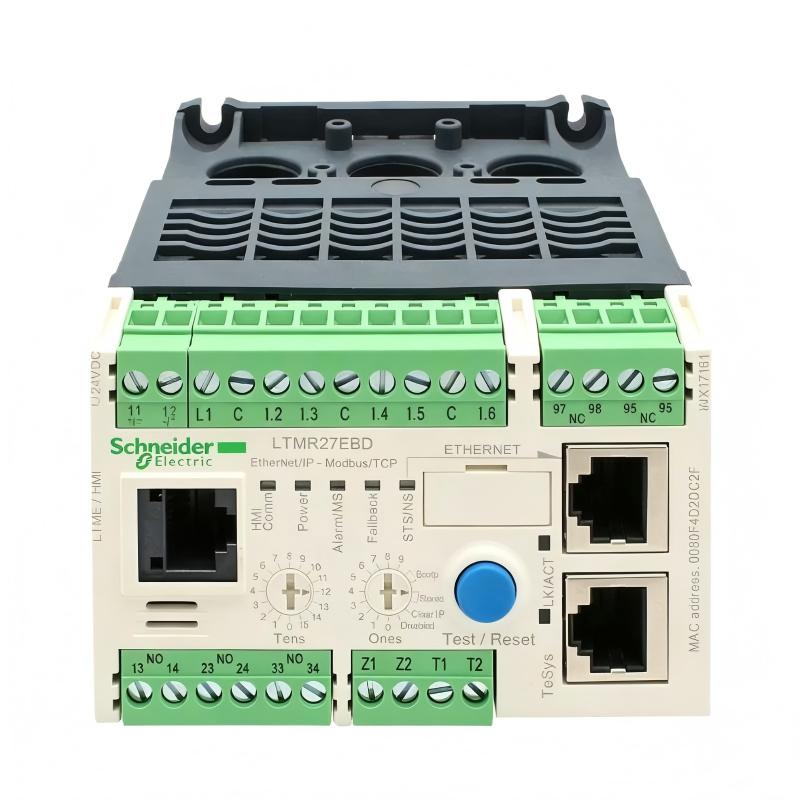
Product Overview
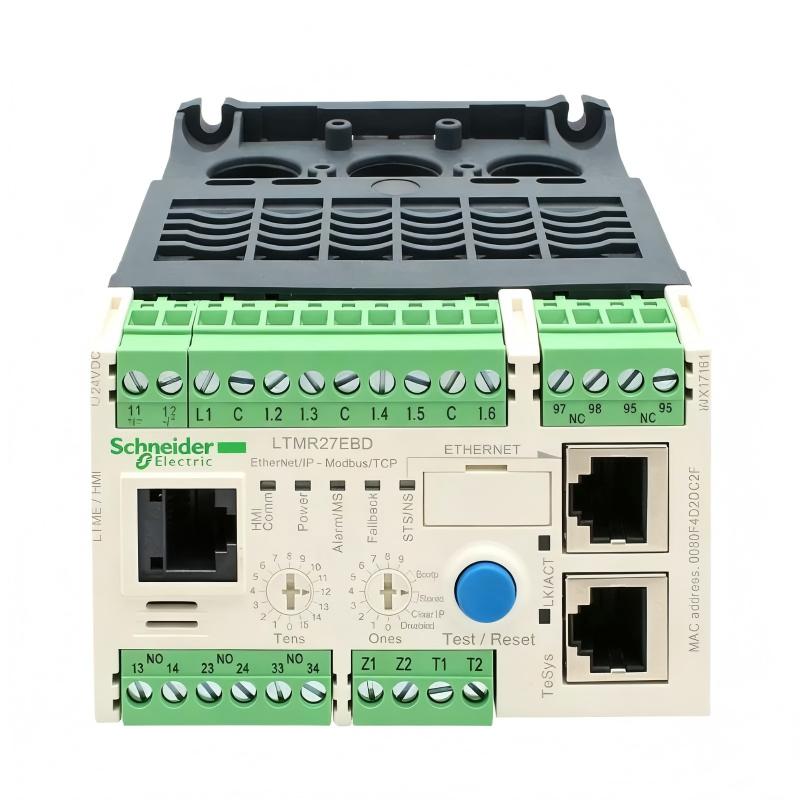
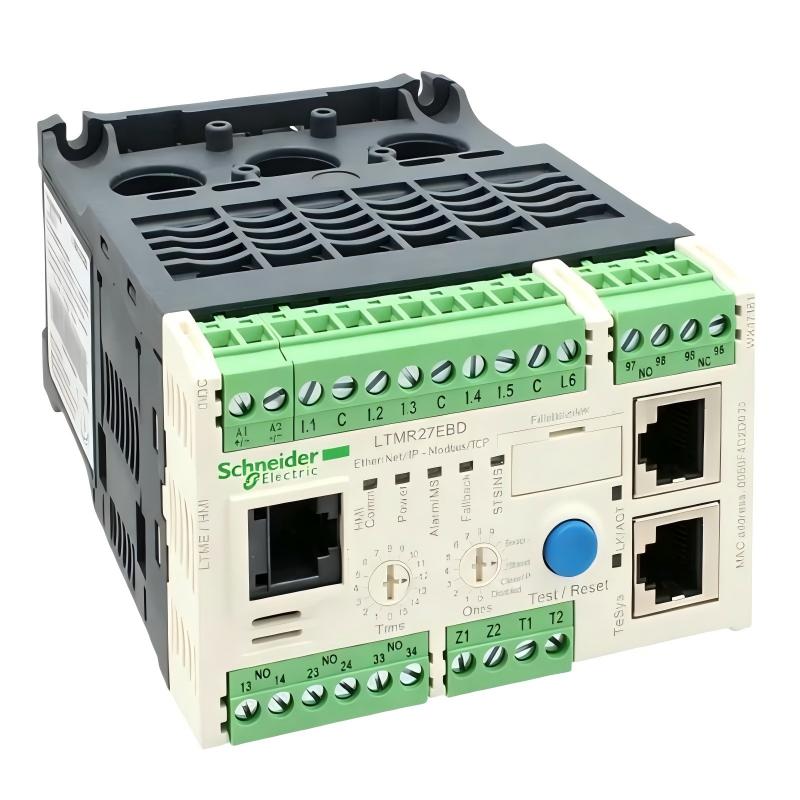
The Schneider Electric LTMR27EBD TeSys T Motor Controller is an intelligent motor management device designed for monitoring, controlling, and protecting industrial electric motors. As part of the TeSys T motor management system, it combines electrical measurements, motor protection functions, control logic, and industrial Ethernet communication in a compact controller.
Unlike a conventional motor starter or variable frequency drive, the LTMR27EBD primarily performs motor management and protection. It monitors operating conditions, evaluates motor-related faults, and communicates status information to a PLC or supervisory control system. When integrated with the appropriate contactor and short-circuit protection, it can support coordinated motor control and protection strategies.
The LTMR27EBD uses a 24 V DC control supply and measures motor current within a range of 1.35 to 27 A. Its communication interfaces support EtherNet/IP and Modbus TCP, making it suitable for industrial automation systems that require networked motor monitoring and control.
The controller includes six discrete logic inputs, three relay logic outputs, and a relay output for fault signaling. It can monitor three-phase current, ground-fault current, and motor temperature through the appropriate connections and sensors. These capabilities help maintenance teams identify abnormal operating conditions and improve visibility into motor performance.
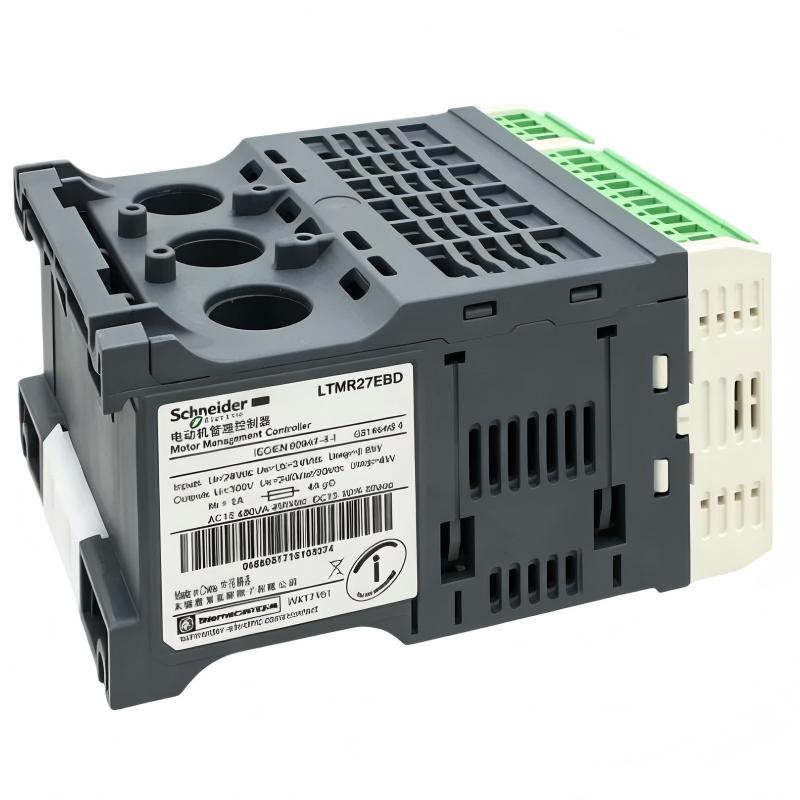
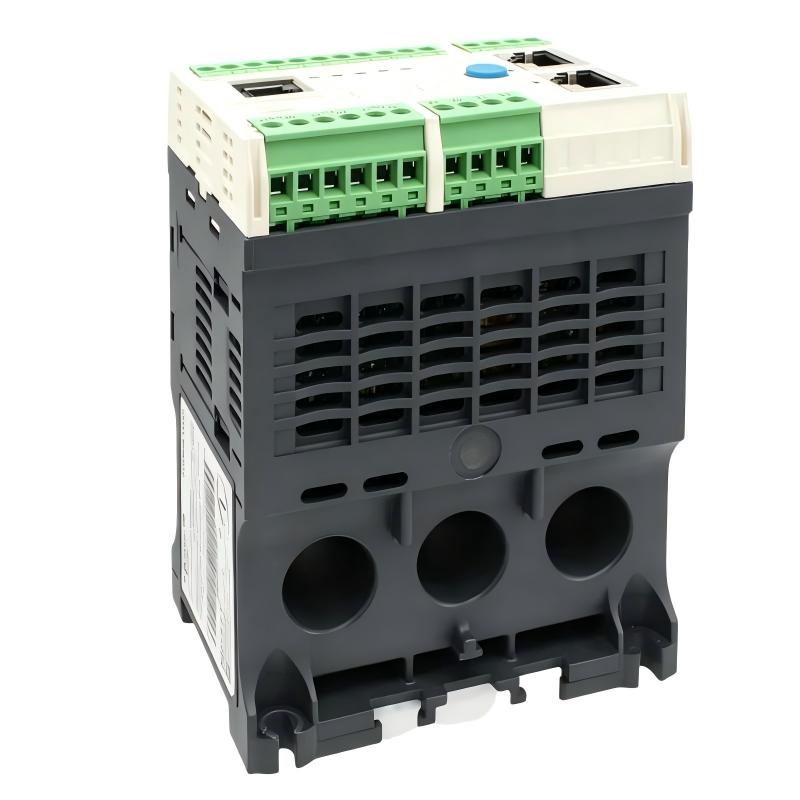
The compact dimensions of 91 × 61 × 122.5 mm make the LTMR27EBD suitable for installation in industrial control panels where space efficiency and organized wiring are important.
Technical Specifications
| Parameter | Specification |
|---|---|
| Brand | Schneider Electric |
| Product Series | TeSys T |
| Model | LTMR27EBD |
| Product Type | Motor Management Controller |
| Application | Motor monitoring, control, and protection |
| Control Supply Voltage | 24 V DC |
| Supply Voltage Limits | 20.4–26.24 V DC |
| Current Measurement Range | 1.35–27 A |
| Current Consumption | 56–127 mA |
| Communication Protocols | EtherNet/IP and Modbus TCP |
| Ethernet Interface | Ethernet IEEE 802.3 |
| Ethernet Ports | 2 RJ45 ports |
| Transmission Rate | 10–100 Mbit/s |
| Digital Logic Inputs | 6 |
| Relay Logic Outputs | 3, normally open |
| Fault Signaling Output | 1 relay output, 1 NO + 1 NC |
| Motor Temperature Monitoring | Thermistor probe connection |
| Ground-Fault Monitoring | Internal measurement or compatible external sensor |
| Rated Insulation Voltage | Up to 690 V, according to applicable standards |
| Short-Circuit Withstand Rating | Up to 100 kA under specified coordinated conditions |
| Dimensions | 91 × 61 × 122.5 mm |
| Weight | 0.53 kg |
| Typical Installation | Industrial control cabinet |
| Product Family | TeSys T motor management system |
Note: Short-circuit withstand capability depends on the specified upstream protective devices and tested coordination conditions. It should not be interpreted as permission to connect the controller directly to any circuit with a prospective fault current of 100 kA.
Function and Working Principle
The LTMR27EBD continuously monitors motor-related electrical and thermal conditions and processes this information according to its configured protection and control settings. It can then provide control outputs, communicate operating data, or signal faults to the wider automation system.
1. Three-Phase Current Measurement
The controller measures three-phase motor current using its integrated current-measurement arrangement. The supported measurement range is 1.35–27 A.
Current monitoring helps identify operating conditions such as overload, phase imbalance, or unexpected changes in motor demand. These measurements can be used by protection logic and can also support troubleshooting by providing information about motor operation.
Correct installation and configuration are essential. The selected controller must match the motor’s current requirements and the application’s operating characteristics.
2. Motor Thermal Protection
Motor windings can overheat when a motor operates under excessive load, experiences repeated starts, or runs under unfavorable cooling conditions. The LTMR27EBD supports motor thermal protection functions that help detect conditions that may lead to damaging temperatures.
The controller can also connect to a compatible thermistor probe to monitor motor temperature directly. The exact protection behavior depends on the configured parameters, sensor arrangement, and application design.
Thermal protection should be coordinated with the motor’s nameplate information and the manufacturer’s recommendations.
3. Ground-Fault Monitoring
Ground faults can occur when insulation deteriorates or an energized conductor makes an unintended connection to ground. The LTMR27EBD supports ground-current monitoring through internal measurement or a compatible external ground sensor.
This information can help the control system detect abnormal leakage-current conditions and initiate the configured response.
The controller is part of a protection system rather than a replacement for all electrical safety devices. Grounding, upstream short-circuit protection, and applicable protective equipment remain necessary.
4. Motor Control Logic
The TeSys T controller supports multiple motor control modes, including overload, independent, reversing, two-speed, two-step, and custom configurations.
These modes allow the controller to support different motor operating strategies without requiring the same external logic for every basic function. However, the final implementation depends on the contactor arrangement, wiring, control requirements, and configured parameters.
5. Fault Detection and Diagnostics
The LTMR27EBD provides fault signaling and diagnostic information to help maintenance personnel identify abnormal operating conditions.
Depending on the configuration, diagnostic information can include fault records, trip history, motor starting information, operating time, and related event data. This information can help technicians distinguish recurring electrical problems from mechanical overload or process-related disturbances.
Role in Industrial Automation Systems
The LTMR27EBD is designed to provide motor-level monitoring and protection within a broader control architecture. It can communicate with PLCs, supervisory systems, and operator interfaces through its supported Ethernet protocols.
PLC Integration
A programmable logic controller can exchange operating data and commands with the LTMR27EBD through EtherNet/IP or Modbus TCP. This allows motor status and fault information to be incorporated into machine sequences, alarms, and interlock logic.
For example, a PLC may prevent a conveyor from restarting until the motor controller reports an acceptable operating state. It can also use motor-related status information to coordinate auxiliary equipment.
The communication configuration, IP addressing, protocol settings, and PLC data mapping must be established during commissioning.
HMI and SCADA Monitoring
When connected to an appropriate supervisory system, the LTMR27EBD can provide motor-related information for operator displays and maintenance dashboards.
Depending on the control-system design, displayed data may include current measurements, operating states, fault indications, and diagnostic records. This visibility can help operators identify abnormal conditions before they develop into extended downtime.
The HMI or SCADA system must support the selected communication protocol and the required data mapping.
Motor Starter Coordination
The LTMR27EBD is designed to operate within a motor management system. It should be coordinated with the contactor, short-circuit protective device, motor, and other required components.
The controller’s role is to monitor, manage, and protect motor operation according to its configuration. It does not replace the power-switching function of a suitably rated contactor or the required upstream short-circuit protection.
Industrial Applications
The Schneider Electric LTMR27EBD can be used in industrial installations that require networked motor management and electrical protection.
1. Conveyor Systems
Conveyors often operate as part of coordinated production lines. The LTMR27EBD can monitor the associated motor and communicate fault or operating information to a PLC.
If the motor experiences an overload or another configured fault, the controller can provide a fault indication so that the automation system can initiate an appropriate response.
2. Pumping Systems
Industrial pumps may operate continuously or under changing process demand. Monitoring motor current and thermal conditions can help detect overloads, abnormal loading, and other operating problems.
In water treatment, industrial processing, and auxiliary utility systems, motor information can be incorporated into supervisory monitoring and maintenance procedures.
3. Fans and Ventilation Equipment
Fans used in factories, equipment rooms, and process facilities require reliable motor operation. The LTMR27EBD can provide motor monitoring and protection when selected for a compatible motor and starter arrangement.
Motor current and temperature-related information can help maintenance personnel investigate abnormal loading, ventilation restrictions, or electrical faults.
4. Material Handling Equipment
Lifting auxiliaries, transfer systems, and other material-handling equipment may depend on motors that must operate reliably during repeated production cycles.
The controller can provide fault detection and motor status information to the wider automation system. Applications involving specialized braking, safety-rated functions, or precise motion control require additional equipment designed for those tasks.
5. Manufacturing and Process Machinery
Industrial mixers, auxiliary machine motors, and process equipment can benefit from centralized motor monitoring. The LTMR27EBD supports communication-based visibility into motor conditions, helping maintenance teams investigate recurring faults and monitor operating history.
Its 27 A maximum measurement range should be checked against the actual motor current and starting characteristics before selection.
Installation and System Integration
Correct installation is essential for reliable motor monitoring, protection, and communication.
1. Verify the Control Supply
The LTMR27EBD uses a nominal 24 V DC control supply, with a specified supply range of 20.4–26.24 V DC.
Confirm the power supply rating, available current capacity, polarity, and wiring arrangement before energizing the controller. An unsuitable control supply may cause unreliable operation or communication interruptions.
2. Check Motor Current Compatibility
The supported current measurement range is 1.35–27 A. Compare this range with the motor nameplate current and the application’s operating conditions.
Do not select the controller based only on motor power. Starting behavior, overload requirements, and the selected protection settings must also be considered.
3. Mount the Controller Correctly
The supplied dimensions are 91 × 61 × 122.5 mm, and the listed weight is 0.53 kg.
Confirm the mounting arrangement and clearances against the manufacturer’s installation instructions. Leave sufficient space for wiring, access to terminals, and maintenance.
The controller should be installed in an appropriate industrial enclosure that provides the required environmental protection.
4. Configure Ethernet Communication
The LTMR27EBD supports EtherNet/IP and Modbus TCP over Ethernet. During commissioning, configure the network parameters and ensure that the controller and PLC or supervisory system use compatible protocol settings.
Use suitable Ethernet cabling and follow the control-system design for network topology, addressing, and grounding. Verify communication status before enabling automatic operation.
5. Wire Inputs, Outputs, and Sensors
The controller provides six discrete logic inputs and three relay logic outputs, plus a relay output for fault signaling. It also supports a thermistor probe and ground-current sensing arrangements.
Check the terminal assignments and electrical ratings before wiring field devices. Sensor types and wiring methods must match the supported input requirements.
6. Coordinate the Protection System
The controller must be coordinated with the motor, contactor, short-circuit protective device, and other required equipment.
Set the motor protection parameters according to the motor’s nameplate information and application requirements. Test the intended fault responses and verify that the overall system reacts safely.
7. Commission and Test
After installation, confirm the control supply, terminal wiring, network connection, and sensor configuration. Test motor start and stop sequences, communication, fault signaling, and the configured protection functions.
Record the final settings and network parameters for maintenance and future replacement.
Compatible System Components
The LTMR27EBD is intended to operate as part of a coordinated motor management system. The following components may be used depending on the application design.
| Component | Function | Integration Considerations |
|---|---|---|
| Three-phase AC motor | Converts electrical energy into mechanical motion | Confirm motor current and thermal protection requirements |
| Contactor | Switches motor power | Select a suitable contactor and coordinate its operation with the controller |
| Short-circuit protective device | Protects against short-circuit faults | Select and coordinate according to applicable standards and manufacturer guidance |
| PLC | Coordinates motor operation with the production process | Configure EtherNet/IP or Modbus TCP communication |
| HMI | Displays operating status and alarms | Map the required controller data and diagnostic information |
| SCADA system | Provides supervisory monitoring | Confirm protocol support, data mapping, and network architecture |
| 24 V DC power supply | Powers the controller | Maintain the specified voltage range and adequate current capacity |
| Thermistor probe | Monitors motor temperature | Verify sensor compatibility and correct wiring |
| Ground sensor | Supports ground-fault monitoring | Confirm compatibility and installation requirements |
| Industrial Ethernet cabling | Provides network communication | Use suitable cabling and follow the network design |
The controller is not a standalone motor power switch. The complete motor management installation must include the appropriate power-switching and protective components.
Alternative Models and Replacement Considerations
The LTMR27EBD belongs to the TeSys T family. When replacing it, the exact communication protocol, current range, supply voltage, and I/O configuration should be verified.
| Alternative Model | Main Difference | Replacement Considerations |
|---|---|---|
| LTMR08EBD | Ethernet-enabled controller with a 0.4–8 A range | Suitable only where the motor current falls within its range |
| LTMR100EBD | Ethernet-enabled controller with a 5–100 A range | May be considered for applications requiring a higher current range |
| LTMR27MBD | 24 V DC controller with Modbus communication | Protocol differs from the EtherNet/IP and Modbus TCP configuration of the LTMR27EBD |
| LTMR27EFM | Ethernet-enabled controller with 100–240 V AC control supply | Requires a different control power arrangement |
| LTMR27PBD | Controller supporting PROFIBUS DP | Requires a compatible PROFIBUS network and control-system configuration |
These models are related options, not automatic drop-in replacements. Before substitution, compare the complete model number, control supply, current range, communication protocols, I/O configuration, firmware requirements, and mounting arrangement.
A change in communication protocol or supply voltage may require modifications to the PLC program, network wiring, cabinet power distribution, and commissioning procedures.
Key Advantages
Integrated Motor Monitoring
The LTMR27EBD measures motor current and supports additional motor-related sensing, providing useful information for operational monitoring and fault diagnosis.
Multiple Protection Functions
The controller supports overload, thermal, phase-related, and ground-fault protection functions according to its configuration and application design.
Industrial Ethernet Communication
EtherNet/IP and Modbus TCP support integration with compatible PLCs and supervisory systems, allowing motor status and diagnostics to be incorporated into the automation architecture.
Flexible Motor Control Modes
The supported control modes allow the controller to be configured for different motor starter arrangements and operating strategies.
Compact Installation
The 91 × 61 × 122.5 mm dimensions and 0.53 kg weight make the controller suitable for installations where control-panel space and organized wiring are important.
Diagnostic Support
Fault and event information can help maintenance teams investigate recurring problems and reduce troubleshooting time.
Technical FAQs
1. What is the Schneider Electric LTMR27EBD?
It is a TeSys T motor management controller used for monitoring, controlling, and protecting industrial motors. It combines current measurement, protection functions, logic I/O, and Ethernet communication.
2. What is the current range of the LTMR27EBD?
Its specified current measurement range is 1.35–27 A. The controller should be selected according to the motor’s current requirements and application conditions.
3. What control voltage does it require?
The LTMR27EBD uses a 24 V DC control supply, with a specified operating range of 20.4–26.24 V DC.
4. Which communication protocols does it support?
The model supports EtherNet/IP and Modbus TCP over Ethernet. Confirm that the PLC or supervisory system supports the intended protocol and data mapping.
5. How many inputs and outputs are available?
The controller provides six discrete logic inputs, three relay logic outputs, and a separate relay output for fault signaling.
6. Can it measure motor temperature?
It supports a thermistor probe connection for motor temperature monitoring. Verify the supported sensor type and wiring requirements before installation.
7. Does the LTMR27EBD directly switch motor power?
No. It is a motor management controller. A suitably rated contactor and appropriate short-circuit protective equipment are required for a complete motor control and protection arrangement.
8. What are the dimensions and weight?
The listed dimensions are 91 × 61 × 122.5 mm, and the weight is 0.53 kg.
9. Can it replace an LTMR27MBD?
Not without checking the system requirements. Although both models use a 24 V DC supply and a 27 A maximum measurement range, their communication configurations differ. Verify the protocol and control-system compatibility before replacement.
10. What should be checked before purchasing a replacement?
Confirm the full catalog number, supply voltage, current range, communication protocol, terminal condition, physical condition, and available test information. Also verify the product’s status and supplier warranty terms.
Procurement and Maintenance Recommendations
When purchasing the Schneider Electric LTMR27EBD, verify the full catalog number and confirm that the unit supports the required current range, 24 V DC control supply, and Ethernet communication protocols.
For replacement projects, compare the controller’s communication settings and I/O arrangement with the existing PLC program. A replacement with a different communication protocol may require network and software changes even if the current range is similar.
For used or refurbished units, inspect the terminals and enclosure, request clear nameplate photographs, and confirm available testing or warranty information. Ensure that any accessories required for installation are included or sourced separately.
During maintenance, inspect wiring and connections, verify the stability of the control supply, and check network communication and sensor connections. Review diagnostic records when investigating repeated motor trips, and ensure that protection settings remain consistent with the motor’s nameplate data and operating requirements.
Conclusion
The Schneider Electric LTMR27EBD TeSys T Motor Controller is an intelligent motor management device designed for industrial motor monitoring, control, and protection. With a 1.35–27 A current measurement range, 24 V DC control supply, EtherNet/IP and Modbus TCP communication, six logic inputs, and relay outputs, it can provide useful motor information to PLC-based automation systems.
Its compact dimensions of 91 × 61 × 122.5 mm and listed weight of 0.53 kg make it suitable for control-panel installations. For reliable operation, ensure that the controller is correctly coordinated with the motor, contactor, short-circuit protection, sensors, and automation network.