

ProductPRODUCT
Featured products
Contact Us
- Siemens
- 6AG1151-7FA21-2AB0
- SIPLUS ET 200S IM 151-1 Standard
- Germany
- 60 × 119.5 × 75 mm
- 0.2kg
- Xiamen, China
- New & In Stock
- T/T, PayPal, Western Union
- 1 Year
- 1-3 Working Days
- DHL, UPS, TNT, FedEx and EMS.
- 24-Hour Service
- COO
- 6
Our advantage

Global Logistics
We have a 10-year logistics and express cooperation agreement, so our products can be shipped to any place in the world.

Brand new and original
Our products are imported in bulk from the place of origin. Because of the cooperative relationship, our products are all original and 100% new.

24-hour service
We provide 7*24 hours service to our customers. We will be there whenever you need us.

Price advantage
All our products are priced very favorably because we have our own warehouse and supply.
| Company Information | |||
| [email protected] | |||
| Mobile | +8615980777398 | ||
| +8615980777398 | |||
| 15980777398 |
Siemens 6AG1151-7FA21-2AB0 — Detailed Product Profile
1. Product Overview
The Siemens 6AG1151-7FA21-2AB0 is a SIPLUS ET 200S IM 151-7 F-CPU, a fail-safe CPU/interface module designed for distributed automation systems. It combines local processing capabilities with PROFIBUS DP communication and safety-related control functions, making it suitable for industrial equipment where operational reliability and personnel or machinery protection are important.
The module belongs to the SIPLUS ET 200S family and is based on the standard 6ES7151-7FA21-0AB0 model. Its design includes a conformal coating and an extended operating-temperature range of -25°C to +60°C, helping it operate in more demanding environmental conditions than standard indoor automation installations.
The product uses a 192 KB work memory and an integrated PROFIBUS DP interface configured for DP slave operation. It does not have an internal backup battery and requires a compatible SIMATIC Micro Memory Card (MMC).
2. Brand and Product Series
| Item | Description |
|---|---|
| Brand | Siemens |
| Product family | SIPLUS ET 200S |
| Product series | SIPLUS IM 151-7 F-CPU |
| Product type | Fail-safe CPU and interface module |
| Main model | 6AG1151-7FA21-2AB0 |
| Standard base model | 6ES7151-7FA21-0AB0 |
| Automation category | Distributed I/O and fail-safe control |
| Primary communication interface | PROFIBUS DP |
| DP operating role | DP slave |
| Environmental protection design | Conformal coating |
| Main purpose | Distributed automation with safety-related control |
The SIPLUS designation identifies a product variant designed for more demanding environmental conditions. In this model, the conformal coating and expanded temperature range are particularly useful where ordinary control equipment may be exposed to temperature variation, humidity-related stress, or other challenging industrial conditions. The coating does not mean that the module is waterproof or suitable for every corrosive environment; installation conditions must still be checked.
3. Detailed Technical Parameters
The following table separates the module’s technical specifications from packaging information. The physical module dimensions are approximately 60 × 119.5 × 75 mm. The listed net logistics weight is approximately 0.250 kg, while some supplier listings give a shipping or packaged weight of around 0.263 kg.
| Parameter | Specification |
|---|---|
| Model | 6AG1151-7FA21-2AB0 |
| Product designation | SIPLUS ET 200S IM 151-7 F-CPU |
| Base model | 6ES7151-7FA21-0AB0 |
| Product type | Fail-safe CPU/interface module |
| Product series | SIPLUS IM 151-7 F-CPU |
| Distributed I/O system | ET 200S |
| Work memory | 192 KB |
| Integrated communication interface | PROFIBUS DP |
| PROFIBUS connector | 9-pin female D-sub |
| PROFIBUS operating role | DP slave |
| Firmware version | V3.3 |
| Rated supply voltage | 24 V DC |
| Permissible supply voltage | 19.2–28.8 V DC |
| Reverse-polarity protection | Yes, against damage |
| Conformal coating | Yes |
| Operating temperature | -25°C to +60°C |
| Battery | No internal battery |
| Memory medium | Compatible SIMATIC MMC required |
| Width | 60 mm |
| Height | 119.5 mm |
| Depth | 75 mm |
| Approximate module weight | 0.200 kg |
| Approximate net logistics weight | 0.250 kg |
| Approximate packaged/shipping weight | 0.263 kg, depending on packaging |
| Mounting | Compatible ET 200S station mounting arrangement |
| Safety-related functionality | Yes; intended for fail-safe automation applications |
CPU, Memory and Processing
| Parameter | Specification |
|---|---|
| CPU type | IM 151-7 F-CPU |
| Work memory | 192 KB |
| Maximum peripheral modules per station | Up to 63, subject to configuration rules |
| Maximum input address area | 2,048 bytes |
| Maximum output address area | 2,048 bytes |
| Default process image | 128 bytes for inputs and 128 bytes for outputs |
| Adjustable process image | Up to 2,048 bytes for inputs and outputs |
| Cycle-time monitoring range | 1–6,000 ms |
| Default cycle-time monitoring value | 150 ms |
| Maximum program nesting levels | 8 |
| Hardware real-time clock | Yes |
| Retentive and synchronizable clock | Yes |
| Typical clock backup time | Approximately 6 weeks at 40°C |
| Operating-hours counter | Supported |
| User program protection | Supported |
| Block encryption | Supported with compatible engineering functions |
| Isochronous mode | Not supported |
Programming and Engineering
| Parameter | Specification |
|---|---|
| Ladder Diagram (LAD) | Supported |
| Function Block Diagram (FBD) | Supported |
| Statement List (STL) | Supported |
| Structured Control Language (SCL) | Optional, depending on engineering setup |
| Continuous Function Chart (CFC) | Optional, depending on engineering setup |
| GRAPH | Optional, depending on engineering setup |
| HiGraph | Optional, depending on engineering setup |
| Engineering environment | Compatible STEP 7 engineering software |
| Safety engineering | Requires compatible Distributed Safety engineering tools and configuration |
| Project compatibility | Must be checked against the CPU firmware and installed engineering software version |
Exact programming options depend on the installed engineering software, software versions, hardware configuration and safety project requirements. A project designed for a standard CPU should not be assumed to be directly interchangeable with a fail-safe CPU project.
Communication and System Configuration
| Parameter | Specification |
|---|---|
| Integrated fieldbus | PROFIBUS DP |
| Integrated DP role | Slave |
| Ethernet interface | No integrated Ethernet interface specified |
| PROFINET interface | No integrated PROFINET interface specified |
| Connection to a higher-level controller | Via compatible PROFIBUS DP configuration |
| Distributed peripheral connection | Through compatible ET 200S modules and station configuration |
| Additional DP master functionality | Requires the appropriate compatible expansion module where supported |
| Maximum station width | Configuration-dependent; ET 200S station limits apply |
| Load-group current limit | Up to 10 A per load group, subject to the power-module configuration |
| Station expansion | Requires compatible peripheral and power modules |
| Safety configuration | Must follow the applicable fail-safe system and engineering rules |
The integrated PROFIBUS DP interface operates as a slave. It should not be mistaken for an integrated DP master, PROFINET controller or Ethernet port. If the installation requires a different communication role, confirm the complete station architecture and the availability of compatible expansion modules before selecting the hardware.
Dimensions and Weight
| Measurement | Value |
|---|---|
| Module width | 60 mm |
| Module height | 119.5 mm |
| Module depth | 75 mm |
| Module dimensions (W × H × D) | 60 × 119.5 × 75 mm |
| Approximate module weight | 0.200 kg |
| Approximate net logistics weight | 0.250 kg |
| Approximate packaged weight | 0.263 kg |
| Approximate package dimensions | 84 × 127 × 83 mm |
Important: The module dimensions refer to the physical unit. Packaging dimensions and shipping weights vary by supplier and packing method. Allow additional clearance for connectors, wiring, adjacent modules and service access when designing the control cabinet.
4. Product Introduction
The 6AG1151-7FA21-2AB0 is intended for automation systems that require both distributed I/O and safety-related processing. Rather than relying entirely on a central PLC to manage every signal, an ET 200S station can be installed near the machinery or process being controlled. This helps organize field wiring and allows control equipment to be arranged in a modular way.
The F-CPU designation is important: this is a fail-safe CPU, not simply a standard interface module. In a correctly engineered safety system, it can participate in safety functions such as monitoring protective devices and initiating a defined safe response when a hazardous condition is detected. The final safety function depends on the complete system, including suitable sensors, safety-rated output devices, wiring, program logic and validated configuration.
Its 192 KB work memory provides resources for the CPU’s user program and associated processing tasks. The integrated PROFIBUS DP interface allows it to communicate as a slave on a compatible fieldbus network, while the ET 200S architecture supports modular expansion with suitable I/O and power modules.
The environmental design is another distinguishing feature. Its conformal coating and operating range from -25°C to +60°C make it relevant to installations where temperature conditions are more demanding than those in a typical climate-controlled cabinet. This does not eliminate the need for appropriate enclosure design, ventilation, wiring practices or protection against environmental contaminants.
5. Main Applications
5.1 Machine safety and protective interlocks
The module can be used in machinery where safety-related conditions must be monitored and acted upon. Examples include protective-door interlocks, emergency-stop circuits and other safety functions when the complete installation uses compatible safety-rated components and is designed and validated to the required standard.
A typical system may monitor protective-device status, evaluate safety logic and command the appropriate safe state when an unsafe condition is detected. The specific response—such as stopping motion or disabling an output—must be defined by the machine’s risk assessment and safety design.
5.2 Distributed manufacturing equipment
The ET 200S platform is useful for machines with multiple groups of sensors and actuators distributed along a production line. A local station can collect field signals and communicate with the wider control system over PROFIBUS DP.
This approach can help reduce long individual signal runs back to a central cabinet and make equipment easier to organize into functional sections. The actual benefits depend on the station layout and the existing control architecture.
5.3 Conveyor and material-handling systems
Conveyor systems may include motors, transfer mechanisms, guarded access points, position sensors and emergency-stop devices. A suitable fail-safe control architecture can coordinate safety-related responses across defined machine sections.
The module is a possible component of such a system, provided that the complete configuration supports the required safety functions and communication arrangements.
5.4 Packaging and processing machinery
Packaging equipment often combines fast machine sequences with safety requirements around access doors, moving mechanisms and operator loading areas. The CPU may be incorporated into a distributed control arrangement where standard process control and safety-related functions are organized according to the system design.
It is important to distinguish ordinary sequence control from safety functions. A normal control program alone does not establish a safety-rated system.
5.5 Industrial retrofits and existing PROFIBUS installations
The integrated PROFIBUS DP interface makes this model relevant to systems built around a compatible PROFIBUS network. In retrofit projects, it may be considered when maintaining an established fieldbus architecture is preferable to redesigning the whole installation.
Before replacing an existing controller, engineers should check the hardware configuration, program compatibility, safety approvals, communication role, memory requirements and availability of the required engineering tools.
5.6 Industrial installations with variable ambient temperatures
The extended temperature range may be useful in equipment exposed to cold start-up conditions or warmer operating environments. The conformal coating offers additional environmental resilience, but it should not be treated as a substitute for an appropriate enclosure or as proof of suitability for every chemical, condensation or corrosive exposure.
6. Main Advantages
6.1 Fail-safe processing capability
The principal advantage is its fail-safe CPU functionality. In an appropriately designed safety system, the module can contribute to the monitoring and execution of safety-related control logic. This is particularly relevant where machine operation must be coordinated with protective devices.
6.2 Compact, modular construction
With physical dimensions of approximately 60 × 119.5 × 75 mm, the module occupies a relatively compact space in an ET 200S station. Its modular architecture makes it easier to arrange compatible interface, power and I/O components according to the requirements of a particular machine.
6.3 Integrated PROFIBUS DP communication
An integrated PROFIBUS DP interface simplifies connection to a compatible fieldbus network without requiring a separate communication module solely for the specified DP slave function.
This can be useful in established industrial installations where PROFIBUS remains part of the plant’s communication infrastructure.
6.4 Extended operating-temperature range
The specified -25°C to +60°C range provides greater flexibility for installations that operate outside conventional indoor control-room temperatures. It may help reduce the need to choose a different equipment variant solely because of ambient temperature, provided all other environmental limits are respected.
6.5 Conformal coating
The conformal coating is intended to improve resilience under specified challenging environmental conditions. It can be an advantage in industrial locations where environmental stress is a concern, although the exact permissible conditions should be evaluated against the installation requirements.
6.6 Flexible programming options
The supported programming languages include LAD, FBD and STL, with additional languages available depending on the engineering environment. This allows engineering teams to use established programming practices while maintaining compatibility with the selected CPU and safety toolchain.
6.7 Support for modular I/O expansion
The ET 200S station architecture supports a range of compatible peripheral modules. The precise number and arrangement depend on station configuration rules, power requirements and module compatibility. This modular approach can simplify equipment segmentation and future maintenance.
6.8 Useful for maintaining existing systems
Where a facility already uses ET 200S and PROFIBUS DP, selecting a compatible module may help preserve existing wiring and system architecture. This is especially relevant for replacement planning, but compatibility should be confirmed rather than inferred from the family name alone.
7. Five Related Models
The following models are related by the ET 200S/SIPLUS architecture or by their role in distributed automation. They are not all direct replacements for the fail-safe CPU. Dimensions and weights are included where a reliable model-specific figure is available; where figures are indicative or require confirmation, this is stated explicitly.
| Model | Product type and key parameters | Dimensions (W × H × D) | Weight (kg) |
|---|---|---|---|
| 6ES7151-7FA21-0AB0 | Standard base version of the IM 151-7 F-CPU; 192 KB work memory; integrated PROFIBUS DP; DP slave; safety-related CPU | 60 × 119.5 × 75 mm | Approx. 0.200 |
| 6AG1151-7AA21-2AB0 | SIPLUS ET 200S IM 151-7 CPU; standard CPU variant rather than the F-CPU version; 128 KB work memory; PROFIBUS DP slave; conformal coating; -25°C to +60°C | 60 × 119.5 × 75 mm | Approx. 0.200; net logistics weight about 0.251 |
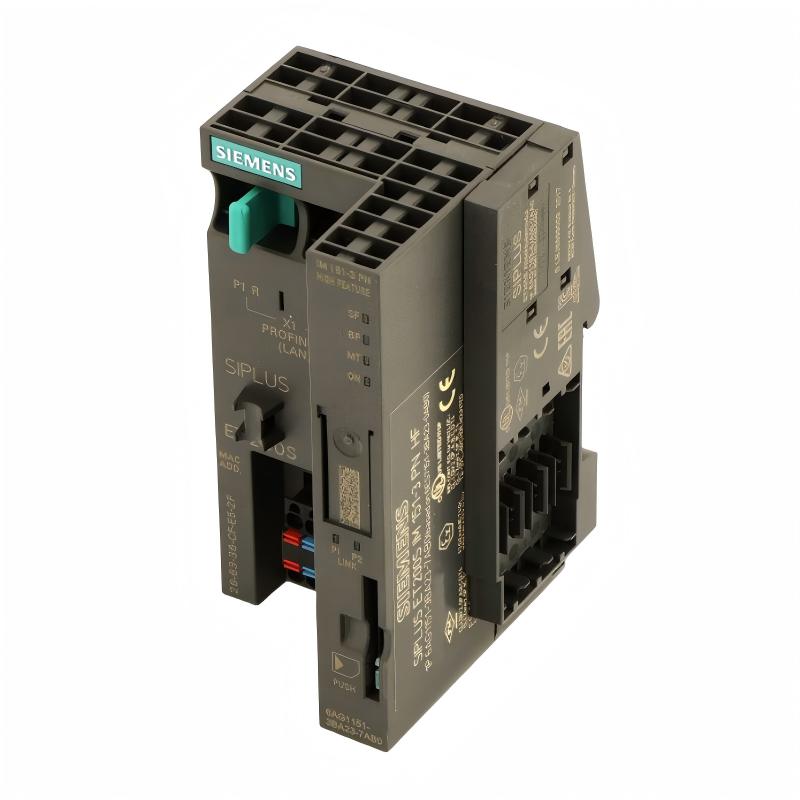
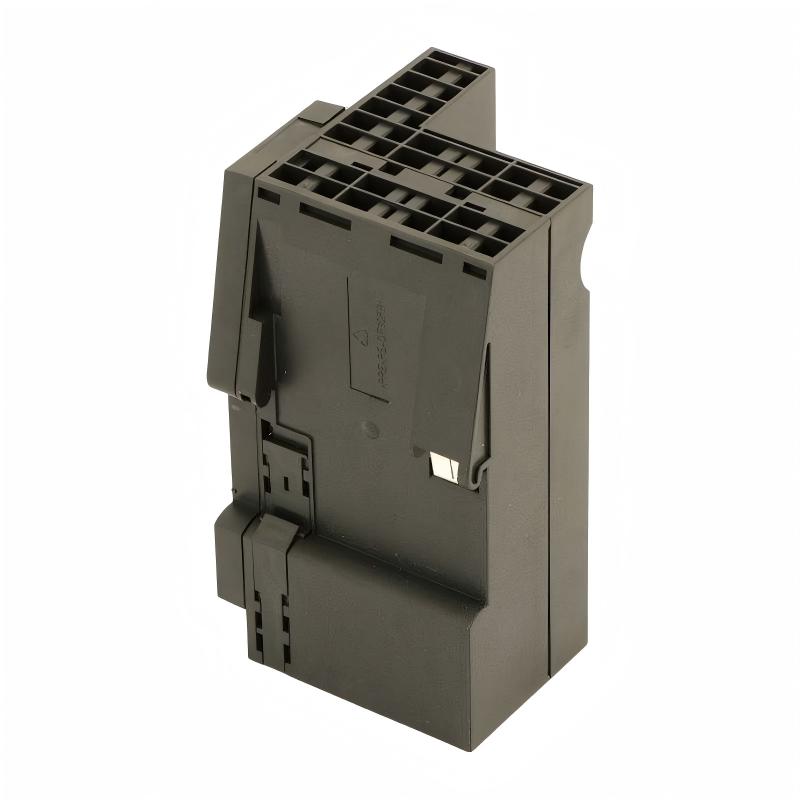
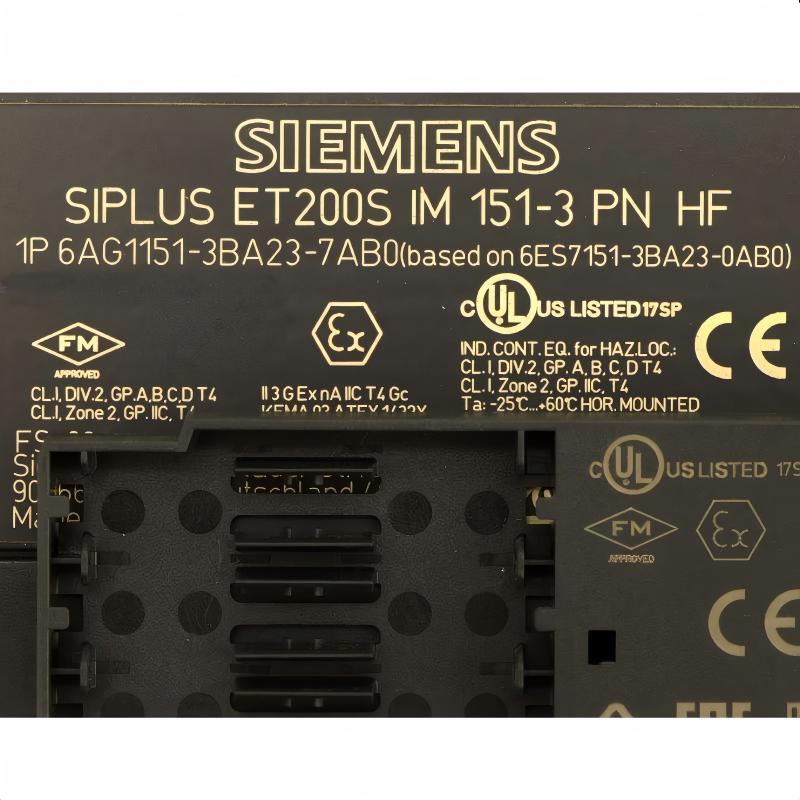
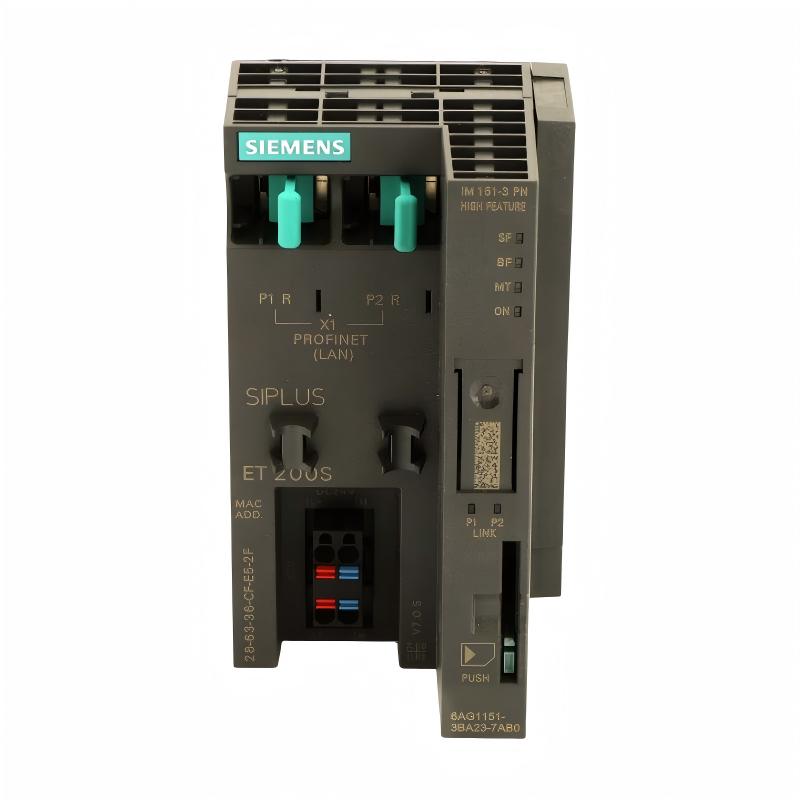
| 6AG1151-3BA23-7AB0 | SIPLUS ET 200S IM 151-3 PN HF interface module; PROFINET-based distributed I/O interface; not a direct F-CPU substitute | Approx. 60 × 119.5 × 75 mm | Approx. 0.205 |
| 6AG1151-1BA02-2AB0 | SIPLUS ET 200S IM 151 HF interface variant; distributed I/O interface for a compatible ET 200S configuration; not a direct F-CPU substitute | Confirm exact variant before installation | Confirm exact variant |
| 6AG1151-7AA20-7AB0 | Related SIPLUS IM 151-7 CPU variant; verify the precise base model, memory and environmental specification before choosing it as an alternative | Confirm exact variant before installation | Confirm exact variant |
How to choose among these related models
– For like-for-like fail-safe CPU replacement: start with 6ES7151-7FA21-0AB0, then verify the required environmental rating, safety configuration and compatibility with the existing project.
– For a standard CPU without the same fail-safe function: 6AG1151-7AA21-2AB0 is related, but it should not be treated as functionally equivalent to the F-CPU.
– For a PROFINET-based distributed I/O architecture: 6AG1151-3BA23-7AB0 may be relevant, but its interface-module role differs from that of the fail-safe CPU.
– For an ET 200S interface-module replacement: 6AG1151-1BA02-2AB0 may be worth checking against the installed station configuration.
– For another IM 151-7 CPU variant: verify the exact model suffix and base product number before comparing memory, temperature limits or safety capability.
The dimensions and weights of related variants should be verified against their exact technical data before purchasing, particularly when cabinet space, shipping weight or mechanical interchangeability is important.
8. Five Popular Models from the Same Brand
The following table provides a broader selection of commonly used Siemens automation products. They belong to related industrial automation categories, but they are not all members of the ET 200S series and are not direct substitutes for the 6AG1151-7FA21-2AB0.
| Model | Product series / type | Key parameters | Dimensions (W × H × D) | Weight (kg) |
|---|---|---|---|---|
| 6ES7214-1AG40-0XB0 | SIMATIC S7-1200 CPU 1214C | Compact PLC; integrated digital I/O and Ethernet interface; suitable for small and medium machine-control tasks | Approx. 110 × 100 × 75 mm | Approx. 0.415 |
| 6ES7511-1AK02-0AB0 | SIMATIC S7-1500 CPU 1511-1 PN | Modular PLC; PROFINET interface; higher-level machine and process control | Approx. 35 × 147 × 129 mm | Approx. 0.650 |
| 6ES7155-6AU01-0BN0 | SIMATIC ET 200SP interface module | Distributed I/O interface for compatible ET 200SP stations; compact modular field I/O | Approx. 50 × 117 × 74 mm; configuration-dependent | Approx. 0.200; verify exact configuration |
| 6EP1333-2BA20 | SITOP power supply | 24 V DC industrial power supply; rated output current depends on the specified model variant | Approx. 90 × 90 × 100 mm | Approx. 0.700 |
| 6AV2123-2GB03-0AX0 | SIMATIC HMI Basic Panel | Operator interface for machine status, alarms and control screens; exact display and interface details depend on model specification | Approx. 214 × 158 × 39 mm | Approx. 0.500 |
The dimensions and weights in this table are indicative selection data, not guaranteed installation dimensions. Confirm each complete order number and its official technical specifications before designing a panel or purchasing a replacement. For the power supply and HMI in particular, verify the precise electrical and mechanical version.
What each model is typically used for
6ES7214-1AG40-0XB0 — SIMATIC S7-1200
A compact controller for individual machines, small production systems and straightforward automation tasks. It may be a practical option for a new design that does not need to preserve the ET 200S architecture or the specific safety functionality of the F-CPU.
6ES7511-1AK02-0AB0 — SIMATIC S7-1500
A modular controller intended for more demanding control applications. It is worth considering where the project calls for a different controller platform, but migration requires engineering work and a review of I/O, communication, safety and program compatibility.
6ES7155-6AU01-0BN0 — SIMATIC ET 200SP
A distributed I/O interface for the ET 200SP family. It can be relevant when planning a new modular I/O station, but ET 200SP and ET 200S components should not be assumed to be mechanically or electrically interchangeable.
6EP1333-2BA20 — SITOP power supply
An industrial DC power supply used to provide power to suitable control equipment. Selection should be based on output voltage, rated current, load profile, protection requirements and the power budget of the complete system.
6AV2123-2GB03-0AX0 — SIMATIC HMI Basic Panel
An operator interface for displaying process information, alarms and machine-control screens. It can complement a PLC-based system, although the communication interface and engineering software must match the chosen controller and project.
9. Installation and Selection Considerations
Before installing or replacing the 6AG1151-7FA21-2AB0, review the following points.
1. Confirm safety requirements. Determine whether the machine needs a fail-safe CPU and check the required safety functions, engineering software, project configuration and compatible field devices.
2. Check the fieldbus architecture. The integrated interface is PROFIBUS DP in slave mode. Confirm that this role matches the intended network design.
3. Verify the power supply. The specified supply is 24 V DC, with a permissible range of 19.2–28.8 V DC. Check supply quality, protective devices and the power requirements of the entire station.
4. Allow for the complete installation envelope. Use the physical module dimensions of approximately 60 × 119.5 × 75 mm as a starting point, then account for wiring, connectors, adjacent modules and service access.
5. Confirm memory-card requirements. The module requires a compatible SIMATIC MMC. Verify that the card and project data are suitable for the installed hardware.
6. Check environmental suitability. The operating-temperature range is -25°C to +60°C. Confirm the actual cabinet temperature, humidity and exposure conditions rather than relying on the coating alone.
7. Verify all peripheral modules. Check station layout, module compatibility, power-module placement, load-group current limits and the permitted station width.
8. Plan maintenance and replacement. Before replacing a safety-related CPU, ensure that the correct program, hardware configuration and safety validation procedures are available. A physical fit does not guarantee functional compatibility.
10. Final Assessment
The Siemens 6AG1151-7FA21-2AB0 is best understood as a compact, environmentally enhanced, fail-safe CPU/interface module for the ET 200S distributed automation family. Its most important characteristics are the 192 KB work memory, integrated PROFIBUS DP slave interface, conformal coating, -25°C to +60°C operating-temperature range and support for safety-related control when used in a correctly engineered system.
Its strongest use case is an industrial installation that needs the specific IM 151-7 F-CPU role within a compatible ET 200S and PROFIBUS DP architecture. For such projects, preserving the correct hardware variant and safety configuration is more important than choosing a model based only on similar dimensions or a shared product family.
For new designs, compare the total requirements—including safety functions, fieldbus architecture, expansion modules, engineering tools, maintenance needs and long-term platform strategy—before deciding whether to retain ET 200S or move to another automation family.