

ProductPRODUCT
Featured products
Contact Us
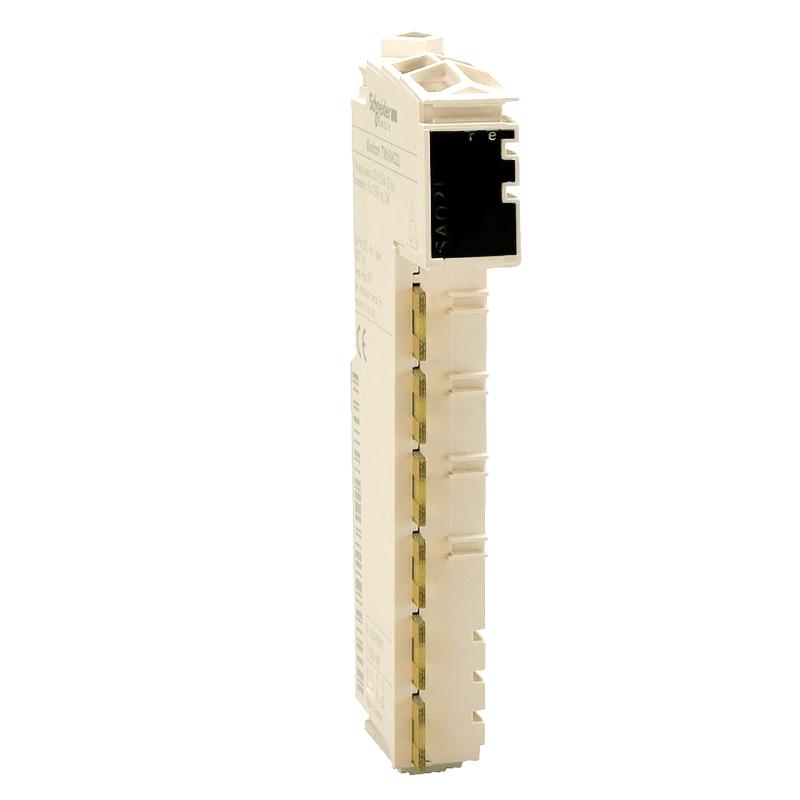
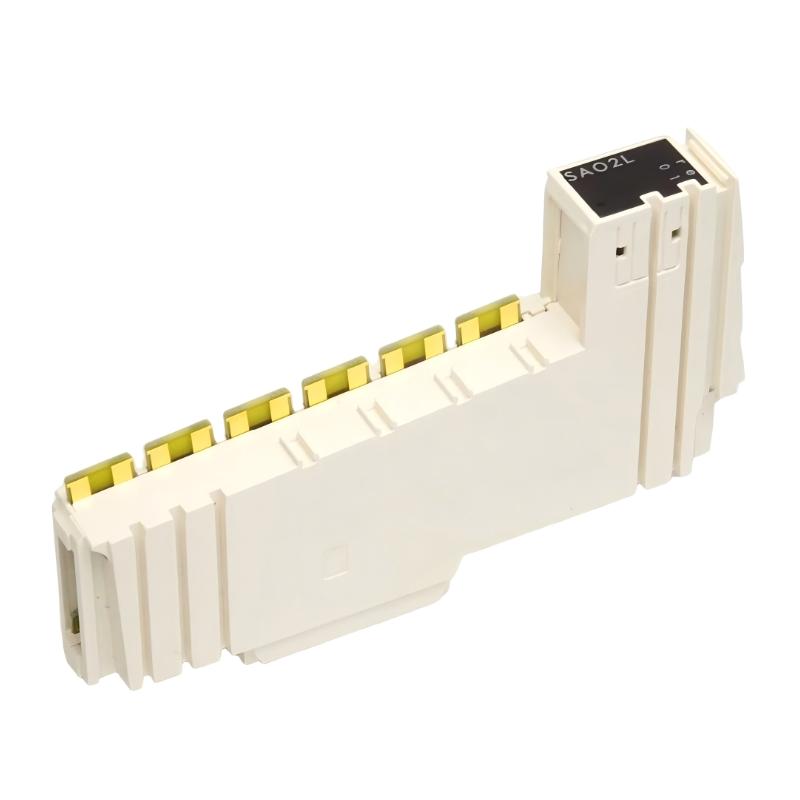
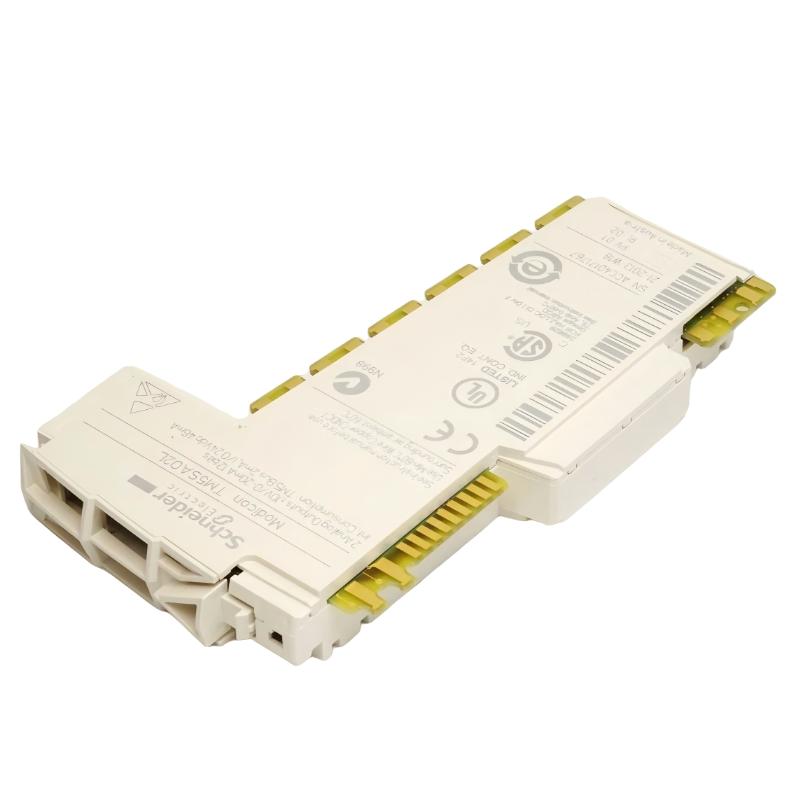
- Schneider
- TM5SAO2L
- Analog Output Module
- France
- 99 × 12.5 × 75 mm
- 0.025 kg
- Xiamen, China
- New & In Stock
- T/T, PayPal, Western Union
- 1 Year
- 1-3 Working Days
- DHL, UPS, TNT, FedEx and EMS.
- 24-Hour Service
- COO
- 7
Our advantage

Global Logistics
We have a 10-year logistics and express cooperation agreement, so our products can be shipped to any place in the world.

Brand new and original
Our products are imported in bulk from the place of origin. Because of the cooperative relationship, our products are all original and 100% new.

24-hour service
We provide 7*24 hours service to our customers. We will be there whenever you need us.

Price advantage
All our products are priced very favorably because we have our own warehouse and supply.
| Company Information | |||
| [email protected] | |||
| Mobile | +8615980777398 | ||
| +8615980777398 | |||
| 15980777398 |
Product Overview
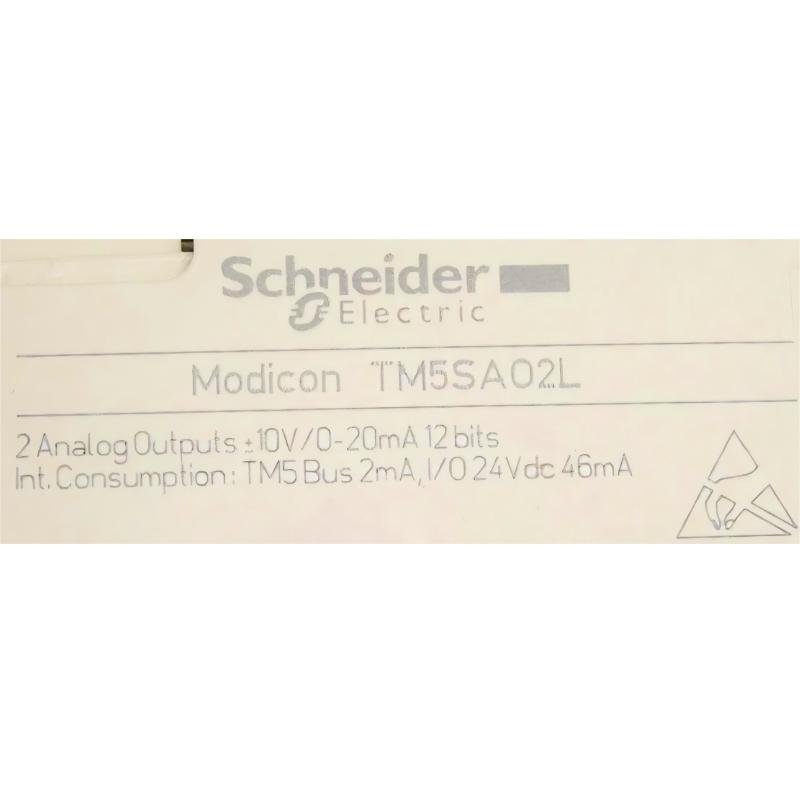
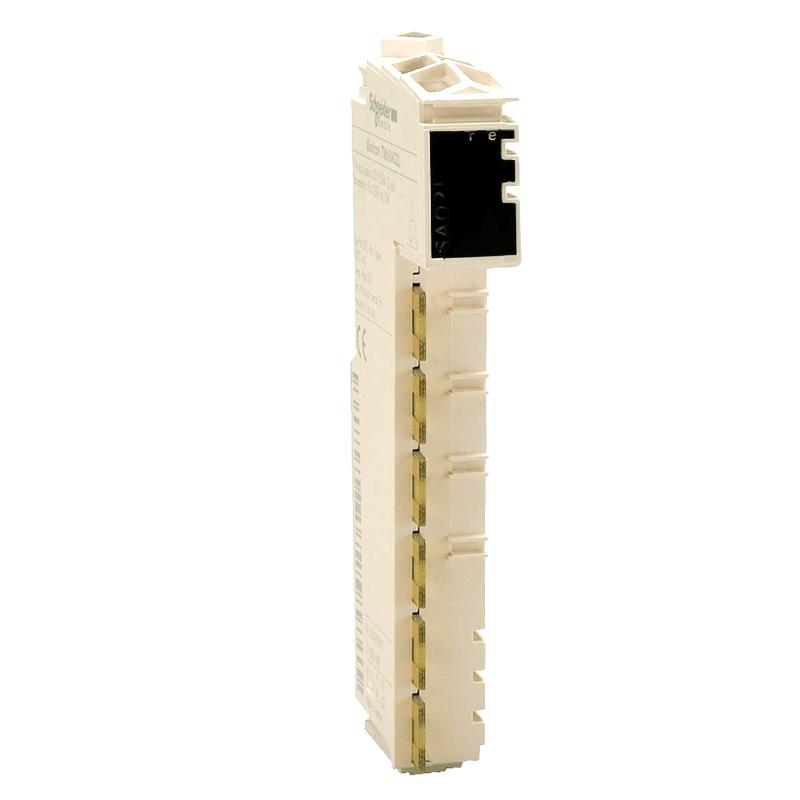
The Schneider TM5SAO2L is a Modicon TM5 analog output module with two output channels. It converts numerical values from the controller into analog voltage or current signals that can be used to regulate external equipment. The module supports −10 to +10 V DC and 0 to 20 mA outputs, making it suitable for control applications where a device needs a continuously adjustable command rather than a simple ON/OFF signal.
In a machine-control application, for example, the controller may need to adjust a proportional valve, command an analog reference input on a drive, or regulate a process device according to a changing setpoint. The TM5SAO2L converts the controller’s output values into the corresponding analog signals, allowing the connected equipment to respond to the commanded operating level.
The module provides two independently assigned analog output channels. One channel can be used for a voltage signal and the other for a current signal when the connected devices and channel configuration permit. This is useful in a machine cabinet serving different types of analog-controlled equipment without requiring a separate module for every output signal.
The TM5SAO2L belongs to the modular Modicon TM5 I/O platform and is used with compatible controllers, including the Modicon M258 logic controller and LMC058 motion controller. It is installed as part of a TM5 slice assembly with the appropriate bus base and terminal block. The module handles analog output generation, while the controller program determines the values sent to each channel.
For replacement work, check the controller model, output signal type, connected device requirements, channel assignments, and terminal wiring. A voltage-command device and a current-command device may require different wiring and scaling even when both are controlled by the same module.
Technical Specifications
| Parameter | Specification |
|---|---|
| Manufacturer | Schneider Electric |
| Model | TM5SAO2L |
| Product Family | Modicon TM5 |
| Product Type | Analog Output Module |
| Number of Outputs | 2 |
| Output Signal Type | Voltage / Current |
| Voltage Output Range | −10 to +10 V DC |
| Current Output Range | 0 to 20 mA |
| Voltage Output Resolution | 12 bits + sign |
| Current Output Resolution | 12 bits |
| Voltage Measurement Resolution | 4.882 mV |
| Current Measurement Resolution | 9.766 µA |
| Response Time | ≤ 1 ms |
| Sampling Duration | 200 µs |
| Maximum Resistive Load Impedance | 500 Ω for current output |
| Rated Supply Voltage | 24 V DC, −15% to +20% |
| Current Consumption at 5 V DC Bus | 2 mA |
| Current Consumption at 24 V DC | 46 mA |
| Maximum Power Dissipation | 1.11 W |
| Isolation | 500 Vrms AC between channel and bus; no isolation between channels |
| Cable Type | Shielded cable |
| Local Signalling | Green and red power LEDs; two yellow output-status LEDs |
| Compatible Controller Families | Modicon M258 / LMC058 |
| Protection Degree | IP20 |
| Dimensions | 99 × 12.5 × 75 mm |
| Weight | 0.025 kg |
Product Features
- Two analog output channels in one TM5 electronic module.
- Supports −10 to +10 V DC voltage signals.
- Supports 0 to 20 mA current signals.
- Provides 12-bit plus sign voltage resolution and 12-bit current resolution.
- Converts controller output values into analog commands for external equipment.
- Response time of 1 ms or less.
- Supports shielded field wiring for analog signal connections.
- Includes local LED indicators for power and output status.
- Integrates into the modular Modicon TM5 slice architecture.
- Compatible with the Modicon M258 logic controller and LMC058 motion controller.
Working Principle
The TM5SAO2L converts digital output values from the controller into analog electrical signals. The controller program calculates the required command value, and the module generates the corresponding voltage or current at the selected output channel.
PLC / Motion Controller → TM5 Bus Base → TM5SAO2L → Analog Signal → Controlled Device
For a voltage output, the controller may command a value within the −10 to +10 V range. For a current output, it may command a value within the 0 to 20 mA range. The connected device interprets the electrical signal according to its own input configuration and scaling.
Consider a machine using an analog-controlled valve to regulate fluid flow. The controller calculates the required command based on the process setpoint, then sends the output value to the TM5SAO2L. The module generates the corresponding analog signal, which the valve’s control electronics interpret as a command for the requested operating position or flow rate.
The module generates the output signal; it does not independently determine the required process value or guarantee that the controlled device reaches the requested position. That depends on the controller logic, the receiving device, and the overall control loop.
When commissioning a channel, the configured signal type, engineering range, wiring, and receiving-device input must match. A correct electrical output with incorrect controller scaling can still produce an incorrect machine response.
Role in a Modicon TM5 Analog Control Architecture
The TM5SAO2L occupies the analog output position in the TM5 I/O assembly. It receives controller-generated values through the TM5 bus and converts them into voltage or current signals for external equipment.
Controller → TM5 Bus → TM5SAO2L → Voltage / Current Signal → Actuator or Analog-Controlled Device
| System Element | Function |
|---|---|
| TM5SAO2L | Converts controller values into two analog output signals |
| Modicon M258 | Executes the machine-control program and manages supported I/O |
| LMC058 Motion Controller | Coordinates supported motion and machine-control functions |
| TM5 Bus Base | Provides the module mounting interface and internal bus connection |
| TM5 Terminal Block | Connects the analog outputs to field wiring |
| Analog-Controlled Drive | Receives an analog reference when supported by its input interface |
| Proportional Valve | Uses a compatible analog command to regulate a process variable |
| Actuator Positioning Interface | Receives a voltage or current command where supported |
| Shielded Cable | Helps reduce electrical interference affecting analog signals |
| Controller Application | Calculates output commands and applies the required engineering scaling |
The final arrangement depends on the controller, bus base, terminal block, receiving equipment, and the voltage or current signal selected for each output.
Industrial Applications
| Application | Typical Use |
|---|---|
| Packaging Machinery | Sending analog commands to compatible actuators or drive interfaces |
| Material Handling | Controlling analog reference inputs on equipment used for positioning or speed adjustment |
| Process Automation | Regulating process equipment through voltage or current command signals |
| Fluid Control Systems | Providing analog commands to compatible proportional valves |
| Machine Tools | Sending adjustable reference values to supported analog-controlled devices |
| Assembly Equipment | Controlling the operating level of equipment that accepts analog setpoints |
| Automated Production Lines | Generating analog commands for devices distributed across the machine |
| Motion-Controlled Machinery | Providing analog references where the receiving device uses an analog interface |
| Industrial Skids | Integrating analog-controlled equipment into a modular TM5 control system |
| Test and Handling Equipment | Setting output levels for compatible equipment with voltage or current inputs |
Installation and Maintenance
- Confirm the complete TM5SAO2L reference and verify that the controller supports the module.
- Identify the receiving device for each output channel and confirm whether it requires a voltage or current signal.
- Check the required command range and engineering scaling in the controller application.
- Isolate the control system according to the equipment’s electrical safety procedure before installing or removing the module.
- Install the module on the appropriate TM5 bus base and ensure that the module is correctly seated in the slice assembly.
- Fit the correct terminal block and inspect the connection points before wiring the analog outputs.
- Connect each output according to the applicable wiring diagram. Use shielded cable and follow the installation’s grounding and shielding practices.
- Verify the 24 V DC supply arrangement and the TM5 bus connection before restoring power.
- Check the power and output-status LEDs after startup.
- Command a known output value and measure the resulting voltage or current with suitable test equipment.
- Compare the measured output with the controller’s requested value and the receiving device’s configured input range.
- If the output is incorrect, check channel configuration, wiring, supply conditions, controller scaling, and the receiving-device input before replacing the module.
- Record the channel assignments, signal type, engineering range, and connected equipment for future maintenance.
Because the two output channels are not isolated from each other, the wiring arrangement must account for the module’s electrical characteristics. An installation should not assume that the channels can be treated as independent isolated signal sources.
Related Components
| Component | Function |
|---|---|
| TM5 Bus Base | Mounts the electronic module and provides the TM5 bus connection |
| TM5 Terminal Block | Provides field wiring connections for the analog outputs |
| Modicon M258 Logic Controller | Controls compatible TM5 I/O arrangements |
| LMC058 Motion Controller | Provides motion and machine control with supported TM5 I/O |
| TM5SAI2L Analog Input Module | Acquires compatible voltage and current signals |
| TM5SAI4L Analog Input Module | Provides four channels for compatible analog input signals |
| TM5SAO4L Analog Output Module | Provides four analog output channels |
| TM5SAO2H Analog Output Module | Provides two analog output channels with higher resolution |
| Shielded Signal Cable | Connects analog outputs to compatible receiving devices |
| Analog-Controlled Drive | Receives a compatible analog reference signal |
| Proportional Valve Controller | Uses an analog command to regulate a compatible valve |
Recommended Related Models
| Model / Product Family | Product Type | Typical Application |
|---|---|---|
| Schneider TM5SAO4L | Four-Channel Analog Output Module | Applications requiring four voltage or current output channels |
| Schneider TM5SAO2H | Two-Channel Analog Output Module | Applications requiring higher-resolution analog output |
| Schneider TM5SAO4H | Four-Channel Analog Output Module | Applications requiring four higher-resolution analog outputs |
| Schneider TM5SAI2L | Two-Channel Analog Input Module | Acquiring compatible voltage and current feedback signals |
| Schneider TM5SAI4L | Four-Channel Analog Input Module | Acquiring multiple analog feedback signals |
| Schneider Modicon M258 | Logic Controller | Machine control with compatible TM5 expansion |
| Schneider LMC058 | Motion Controller | Motion and machine-control applications using supported TM5 I/O |
Key Advantages
- Two analog outputs for voltage- or current-controlled equipment.
- Supports −10 to +10 V DC and 0 to 20 mA signals.
- 12-bit plus sign voltage resolution and 12-bit current resolution.
- Response time of 1 ms or less.
- Local LED indicators simplify initial status checks.
- Integrates with compatible Modicon TM5 control architectures.
- Suitable for applications requiring continuously adjustable output commands.
Technical FAQs
What output signals does the TM5SAO2L support?
The module supports −10 to +10 V DC voltage outputs and 0 to 20 mA current outputs. The receiving device and controller channel configuration must match the selected signal type.
Can the TM5SAO2L directly control a proportional valve or variable-speed drive?
It can provide an analog command to equipment that accepts a compatible voltage or current input. Whether it can control a particular valve or drive depends on that device’s input specifications, wiring requirements, and control configuration.
What is the difference between the TM5SAO2L and TM5SAO2H?
Both modules provide two analog output channels, but the TM5SAO2L uses 12-bit plus sign resolution for voltage and 12-bit resolution for current, while the TM5SAO2H provides higher output resolution. The appropriate choice depends on the required signal precision and the supported system configuration.
What should be checked if an analog output does not match the commanded value?
Check the configured output type, controller scaling, terminal wiring, supply conditions, and the receiving device’s input configuration. Measuring the actual output voltage or current helps determine whether the discrepancy originates in the module output, the controller command, or the connected equipment.