

ProductPRODUCT
Featured products
Contact Us
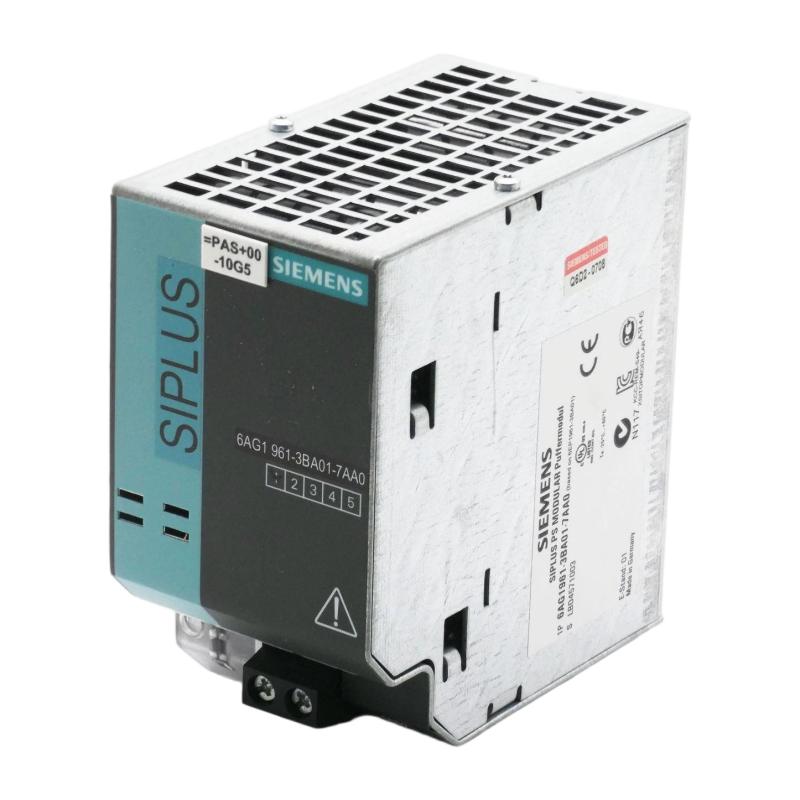
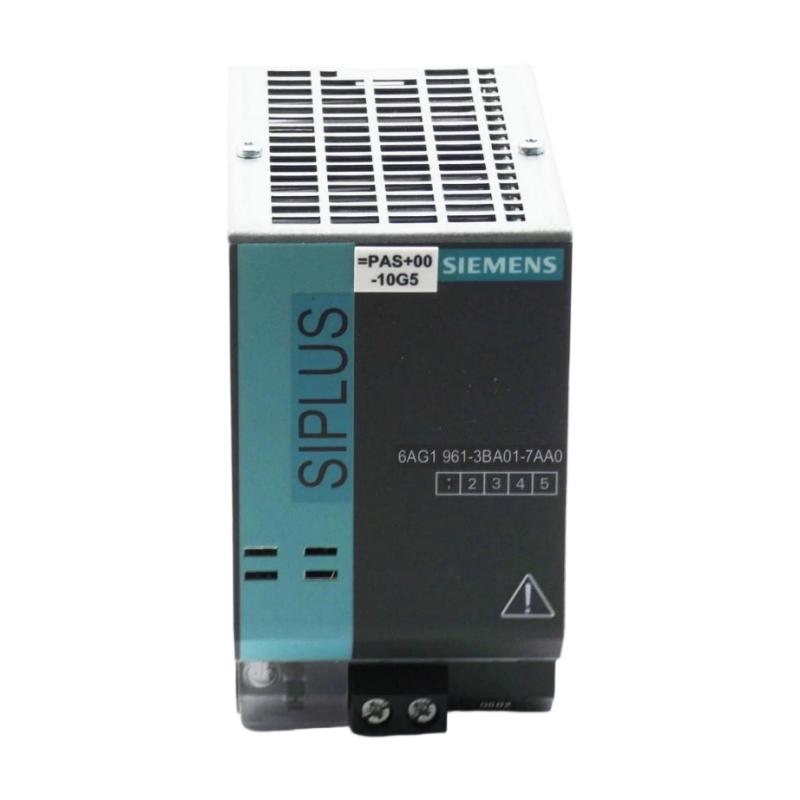
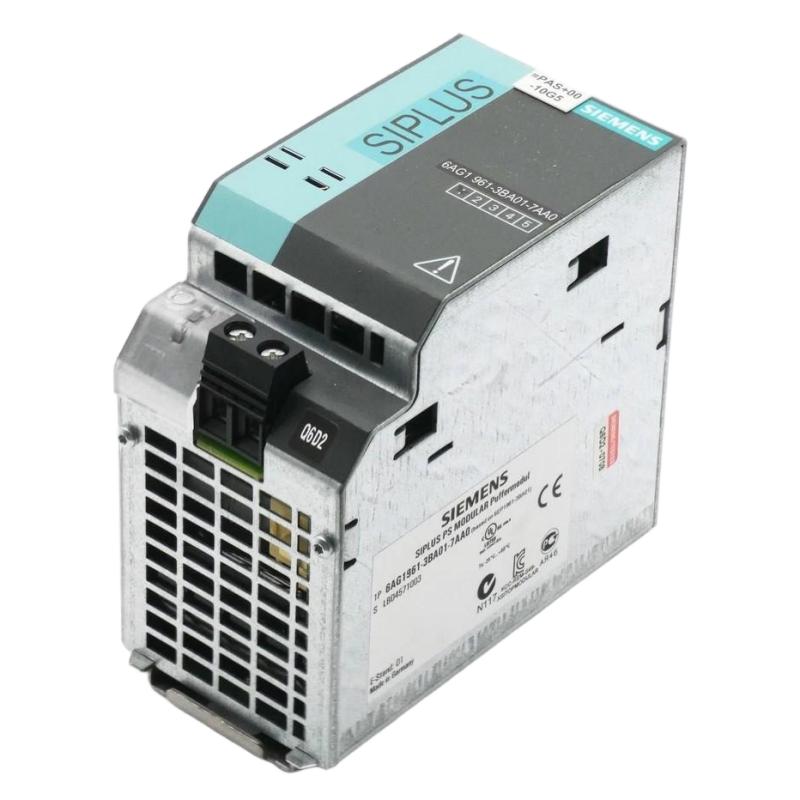
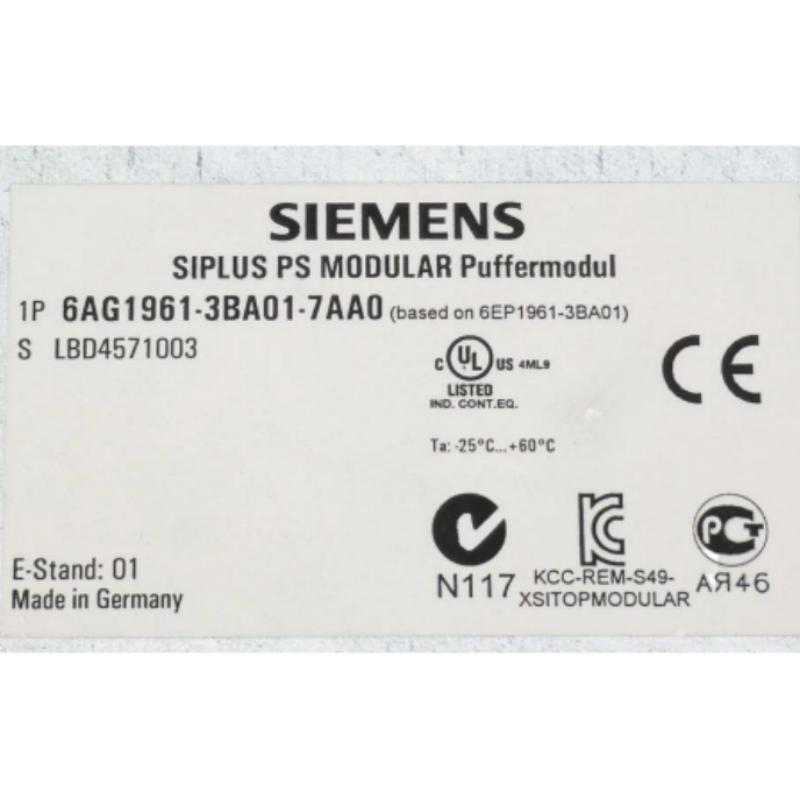
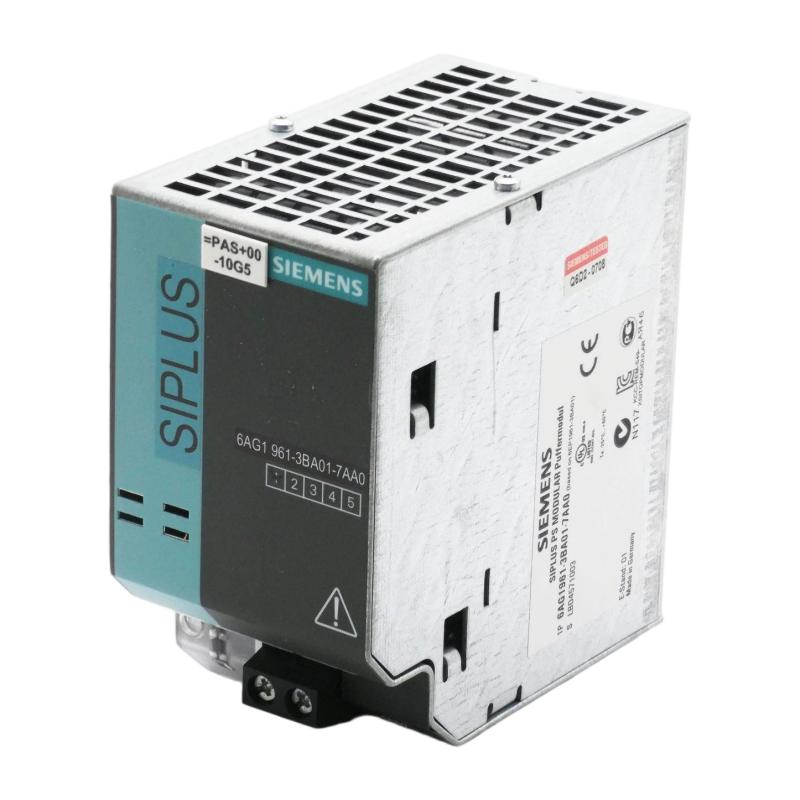
- Siemens
- 6AG1961-3BA01-7AA0
- Modular Buffer Module
- Germany
- 135 × 135 × 80 mm
- 1.2 kg
- Xiamen, China
- New & In Stock
- T/T, PayPal, Western Union
- 1 Year
- 1-3 Working Days
- DHL, UPS, TNT, FedEx and EMS.
- 24-Hour Service
- COO
- 5
Our advantage

Global Logistics
We have a 10-year logistics and express cooperation agreement, so our products can be shipped to any place in the world.

Brand new and original
Our products are imported in bulk from the place of origin. Because of the cooperative relationship, our products are all original and 100% new.

24-hour service
We provide 7*24 hours service to our customers. We will be there whenever you need us.

Price advantage
All our products are priced very favorably because we have our own warehouse and supply.
| Company Information | |||
| [email protected] | |||
| Mobile | +8615980777398 | ||
| +8615980777398 | |||
| 15980777398 |
Product Overview
The Siemens 6AG1961-3BA01-7AA0 SIPLUS Modular Buffer Module is an industrial DC power-supply accessory designed to maintain power availability during short interruptions in the main supply. It belongs to the Siemens SIPLUS power supply product family and is based on the standard SITOP modular buffer module 6EP1961-3BA01.
In industrial automation systems, even a brief power interruption can affect PLC operation, communication equipment, sensors, control circuits, and other essential loads. A buffer module helps bridge these interruptions by temporarily supplying stored energy to the connected DC system. This allows compatible equipment to continue operating for a limited period or complete an orderly shutdown.
The 6AG1961-3BA01-7AA0 is designed for 24 V DC applications and supports a rated output current of 40 A. Its buffering time depends on the connected load current and can range from approximately 100 milliseconds to 10 seconds under the specified application conditions.
As a SIPLUS version, this module features conformal coating and an extended operating temperature range of -25°C to +70°C. These characteristics make it suitable for industrial environments where temperature variation and environmental exposure may place additional demands on electronic equipment.
The module is intended for use with compatible Siemens SITOP power supply configurations, particularly the specified 6EP1x3x-3BAx0 family. It should be selected according to the connected power supply, load current, required backup time, and installation conditions.
Technical Specifications
| Parameter | Specification |
|---|---|
| Brand | Siemens |
| Product Series | SIPLUS PS MODULAR |
| Model | 6AG1961-3BA01-7AA0 |
| Product Type | Modular Buffer Module |
| Base Model | 6EP1961-3BA01 |
| Rated DC Supply Voltage | 24 V DC |
| Input Voltage Range | 24–28.8 V DC |
| Rated Output Current | 40 A |
| Output Voltage | Input voltage minus approximately 1 V |
| Buffering Time | Approximately 100 ms to 10 s, depending on load and configuration |
| Operating Temperature | -25°C to +70°C |
| Protective Treatment | Conformal coating |
| Electrical Isolation | Galvanic isolation between input and output |
| Protection Rating | IP20 |
| Mounting | DIN rail mounting |
| Electrical Connection | Screw terminals |
| Communication Interface | Not included |
| Dimensions Provided | 135 × 135 × 80 mm |
| Weight Provided | 1.2 kg |
| Typical Application | 24 V DC power buffering in industrial automation |
Note: Buffering time is application-dependent. The actual available backup duration must be determined from the load current and the manufacturer’s configuration data. The supplied dimensions are retained as listing information; confirm the physical product dimensions before panel design.
Function and Working Principle
The primary function of the Siemens 6AG1961-3BA01-7AA0 is to provide temporary energy buffering for compatible 24 V DC power systems. It helps maintain the DC output when the upstream supply experiences a short interruption.
1. Short-Term Power Interruption Bridging
Industrial control systems often require stable DC power for controllers, communication devices, and field equipment. A brief interruption can cause a controller to restart or interrupt a production sequence.
The buffer module provides temporary energy during a supply interruption. This bridging function can help prevent unnecessary equipment resets and give the control system time to complete critical operations.
The actual duration depends on the load current and the connected power supply arrangement.
2. Energy Buffering
The module stores energy for use when the incoming DC supply is interrupted. When the normal supply is available, the buffering system is maintained in its ready condition.
If the input supply fails temporarily, the stored energy supports the connected load for a limited period. Once the normal supply returns, the system can resume its regular operating condition according to the product’s operating characteristics.
3. Maintaining 24 V DC Control Power
The module is designed for 24 V DC systems, a common power standard in industrial automation.
It can support compatible control loads such as PLCs, communication equipment, sensors, and other DC-powered devices. The output voltage is approximately the input voltage minus 1 V, so the complete power system must be designed with suitable voltage margins.
4. Load-Dependent Buffering Time
Buffering time is directly influenced by the current drawn by connected equipment. Higher load current generally results in a shorter backup period, while lower load current can provide a longer period of support.
The manufacturer’s published examples for the base design include:
| Load Current | Approximate Buffering Time |
|---|---|
| 40 A | 200 ms |
| 20 A | 400 ms |
| 10 A | 800 ms |
| 5 A | 1.6 s |
These figures are reference values for the documented configuration. The actual system performance depends on the connected power supply, load profile, operating conditions, and applicable configuration restrictions.
5. Galvanic Isolation
The module provides galvanic isolation between its input and output. This is an important electrical characteristic when integrating the device into industrial DC power systems.
The complete installation must still follow the manufacturer’s wiring, grounding, and protective requirements.
Role in Industrial Automation Systems
The 6AG1961-3BA01-7AA0 can be installed as part of a Siemens SITOP DC power architecture. It supports the availability of control power during short interruptions and can help reduce the impact of unstable supply conditions.
PLC Power Continuity
Programmable logic controllers coordinate machine operations and process sequences. A brief power interruption may cause a PLC to restart or lose the current operating state, depending on its hardware and configuration.
A suitable buffer module can provide temporary support to the DC supply feeding compatible control equipment. This may help the system maintain operation through short interruptions or complete an orderly shutdown.
Industrial Communication Equipment
Communication devices exchange process data between PLCs, remote I/O stations, HMIs, and supervisory systems. An interruption in their power supply can temporarily disrupt communication.
By supporting the DC supply during short power disturbances, the buffer module can help improve the availability of compatible communication equipment.
Sensor and Field Device Support
Industrial sensors and control devices often rely on 24 V DC power. Maintaining a stable supply can help prevent unnecessary resets and interruptions in monitoring functions.
The total connected current must remain within the power system’s permitted operating limits.
Centralized DC Power Distribution
In a control cabinet, a Siemens SITOP power supply can provide the primary 24 V DC output, while compatible buffer modules and other accessories support power availability and distribution.
The complete arrangement should be engineered according to the required current, backup duration, voltage tolerance, and equipment priorities.
Industrial Applications
The Siemens 6AG1961-3BA01-7AA0 can be used in industrial installations where short-term DC power continuity is important.
1. Manufacturing Automation
Production lines rely on PLCs, sensors, communication equipment, and control circuits to coordinate machinery. A brief interruption may interrupt the production sequence or cause equipment to restart.
A properly designed buffer system can help maintain power to selected control loads during short supply disturbances.
2. Industrial Control Cabinets
Control cabinets commonly contain several devices operating from a 24 V DC supply. These may include PLCs, remote I/O, interface relays, and communication components.
The buffer module can be incorporated into compatible DC power architectures to support short-term power continuity.
3. Process Automation
Continuous industrial processes often require stable control power for monitoring and process coordination. Short interruptions can affect control functions even when the main production equipment remains mechanically operational.
The buffer module can help support critical DC loads during temporary supply interruptions.
4. Packaging and Material Handling
Packaging machinery, conveyor systems, and material-handling equipment use control electronics to coordinate movement and production timing.
Temporary power buffering can help prevent avoidable controller resets and support orderly responses to brief supply disturbances.
5. Industrial Facilities with Variable Supply Conditions
Some industrial facilities experience brief voltage disturbances or interruptions caused by switching operations and changes in the electrical distribution system.
A correctly configured buffer system can provide limited DC support during these events. It is not a substitute for a full uninterruptible power supply where extended backup operation is required.
Installation and System Integration
Correct installation is essential for reliable operation and safe integration into a 24 V DC power system.
1. Verify Power Supply Compatibility
The 6AG1961-3BA01-7AA0 is based on the 6EP1961-3BA01 design and is intended for compatible Siemens SITOP power supply configurations.
Before installation, verify the upstream power supply model, output voltage, current rating, and approved system arrangement. Do not assume that every 24 V DC power supply is compatible.
2. Check the Load Current
The module has a rated output current of 40 A. The actual connected load must be evaluated carefully.
Calculate the total current drawn by the PLC, communication equipment, sensors, and other connected devices. Consider normal operating current and temporary load peaks when designing the system.
3. Calculate Required Buffering Time
Determine how long the connected equipment needs to remain powered during a supply interruption.
For some applications, a few hundred milliseconds may be sufficient to bridge a short disturbance. Other systems may require additional time to save data, complete a controlled stop, or initiate a shutdown sequence.
Select the buffering arrangement according to the actual load current and the manufacturer’s published performance data.
4. DIN Rail Installation
The module is designed for DIN rail mounting. Install it in the orientation and arrangement specified by Siemens.
Allow adequate space for wiring, ventilation, inspection, and maintenance. Avoid locations where the equipment may be exposed to conditions outside its permitted environmental limits.
5. Electrical Wiring
Use appropriately rated conductors and follow the manufacturer’s connection diagrams. Pay attention to polarity, terminal identification, conductor size, and tightening requirements.
Before installation or maintenance, isolate the power supply and follow the applicable electrical safety procedures.
6. Environmental Considerations
The SIPLUS version has conformal coating and an operating temperature range of -25°C to +70°C under the specified mounting conditions.
These features provide additional environmental capability, but they do not eliminate the need for suitable cabinet design, ventilation, wiring protection, and compliance with installation requirements.
7. Commissioning and Functional Testing
After installation, verify the input voltage, output voltage, load current, and wiring connections.
Test the buffering function under controlled conditions and confirm that the connected equipment remains within its permitted voltage range during a simulated interruption. Record the measured backup time and final configuration for future maintenance.
Compatible System Components
The Siemens 6AG1961-3BA01-7AA0 is designed to operate as part of a compatible SITOP power supply arrangement.
| Component | Function | Integration Considerations |
|---|---|---|
| Siemens 6EP1961-3BA01 | Standard SITOP modular buffer module design | Base model for the SIPLUS version |
| Siemens SITOP 24 V DC power supply | Provides the primary DC supply | Confirm approved model and system configuration |
| Compatible 6EP1x3x-3BAx0 power supplies | Intended power supply family | Verify the specific supply and buffering compatibility |
| Siemens PLC | Executes automation logic | Confirm DC voltage and current requirements |
| Remote I/O modules | Connect field signals to the controller | Check total power consumption |
| Industrial Ethernet switches | Support communication between devices | Confirm 24 V DC supply requirements |
| HMI panels | Provide operator monitoring and control | Consider backup requirements for the complete control system |
| DC distribution terminals | Distribute power to connected loads | Ensure suitable current ratings and protection |
| Circuit protection devices | Protect DC circuits | Select according to conductor and load requirements |
The components listed above are examples of equipment used in industrial DC power systems. They are not necessarily included with the buffer module.
Alternative Models and Replacement Considerations
When replacing the 6AG1961-3BA01-7AA0, engineers should compare the electrical characteristics and environmental specifications rather than selecting a component based only on its physical appearance.
| Model or Product Family | Description | Replacement Considerations |
|---|---|---|
| Siemens 6EP1961-3BA01 | Standard SITOP modular buffer module | Closely related base design; verify environmental and coating differences |
| Siemens 6AG1961-3BA01-7AA0 | SIPLUS modular buffer module | Extended environmental capability and conformal coating |
| Siemens 6AG1961-3BA21 series | SIPLUS redundancy module family | Designed for power supply redundancy, not the same buffering function |
| Siemens SITOP DC UPS modules | DC uninterruptible power supply products | May be more appropriate when longer backup time or battery-based buffering is required |
| Siemens SITOP signaling modules | Monitoring and signaling accessories | Provide signaling functions rather than energy buffering |
Before selecting an alternative, compare:
- Rated input voltage and permissible voltage range.
- Rated output current.
- Buffering time at the actual load current.
- Compatibility with the upstream SITOP power supply.
- Output voltage behavior during buffering.
- Environmental temperature range.
- Conformal coating and environmental protection.
- Mounting dimensions and terminal arrangement.
- Required monitoring and signaling functions.
A redundancy module and a buffer module serve different purposes. A redundancy module helps maintain supply availability by decoupling power supplies, while a buffer module provides temporary energy during a short interruption. They should not be treated as interchangeable devices.
Key Advantages
Short-Term Power Continuity
The module provides temporary energy buffering for compatible 24 V DC systems, helping reduce the impact of brief power interruptions.
40 A Rated Output Current
Its 40 A rated output current supports appropriately designed industrial DC loads within the manufacturer’s specified operating conditions.
Load-Dependent Backup Performance
The buffering arrangement can provide different backup durations according to the connected load current, allowing engineers to design around actual application requirements.
SIPLUS Environmental Design
The conformal coating and extended operating temperature range support installations exposed to more demanding industrial environmental conditions.
Integration with Siemens SITOP Systems
The module is based on the 6EP1961-3BA01 design and is intended for compatible Siemens SITOP power supply arrangements.
DIN Rail Mounting
DIN rail installation supports organized mounting in industrial control cabinets and simplifies integration into modular power distribution layouts.
Galvanic Isolation
Galvanic isolation between input and output is an important electrical characteristic of the module and should be considered during system design.
Technical FAQs
1. What is the Siemens 6AG1961-3BA01-7AA0?
It is a SIPLUS PS modular buffer module designed to provide temporary power support for compatible 24 V DC industrial power systems.
2. What is the base model of this module?
The module is based on Siemens 6EP1961-3BA01, the standard SITOP modular buffer module design.
3. What is the rated output current?
The rated output current is 40 A.
4. What is the input voltage range?
The documented DC input voltage range is 24–28.8 V DC, with a rated supply voltage of 24 V DC.
5. How long can the module provide backup power?
The buffering time depends on the connected load current and system configuration. The published range is approximately 100 milliseconds to 10 seconds for the specified compatible power supply family.
6. What is the operating temperature range?
The specified operating temperature range is -25°C to +70°C under the documented mounting conditions.
7. What is the purpose of conformal coating?
Conformal coating provides additional protection for electronic assemblies against certain environmental influences. It is particularly useful in industrial environments where electronic equipment may be exposed to more demanding conditions.
8. Can this module replace a DC UPS?
Not necessarily. A buffer module is designed for short-term energy support, while a DC UPS may provide a different backup architecture and longer operating duration. Select the solution according to the required backup time and load.
9. Is the module compatible with all Siemens SITOP power supplies?
No. Compatibility must be checked against the specific SITOP power supply family and the manufacturer’s system configuration requirements.
10. What should be checked before purchasing?
Verify the complete part number, product condition, electrical ratings, conformity of the installed connectors, and compatibility with the existing power supply. For used equipment, request clear product photographs and appropriate functional test information.
Procurement and Maintenance Recommendations
When purchasing the Siemens 6AG1961-3BA01-7AA0, confirm the complete order number and ensure that the SIPLUS version is required for the intended installation. The standard 6EP1961-3BA01 and SIPLUS 6AG1961-3BA01-7AA0 share a related design but have different product configurations.
For replacement projects, check the upstream power supply, load current, required backup time, and operating temperature. These factors determine whether the selected buffer module can provide the required performance.
For new-old-stock or used units, inspect the housing, terminals, labels, and visible condition of the device. Confirm whether the product has been stored under suitable conditions and whether functional testing is available.
During maintenance, inspect wiring and terminals, check the DC supply voltage, and verify the buffering performance according to the maintenance plan. Any test involving power interruption should be performed under controlled conditions to avoid unexpected equipment shutdown.
Keep records of the installed model, connected loads, measured backup time, and replacement history. This information can help maintenance teams identify suitable spare parts and reduce troubleshooting time.
Conclusion
The Siemens 6AG1961-3BA01-7AA0 SIPLUS Modular Buffer Module is designed to provide short-term power continuity in compatible 24 V DC industrial automation systems. Based on the 6EP1961-3BA01 design, it offers a 40 A rated output current, load-dependent buffering performance, conformal coating, and an extended operating temperature range of -25°C to +70°C.
For industrial applications involving PLCs, communication equipment, control cabinets, and other DC-powered devices, the module can help bridge brief power interruptions and improve control-system availability. Correct power supply compatibility, load-current calculation, and backup-time verification are essential when selecting and installing this Siemens component.