
NewsNEWCENTER
Featured products
Contact Us
ABB Advances Distributed Control System Modernization with Automation Extended
2026-10-13ABB is advancing industrial process automation with its Automation Extended program, a modernization approach designed to help manufacturers upgrade distributed control systems (DCS) while maintaining the reliability of existing operations.
Introduced in February 2026, the program builds on ABB’s established automation platforms, including ABB Ability System 800xA, ABB Ability Symphony Plus and ABB Freelance. It is designed to help industrial operators adopt digital technologies, advanced analytics and artificial intelligence progressively, without requiring a complete replacement of their existing control infrastructure.
For industries such as oil and gas, power generation, chemicals, pharmaceuticals and water treatment, this approach addresses a major challenge: how to modernize aging automation systems while keeping essential production processes running.
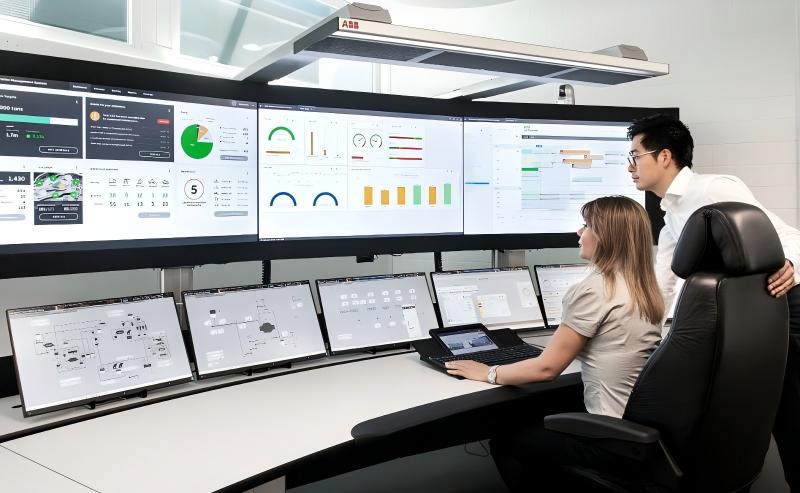
Why Industrial DCS Modernization Matters
Distributed control systems are central to many continuous-process industries. They coordinate process measurements, control loops, alarms, operator interfaces and communication between field devices and plant equipment.
Although these systems can operate reliably for many years, industrial facilities eventually face changing requirements. Older hardware may become harder to maintain, cybersecurity requirements may increase, and operators may need better access to production data for optimization and predictive maintenance.
Traditional modernization projects can involve significant engineering work, system validation and production downtime. Replacing an entire control system at once can also create operational risks, particularly in facilities where shutdowns are expensive or difficult to schedule.
ABB’s Automation Extended approach focuses on progressive modernization. Rather than treating every upgrade as a complete system replacement, operators can introduce selected new capabilities while preserving the core functions of their established automation platforms.
A Modular Architecture for Industrial Automation
A central principle of Automation Extended is the separation of core control functions from additional digital capabilities.
In this architecture, mission-critical control remains protected while supplementary applications can be introduced in a more flexible environment. The two environments remain securely connected, allowing industrial facilities to expand their digital capabilities without unnecessarily changing the underlying control logic.
This design can support the gradual adoption of technologies such as:
-
Advanced process analytics and performance monitoring.
-
Industrial Internet of Things (IIoT) applications.
-
Artificial intelligence-assisted analysis.
-
Additional data integration and reporting tools.
-
New applications that support operational optimization.
The modular approach allows facilities to evaluate new technologies according to their operational priorities, available resources and technical readiness.
For example, a chemical plant might initially improve process data collection and reporting before introducing more advanced analytics. A power generation facility could prioritize equipment monitoring and operational performance analysis while maintaining its existing control strategy.
Actual implementation depends on the selected system configuration, supported interfaces and project requirements.
Supporting Existing ABB DCS Platforms
ABB’s approach builds on three established automation platforms.
ABB Ability System 800xA
System 800xA integrates process control, electrical integration, operator interfaces and asset-related functions within a unified automation environment. It is used in complex industrial applications where coordinated control and plant-wide visibility are important.
ABB Ability Symphony Plus
Symphony Plus serves power generation and process automation applications. Its modernization capabilities are relevant to facilities seeking to extend the life of existing control infrastructure while introducing additional digital functionality.
ABB Freelance
Freelance is a distributed control system designed for industrial applications requiring integrated process control and engineering. Its role in ABB’s broader automation portfolio gives users another established platform through which modernization can be planned according to plant requirements.
By supporting a progressive modernization strategy across these platforms, ABB aims to help customers preserve existing investments while preparing for future automation needs.
How Advanced Analytics and AI Can Improve Plant Operations
Industrial facilities generate large volumes of information from transmitters, analyzers, controllers, motors, drives and other equipment. However, collecting data does not automatically translate into better decisions.
Advanced analytics can help engineers identify relationships between process variables, recognize abnormal operating patterns and investigate performance changes. When combined with suitable engineering knowledge, these insights can support more informed operational decisions.
Artificial intelligence may also assist with selected tasks, including data interpretation, anomaly detection and the analysis of operating histories. These applications can help maintenance and operations teams investigate problems more efficiently.
However, AI-generated recommendations should not automatically be treated as control commands. Critical control functions, alarm management, safety interlocks and process protection require appropriate engineering validation and governance.
ABB’s separation-of-concerns approach is intended to make it easier to introduce additional digital applications while protecting the stability of essential control functions.
Benefits for Industrial Operators and System Integrators
For plant owners, the value of progressive DCS modernization extends beyond adding new software. A well-planned project can improve lifecycle management while reducing the risks associated with major control-system changes.
Potential benefits include:
Reduced modernization disruption. Phased implementation can limit the scope of individual upgrades and help plants maintain production where the project configuration permits.
Better use of existing investments. Facilities may continue using established control hardware and engineering practices instead of replacing every component at once.
Greater flexibility. Modular architecture can provide a structured way to introduce additional applications as operational needs evolve.
Improved data utilization. Integration with suitable analytics and monitoring tools can help teams extract more value from existing process information.
More manageable lifecycle planning. A staged roadmap can help organizations prioritize upgrades based on system condition, cybersecurity needs and production requirements.
These benefits are not automatic. Compatibility assessments, system testing, cybersecurity reviews and careful commissioning remain essential parts of any modernization project.
Practical Considerations Before Upgrading a DCS
Before implementing a modernization program, industrial operators should evaluate the condition of their existing control infrastructure and define clear project objectives.
Important considerations include:
-
Hardware and software compatibility: Confirm support for the installed controllers, I/O modules, operating systems, engineering tools and communication interfaces.
-
Process continuity: Plan installation and testing around operating constraints, including shutdown windows and backup arrangements.
-
Cybersecurity: Review network segmentation, remote access, user permissions and software update procedures.
-
System validation: Test control logic, alarms, interfaces and data exchange before changes are introduced into production.
-
Lifecycle support: Evaluate spare-part availability, maintenance arrangements and the expected service life of existing equipment.
-
Staff training: Ensure engineers and operators understand the updated architecture and the procedures for managing new applications.
For facilities operating around the clock, a phased implementation plan can help balance modernization objectives with the need for safe, stable production.
Conclusion
ABB’s Automation Extended program represents an important development in the evolution of industrial distributed control systems. By combining established automation platforms with a modular approach to digital expansion, ABB is addressing the need to modernize industrial operations without unnecessary disruption.
For PLC and DCS engineers, system integrators and industrial plant operators, the approach highlights the growing importance of interoperability, cybersecurity and lifecycle planning. As advanced analytics and AI become more prominent in industrial environments, the ability to introduce new capabilities while protecting core control functions will remain a key consideration.
For companies operating long-life process automation infrastructure, progressive modernization offers a practical framework for balancing existing system reliability with the demand for more connected, data-driven and adaptable industrial operations.