
NewsNEWCENTER
Featured products
Contact Us
Allen-Bradley 140G-K3F3-D40 Molded Case Circuit Breaker Fault Diagnosis Guide
2026-06-24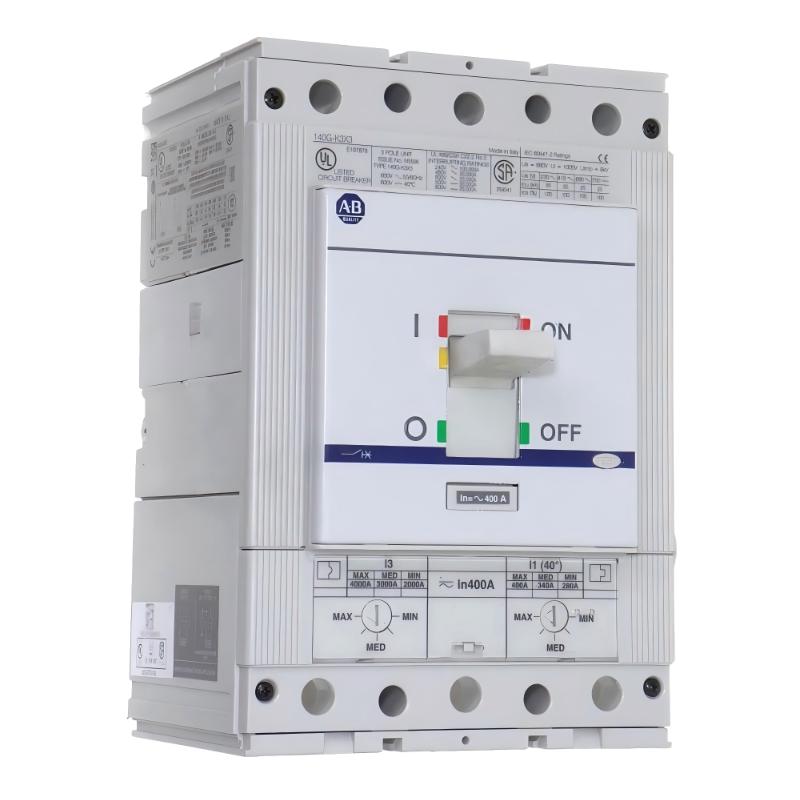
Table of Contents
- Field Case: 400A MCCB Trips Randomly in MCC Panel
- Fault Symptoms of 140G-K3F3-D40 Circuit Breaker
- Observed Trip Behavior & Current Distortion Patterns
- Root Cause Analysis (Thermal Stress & Magnetic Trip Misoperation)
- Diagnostic Workflow for MCCB System
- Repair & Recovery Actions
- Prevention Strategy for Power Distribution Stability
- FAQs on 140G-K3F3-D40 Faults
- Engineering Summary
Field Case: MCCB Nuisance Trip on Motor Start
Allen-Bradley 140G-K3F3-D40 molded case circuit breaker faults are often misdiagnosed as motor or load issues. In one industrial pumping station, a 400A MCCB repeatedly tripped during motor startup. Initial assumption pointed to motor inrush current, but detailed analysis revealed improper thermal-magnetic setting coordination with downstream load behavior.
Fault Symptoms of 140G-K3F3-D40 Circuit Breaker
Typical field symptoms include:
- Breaker trips during motor start or load switching
- Intermittent thermal trip under normal operating load
- Magnetic trip triggered without visible short circuit
- Breaker reset required frequently after load fluctuations
Observed Trip Behavior & Current Distortion Patterns
During field measurements, engineers observed abnormal inrush and harmonics behavior:
LOAD_CURRENT = 280A steady state
STARTUP_INRUSH = 1800A peak
MAGNETIC_TRIP_THRESHOLD = 2000A
TRIP_EVENT = occurs during transient spike
VOLTAGE_DROP = 12% during motor acceleration
HARMONICS = elevated THD during switching
The breaker did not fail electrically but reacted to transient overcurrent conditions caused by system-level load dynamics.
Root Cause Analysis (Thermal Stress & Magnetic Trip Misoperation)
The 140G-K3F3-D40 MCCB uses thermal-magnetic protection. Common failure mechanisms include:
- Thermal element sensitivity shift due to long-term heating cycles
- Magnetic trip reacting to high inrush motor currents
- Poor coordination with upstream/downstream protection devices
- Loose terminations increasing localized heating
In one commissioning case, repeated motor starts caused cumulative heating inside the breaker, reducing trip tolerance and leading to premature shutdowns.
Diagnostic Workflow for MCCB System
A structured electrical and mechanical inspection is required:
- Measure real-time load current under steady and transient conditions
- Check breaker torque and terminal tightness
- Verify thermal-magnetic settings against load profile
- Inspect breaker temperature rise using thermal imaging
- Analyze motor starting current waveform
MCCB_DIAG /MODEL=140G-K3F3-D40 /THERMAL_CHECK /MAGNETIC_TRIP_ANALYSIS /LOAD_PROFILE
Repair & Recovery Actions
- Re-torqued all main power connections to specification
- Adjusted thermal-magnetic settings to match motor load profile
- Improved coordination with upstream protection devices
- Replaced aged breaker in case of internal thermal drift
After correction, nuisance tripping stopped and system stabilized under repeated start cycles.
Prevention Strategy for Power Distribution Stability
- Always verify motor inrush current against breaker magnetic setting
- Ensure proper cable sizing to reduce heating losses
- Perform periodic thermal scanning of MCC panels
- Maintain correct torque on breaker terminals
- Avoid operating near 100% continuous current rating
FAQs on 140G-K3F3-D40 Faults
Why does the breaker trip during motor start?
This is typically due to magnetic trip sensitivity reacting to high inrush current.
Can breaker aging affect trip accuracy?
Yes. Thermal components can drift over time, changing trip characteristics.
Is replacement always necessary?
No. Many issues are resolved through load adjustment and proper coordination settings.
Engineering Summary
The Allen-Bradley 140G-K3F3-D40 molded case circuit breaker is a high-capacity protection device used in industrial power distribution. Most faults are not internal failures but system-level coordination issues involving inrush current, thermal loading, and wiring conditions. Proper diagnostic separation between load behavior and breaker response is essential for stable operation.